How beaded picture frames are made, from bead library to finished frame
Journal · Buyer’s Guide

How beaded picture frames are made, from bead library to finished frame

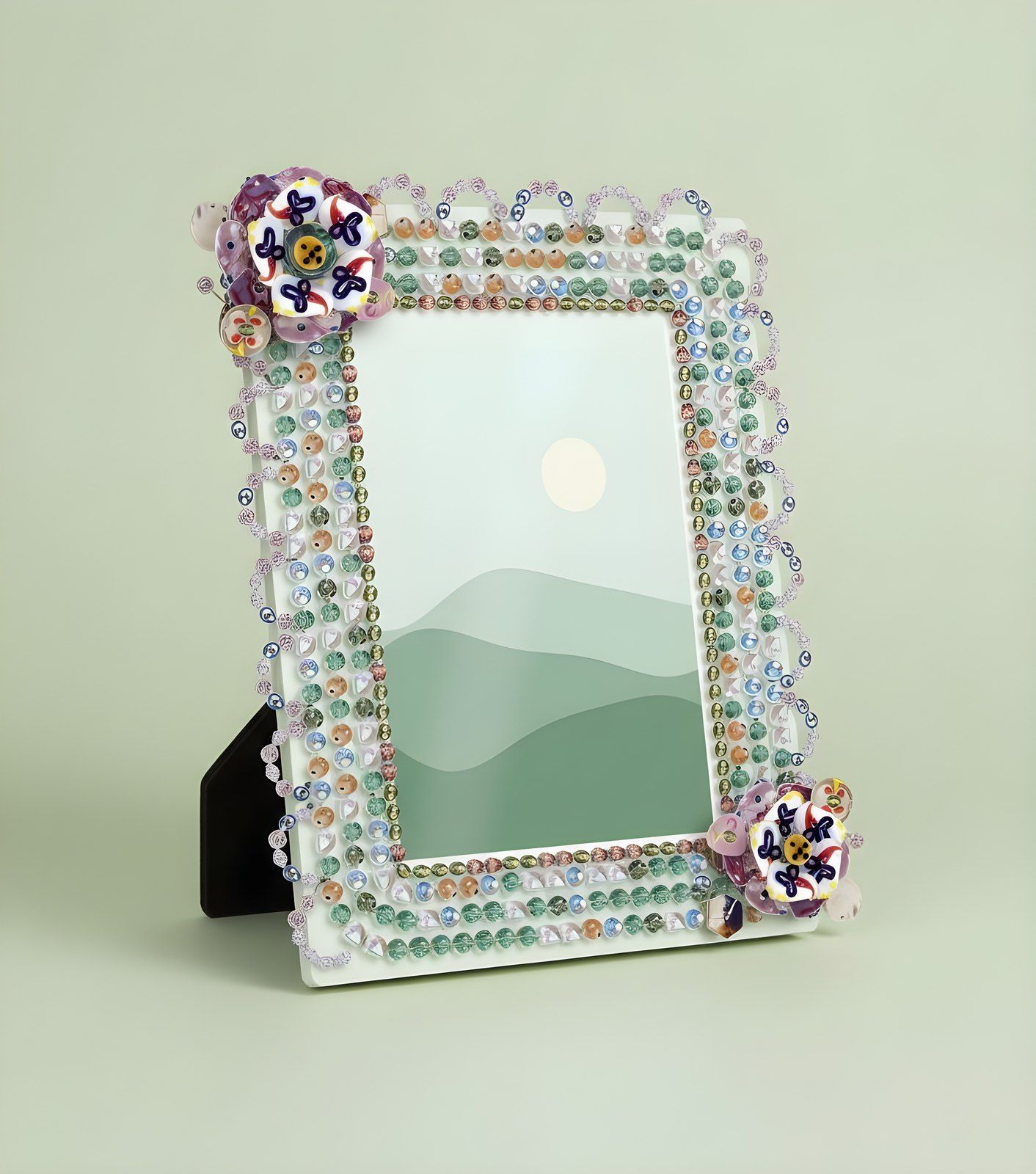
This is how we design beaded picture frames at Gemixx and how each one is planned to be built, step by step. Our ten frames are concepts still to be sampled. Every bead on a beaded frame has a planned position and a planned way of being held. We work out both on paper before a single bead is threaded, so the frame that is built matches the drawing the buyer approved. The same method sits behind our ten beaded picture frames, from the bow-topped Big Bow to the loop-edged Sorbet Double Loop.

· Gemixx Exports

Step 1: a library of real beads

A frame is never drawn in made-up colours. Each bead type in a design, such as a crackle round or a coin drop, is a pool of real catalogued beads: one shape, one stocked size, in the colours we hold it in. A bead joins the library only once a photograph shows that single bead clearly, so drawings use its true colour and size.

When nothing closer than a near match exists, the substitution is written into the design so the buyer knows: a crackle bead asked for at 8 mm may be drawn as a 9 mm flake glass bead. Recorded at the start, it never becomes a surprise on the sample.

Step 2: beaded photo frame design, bead by bead

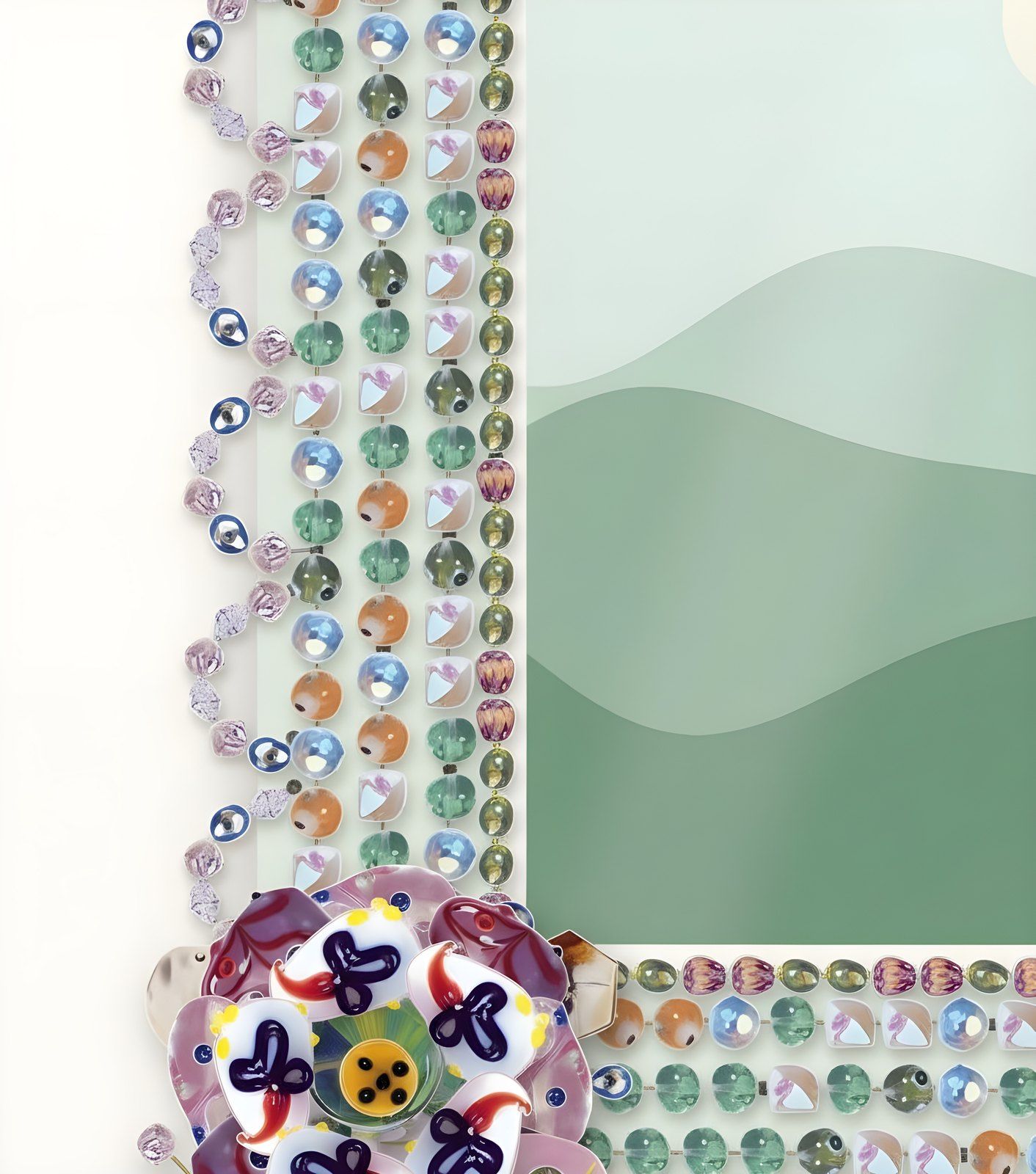
Good beaded photo frame design starts with the photo window and works outwards. Rows of beads run along paths round the window, bands fill the border, loops reach past the edge, strands hang as fringe, and motifs such as bows, daisies or toadstools are placed where they belong.

Every bead becomes one record: which bead, its colour, its position and its angle. So the buyer sees exactly the bead that will be threaded, a colour change is a swap from one catalogued colour to another, and the bead count is known before sampling.

Step 3: drawings at true size

The layout is drawn at true size from the photograph of each bead, at its real size and angle, so the buyer sees the actual bead mix rather than an artist's impression. Each frame is also rendered in 3D on its easel, so the depth of loops and motifs can be judged early.

Step 4: beaded frame construction, or how each bead is held

The rule of good beaded frame construction is simple: no bead is ever just placed. Each one is either threaded on a wire that starts and ends in a hole drilled through the 6 mm core, or glued to a seat on the core face. There are nine ways a bead can be held, and every bead in a layout belongs to exactly one of them.

Held by: How it works

Face row: Brass wire through a pair of holes every 42 mm, so a long row cannot bow

Tacked bead: One short brass wire per bead, bent flat at the back

Stem: A brass pin through one hole at the foot

Pinned rosette or fan: Brass headpins through one centre hole, or three on an arc wire

Edge loop: Nylon-coated steel wire through two holes, one at each foot, crimped

Fringe strand: Coated steel wire through one hole, crimped; the bottom bead is the stop

Armature: Heavier brass wire tied down at three or four points, for bows and crowns

Hanging loop: Doubled coated wire through two holes behind the top edge

Glued cabochon: No wire: a flat-backed cabochon has no hole, so it sits on a glued seat

### Loops strung past the edge

A loop is strung on coated wire, and both feet are anchored through the core and crimped at the back. When neighbouring loop feet land within 5 mm of each other they share one hole, drilled once, so neighbouring loops can be crimped together. An anchor that would fall beyond the core is pulled straight in towards the centre, never squared off to the nearest edge, so a corner's loops fan out instead of piling onto one point.

### Glued seats and spacers

Cabochons, such as the toadstool caps, sit on glued seats marked on the plan. Between beads in a row, 4 mm spacers in pressed glass or brass keep the spacing even and stop beads crowding.

Step 5: the construction pack

Everything above goes into a construction pack: the order of work, then one page per frame with the plan, the holding method for each run, the drill count and the metres of wire. Each wire is drawn in the colour of its method, every hole is ringed and every glued seat hatched, so a worker builds without guessing.

The layout is checked before the pack is issued. It cannot be released if a bead is held by nothing, a cabochon has been threaded, too many pins share one hole, an anchor falls off the core or two holes sit on top of each other.

Step 6: sampling and quality checks

The first sample of each design will be built from the pack, with a glass front and a velvet easel back, or a hanging loop for a wall frame. It is checked against the approved drawing, then photographed for the buyer's approval. The buyer sees a rough cost sheet before sampling starts, and we confirm the sample time when we quote.

In production, the checks will follow the same pack:

Hold: every bead is secure and every crimp is closed.

Shape: loops are even, rows are straight and fringes hang at the drawn length.

Colour: beads match the approved sample.

Finish: the glass is clean, the photo window is clear and the frame stands or hangs true.

How to make a beaded picture frame at home

The same principles help at home: start from a plain, flat frame, plan the beads on paper at real size, wire threaded beads through the frame and keep glue for flat-backed pieces.

Good to Know

Questions buyers ask about how beaded frames are made

Are the beads on a frame glued or wired?

Mostly wired through holes in the core and tied off at the back; only flat-backed cabochons are glued.

Can I change the beads on a design?

Yes. Each bead can be swapped for another colour of the same catalogued bead, and beads we make ourselves can be matched to a Pantone reference or physical chip.

How long does a beaded frame sample take?

We confirm the sample time when we quote; our beaded curtain samples usually take 16 to 20 days.

Keep Exploring

Related pages

Beaded picture frames

Beaded picture frames to develop for your range: ten 4 x 6 in designs to develop in glass beads, wired bead by bead, recoloured and sized to order.

Read more

Beaded curtain design library

Beaded curtain designs from our 2027 Trends library: doorway curtains, portals, valances, wall hangings and lamp shades in fourteen colour stories.

Read more

Beaded curtains wholesale

Beaded curtains wholesale from an Indian manufacturer: door beads, valances and room dividers in glass, acrylic and wood, colour-matched and made to order.

Read more

Custom bead curtains

Custom bead curtains from a beaded curtain manufacturer: valances, door beads and room dividers in glass, acrylic or wood, colour-matched and sampled fast.

Read more

Beaded lamp shades

Beaded lamp shade designs made by hand in India: pendant drums, empire table shades and sconce shades in glass beads, colour-matched to your palette.

Read more

Beaded wall hangings

Beaded wall hanging designs strung by hand in India: glass, wood and faux capiz pieces 50 to 76 cm wide on a dowel, colour-matched for retail and hotels.

Read more
Start a Conversation

Start a beaded frame brief.

Send a sketch, photo or CAD. We reply within one business day.