Manufacturing
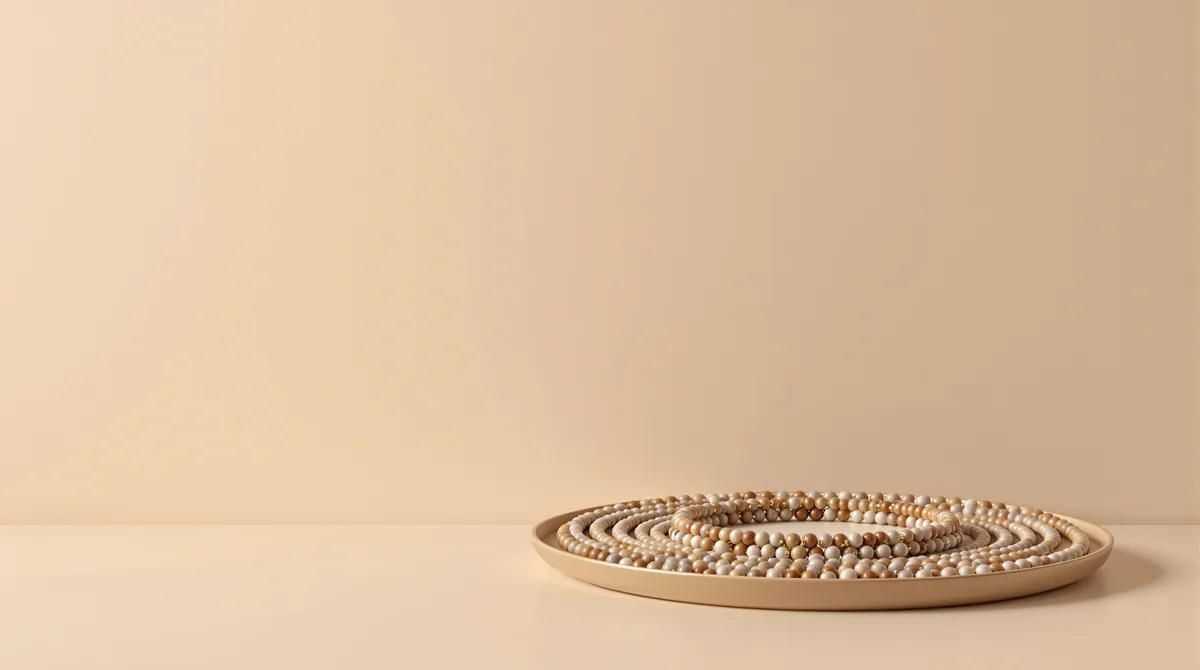
Beaded charger plates
Two constructions — a couched bead field on a stiffened ground, and coiled strung rounds lashed together — plus the limits on heat and washing.
Compare the optionsCompliance · Food contact
A charger is a service piece, not a plate. A coaster meets the outside of a glass. Most beaded tabletop is therefore not a food-contact article at all — and the answer about what Gemixx holds is narrower than a buyer might hope.
Food-contact rules apply to materials intended to contact food. A beaded charger, placemat or coaster is a service piece: food sits on a plate and a drink sits inside a glass, so the beadwork is not normally a food-contact surface. Gemixx's published FDA and California Proposition 65 food-grade statements cover its stainless steel lines, not beadwork, and this page does not extend them.
Food-contact rules apply to materials and articles intended to come into contact with food. In the United States that regime sits under federal food law and its implementing regulations, and the question asked is whether a substance may migrate into food and whether its use is permitted for that purpose. In the European Union the framework regulation on food-contact materials, plus material-specific rules such as those for plastics, requires a declaration of compliance and supporting migration data.
Both regimes turn on intent and on actual contact. A material that is not intended for food contact and does not touch food is not inside either framework.
Rarely, and that is the useful finding of this page.
Chargers are service pieces: a plate is placed on them, which is what a charger is for. Placemats carry crockery and glassware. A coaster meets the outside of a glass; the drink is inside the glass. A napkin ring holds a textile. In none of those cases does the beadwork meet food.
Where it does apply is narrower and real: a tray or bowl with a beaded rim where food could touch the rim, or anything designed to hold food directly. Those are different products and should be specified as such rather than squeezed into a décor specification.
For tabletop, the compliant answer is usually a design answer: build the piece so that food contact cannot occur, and say so in the product specification.
That means a charger with a recessed or flat field that a plate covers, a coaster sized so a glass base sits inside the beaded field, and a placemat whose beadwork does not extend under where food is served. Then specify the two things that actually matter for a service piece: a heavy-metals test on the beads and any coating, and a cleaning instruction appropriate to a bead-embroidered ground.
Lab testing is where a heavy-metals screen on the beads and any coating is commissioned.
A heavy-metals screen on beads and coatings is quick and cheap. Migration or extraction testing for a genuine food-contact article is slower and dearer, because it involves conditioning with food simulants over time, and it has to be run against the specific contact material rather than against the piece as a whole.
Both are quoted per market and per package. Neither is published here. The planning point is that food-contact testing is a development-stage activity, not a pre-shipment one.
Coatings, first. If a bead is painted, lacquered or plated, the coating is the surface that would be in contact and the one that would migrate. A bare fired-glass or glazed-ceramic bead is a much easier material to argue for than a coated one.
Adhesives second — a glued cabochon has a glue line, and glue is a material nobody lists.
Third, the ground. Bead-embroidered tabletop is built on stiffened fabric or felt, couched with metallic thread, and felt-backed. That is a cleanability question rather than a migration one: a porous ground that cannot be wiped is the wrong construction for a piece that will meet spills, whatever the chemistry says.
For a child's place setting, CPSIA applies on top of everything on this page.
Two boundaries, and they are different.
The food-contact boundary is intent plus actual contact: does the piece hold food. The children's-product boundary is age grading, and a beaded tabletop piece in a children's range brings the stricter chemical limits with it regardless of whether food touches the beads.
A child's place setting is where the two meet, and it is the one tabletop specification that should be written to both regimes from the start.
Holds, published: stainless steel product lines food-grade compliant with FDA requirements and California Proposition 65; copper products with food-safe coating or stainless lining, with relevant components meeting Proposition 65 requirements.
Those published statements are about metalware, and they describe metalware. A beaded tabletop piece is a different article in a different material set, so the food-contact question for it is answered on its own terms rather than by extension — which is the distinction a buyer's compliance team looks for first, and the reason the answer here is a test result rather than a borrowed declaration.
If a programme genuinely needs a beaded food-contact article, the route is to specify the contact material deliberately, test it against the destination's regime, and issue a declaration from the party placing it on the market. That route is open and is quoted with the programme.
The pieces this question actually reaches are the beaded table décor formats: beaded placemats and charger plates, beaded napkin rings, beaded table runners and coasters. All of them are service pieces in normal use. The chemical questions that do apply to them — lead in glass beads, and pigment chemistry in deep colours — are answered by lab testing on the named components rather than by a food-contact declaration.
A food-contact declaration that does not match the article is a serious problem in the EU, where the declaration is the compliance instrument and market surveillance can ask for it directly. In the US the exposure is about whether the use of the material is permitted at all.
The more common commercial failure is smaller and more avoidable: a product listed as "food safe" in marketing copy on the basis of a statement about a different material. That is a claim nobody made deliberately and everybody has to defend.
By designing the contact out. This is the one page in the compliance layer where the answer is overwhelmingly a geometry answer rather than a chemistry one.
Make the plate cover the beadwork. Keep beads off the inside of any vessel. Size a coaster so the glass base lands inside the field. Keep the beaded area away from the serving zone on a placemat. Use uncoated fired glass or glazed ceramic where incidental contact is plausible. And give the piece a cleaning instruction that matches its construction, since a bead-embroidered ground is wiped, not soaked.
The European Union asks for a declaration of compliance and supporting data, and asks it of the party placing the article on the market. The United States asks whether the material's use is permitted for food contact, within its own regulatory scheme. The UK runs its own version of the EU-derived framework.
Where a programme is multi-market, the design answer travels and the documentation does not. Which is another argument for designing the contact out: a service piece needs no declaration anywhere.
Where the piece is bead embroidery on a stiffened ground, care and cleaning is the document that matters more than any declaration.
For a service piece: a statement that the item is a service piece not intended for food contact, the heavy-metals testing required, the components to be tested, and the cleaning instruction to be supplied with the product. Then a clause barring "food safe" claims in marketing copy unless a declaration exists.
For a genuine food-contact article: the contact material, the regime, the migration testing required, and who issues the declaration. And a construction clause requiring that the contact surface is not changed without written approval.
The declaration belongs to the party placing the article on the market. The material specification belongs to the manufacturer. Testing is commissioned by whoever needs the declaration, which is almost always the importer or brand.
The one obligation a factory should always carry in this area is honesty about scope. A statement about stainless steel is a statement about stainless steel, and we are not going to let it be read as a statement about glass beads on felt.
Extractable data
| Piece | Does beadwork meet food? | Treatment |
|---|---|---|
| Charger | No. A plate is placed on it | Service piece. Specify cleanability, not food contact |
| Placemat | Normally no. Crockery and glassware sit on it | Service piece, with incidental contact considered |
| Coaster | No. A glass stands on it; the drink is inside the glass | Service piece |
| Napkin ring | No. It holds a textile napkin | Service piece |
| Table runner | No | Service piece |
| Bowl or tray with a beaded rim | Possibly, at the rim | Treat as a food-contact question and specify the contact material |
| Anything intended to hold food directly | Yes | A different product specification entirely |
Good to know
Only to the small part of it that could contact food. The great majority of beaded tabletop — chargers, placemats, coasters, napkin rings, runners — is a service category where food never meets the beadwork. Treating the whole category as a food-contact problem produces the wrong specification.
For a genuine food-contact article, a declaration of compliance identifying the contact material and the regime it complies with, supported by migration or extraction data where the regime requires it. For a service piece, the useful documents are a heavy-metals test report and a cleaning instruction, not a food-contact declaration.
The party placing the article on the market carries the declaration. The manufacturer is responsible for the contact material being what it is specified to be. The split is the same as everywhere else in this section, and it is the reason the declaration should never be requested from a factory that did not make the contact surface.
Painted, coated or plated surfaces, because a coating is the part that would migrate. Then any adhesive, and the textile or felt ground on bead-embroidered pieces, which is a cleanability question more than a chemical one. Fired glass, glazed ceramic and bare metal are the easier materials to argue for.
Gemixx publishes that its stainless steel product lines are food-grade compliant with FDA requirements and California Proposition 65, and that copper products use food-safe coating or are stainless-lined with relevant components meeting Proposition 65 requirements. That is a statement about metalware, not about beadwork. No food-contact declaration exists for a beaded tabletop piece, and none is claimed here.
Migration and extraction testing is slower than a heavy-metals screen, because it involves conditioning and simulants over time. Allow weeks rather than days, and build it in front of the production window rather than inside it.
Keep exploring
Manufacturing
Two constructions — a couched bead field on a stiffened ground, and coiled strung rounds lashed together — plus the limits on heat and washing.
Compare the optionsPillar
Lead, CPSIA, Prop 65, REACH, fire standards, electrical listing and audit — what applies, who carries it, and what we hold.
Specs and sizesGuides
One guide per question that arrives often enough to be worth answering properly.
Compare the optionsCompliance
Why lead oxide is used in cut glass, which bead families are affected, and what the limits actually measure.
Read the guideCompliance
The children’s-product determination for décor, the four factors it rests on, and what the 100 ppm limit actually covers.
Compare the options
Start a conversation
Send a reference, a colour chip or a sketch. Minimums are set per design and confirmed per quote; sampling is quoted separately and usually runs 16 to 20 days from an agreed brief.