Pillar
Beaded décor compliance
Lead, CPSIA, Prop 65, REACH, fire standards, electrical listing and audit — what applies, who carries it, and what we hold.
Compare the options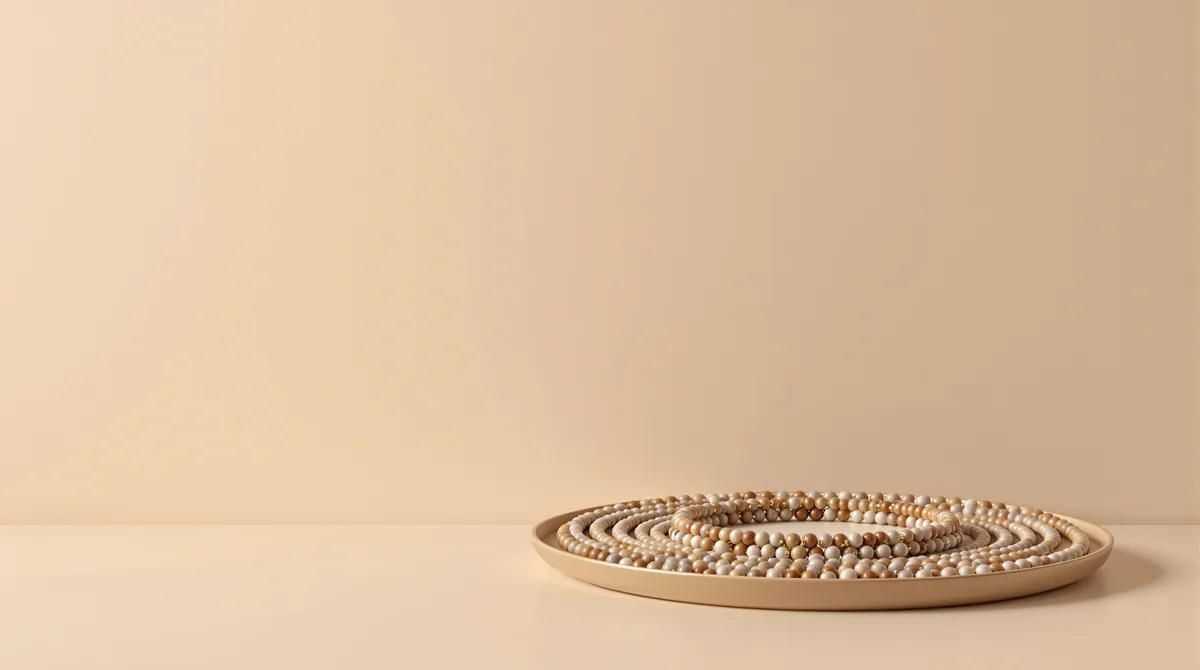
Manufacturing · Tabletop
A placemat is the only beaded object that sits under hot food and gets wiped afterwards. Two things decide whether it survives: the ground it is built on, and whether the buyer was told the truth about heat.
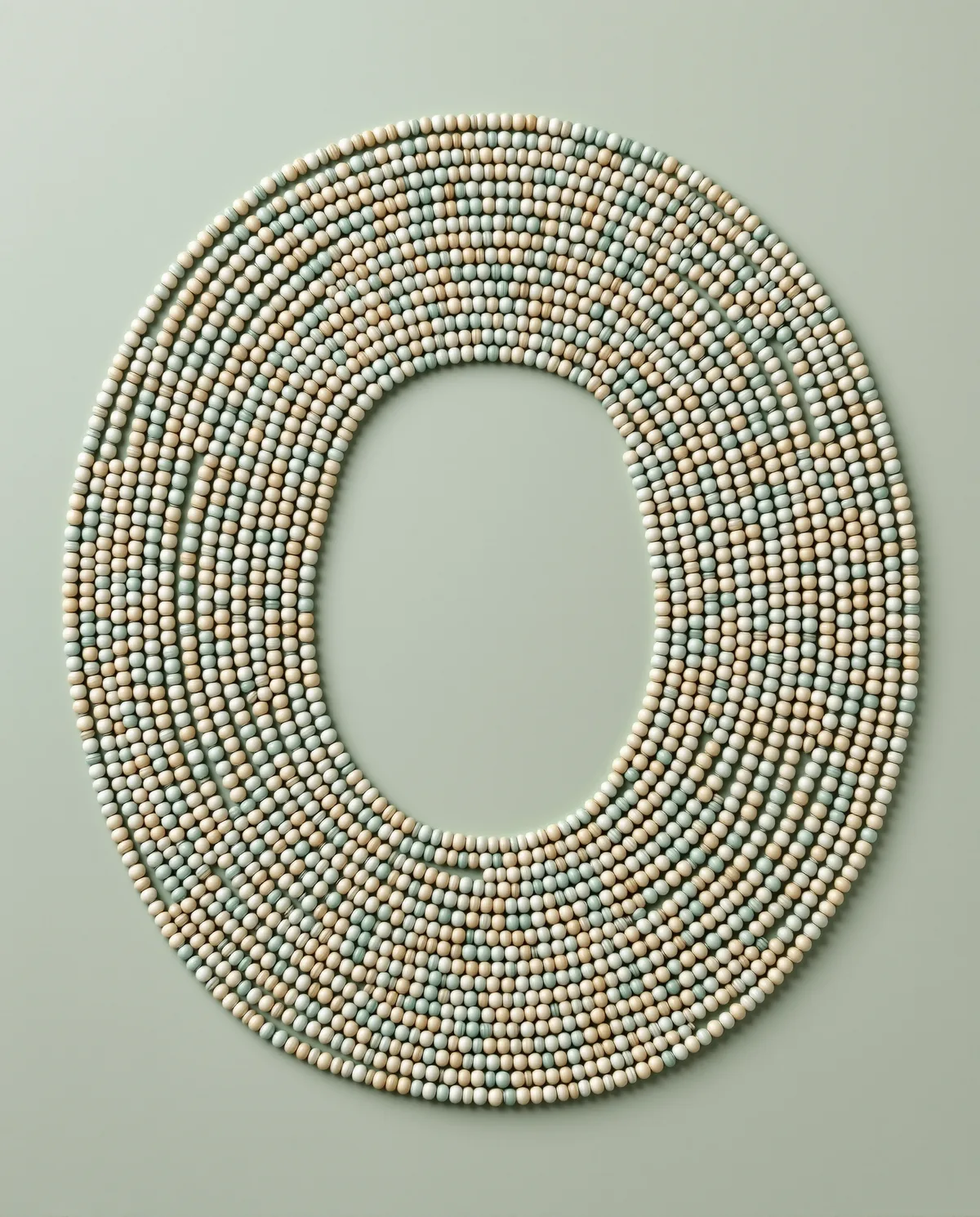
A coiled beaded mat lying flat, strands of wood and glass beads wound in close concentric rounds.
Beaded placemats and chargers are built two ways: a bead field couched onto a stiffened ground with a turned edge, or strung bead rounds coiled in concentric rings and lashed to each other. Both are decorative, not thermal. Neither goes in a dishwasher, and hot cookware needs a trivet rather than the mat.
Placemats and chargers are named in our published Beaded Décor scope, and two constructions cover them.
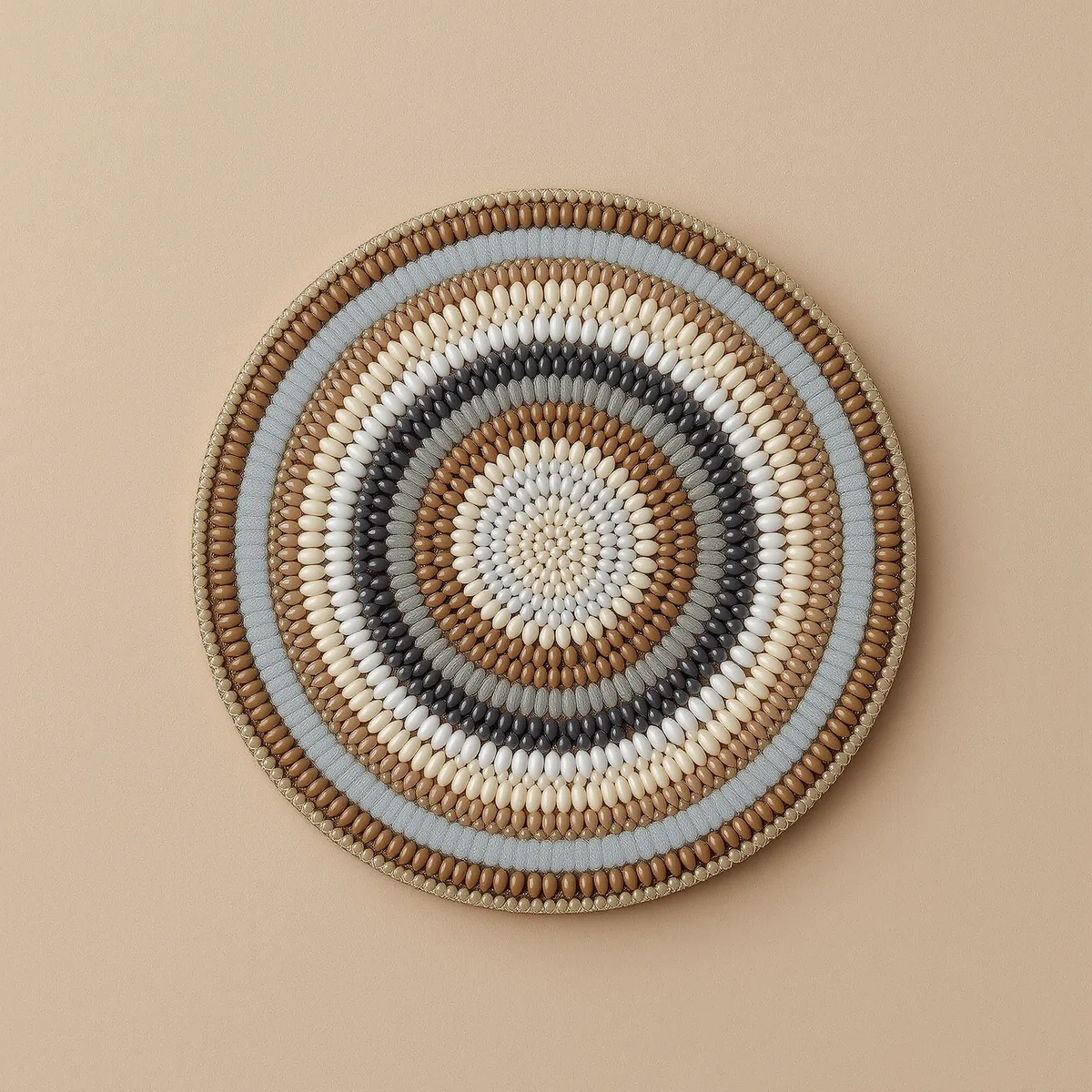
The couched bead field is bead and thread embroidery in the zardozi tradition: glass seed and bugle beads laid on a stiffened ground and held down by a separate fine thread, with the edge turned and a backing applied. The coiled round drops the ground entirely: beads are strung on cord and the strung cord is coiled in concentric rounds, each round lashed to the one inside it, so the lashing rather than a cloth holds the object together.
They are different objects with the same name on a shelf, and buyers should know which one they are specifying.
Choose the couched field when the design contains an image — a motif, a monogram, a tonal area. Seed beads at one to three millimetres behave like pixels, and nothing else on a table can draw. Choose the coiled round when the design is about texture, warmth and weight, or when the target price will not carry a seed-bead field. A coiled mat covers the same area with a fraction of the units because the beads are much larger.
The hand is different too. A couched mat is thin and formal; a coiled mat is thick, with a visible relief, and reads as craft.
Two, and both get glossed over in this category.
No dishwasher. Ever. Sustained heat, detergent and pressurised water together slacken thread, swell and distort a stiffened ground, mark felt and strip surface dye off beads. The instruction is spot-clean: soft brush for crumbs, barely damp cloth on the beads, dry cloth straight after.
No direct heat. Use a trivet. Glass tolerates a warm plate, but the thread and the ground do not like sustained heat, and acrylic softens well below the temperature of something out of an oven. Heat tolerance is confirmed on the sample. Specify the piece against the service temperature it will actually see, and keep a hot pan off it.
On a couched mat the ground is the specification buyers most often leave out and the one that determines whether the object works. Stiffened cotton or felt holds a dense bead field and can be edge-turned cleanly. An unstiffened face ripples as soon as the bead density rises, and a rippled mat will not sit flat under a plate.
The backing then does two jobs: it encloses the couching stitches so they cannot catch or scratch a lacquered table, and it keeps the underside flat so the mat does not rock. A mat with exposed stitches on its base is a returns problem waiting to happen.
On a coiled mat the equivalent variable is lashing tension. Even lashing produces a mat that self-flattens; uneven lashing produces a saucer.
Changeable: construction, size and shape, bead material and size, the motif, infill density, the edge treatment, the backing, and whether a charger carries a beaded rope edge at the rim.
Fixed: made to order, so nothing ships from stock. On couched work the bead map precedes the first stitch. On coiled work the cord is sized to the smallest drill hole in the build. And neither construction becomes dishwasher-safe or heat-rated by being specified differently — that is a property of beadwork, not of a decision we could take.
| Specification | Couched bead field | Coiled strung rounds |
|---|---|---|
| Construction | Beads couched with thread onto a stiffened ground | Beads strung on cord, coiled and lashed round to round |
| Ground | Stiffened fabric, turned edge | None — the rounds are the body |
| Backing | Felt, edge turned | Optional felt disc |
| Bead material | Glass seed and bugle, with pressed accents | Wood and glass, larger sizes |
| What it can depict | An image — motifs, letters, tonal fields | Pattern by concentric colour band |
| Flatness | Depends on the stiffening | Self-flattening if the lashing is even |
| Thickness in the hand | Thin | Thicker, with a visible relief |
| Heat | Decorative only | Decorative only |
| Cleaning | Spot-clean, never immersed | Spot-clean, never immersed |
| Sizes | Set per design | Set per design |
| Production | 40–60 days after sample approval | 40–60 days after sample approval |
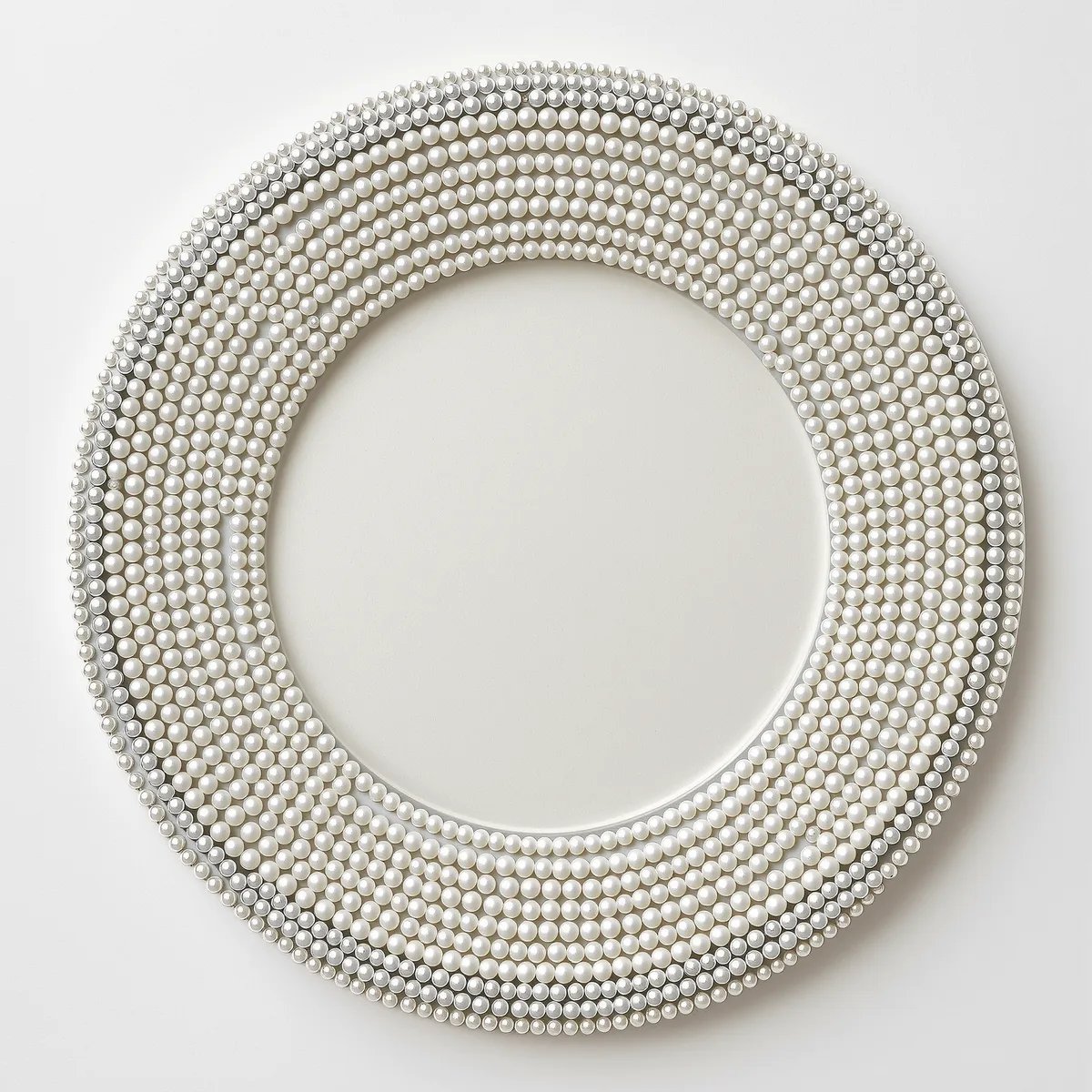
Sizes are set per design, because the useful dimension depends on the job. A placemat is sized to a cover. A charger is sized to sit under a plate, which means most of its face is hidden in service — so the design belongs at the rim, and a motif drawn for the centre of a placemat is simply wasted on a charger.
Glass seed and bugle beads for couched detail. Pressed glass for accents and motif beads, because a larger moulded bead covers an area for a fraction of the units a seed-bead field needs. Wood for coiled work, where warmth and low weight matter and the grain reads as material rather than colour. Metallic thread and zari in the same stitch as the beads. Acrylic where the widest dyed colour range is wanted — with the heat caution above applying more strictly, not less.
The construction. The size and shape, and for a charger the plate it sits under. The ground and its stiffening. The bead material and bead size. The motif, as artwork or a reference image. The infill density. The edge treatment and the backing. The colours, with references or physical chips. Then the care wording for the pack, packing, quantity per colourway, and the port or warehouse.
The care wording belongs on that list. A beaded mat sold without a care instruction gets washed, and then it gets returned.
Beads are matched to a colour reference or a physical chip and confirmed on the sample. On a couched mat the ground is matched separately and approved alongside the beads, because a bead and a ground at similar tonal value cancel out at two paces even when both are individually right.
Surface-dyed seed beads shift between dye lots, which is a batch property of the material rather than a fault, so the approved sample is the reference a run is held to.
A brief with the construction, the size, the motif and the colours. A rough cost sheet before anything is made, so look can be traded against price while it is free to change. Then the bead map or the round count. Then the sample, usually 16 to 20 days from an agreed brief, photographed for approval before it ships. Production runs against that approved sample.
Beaded décor runs 40 to 60 days after sample approval. Sampling is quoted separately. Where a mat combines beadwork with crochet or knotted elements, bohemian lead times of 60 to 90 days govern, because the slowest craft on the piece sets the date.
Flat, beaded face protected so no two faces press against each other, and as a set where the range sells in sets. The set and its box are part of the specification and are sampled with the mats. Cartons, labels and inner packing follow your specification, and the care instruction is printed rather than left to the shelf.
Bead count first, and on couched work that means density. De-densifying the infill — keep the outline tight, open the fill — is the single most effective change and is invisible at arm's length. Bead size second: a larger bead covers the same area with far fewer units and far fewer stitches. Then the edge and the backing, which are a fixed cost per piece and do not scale down with the face.
Reducing the mat size therefore saves less than buyers expect, which is why the first conversation on a mat above target is about density and not dimensions.
Home and lifestyle retailers buying under their own label, who sell mats in sets of four or six. E-commerce sellers, where a flat stack of mats is one of the better beaded formats to ship. Interior and hospitality designers specifying for restaurant and hotel covers, where the heat and washing limits have to be stated in the specification rather than discovered in service. And gifting programmes, where a boxed set of chargers does the work of a far more expensive object.
Good to know
No. Minimums are set per design and confirmed per quote. A coiled wood-bead mat and a fully couched seed-bead mat at the same diameter differ by an order of magnitude in bead count and in hours, so a range-wide figure would be useless to a buyer.
No. There is no retail stock programme for beaded décor. Every mat and charger is made to order against an approved sample, in the size, colours and packing you specify.
No, and this is the answer we give even when it loses a conversation. A dishwasher combines sustained heat, detergent and water at pressure. Thread slackens, a stiffened ground swells and distorts, felt marks and surface-dyed beads lose colour. Spot-clean only: lift crumbs with a soft brush, wipe the beads with a barely damp cloth, dry immediately.
Treat the mat as decorative and put a trivet between it and anything hot. Glass beads tolerate a warm plate, but the thread and the ground do not like sustained heat and acrylic softens well below the temperature of a dish straight from an oven. Heat tolerance is confirmed on the sample: specify the piece against the service temperature it will actually see.
Yes. Beads are matched to a colour reference or a physical chip and confirmed on the sample, and on a couched mat the ground is matched separately. Where a field carries a larger accent bead, the field is routinely dyed to match the accent so the accent reads as the subject.
Yes, and it is a redraw rather than a scale. A charger and a placemat are different diameters doing different jobs, so a motif drawn for one has to be re-plotted for the other: on a charger most of the face is hidden by a plate, which changes where the design should sit entirely.
Beaded décor runs 40 to 60 days after sample approval. Sampling usually runs 16 to 20 days from an agreed brief and is quoted separately.
Keep exploring
Pillar
Lead, CPSIA, Prop 65, REACH, fire standards, electrical listing and audit — what applies, who carries it, and what we hold.
Compare the optionsManufacturing
Bead-embroidered glass coasters on stiffened felt, or moulded acrylic sets in translucent and opaque — construction, sizes and what moves the cost.
How it is madeGuides
One guide per question that arrives often enough to be worth answering properly.
Specs and sizesPillar
The table cluster: coasters, placemats and chargers, runners and napkin rings, with the construction and ground material each one needs.
Compare the optionsManufacturing
The ground, the couched bead field, the fringed or beaded end — and how runner length and end drop are set from the table rather than from the drawing.
Specs and sizesManufacturing
Six to nine centimetres, beads wrapped over a shaped brass armature with a flat-back wrap — the construction, the sizes and what sets the cost.
See the detail
Start a conversation
Send a reference, a colour chip or a sketch. Minimums are set per design and confirmed per quote; sampling is quoted separately and usually runs 16 to 20 days from an agreed brief.