Pillar
Beaded curtains: the formats, and what each one is for
Door curtains, portals, café lengths and valances: the standard sizes, the strand counts and the one question each format answers.
Read more
Manufacturing · Valances
A valance is a bead curtain with the height taken out of it. That single change moves the price, the carton and the shelf it sells from — which is why it is usually the first beaded piece a buyer commits to.
A beaded curtain in olive and oatmeal glass, gathered and drawn back at one side of the frame against clear ground.
A beaded valance is a short strung panel that dresses the top of a window or doorway without covering it. Formats run around 120 × 30 to 40 cm at 56 to 60 strands, and a smaller 76 × 61 cm format at 30 strands. Height is the largest cost lever in beadwork, so a valance tests a colour story at a fraction of a full curtain's bead count.
A beaded valance is built exactly as a curtain is built, only shorter. A bead map fixes every bead position, strands are threaded on cord one at a time in map order, and the finished strands are gathered on a single turned wooden dowel or into a sewn rod pocket. Strand lengths are then cut to the hem shape.
Two formats carry most of the work: around 120 by 30 to 40 cm at 56 to 60 strands, and a smaller 76 by 61 cm at 30 strands. The valance sits inside the beaded curtain programme rather than beside it — valances are made continuously alongside portals, curtains, café curtains and wall hangings.
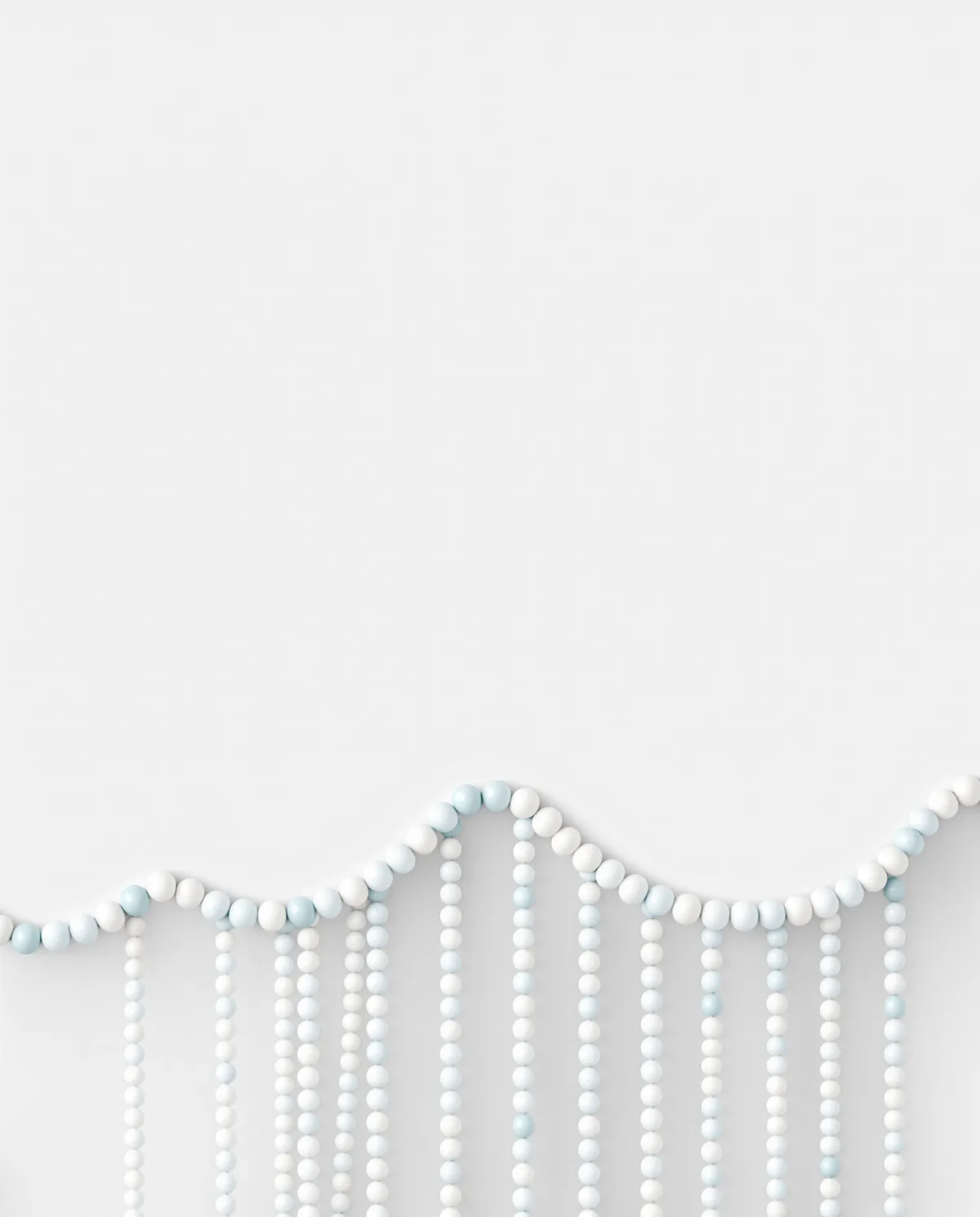
The hem is the whole personality of a valance, and it is nothing more than strand length written on the count sheet.
A scalloped arch rises and falls in repeating soft curves and is the most forgiving shape on an uneven window. A fan arch inverts that into a spread of points. A V-point drops to one centre point and reads formal. A swag dips across the middle like fabric. A straight fringe ends every strand level, usually finished with a heavier drop bead so the line stays crisp.
One shipped sea-glass valance runs its longest strand at about 24 inches and its shortest at about 10, fullest at the sides — the stepping in that single range is what makes the arch read from across a room.
Changeable: bead material, bead size, colour, strand count, pitch, drop, hem shape, the end bead, and whether the top is a dowel or a sewn cotton header with a rod pocket. All of them are specification decisions taken before sampling.
Fixed: made to order, so nothing ships from stock. The count sheet governs production, so a hem cannot be adjusted on the floor without redrawing the sheet. And cord is sized to the smallest drill hole in the build — on a valance that usually means the seed beads on the base strand, not the showy drop bead at the end.
| Specification | Value |
|---|---|
| Common format | 120 × 30–40 cm on a dowel |
| Shipped smaller format | 76 × 61 cm (30 × 24 in), 30 strands |
| Strand count | 30 to 60 |
| Strand pitch | About 2 cm on a 120 cm width |
| Bead count | About 900 to 2,000 |
| Shaped-hem drop range | Longest about 24 in, shortest about 10 in |
| Bead materials | Glass, frosted sea-glass, acrylic, wood, cast faux capiz |
| Hems | Scalloped arch, fan arch, V-point, swag, straight fringe |
| Top fixing | Turned wooden dowel; sewn rod pocket on request |
| Colour matching | To a colour reference or a physical chip, confirmed on the sample |
| Sampling | 16–20 days from an agreed brief, quoted separately |
| Production | 40–60 days after sample approval |
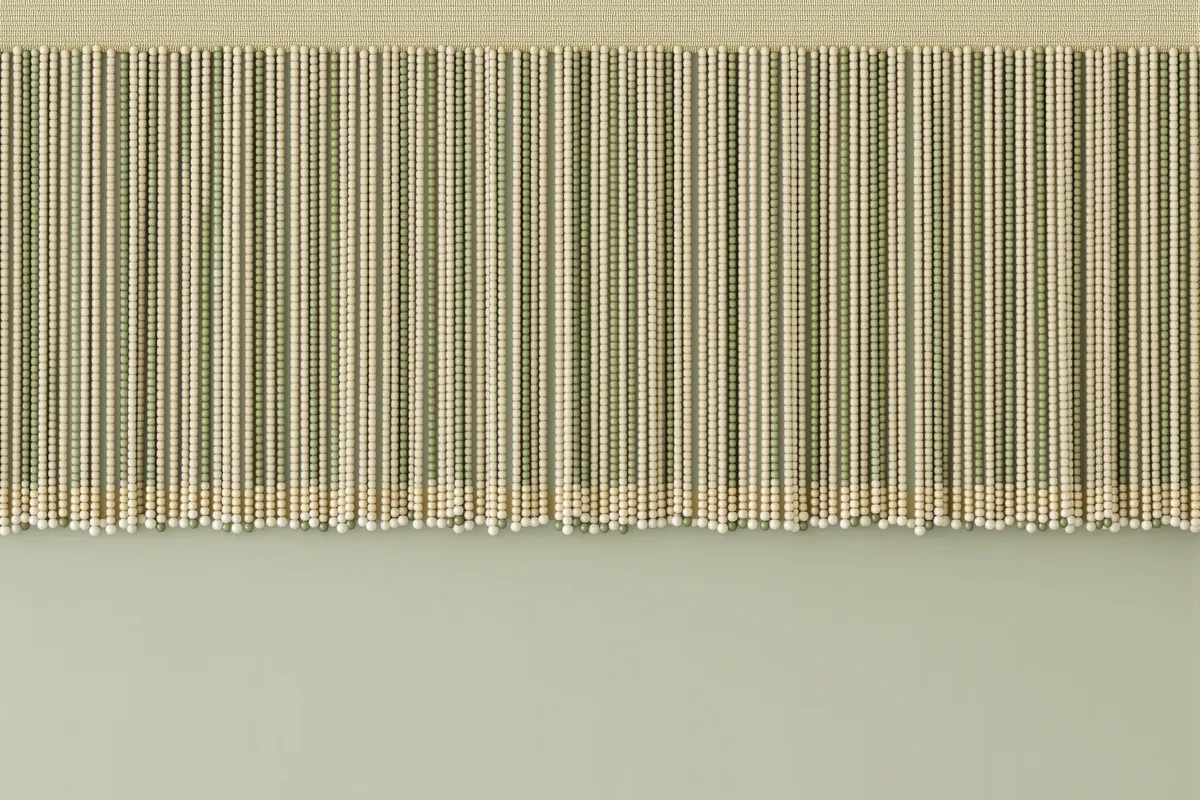
Buyers use valance, pelmet and short beaded curtain interchangeably, and the only real difference is the drop. A valance dresses the top of the opening. A short curtain runs a third to half the way down, which suits a kitchen window or a cabinet opening. Both are made the same way, from the same count sheet, so asking for one and selling the other is a drop decision rather than a new development.
Glass carries weight and sparkle, and a glass valance hangs dead straight from day one. Irregular frosted glass — the sea-glass look — at around 4 to 5 mm, strung with seed beads and ended with a larger drop, is one of the most effective valance builds there is, because the frosted surface catches light without the hard glitter of cut glass. Acrylic gives the widest colour range because it is dyed to colour. Wood reads warm and quiet. Cast faux capiz, which is cast resin or dyed cut acrylic finished to imitate capiz shell, gives a pearlised shell-look fringe with no shell in it.
Three things a curtain brief does not. Whether the valance sits inside or outside the frame, because an inside mount has to clear the reveal and an outside mount covers the architrave. The hem profile drawn rather than named — a scallop, an arch and a sunburst are three different count sheets. And the end bead at each strand tip, because on a short drop the tip sits at eye level and an unfinished strand shows.
The rest is the standard brief every bead programme starts from: type, size, density, bead, colour, pattern, fixing, packing, quantity, and the port or warehouse.
Beads are matched to a colour reference or a physical chip and confirmed on the sample, never on a screen. Where a plain base strand carries a larger accent, the base is dyed to match the accent so the accent reads as the subject rather than fighting its ground. Surface-dyed glass shifts between dye lots; that is a batch property of the material rather than a fault, which is why the approved sample — not the original chip — is the reference a production run is held to.
A brief with size, material, colours and quantity. Then a rough cost sheet before anything is made, so the look can be traded against the price while changing it is still free. Colour matching next, then the sample: usually 16 to 20 days from an agreed brief, photographed for your approval before it ships. Production runs against that approved sample.
Where a design lands above target, the drop is the first thing we look at with you, because on a valance height and bead count are very nearly the same number.
Beaded décor runs 40 to 60 days after sample approval. Knotted and bohemian work runs 60 to 90, which matters only if the valance combines beadwork with knotted cord. Sampling is quoted separately from production.
Those are the only lead times we publish, and we do not shade them to win a conversation. A new moulded or cast bead shape adds tooling in front of the 40 to 60 days, and that is quoted per design.
Short strands make this the best-behaved beaded format in a carton. Strands are kept in strict order so they cannot cross, the dowel ends are protected, and the whole piece goes into the carton, label and inner-packing specification you give us. Smaller and lighter cartons than a full curtain also mean a lower landed cost per piece, which is part of why the format works so well as a range opener.
Every strand is checked against the count sheet for length and bead order. Knots and crimps are checked closed. The hem is checked against the drawn shape, which on a scalloped or fan hem is where a drifting strand shows first. Colour is checked against the approved sample rather than the original reference. First-article and lot inspection, kitting and export packing all run through our own quality and packing house, and published issue rates across the group run at a fraction of a percent.
In order: bead size and material, construction, strand spacing, the dowel and the packing, and height. On a valance, height is already minimised, so the next lever is usually bead size — a slightly larger bead fills the same drop with far fewer units and the difference is invisible at arm's length. After that it is density: a scattered accent on a plain base instead of a fully covered strand.
Buyers underestimate this constantly. A graphic 90 by 200 cm curtain can hold around 11,800 beads, every one placed by hand. A valance in the same design holds a tenth of that.
Retailers and e-commerce sellers, who use a valance to test a palette before committing to full-length curtains, and who like the freight numbers. Brands buying under their own label, who can put a valance and a full curtain in one design side by side on the shelf and sell them as a pair. Interior and hospitality designers dressing café windows, bars, salons and spas. And renters' ranges, because a valance needs no permission and no permanent fixing to a door frame.
Good to know
Yes, and a resize is a redraw rather than a stretch. Strand count, pitch, strand lengths and bead count are all recalculated for the new width and drop, and the hem is re-plotted so the arches or points still land evenly. On one sea-glass valance, cutting the drop from 30 to 26 inches took real material out of the bead count without changing the design at all.
Beaded décor runs 40 to 60 days after sample approval. Sampling usually takes 16 to 20 days from an agreed brief and is quoted separately. A valance that needs a new moulded or cast bead shape carries tooling time in front of that.
Strands are kept in order so they cannot cross or knot in transit, the dowel is protected at both ends, and the piece is packed to the carton, label and inner-packing specification you give us. A valance is the easiest beaded format to pack well: short strands mean a smaller, lighter and squarer carton than any full-length curtain.
Glass beads are drawn and hand-strung in our own Firozabad glass works. The dowel is turned in our own Saharanpur wood factory. Acrylic and resin beads are moulded and dyed to our colour, to our own dies where a design needs a custom bead. Inspection and export packing run through our own Greater Noida house.
No. Minimums are set per design and confirmed per quote, because a plain-strand valance and a fully patterned one at the same size use very different amounts of material and stringing time. We do not publish a range-wide figure.
No. There is no retail stock programme for beaded décor. Every valance is made to order against an approved sample, in the colours, size and packing you specify.
Yes. Beads are matched to a colour reference or a physical chip and confirmed on the sample. Acrylic is dyed to colour, so it gives the widest range; tinted and frosted glass is matched by specifying the glass rather than by dyeing after the fact.
Keep exploring
Pillar
Door curtains, portals, café lengths and valances: the standard sizes, the strand counts and the one question each format answers.
Read moreDesign
Valances at 120 × 30 to 40 cm and café curtains at 76 × 76 cm, documented by hem shape, strand count and bead count.
Specs and sizesSpecification
The dimensions, strand values, fixings and performance limits a drawing and schedule have to carry.
Specs and sizesHub
The full beaded range — curtains, portals, valances, tabletop, cushions, textiles and beads — from a leading manufacturer that makes the bead as well as the piece.
How it is madeManufacturing
Brief, rough cost sheet, colour match, sample, production, packing — the route from a sketch to a packed carton, in plants we own.
Compare the optionsReference
The core, the bead field, the fixing and the load a tieback has to carry — made to order against an approved sample.
See the detailManufacturing
Widths from 50 to 76 cm on a turned dowel, in glass, wood and cast faux capiz — hem shapes, strand counts and what is a shipped format against a concept.
How it is madeManufacturing
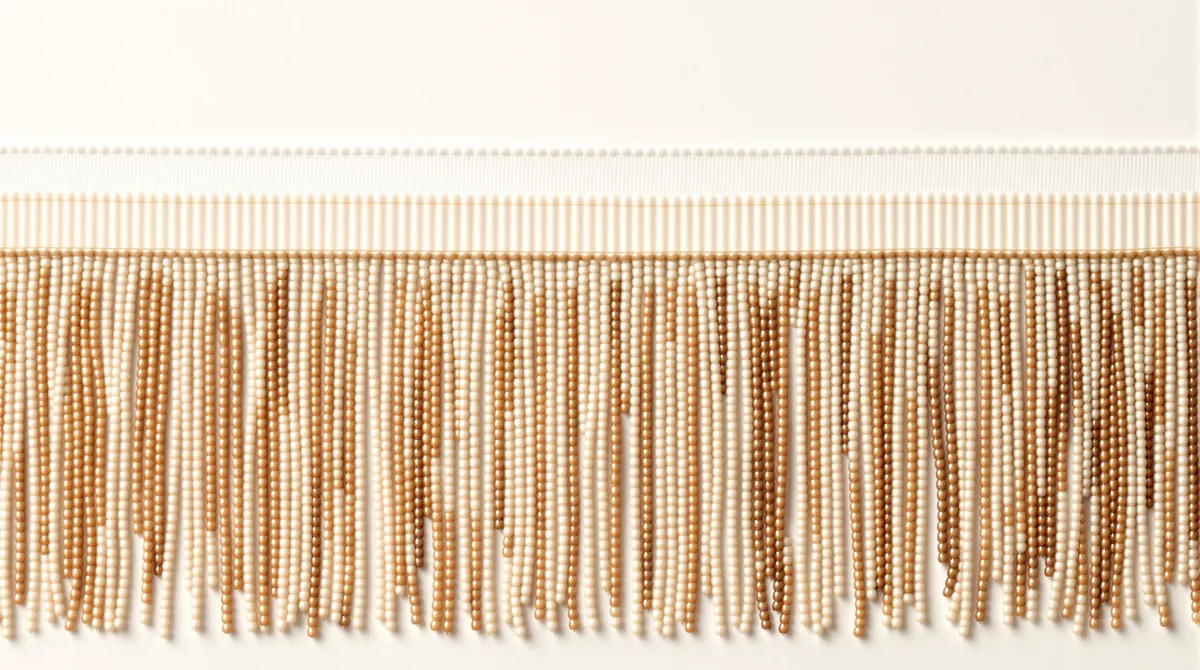
The header tape, the drop, the repeat length and the tolerances — how beaded fringe is built and quoted when it is a component in somebody else's product.
Compare the options
Start a conversation
Send a reference, a colour chip or a sketch. Minimums are set per design and confirmed per quote; sampling is quoted separately and usually runs 16 to 20 days from an agreed brief.