Pillar
Beaded drapes
Door curtains, portals, café lengths and valances: the standard sizes, the strand counts and the one question each format answers.
How it is made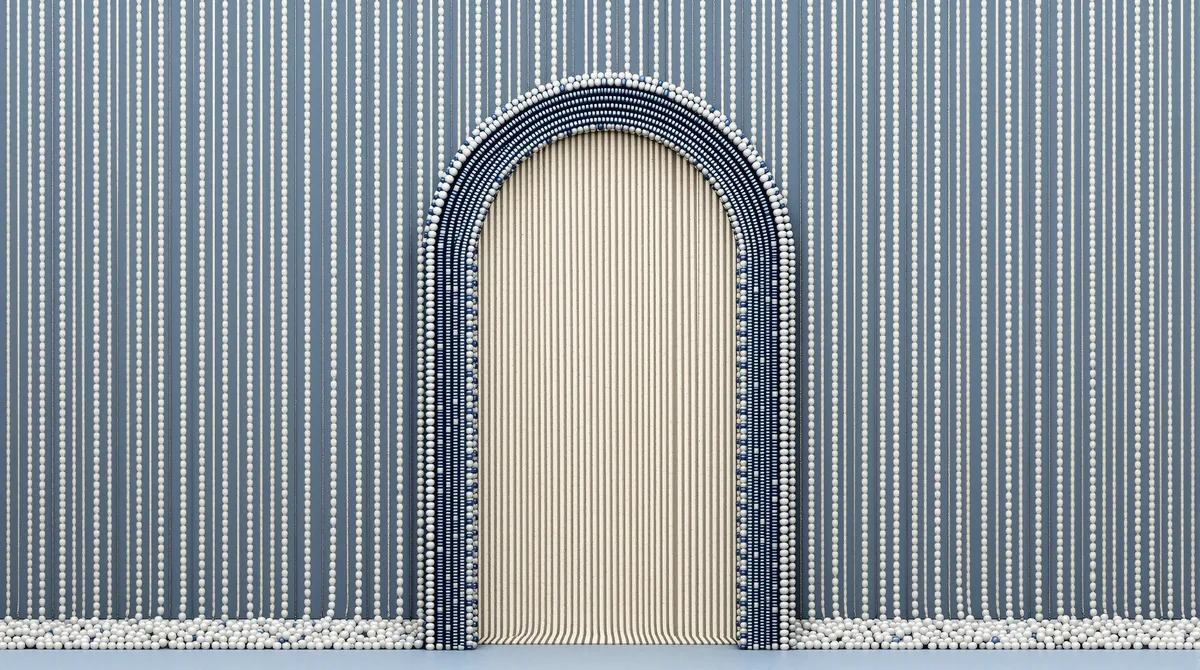
Manufacturing · Portals
A portal frames a doorway and leaves the middle of it clear. The open centre is cut into the beadwork by strand length, which makes it a different build from a curtain and the most reordered format we make.
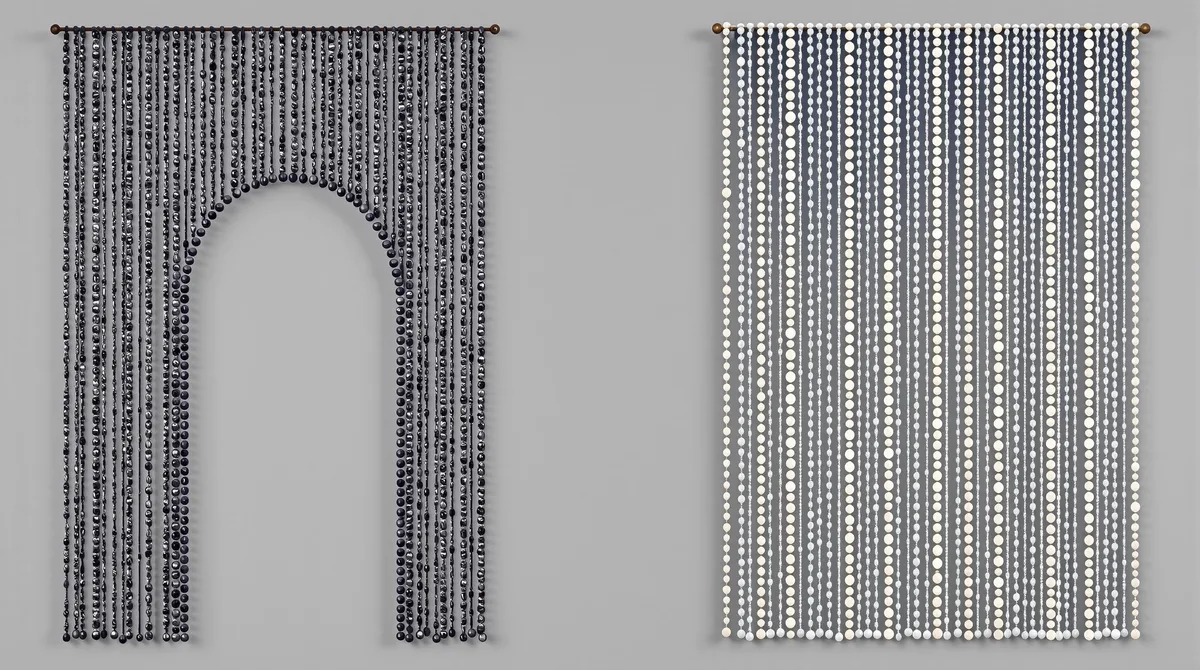
A beaded door portal with an arched opening cut through its centre, the strand lengths stepping in deep lapis, cobalt, slate and pale sky glass to shape the curve.
A beaded door portal frames an opening and leaves its centre clear, so the walk-through is designed rather than pushed through. The open centre is cut into the beadwork by grading strand lengths — an arched or inverted-V drop, fullest at the sides. The standard format is 90 by 200 cm on a turned dowel or a stained header rail.

A portal is a hand-strung panel with its centre deliberately left clear. The strands are threaded on cord and gathered on a single turned wooden dowel or a stained wooden header rail, and the opening is produced by grading strand lengths — longest at the sides, shortest in the middle — so an arch or an inverted V is cut out of the panel itself.
Thirty hand-strung strands on a single dowel is the common construction at the standard 90 × 200 cm size. The bead map comes first: every bead position is fixed on paper before anyone threads a needle, which is what makes a scattered accent land scattered and a pattern repeat identically across a run.
The walk-through. On a full curtain you push through the beads and they close behind you. On a portal you pass through a gap that was designed, which changes how the piece reads and how it wears.
Two consequences follow. It reads as architecture — an opening framed — rather than as a thing hanging in a doorway, which is why it photographs and merchandises differently. And the wear is distributed differently: nobody is displacing strands at the centre of the panel several times an hour, so the strands that take the most handling are the ones at the edges of the gap.
Changeable: size, bead material, bead size, strand count and pitch, colour, the shape and height of the open centre, the hem profile, the top fixing, and the packing.
Fixed: the construction logic. Strands hang from a straight line, cord is sized to the smallest drill hole in the build, and the open centre is made by strand length rather than by a cut-out. Those are not preferences, they are how a strung panel works.
The line that makes a portal brief a portal brief is the open centre: its shape, its height at the apex and its width at the sill, drawn rather than described. Everything else about a portal follows from it, because the centre strands are what get shortened on the count sheet.
Then the shortest drop as well as the longest, because a portal always has a shaped profile. Then the eight standard lines — type and format, density, bead with its drill hole, colour, pattern, top fixing and its length, packing, and quantity per colourway with its destination.
Leave out the drill hole and the panel cannot be assembled. Leave out the strand count and it cannot be costed.
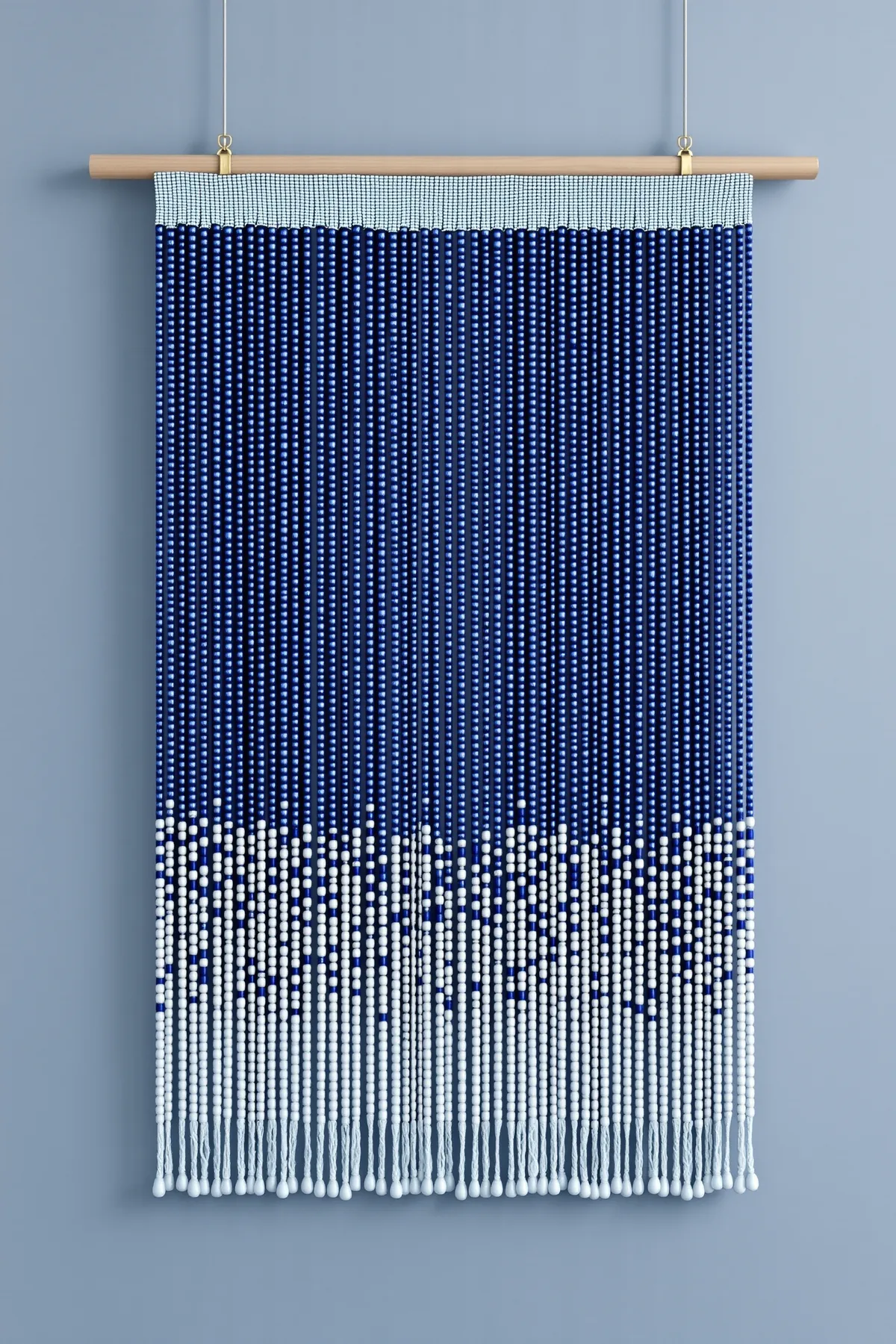
Glass — drawn seed beads for fine ground, pressed glass for repeatable moulded shapes and body colour, hand-made lampwork and Venetian-style beads for large feature beads. Drawn and hand-strung in our own Firozabad glass works, which is why colour and annealing are adjustable rather than fixed.
Acrylic — moulded and dyed to your colour, translucent or opaque, with our own dies where a design needs a bead nobody makes.
Wood — turned in our own Saharanpur factory; matte, warm, light, and the best screening material in the category.
Faux capiz — cast resin or dyed cut acrylic, finished to imitate capiz shell. Not shell.
All nine material families, and a working library deep enough to give a brand a bead nobody else is using.
The standard door format is 90 × 200 cm, about 35 × 79 in, which suits the 28 to 36 in interior doors common in North America; from 36 in upwards the panel moves to 120 cm. The design library carries a 76 × 140 cm portal format and a 90 × 67 cm dual format that works as either a wall piece or a short door portal.
Strand counts of 27 to 40 on the library portal come from the current 2027 designs and are confirmed on the approved sample.
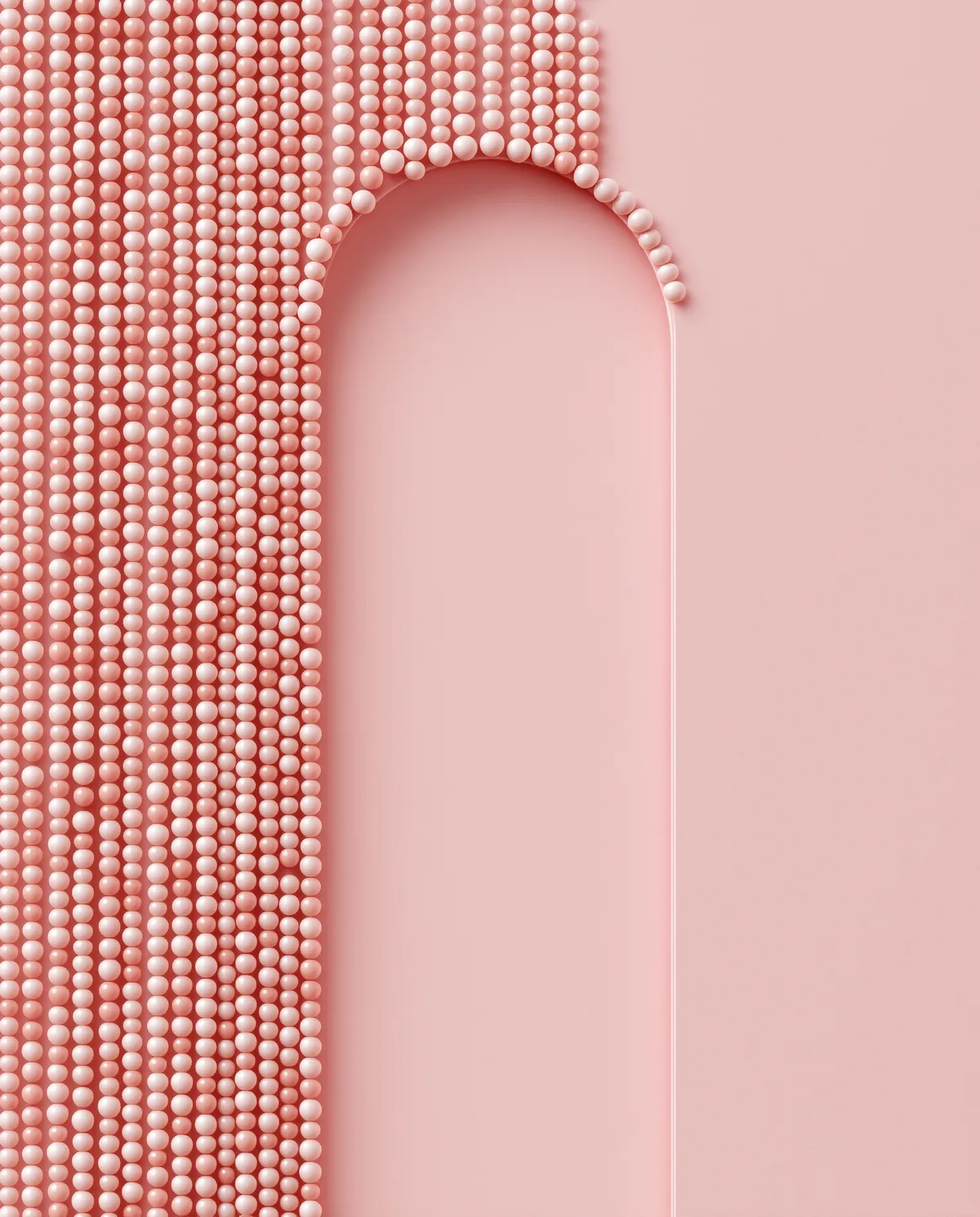
By strand length, set on the colour-count sheet. Each strand's finished drop is a number, and the pattern those numbers make is the profile: an arched-cut drop with a continuous sweep, or an inverted V with a sharper apex.
Because it is data rather than craft judgement, every piece in a production run matches, and a repeat order years later reproduces the same profile. It also costs nothing extra: a shaped profile and a straight cut take the same labour, and a shaped one removes beads.
The functional check is proportion. The gap has to be wide enough at head height to walk through without brushing, and narrow enough at the top that the panel still reads as a frame.
Against a colour reference or a physical chip, confirmed on the approved sample. Nobody signs off beadwork from a rendering.
Two mechanisms do most of the work. Dyed to match: the base bead is dyed to the accent colour so the accent reads as the subject rather than fighting its ground. And grading by bead size, where the colour change lands on a change of scale rather than a change of dye, which reads as depth instead of as a band.
One real constraint on glass: strength is colour-dependent, and some colours are weaker when large beads knock together in a hanging panel. We met that on a Venetian-bead portal and solved it by changing the furnace process, annealing the beads and revising the palette.
A brief — photograph, sketch or artwork, with size, material, colours and quantity. Then a rough cost sheet before any sample is made, showing where the cost sits and which lever moves the price, so look can be traded against price while the design is still a drawing.
Then colour matching against a reference or chip, then the sample. On a portal the approval to insist on is the open centre: a shaped profile reads differently in the hand than on a drawing, and it is the one feature a photograph flattens.
Production runs 40 to 60 days after sample approval, strung by hand to the colour-count sheet and fixed to the dowel or rail.
A portal is two manufactured things: the beads, and the header they hang from. The beads are drawn and hand-strung at our own Firozabad glass works, or moulded and dyed to our colour on our own dies where the design is acrylic. The header — a turned dowel or a stained rail — comes from our own Saharanpur wood factory, and its section is checked against the finished weight rather than copied from the last design.
Inspection, kitting and export packing then run through our own Greater Noida quality house. We own the plants: no agents, no brokers.
Doorway buyers divide in two. Retail and e-commerce, where a portal is a boxed product with a price point and a carton size. And specification, where it is an opening treatment on a drawing — hotels, restaurants, salons and spas through their designers, and event and display companies.
The portal is the format with the deepest record behind it. The lead style has been reordered season after season. We work to a client's own packaging and specification and never compete with our clients at retail.
Extractable data
| Specification | Value |
|---|---|
| Standard door format | 90 × 200 cm (35 × 79 in) |
| Wide format | 120 × 200 cm |
| Library portal format | 76 × 140 cm, ~27–40 strands |
| Wall and short-portal dual format | 90 × 67 cm |
| Typical construction | 30 hand-strung strands on a single turned wooden dowel |
| Dense bead count, 90 × 200 cm | About 11,800 beads, each placed by hand |
| Bead materials | Glass (seed, pressed, lampwork, Venetian-style), acrylic, wood, faux capiz |
| Open centre | Arched or inverted-V drop, graded by strand length |
| Top fixing | Turned dowel, stained header rail, or end suspension loops |
| Colour | Matched to a colour reference or physical chip, confirmed on sample |
| Sampling | 16–20 days from an agreed brief, quoted separately |
| Production | 40–60 days after sample approval |
| Inspection | First-article and lot AQL inspection in our own Greater Noida house |
| Packing | To your carton, label and packaging specification |
Good to know
No. We do not run a retail stock programme for beaded décor — every portal we ship is made to order against an approved sample. That is also why a non-standard size is routine rather than exceptional: width, drop and strand count are set per order.
Yes. Beads are matched to a colour reference or a physical chip and confirmed on the sample rather than on a screen. Acrylic is moulded and dyed to the reference; glass is matched from the library or run as a new colour. Base beads are routinely dyed to match an accent bead so the accent carries the design.
Yes. Strand count and bead count are recalculated for the new width and drop, and we check that the pattern still reads at the new scale. On a portal that check matters more than on a curtain, because the open centre has to stay in proportion to the opening it frames.
Beaded décor runs 40 to 60 days after sample approval. Sampling itself usually runs 16 to 20 days from an agreed brief and is quoted separately, and you approve photographs before the sample ships.
To your carton, label and packaging specification, shipped to the port or warehouse you name. On a strung portal the inner packing is part of the design rather than an afterthought: the strands have to arrive in order and unknocked, which is what stops a panel reaching the shelf tangled.
Glass beads are drawn and hand-strung in our own Firozabad glass works. Wooden dowels are turned in our own Saharanpur wood factory. Acrylic and resin beads are moulded and dyed to our colour, to our own dies where a design needs a custom bead. Faux capiz is cast resin or dyed cut acrylic. Inspection and export packing run through our own Greater Noida house.
No. Minimums are set per design and confirmed per quote, because a plain-strand portal and a fully patterned one use very different amounts of material and stringing time. Minimums are set per design and confirmed with your quote.
Keep exploring
Pillar
Door curtains, portals, café lengths and valances: the standard sizes, the strand counts and the one question each format answers.
How it is madeDesign
Portals at 76 × 140 cm and hanging divisions at 90 × 180 and 120 × 180 cm, documented by strand count and opening shape.
See the detailIndex
Seventeen beaded objects documented from inside the craft — what each one is, how the tradition builds it, and what it would take to develop one.
Specs and sizesHub
The full beaded range — curtains, portals, valances, tabletop, cushions, textiles and beads — from a leading manufacturer that makes the bead as well as the piece.
Read the guideManufacturing
Short strung panels at 120 × 35 cm and other formats, 56 to 60 strands, with scalloped, fan-arch, V-point and straight hems — and why height is the cost lever.
Read the guideManufacturing
Brief, rough cost sheet, colour match, sample, production, packing — the route from a sketch to a packed carton, in plants we own.
Read the guide
Start a conversation
Send a reference, a colour chip or a sketch. Minimums are set per design and confirmed per quote; sampling is quoted separately and usually runs 16 to 20 days from an agreed brief.