Reference
Which bead material to specify
Nine material families, what each gives in light, weight and colour, and how far our own manufacturing reaches into every one of them.
Read the guide
Cluster pillar
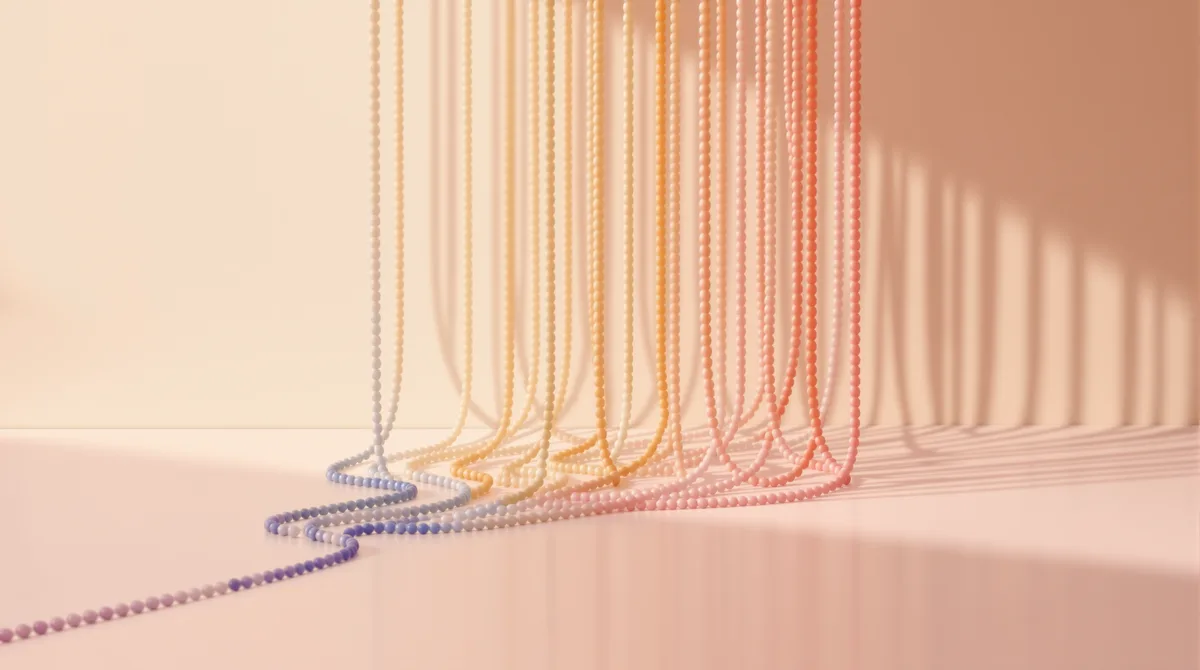
A beaded curtain is a set of hand-strung strands hanging from a dowel. Everything else — how much light it keeps, what it weighs, what it sounds like — follows from the format you pick and the bead you hang on it.
Close hand-strung strands of glossy orange, rust and cream glass beads, hung in two dense banks with clear ground between them.
A beaded curtain is a panel of hand-strung strands hung from a wooden dowel or a sewn rod pocket, to dress or part-screen an opening. The standard door size is about 90 by 200 cm, roughly 35 by 79 inches. Format decides the brief: a portal, a drape, a café length and a valance are different objects. We draw the glass and turn the dowel in our own plants.
A beaded curtain is a panel built from strands rather than from cloth. Beads are threaded onto cord one at a time, the strands are gathered along a single turned wooden dowel or into a sewn rod pocket, and the bottom edge is cut to a shape by varying the length of each strand. Remove the beads and there is no object left — which is what separates beaded décor from a textile with beads sewn onto it.
That construction has consequences a fabric curtain does not have. The panel is open, so air moves through it. It is heavy for its area if the beads are glass. It makes a sound when someone walks through it. And it can be repaired strand by strand instead of replaced.
Six formats cover almost everything sold under the name. A door curtain, sometimes called a beaded drape, hangs the full height of a doorway. A portal frames the opening and deliberately leaves the middle clear, so you walk through a gap rather than through the beads. A café curtain covers the lower half of a window from a fabric header. A valance dresses only the top of an opening. A window panel is a door curtain sized to a window and usually hem-shaped to the frame. A wall hanging is the same construction hung on a wall with no opening behind it.
The format decides the brief. A portal and a drape of the same width use completely different strand lengths and have different bead counts, so quoting one from the other is meaningless.
The published standard for a full-length door curtain is about 90 × 200 cm, which is roughly 35 × 79 in. North American interior doors are commonly 28 to 36 in wide, so a 90 cm panel covers most of them; from 36 in upwards the panel moves to 120 cm, about 47 in.
Portals in the design library run 76 × 140 cm, and there is a dual-purpose 90 × 67 cm format developed in 2026 that works as either a wall hanging or a very short door portal. Valances sit at 120 × 30–40 cm.
Production formats are built, shipped and reordered. The 2027 library designs are drawn against real beads at true size, and every figure is confirmed on the approved sample when a design is developed — which is how every piece here is contracted anyway.
| Format | Standard size | Strands | The question it answers |
|---|---|---|---|
| Door curtain (beaded drape) | 90 × 200 cm (35 × 79 in) | 30–40 | A single interior doorway |
| Wide door curtain | 120 × 200 cm | ~60 | An opening from 36 in wide |
| Door portal | 76 × 140 cm | ~27–40 | Framing an opening and leaving the centre clear |
| Wall-hanging and portal dual format | 90 × 67 cm | — | A wall, or a very short opening |
| Café curtain | 24 × 30 in plus a 3 in rod pocket | — | The lower half of a window |
| Valance | 120 × 30–40 cm | ~56–60 | The top of a window or doorway only |
| Window panel | 30 × 24 in | 30 | A small window, hem shaped to the frame |
| Dense bead count | 90 × 200 cm, fully patterned | — | About 11,800 beads, each placed by hand |
| Spaced bead count | 90 × 200 cm, open pattern | ~40 | About 3,100 beads |
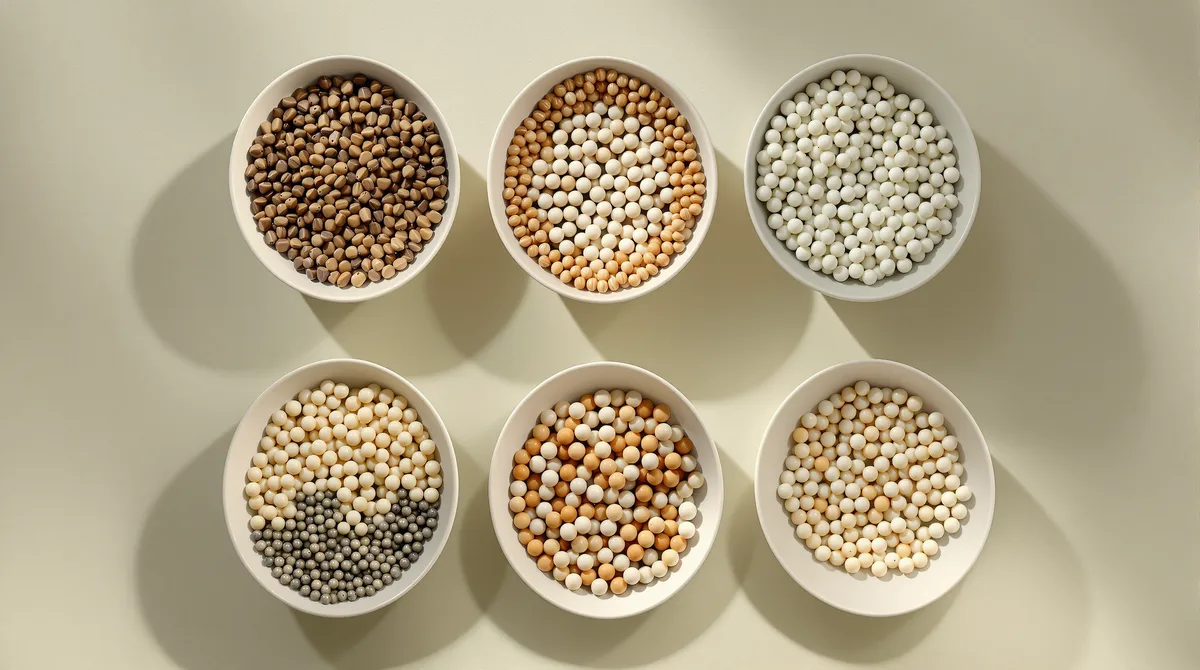
Four families do nearly all the work, and they differ in exactly the ways you notice from a metre away.
As a rough physical guide, glass sits near 2.5 g/cm³, acrylic near 1.2 and most woods below 1. That ratio is why a glass panel and a wood panel of identical design are not interchangeable on the same fixing.
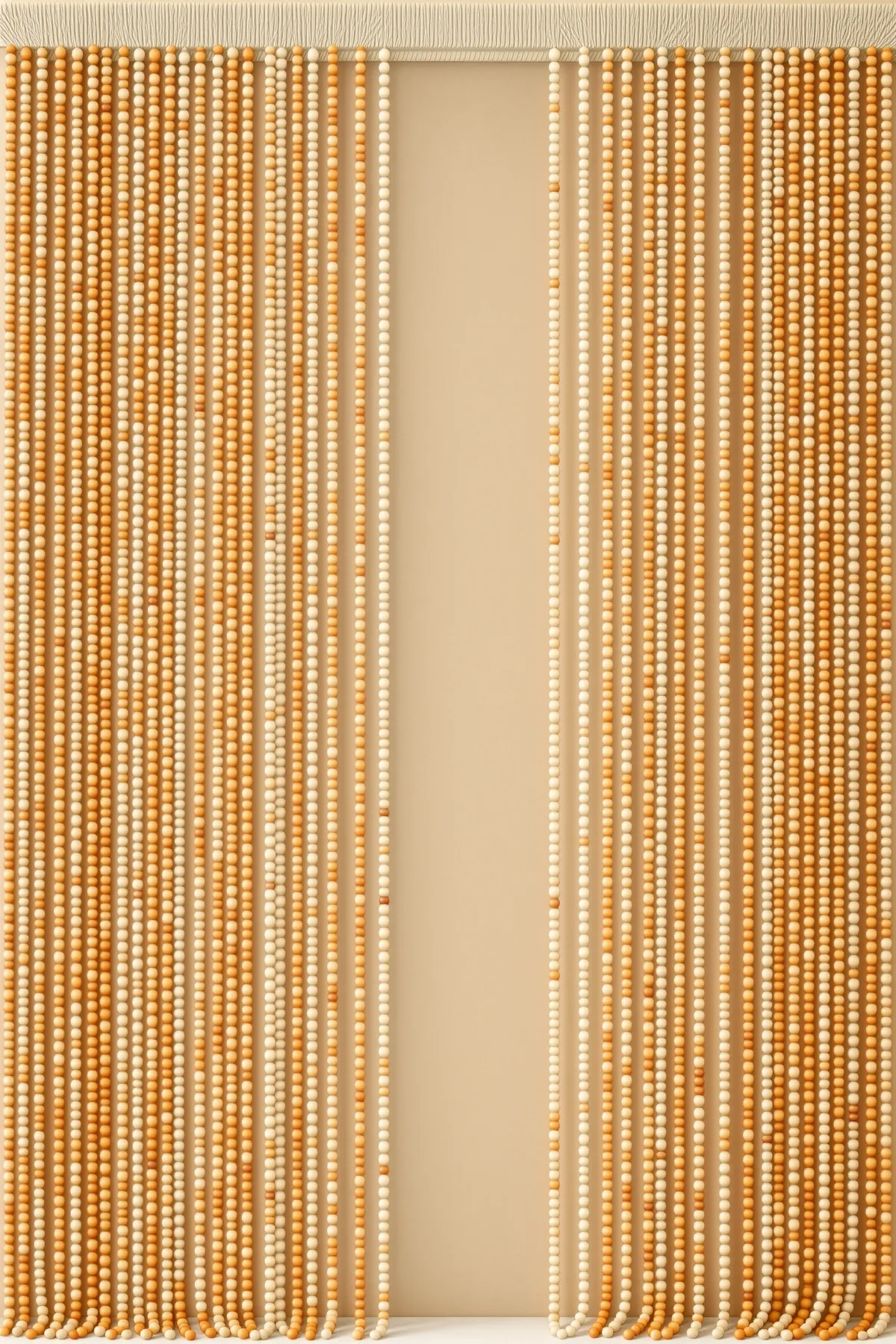
Every panel starts as a drawing. A bead map fixes each bead position before anyone threads a needle, which is the only way a scattered accent lands scattered rather than in rows, and the only way a pattern repeats identically across a production run.
Thirty hand-strung strands on a single wooden dowel is the shipped construction for a 90 × 200 cm panel, which is a 3 cm pitch. Cord is sized to the smallest drill hole in the build, not to the look of the piece. Strand spacing at the header sets the density of the whole thing, and the design library draws denser than the shipped build — roughly 2.25 cm for 40 strands across 90 cm, roughly 2 cm for 60 across 120 cm. Then the hem is cut: straight, diagonal, scalloped, V-point, inverted-V, or an arched opening cut out of the middle for a walk-through.
If you know the opening but not the bead, start with the material pages. If you know the look but not the fit, start with the format pages: wide doorways, arched openings, windows, closets and the short lengths each have their own geometry.
If you are weighing the idea at all, two pages are worth reading before any other: what a beaded curtain will not do, and the pros and cons. Both are written to lose the sale if the answer is that beadwork is the wrong object for the job.
Airflow first: a strand panel moves air where cloth stops it, which is why the format holds its place in hot climates and busy kitchens. Movement second — the panel registers everyone who walks through it and settles level again within a day. Then light broken rather than blocked, so an opening keeps its daylight and loses its hard edge. Then repairability: a single strand is restrung where a damaged textile is replaced. And presence out of all proportion to what it costs to make.
One clause for the brief: specify a mesh screen where insects have to be excluded, a blind where blackout is the requirement, and a solid door where close privacy is the point.
A division built from door curtains, portals or wall hangings hung side by side is the format we build, and it is how a hanging division is specified on this property: everything on these pages hangs a panel in an opening. A beaded room divider as a single engineered object is drawn in the library and available to develop.
Fire performance is tested on the specified build — bead, cord, header and mount together, at an accredited laboratory — and quoted with the project, with the report naming that construction. Beadwork is a visual and spatial device rather than an acoustic one.
If you know the opening, start with the format pages: a wide doorway, an arched opening, a window bead panel or a short bead panel. If you know the look, start with the material pages: glass bead curtains, a wood bead curtain, an acrylic bead curtain or a capiz curtain. If you are still weighing the idea, read the limits and then the pros and cons, in that order. And if the panel is being manufactured for a brand rather than bought for a room, made to order beadwork is the route, with a beaded portal as the format that reorders most.
Every page in this cluster
One page per question. Nothing here is a spelling variant of something else.
Guide
A soft knock instead of a chime, grain that never matches twice, low weight, and the one thing wood cannot tolerate.
Guide
The heaviest panel and the only one that refracts: weight, chime, a straight hang, and the chipping risk that comes with them.
Guide
The lightest panel you can hang, the widest colour range, a light click rather than a chime, and no shatter risk.
Guide
Cut or faceted glass, described plainly: the heaviest panel in the category and the only one that genuinely dazzles.
Guide
Flat translucent discs in linked columns: a different construction, a different sound, and an engineered imitation of shell rather than shell.
Guide
Hundreds of beads to a strand: the finest colour resolution in beadwork, and the longest stringing time in the category.
Guide
Acrylic or PVC: the distinction that decides colour depth, smell, chemical compliance and lifespan.
Guide
A coated surface rather than a body colour: why pearl beads scuff where others dull, and where they are still the right answer.
Guide
A dry rattle, almost no weight, a natural look that marks in damp — and the note that bamboo is confirmed design by design.
Guide
Glass where the light hits it, lighter beads everywhere else: the arrangement that most good bead panels actually use.
Guide
Beads, cord, dowel, end beads, header and fixings: the six components, what each one has to do, and which decision comes first.
Guide
Resolution, weight, hang and hours — the four things one number decides, and how to trade between them.
Guide
Across the strands or down each one: the distribution decision that matters more than the palette, plus grading by bead size.
Guide
Nine profiles, what each one suits, and why a shaped hem costs no more than a straight cut.
Guide
Panels as modules: standard widths, where a join reads, and how a run is set out across a wall rather than an opening.
Guide
Valance, café length and half drop: three short formats, what each one does, and how bead count falls with height.
Guide
Cumulative strand weight, cord creep and header load: what changes when a bead panel goes past two metres.
Guide
Dowel deflection, mid-span support and the case for modules: why a very wide opening is a header problem first.
Guide
One panel or a pair, where the join falls, and why the walk-through gap should be designed rather than left to chance.
Guide
Three ways to hang beadwork in an arch: a straight rod inside the opening, a hem cut to the curve, or a shaped top rail.
Guide
Backlit all day: why body-coloured glass belongs at a window, how length is measured from the sill, and what fades.
Guide
Shallow header depth, a narrow opening and constant contact with clothes: the lighter build that a closet actually needs.
Guide
Which materials tolerate steam, which mark permanently, and why the cord rather than the bead sets the lifespan.
Guide
Three predictable failures — soaked cord, lime scale, no containment — and the two things people usually want instead.
Guide
The only divider that costs no floor area — and how pitch, colour and sound all change when you are standing a foot from it.
Guide
No drilling, packs flat twice a year, survives a car boot, and does the work of a whole wall of decoration.
Guide
Tension rods inside the frame, the real limits of adhesive fixings, and how to match the panel's weight to what the fixing will take.
Guide
Breaking light rather than blocking it: what a bead panel does to daylight through the day, and which beads come closest to shade.
Guide
Opaque beads at a tight pitch screen movement and never detail — and nothing in this category works from close up.
Guide
Air moves through, insects are discouraged rather than excluded, and strand pitch is the only lever that changes either.
Guide
Glass chimes, acrylic clicks, wood knocks, bamboo rattles, discs clatter: the sound of each material and how to choose one.
Guide
Strand weight, pitch, handling and packing: the four variables that decide whether a panel knots, and the three set at the brief.
Guide
Why there is no single weight figure, the density ratios that matter, and which fixing each weight class needs.
Guide
Cord first, then surface finish, then beads: what wears out in which order, and what each stage looks like before it fails.
Guide
No soundproofing, no blackout, no insulation, no insect exclusion, no close-range privacy — and why none of them is fixable.
Guide
Airflow, light, character and repairability against noise, dust, partial privacy and tangling — with which side each one sits on, and why.
Guide
Bead count first, bead size second, pattern density third: the five levers that actually move the cost of a bead panel, in order.
Guide
Answered from the production floor rather than from opinion: which formats are selling now, and which version of the look genuinely reads as dated.
Guide
Pulling, cord loops and loose beads: the three real risks, and the two that are design decisions rather than inevitabilities.
Guide
Cats climb, dogs push through: which builds survive it, which beads are a swallowing risk, and how to hang in a pet home.
Manufacturing
Strands that frame an opening and leave a clear walk-through: arched and inverted-V drops, built to order on a turned dowel or a stained rail.
Good to know
Read this one for the format, then the material page for whichever bead you are drawn to — glass, wood, acrylic, capiz or seed bead. Those two decisions settle weight, sound, light and cost between them. Everything else on this cluster is a refinement of one of the two.
Fixed across the category: the 90 by 200 cm standard size, the 11,800 beads in a densely patterned panel of that size, the 30-strand construction on a single turned dowel, and the material routes. Set per design and confirmed with your quote: pricing, minimums, and fire performance, which is tested on the specified build.
Five craft families run in plants we own. Glass is drawn and hand-strung in our own Firozabad glass works, wood and dowels are turned in Saharanpur, ceramic is glazed and fired in Khurja, metal is finished and plated in Moradabad, and acrylic and resin are moulded and dyed to our own dies. Inspection and export packing run through our own Greater Noida house, shipping into the US, the UK, the EU and Canada.
A turned wooden dowel from our own wood factory, a metal rail where a project calls for one, or a sewn cotton rod pocket on a textile header. The header is specified with the panel because it carries every strand, which is why extra-long and extra-wide builds are engineered from the header down rather than from the bead up.
By question, not by keyword. Material pages answer what a bead is like to live with, format pages answer how a panel fits an opening, performance pages answer what it actually does once hung, and the choosing pages answer the three decisions a brief has to contain — bead size, colourway and hem shape.
No. There is no retail stock programme for beaded décor: every door curtain we ship is made to order against an approved sample. That is also why sizes other than the standard ones are normal rather than exceptional.
Keep exploring
Reference
Nine material families, what each gives in light, weight and colour, and how far our own manufacturing reaches into every one of them.
Read the guideSpecification
Diameters, drill holes, cord selection, strand counts and format dimensions — the sheet to copy into a tech pack.
Compare the optionsDesign
Colour stories documented by how they are built, not by how they look in a mood board.
Read the guideIndex
Twenty-four named looks, each described by the material, palette, pitch and hem that actually produce it.
Specs and sizesHub
The full beaded range — curtains, portals, valances, tabletop, cushions, textiles and beads — from a leading manufacturer that makes the bead as well as the piece.
Read the guidePillar
The table cluster: coasters, placemats and chargers, runners and napkin rings, with the construction and ground material each one needs.
Specs and sizesTechnique
The bead map, the cord, thirty strands on a dowel, hem shapes, suspension loops — and the three levers that move the cost.
Read the guide
Start a conversation
Send a reference, a colour chip or a sketch. Minimums are set per design and confirmed per quote; sampling is quoted separately and usually runs 16 to 20 days from an agreed brief.