Colour story
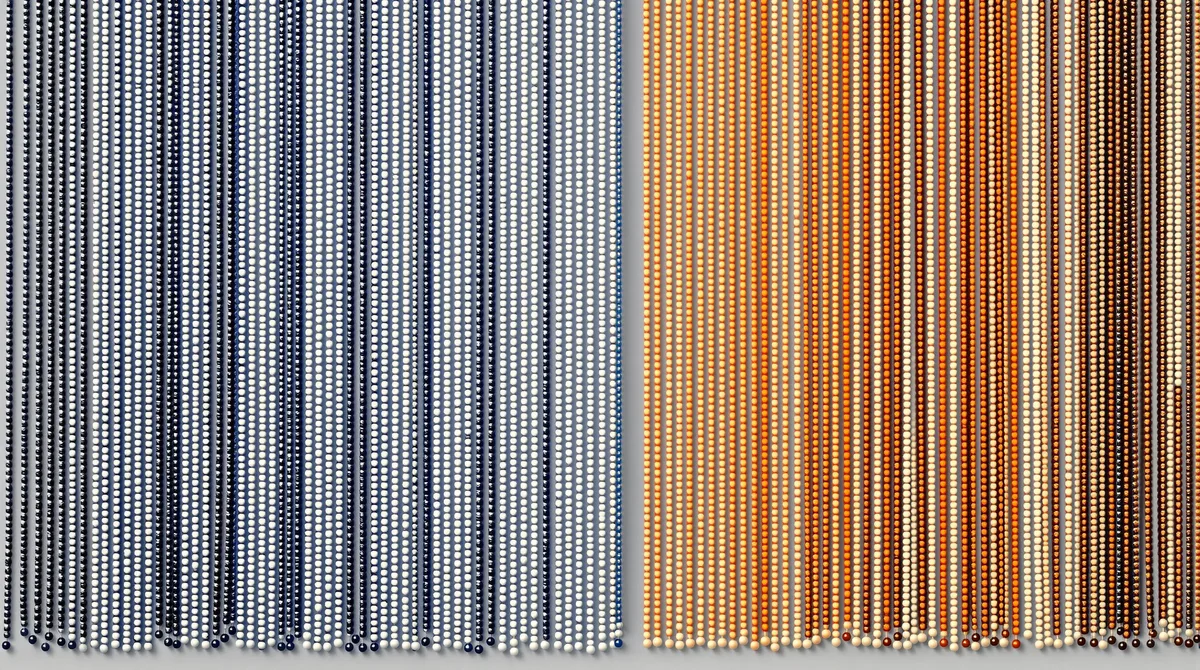
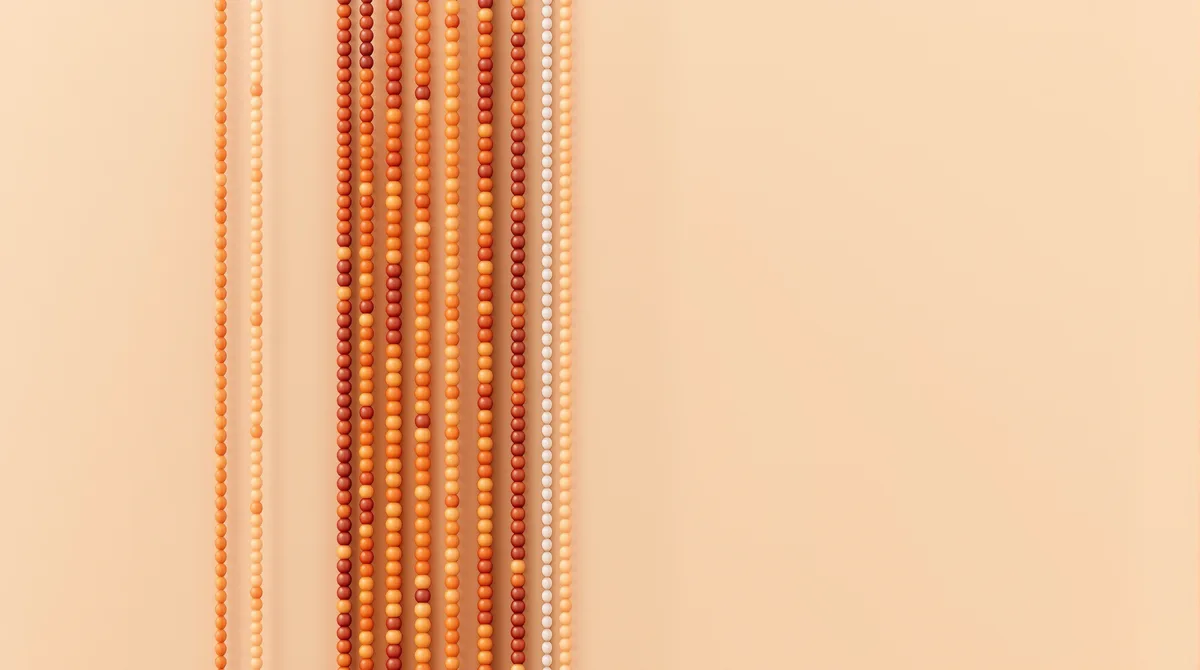
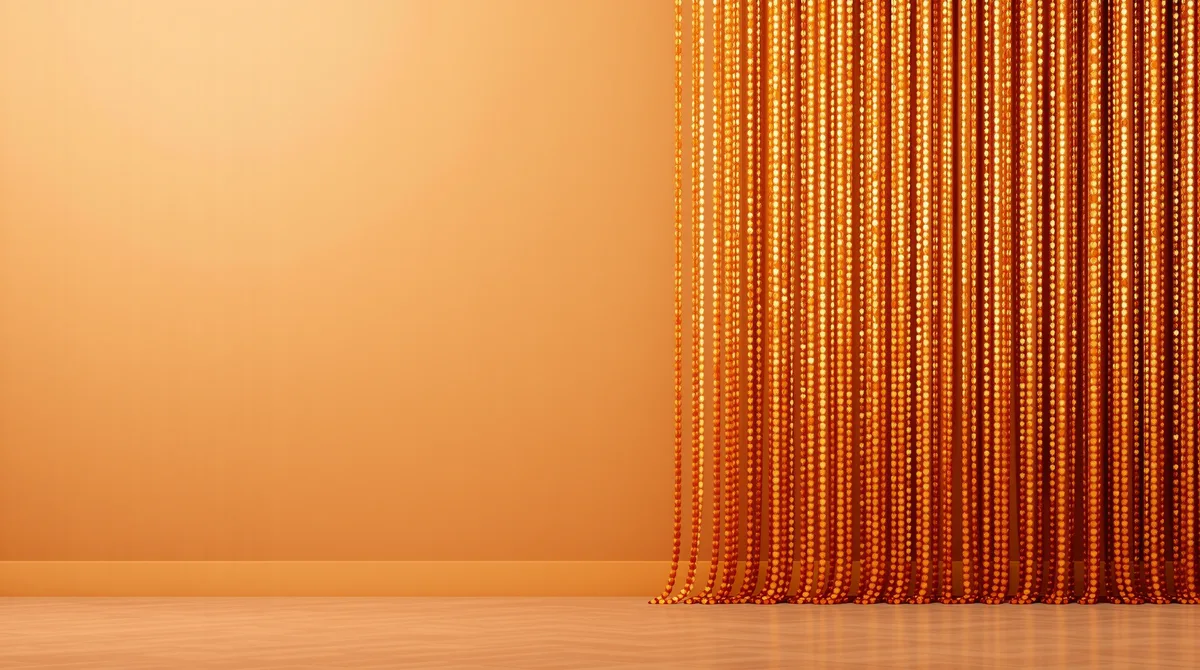
Ombre graded by size
Cornsilk to deep amber down the drop, with the colour change landing on a change of bead size rather than on a dyed gradient.
How it is madeDesign library
A colour story here is not a mood board. It is a construction: which beads, in which sizes, in which order down the drop.
The design library documents colour stories by their construction rather than by their palette: which beads, in which sizes, in which order down the drop. Each story names the mechanism that produces its effect — size grading, a scattered accent on a matched ground, or a single frosted material — so it can be specified rather than approximated.
Formats and colour stories
Five format indexes, then the named colour stories. Each story names the mechanism rather than just the palette.
Design
The full-length doorway designs, 90 × 200 to 120 × 210 cm, documented by strand count, hem shape and bead count.
Design
Portals at 76 × 140 cm and hanging divisions at 90 × 180 and 120 × 180 cm, documented by strand count and opening shape.
Design
Valances at 120 × 30 to 40 cm and café curtains at 76 × 76 cm, documented by hem shape, strand count and bead count.
Design
Strung wall pieces from 50 × 90 to 60 × 100 cm at 20 to 40 strands, documented by hem shape and bead list.
Design
Linked faux-capiz disc hangings at 70 × 130 to 90 × 200 cm, and beaded shade designs from a 15 cm sconce to a 50 cm pendant.
Colour story
Cornsilk to deep amber down the drop, with the colour change landing on a change of bead size rather than on a dyed gradient.
Colour story
Cobalt and ink glass spaced across 40 strands at about 3,100 beads, where the gaps are as designed as the beads.
Colour story
Cool, low-contrast tones in foil-lined and frosted glass, built as a strung hanging and as a linked disc piece.
Colour story
Wood, bone and amber glass mixed on one strand — warmth at a lower weight and cost than an all-glass build.
Colour story
Glossy orange, canary glass, chocolate brown and cream soda, built as a door curtain, a sunburst valance and a wall hanging.
Colour story
Scattered pastel accents across 60 strands at 120 × 180 cm, placed from a bead map rather than by chance.
Colour story
A graphic check across the strands, which holds only when the pattern is mapped to the bead grid rather than sketched.
Colour story
A pale, reflective palette drawn at 120 × 210 cm, where silver and clear glass read as light rather than as colour.
Colour story
Jet and garnet glass with gold rounds across 33 strands — the point where an all-glass wall piece reaches its sensible weight.
Colour story
Wood rondelles with honey glass and dotted drops on 30 strands — warmth carried by the wood rather than the glass.
Colour story
Cream, lagoon and jade glass ovals on 27 strands, where the optical read comes from bead geometry rather than colour.
Colour story
Five-petal faux capiz blossoms cut to shape, each held by a spacer bead dyed to match, in a sampled and approved build.
Colour story
Olive and sage glass in a grove palette, built as a valance first because green needs restraint at scale.
Colour story
Espresso and cocoa, crema, dusty cornflower and pistachio, with one glossy cherry-red note doing the work of five.
Colour story
Sun-baked blush, soft sage, butter yellow and milky glaze, built as a linked disc hanging because the palette is matte.
A named mechanism plus a palette. The honey ombre colour story is a size grade: the colour change lands on a change of bead size rather than on a dyed gradient. A dotted story is a scattered accent over a ground dyed to match it. A sea-glass story is a single frosted material filling the whole strand, which is the simplest of the three to specify and the hardest to make interesting. Our written guides cover the bead choices behind each.
Pick the mechanism, then the materials, then the sizes. Glass seed beads carry grading and matched grounds. Pressed glass beads carry repeatable accents at volume, and the two are usually combined.
A palette can be copied from an image. A mechanism has to be built, and which bead materials are in play decides whether the mechanism is even available. A ground dyed to match an accent needs a dyeable bead; a size grade needs three bead lines in stock. If a brief asks for "an amber ombre" without naming whether the grade comes from size or from dye, the two routes give different objects, different costs and very different repeat behaviour in production.
Hand-strung strands covers how the chosen story is actually assembled, strand by strand. Bead sizes and stringing specifications is the sheet the finished brief gets written onto, and it is the document a designer should have open before drawing anything.
Both, and every page says which. Designs such as Chiara, Naia, Gigi, Mushroom, the Dot portal, the Daisy café curtain and the Cherry Blossom wall hanging have been sampled, approved and shipped, so their figures come from production documents. The named colour stories and most of the valance, wall-hanging, disc and shade designs are drawn, and available to develop.
A figure drawn for the 2027 library is an accurate count of what the design contains. It is confirmed on the sample, because a bench sorting a real bead line can part company with the drawing. A drawn design is treated as available to develop rather than as a product on a shelf.
The format indexes, because the first real question is almost always about size and density rather than colour. Doorway curtain designs covers the full-length formats from 90 × 200 to 120 × 210 cm. Valance and café curtain designs covers everything short, where the hem shape is the design. Wall hanging designs covers the pieces read from one side at close range, and disc hanging and shade designs covers the two builds that are not strung at all.
The remaining drawn designs, as construction detail is written for each. A name and a palette are not enough: a page lands when it can give a specifier a size, a strand count or column count, a bead list and a hem shape.
Good to know
Yes, and that is most of the work. Bring a reference, a palette or a physical chip; we draw a bead map, agree the bead sizes and the colour method, and sample. Sampling usually runs 16 to 20 days from an agreed brief and is quoted separately.
Exclusivity is a commercial decision taken per programme, not a property of the library. Ask for it in the brief and it is quoted alongside the piece.
Because the construction is the part that can be specified and repeated. Two panels with the same palette and different constructions do not look alike — the mechanism, not the colour list, is what produces the effect.
Mostly, with one caveat: a mechanism that depends on the drop will not transfer to a short format. A size-graded ombre needs height to read, so it works on a door panel and a wall hanging but compresses into stripes on a café curtain or a valance.
Yes. The published stories are expressions of a mechanism, not a fixed palette. Bring a colour chip, name the mechanism you want, and it is sampled in your colours. Sampling usually runs 16 to 20 days from an agreed brief and is quoted separately.
No, and they are captioned that way. Editorial frames are styled to show light behaviour and construction principle; the piece a buyer receives is the approved sample. Where a page needs a true record shot and we do not have one yet, the slot is marked as pending rather than filled with something approximate.
Keep exploring
Colour story
Cornsilk to deep amber down the drop, with the colour change landing on a change of bead size rather than on a dyed gradient.
How it is madeDesign
The full-length doorway designs, 90 × 200 to 120 × 210 cm, documented by strand count, hem shape and bead count.
Read the guideDesign
Strung wall pieces from 50 × 90 to 60 × 100 cm at 20 to 40 strands, documented by hem shape and bead list.
Compare the optionsMaterial
How seed beads are drawn, why dye lots are quoted per run, what the drill hole limits, and where seed-bead work earns its cost.
See the detailTechnique
The bead map, the cord, thirty strands on a dowel, hem shapes, suspension loops — and the three levers that move the cost.
Read more
Start a conversation
Send a reference, a colour chip or a sketch. Minimums are set per design and confirmed per quote; sampling is quoted separately and usually runs 16 to 20 days from an agreed brief.