Technique
How a panel is strung
The bead map, the cord, thirty strands on a dowel, hem shapes, suspension loops — and the three levers that move the cost.
Read the guideSpecification sheet
The sheet to copy into a tech pack. Diameter describes how a bead looks; the drill hole decides whether the piece can be built at all.
A quotable bead specification names seven values: bead material, outside diameter, drill hole, cord, strand count, strand spacing, and finished width and drop. The drill hole is the one most often omitted and the one that stops production: cord is always selected from the smallest hole in the build, not from the look of the panel.

Bead material. Outside diameter. Drill hole. Cord. Strand count. Strand spacing. Finished width and drop. With all seven, a panel can be costed and sampled. With six, someone in the studio is making a decision on your behalf.
The material itself is chosen first, material by material, and the construction second, from the technique families. This sheet covers what has to be written down once both are settled.
The outside diameter is a design value: it tells you how the bead looks and how many fit in a given drop. The drill hole is a structural value: it tells you what can physically pass through the bead.
Cord is always chosen from the smallest hole in the build. On almost every panel that means the glass seed beads on the base strand, not the large pressed glass accent the design is about. On flat work the equivalent constraint is the thread, which is why a coaster programme is specified by ground and stitch rather than by cord. A cord specified for the hand of the finished panel will frequently not pass the beads it has to carry, and that is where samples stall.
| Bead | Working dimension | Role in a build |
|---|---|---|
| Glass seed bead | About 1–3 mm outside diameter | Base strand and embroidered grounds |
| Glass bugle bead | Short tube, used with seed beads | Directional texture in embroidery |
| Frosted sea-glass bead | Irregular, about 4–5 mm | Whole-strand field with a soft surface |
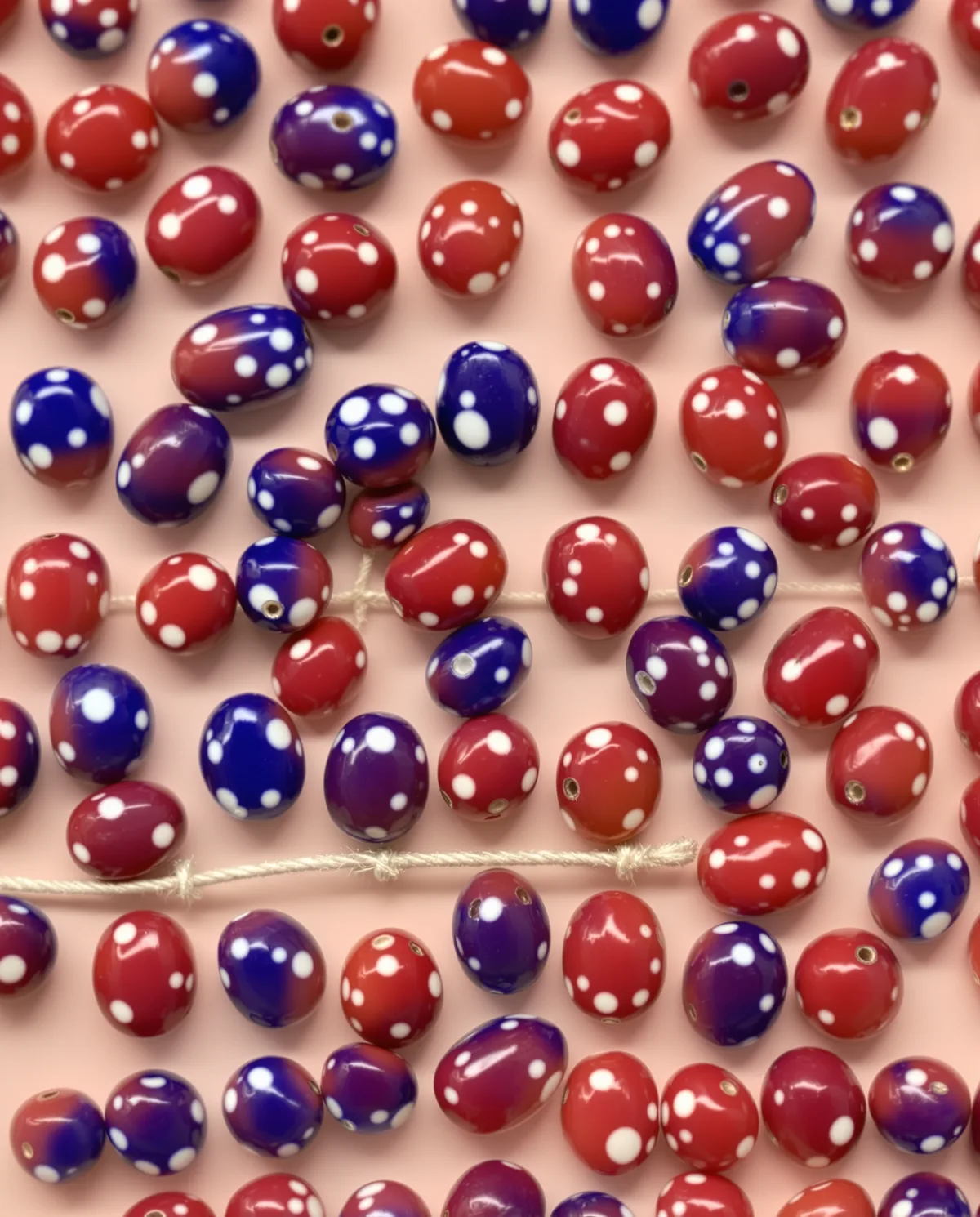
| Dotted oval pressed glass | About 13 × 22 mm | Scattered accent, 3–4 per strand |
| Glass mushroom bead | Figurative accent | About 120 per panel, scattered, never aligned |
| Moulded almond bead | About 3 in long | Connector bead forming a 6 in motif |
| Faceted iridescent teardrop | Drop form | Light-catching accent on a clean base |
| Faux-capiz blossom | 5-petal, laser-cut from sheet | 130–170 blossoms per wall hanging by mount type |
| Buyer-specified drill hole | 4–5 mm commonly requested | For beads supplied loose for a customer's own assembly |
For beads supplied loose, for a customer's own assembly, a four to five millimetre hole is the range most often requested and the one we have supplied against. Treat it as something to agree rather than a standard — the right hole depends on the cord or wire the assembler intends to use, and nobody but the assembler knows that. Where a base bead is dyed to match an accent, both holes are stated separately.
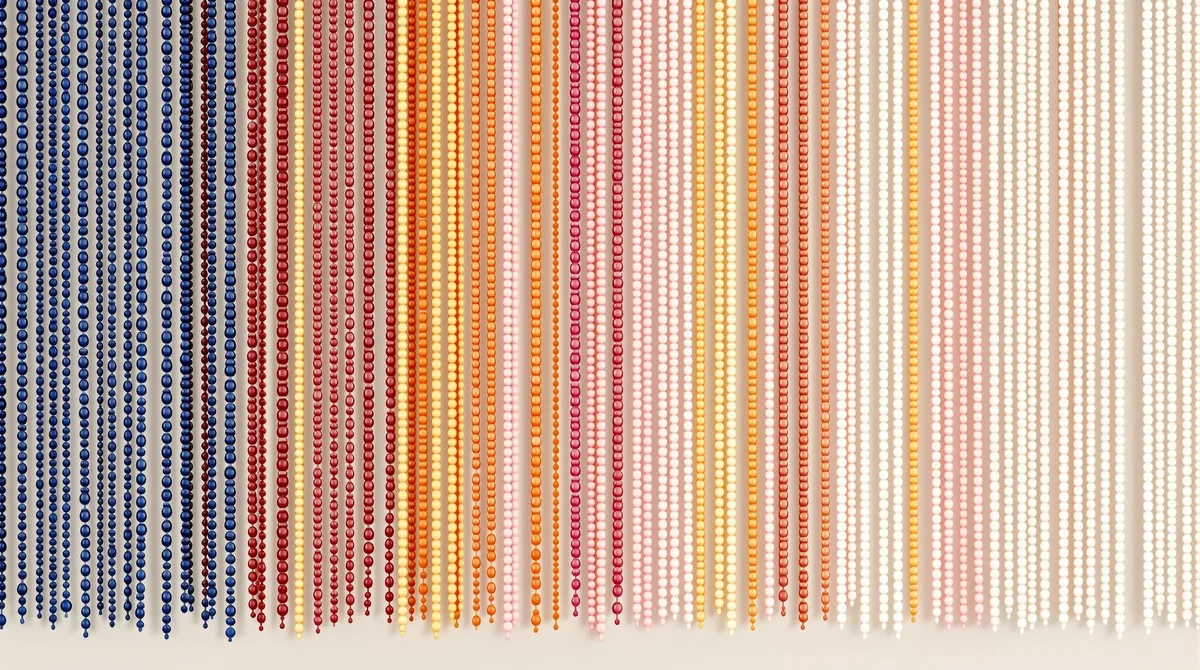
Strand count and spacing do more than width to determine how a panel reads. Thirty strands on a single dowel is the common build at around 90 by 200 cm. Tight spacing gives density, privacy and weight; open spacing gives transparency and a much lighter freight weight. Where the panel is a graded one, as in the honey ombre colour story, spacing also controls how sharply the three bead sizes read as steps. Hand-strung strands sets out how spacing is set at the header.
Door panel, about 90 by 200 cm (35 by 79 in). Wall hanging and portal, 90 by 67 cm and 76 by 140 cm. Café curtain, around 60 by 76 cm on a cotton header with a three-inch rod pocket. Valance, around 76 by 61 cm, scalloped arch hem, fullest at the sides.
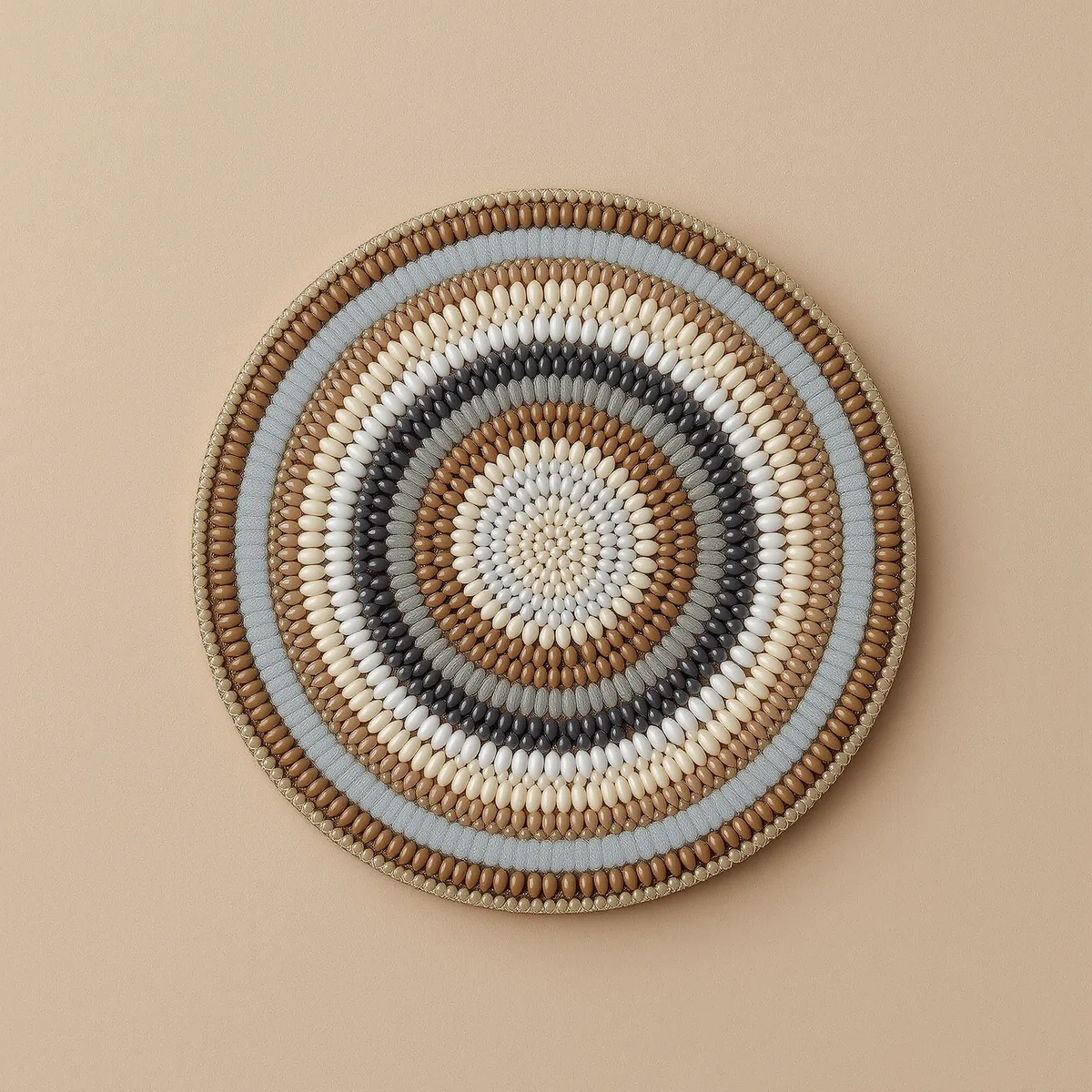
Flat work is dimensioned differently: table beadwork is specified by finished diameter and ground, not by drop and strand count.
A densely patterned 90 by 200 cm curtain can hold about 11,800 beads, placed one at a time. Change the pattern from fully covered strands to scattered accents and the count collapses. That is the entire reason minimums are set per design and confirmed per quote: the material and labour content of two panels of identical dimensions can differ by a factor of several.
A price, a minimum order quantity, a weight per panel or a fire rating. None of those is a published figure for this category. Minimums are confirmed per quote; weight depends on the bead and the spacing; flammability has to be tested per build. Where you need any of them, ask for them against a specific specification and they come back as a quote rather than as a number on a web page. Routine care is not a specification either, but care and cleaning sets out what a buyer should be told at handover. Terms such as dyed to match have their own glossary pages so a tech pack can cite them directly.
Good to know
The drill hole. A brief will name the bead, the colour and the finished size and say nothing about the hole — and the hole is what decides which cord can carry the build. Without it the sample is a guess and the first question back is always the same.
Four to five millimetres is the range customers assembling their own pieces most often specify, and it is the one we have supplied against. It is a specification to agree rather than a standard: it depends entirely on the cord or wire you intend to use.
Thirty hand-strung strands is the common build for a panel around 90 by 200 cm. Fewer strands with wider spacing gives a lighter, more transparent panel; more strands gives density, privacy and weight. Decide it from how the panel should read, then let the width follow.
The door panel is about 90 by 200 cm, or 35 by 79 inches. Wall-hanging and portal formats run 90 by 67 cm and 76 by 140 cm. Café curtains sit around 60 by 76 cm on a cotton header with a three-inch rod pocket, and valances around 76 by 61 cm with a scalloped arch hem.
A densely patterned 90 by 200 cm curtain can hold about 11,800 beads. A plain-strand panel at the same size holds a fraction of that. This is exactly why minimums are set per design and confirmed per quote rather than published as one number.
No. Flammability has to be tested against the actual build — bead material, cord, header and mount — and the testing is quoted separately. Any rating offered without naming the test and the build should be treated as unverified.
Keep exploring
Technique
The bead map, the cord, thirty strands on a dowel, hem shapes, suspension loops — and the three levers that move the cost.
Read the guideMaterial
How seed beads are drawn, why dye lots are quoted per run, what the drill hole limits, and where seed-bead work earns its cost.
Read the guideGuide
Resolution, weight, repeatability, cost per covered area and breakage risk, with the working figures from production.
See the detailGlossary
Dyeing one bead to another bead's colour rather than to a swatch — why it is used, and what it does not promise.
Read moreManufacturing
Bead-embroidered glass coasters on stiffened felt, or moulded acrylic sets in translucent and opaque — construction, sizes and what moves the cost.
Compare the options
Start a conversation
Send a reference, a colour chip or a sketch. Minimums are set per design and confirmed per quote; sampling is quoted separately and usually runs 16 to 20 days from an agreed brief.