Pillar
The order process
Brief, rough cost sheet, colour match, sample, production, packing — the six stages with the real published timings.
View the range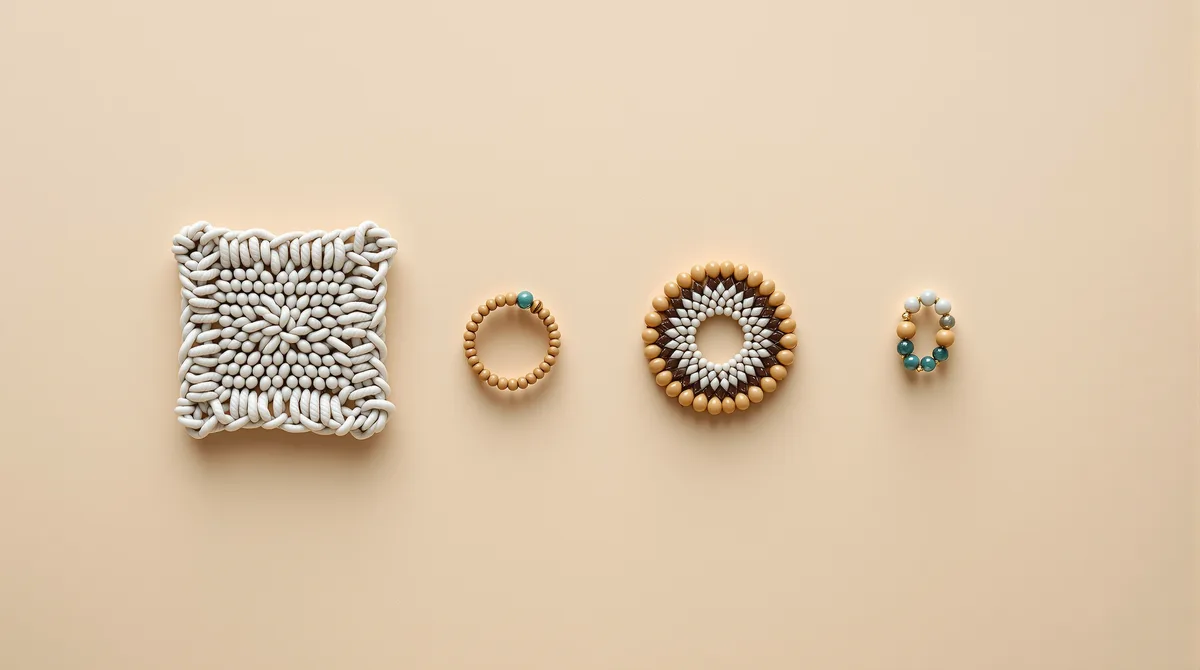
Manufacturing · Made to order
Every piece of beaded décor we ship is built to a specific design in plants we own — drawn, turned, moulded, strung and finished to order. This is the route from a sketch to a packed carton, and where the decisions actually get made.
Four small beadwork samples laid out in a row: a knotted macramé square, two wire-wrapped beaded collars and a disc of couched bead embroidery.
Every piece of beaded décor we ship is built to a specific design in plants we own. The route is a brief, a rough cost sheet before any sample, colour matched to a reference or a physical chip, a sample in 16 to 20 days with photographs for approval, then production in 40 to 60 days after approval, packed to your specification.
That the piece is manufactured for you, from beads we make ourselves, against a sample you approve. Every beaded door curtain we ship is drawn, turned or moulded, strung and finished to your specification in plants we own.
The trade is real in both directions: nothing is available next week, and in exchange a non-standard size, a bead nobody stocks or a colour that exists only as a chip in your hand are all routine rather than exceptional. The specification is the product.
What follows is the route from a brief to a packed carton, with the published timing at each stage.
The formats that exist as real construction: door curtains, portals, café curtains, valances, window panels and strung wall hangings in the hanging category; coasters, placemats, runners, napkin rings and chargers on the table side; and bead-embroidered, wire-wrapped and framed objects in the smaller work.
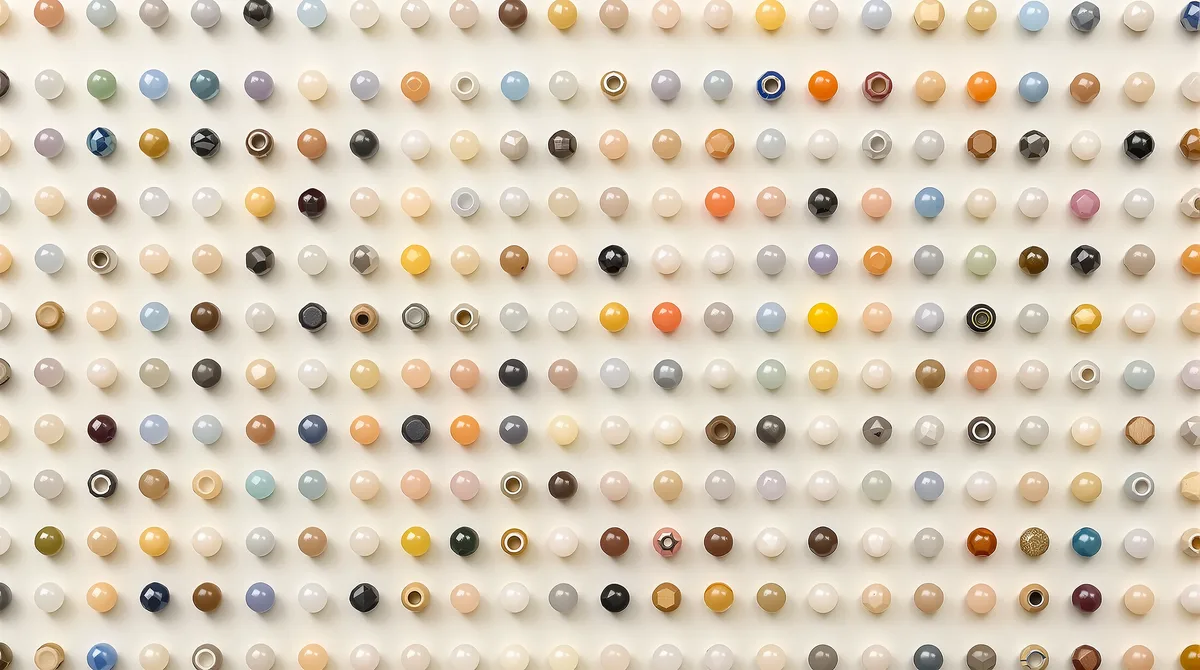
The working bead library spans glass, acrylic, wood, bone, horn, ceramic, shell, capiz and metal, and it is deep enough that a brand can be given a bead nobody else is using. The practical shortlist for any one design is usually a dozen, once hole diameter, weight and colour latitude have been applied.
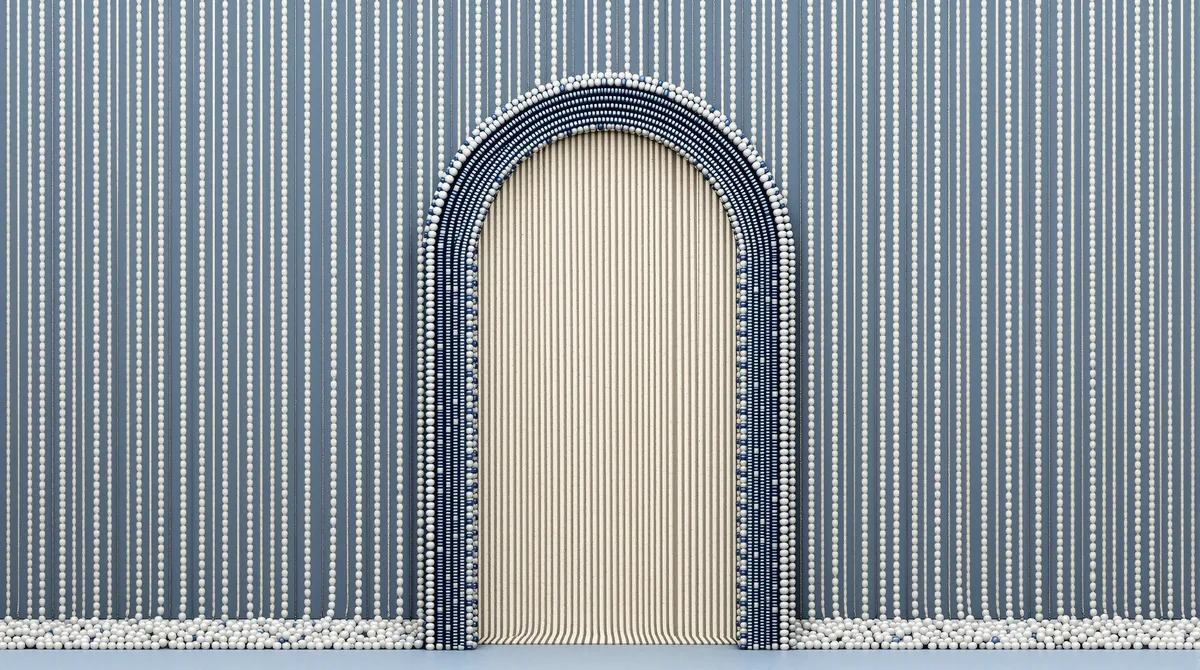
Beaded room dividers are available to develop. The library carries drawn designs for them, and a division is built to the opening it has to fill rather than cut down from a shelf size.
Ten lines, and the brief is costable once they are all present.
Product type. Finished size — width and the longest drop, plus the shortest drop if the edge is shaped. Strand count or pitch, or a reference photo showing the density. Beads: material, shape, size and drill hole for the main bead and each accent. Colours, as references or physical chips, one per bead. Pattern, as artwork or a reference image. Top fixing and its length. Edge shape and any end beads. Packing: inner packing, carton size and labels. Quantity per colourway and the destination port or warehouse.
Omit the drill hole and the piece cannot be assembled. Omit the strand count and it cannot be costed.
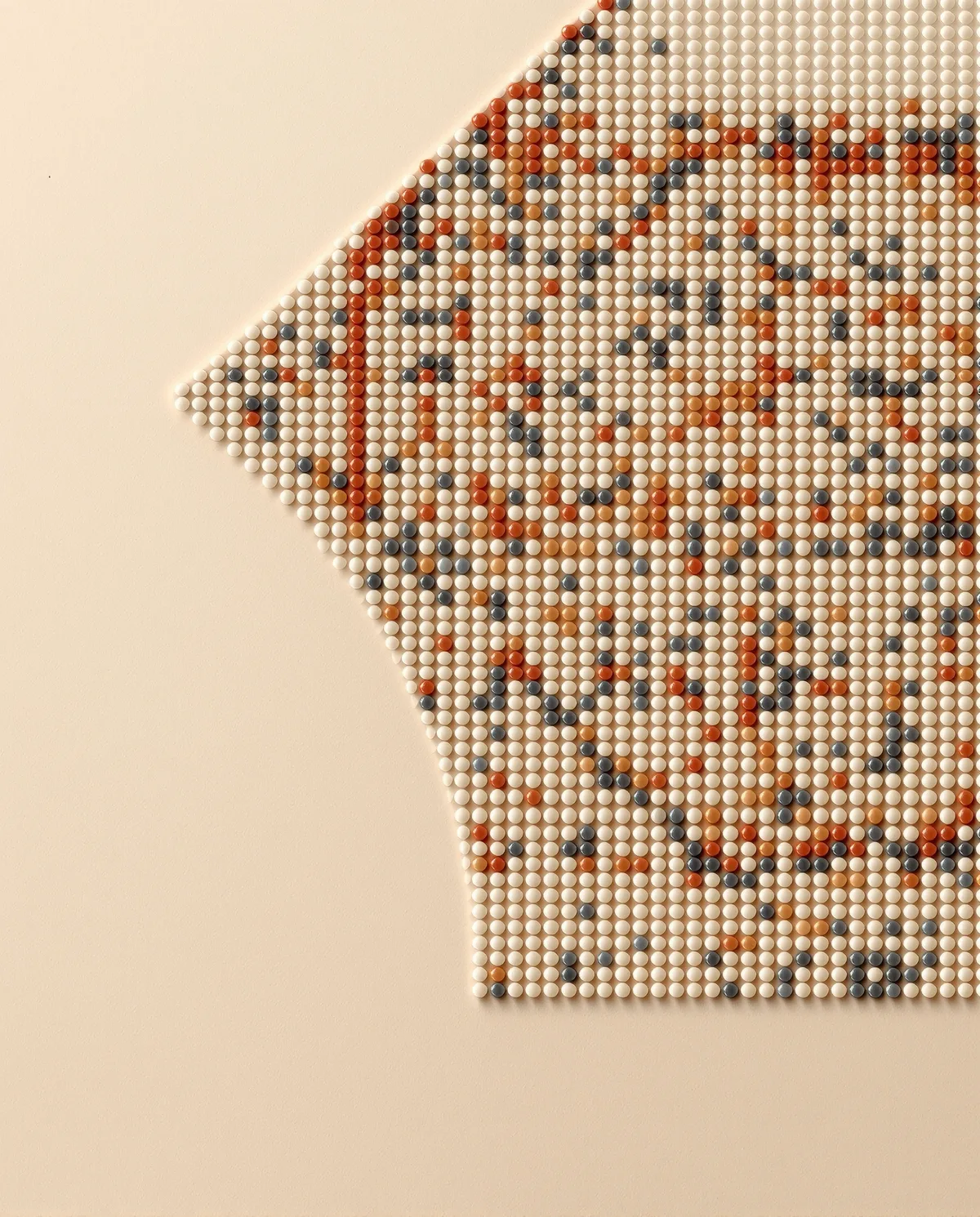
A pre-sample costing that shows where the cost sits and which lever moves the price, delivered before any sample is made.
It exists because beadwork's cost is bead count and stringing hours, and those are decided by the design rather than by the dimensions. A densely patterned 90 × 200 cm curtain can hold about 11,800 beads, each placed by hand; an open-pattern panel of the same size holds a fraction of that. Finding out which one you have specified after approving a sample is the expensive way round.
The levers, in order: bead size and material, construction, strand spacing, the dowel and packing, then height.
Against a colour reference or a physical chip, and confirmed on the sample rather than on a screen.
Acrylic beads are moulded and dyed to the reference, which is why acrylic carries the widest colour range in the category. Glass is matched from the library or run as a new colour — and glass has one real constraint worth knowing: strength is colour-dependent, so some colours are weaker where large beads knock together in a hanging panel. On a Venetian-bead portal we solved exactly that by changing the furnace process, annealing the beads and revising the palette.
Two mechanisms do most of the work on any design: dyed to match, where the base bead is dyed to the accent so the accent carries the design, and grading by bead size, where colour changes on a change of scale.
To the published window, and the sequence matters more than the number: a brief is agreed, a rough cost sheet is issued, and only then is a sample made — so the piece that gets sampled is already one that can be afforded.
A prototype has to be approved before a full production run begins. That approved sample then becomes the standard: production is held to the sample, not to the reference or the rendering.
Development can take more than one loop, and often does. A 2025 portal development ran through six or seven iterations before it hit its target cost, and the change that got it there was using two bead sizes in one strand.
Each strand is strung by hand to the colour-count sheet — the bead-by-bead plan that fixes every position, which is what makes a pattern repeat exactly across a run and keeps strand lengths identical. Strands are then fixed to the dowel, the rail or into a sewn rod pocket, and the hem is cut to shape by strand length.
Published timing: 40 to 60 days after sample approval for beaded décor. Bohemian and macramé work runs 60 to 90 days.
On average 16 artisans contribute to a finished Gemixx product, each applying a specific craft discipline, and product issue rates across the network run at a fraction of a percent.
Inspection and export packing run through our own quality-control and packaging house at Greater Noida: first-article and lot AQL inspection, assembly and kitting, export packing and labelling, and consignment consolidation.
Packing is specified rather than assumed. We pack to your carton, label and packaging specification and ship to the port or warehouse you name. On strung work the inner packing is part of the design — strands have to arrive in order and unknocked, and a panel that reaches a shelf tangled is a returns problem before it is a quality one.
Landed duty paid is available: we handle manufacturing, export, freight, duties and US warehousing and quote a single delivered price at your chosen US location, with no separate freight agents or customs brokers in between.
Glass beads are drawn and hand-strung in our own Firozabad glass works. Wood, including curtain dowels, is turned in our own Saharanpur factory. Ceramic is glazed and fired in our own Khurja plant. Metal is finished and plated in our own Moradabad plants. Bone, horn, shell and capiz are cut, drilled and finished to specification in our own beadwork studios. Acrylic and resin beads are moulded and dyed to our colour, to our own dies where a design needs a custom bead.
Bamboo is confirmed per design rather than held as an owned capability. We own the network; we are not a sourcing office.
Price, minimums, the test package and the fire classification. Each of those attaches to a named build and a named programme, so they come back together with the specification. Our standing audits are Sedex SMETA, FSC for wood, C-TPAT and Omega social compliance, and fire performance is tested on the specified build — bead, cord, header and mount together — at an accredited laboratory.
Lead-content testing to California Proposition 65 runs as standard on the beaded curtain programme. Anything further is scoped against the specified build and quoted with it.
Private label beadwork covers manufacturing under your own brand, component beadwork covers supply into somebody else's product, design exclusivity covers what can be held for one brand, and repeat bead orders covers what keeps a design identical across seasons. For the craft behind all four, bead curtain formats and bead materials are the places to start.
Pages in this cluster
One page per commercial question. Each answers something the others do not.
Manufacturing
Your label, your packaging, your SKU structure, built in plants we own — and we never compete with our clients at retail.
Manufacturing
Strands, trims, panels and framed shapes built to another maker's drawing, inspected, kitted and delivered to their line.
Manufacturing
Library design, recolour or ground-up development: the three routes, and what exclusivity can realistically cover on each.
Manufacturing
The approved sample, the colour-count sheet, the dye-lot record and first-article inspection: what keeps a reorder identical.
Manufacturing
Matched to a Pantone reference or a physical chip, approved on the sample, never on screen — and what a dye lot can promise.
Manufacturing
Artwork to bead map, the resolution limit set by bead size, and why a scattered accent costs a fraction of a graphic.
Manufacturing
Draw the bead, cut the die, mould and dye it: what a custom bead shape costs, what it needs from a buyer, and when it pays.
Extractable data
| Stage | What happens | Published timing |
|---|---|---|
| Brief | Photograph, sketch or artwork with size, material, colours and quantity | — |
| Rough cost sheet | Where the cost sits and which lever moves it, before any sample | — |
| Colour match | Beads matched to a colour reference or a physical chip | — |
| Sample | Photographed for approval before it ships | 16–20 days from an agreed brief |
| Production | Strung by hand to the colour-count sheet | 40–60 days after sample approval |
| Inspection | First-article and lot AQL inspection, Greater Noida | Within production |
| Packing | To your carton, label and packaging specification | Within production |
| Shipping | To the port or warehouse you name; landed duty paid available | — |
| Minimums | Set per design, confirmed with your quote | Against the construction you specify |
Good to know
Made to order, every time. Each piece is produced in the colours, size and packing you approve, built from beads we draw, turn, mould or cut ourselves. The trade is honest in both directions: nothing ships tomorrow, and nothing is limited to what a catalogue happens to contain.
Yes. Beads are matched to a colour reference or a physical chip and the colour is confirmed on the sample rather than on a screen. Acrylic is moulded and dyed to the reference; glass is matched from the library or run as a new colour. Base beads are routinely dyed to match an accent.
Beaded décor runs 40 to 60 days after sample approval. Bohemian and macramé work runs 60 to 90 days. Sampling is a separate step, usually 16 to 20 days from an agreed brief, and is quoted separately from production.
No. We set minimums per design rather than across the range, because a plain-strand curtain and a fully patterned one use very different amounts of material and stringing time. They are confirmed per quote, and minimums are set per design and confirmed with your quote.
To your carton, label and packaging specification, shipped to the port or warehouse you name. On strung work the inner packing is part of the design: a panel has to arrive with its strands in order and unknocked, and that is specified rather than assumed.
Glass beads are drawn and hand-strung in our own Firozabad glass works. Wood, including curtain dowels, is turned in our own Saharanpur factory. Ceramic is glazed and fired in Khurja and metal finished and plated in Moradabad. Acrylic and resin beads are moulded and dyed to our colour, to our own dies where a design needs a custom bead. Inspection and export packing run through our own Greater Noida house. We own the plants — no agents, no brokers.
Keep exploring
Pillar
Brief, rough cost sheet, colour match, sample, production, packing — the six stages with the real published timings.
View the rangePillar
A live app holding the full bead library and the Gemixx 2027 collections: build a design, render it in about a minute, take it to tech pack and costing.
How it is madePillar
Door curtains, portals, café lengths and valances: the standard sizes, the strand counts and the one question each format answers.
Read the guideHub
The full beaded range — curtains, portals, valances, tabletop, cushions, textiles and beads — from a leading manufacturer that makes the bead as well as the piece.
Read the guideManufacturing
The face cloth, the couched bead field, de-densified infills and the closure — and what actually keeps beads attached on an object people lean on.
How it is madeManufacturing
Strands that frame an opening and leave a clear walk-through: arched and inverted-V drops, built to order on a turned dowel or a stained rail.
Read more
Start a conversation
Send a reference, a colour chip or a sketch. Minimums are set per design and confirmed per quote; sampling is quoted separately and usually runs 16 to 20 days from an agreed brief.