Design
The design library: colour stories, by construction
Colour stories documented by how they are built, not by how they look in a mood board.
Specs and sizes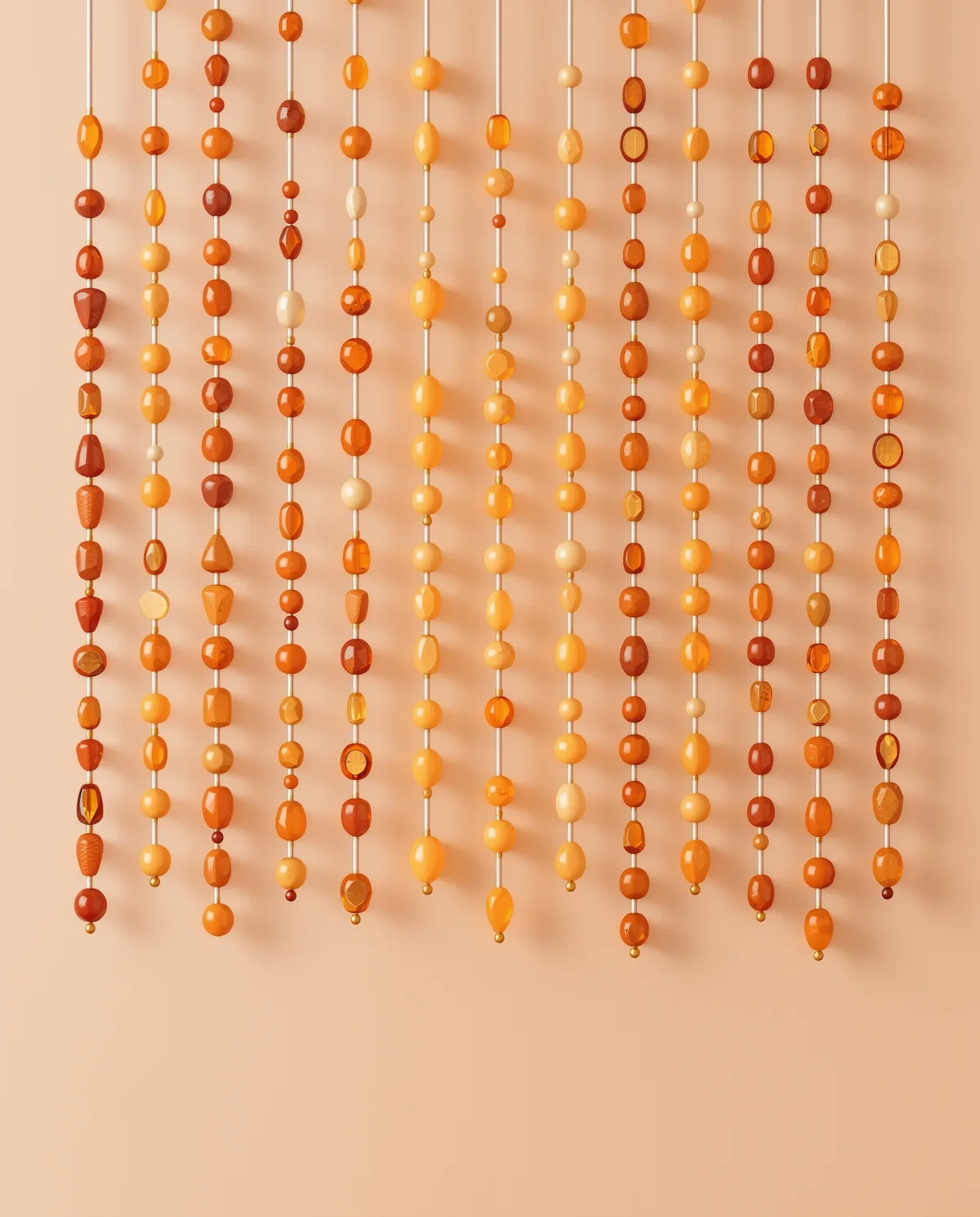
Colour story
Three materials on one cord, chosen because no single material gives warmth, weight and cost at the same time.
Six bead strands in the Ember and Honey palette, rust and burnt orange through amber to honey mustard, light passing through the translucent glass.
Ember and Honey is the warm mixed-material story: turned wood, cut bone and amber glass on the same cord. The mix is the design decision. Glass carries the colour and the weight, wood carries the warmth at roughly half the density, and bone supplies an off-white that neither of the others can reach. It is drawn as a wall piece at 60 × 100 cm and as a hanging division.
Ember and Honey is the warm mixed-material story of the 2027 design library. Amber, ember orange, honey, warm off-white and mid brown, carried on three different bead materials at once.
The mixing is the design, not a compromise. It is drawn as a strung wall hanging at 60 × 100 cm on 33 strands with an inverted-V hem, and as a hanging division at 90 × 180 and 120 × 180 cm.
Amber and honey glass for saturation. Turned wood rondelles for warmth. Cut bone for a warm off-white. All three on the same cord, in a written sequence.
Each is there for a property the others lack. Amber glass is the only one of the three that transmits light, so it is what makes the piece glow when it is backlit. Wood is the only one that is warm without being coloured — the warmth is the material. Bone gives an off-white with no finish applied to it, which no wood and no glass quite matches; it is cut, drilled and finished to specification in our own beadwork studios.
Three different mechanisms, which is the cost of three materials. The glass is held by its bead line, and a stock amber repeats closely batch to batch. The bone is held to a finish specification.
The wood is the interesting one, because it cannot be held to a point. Natural grain varies, so what is approved on the sample is a tone range, and production is held inside that range rather than to a single colour. Buyers who expect wood to behave like glass are disappointed; buyers who approve a range get what they approved.
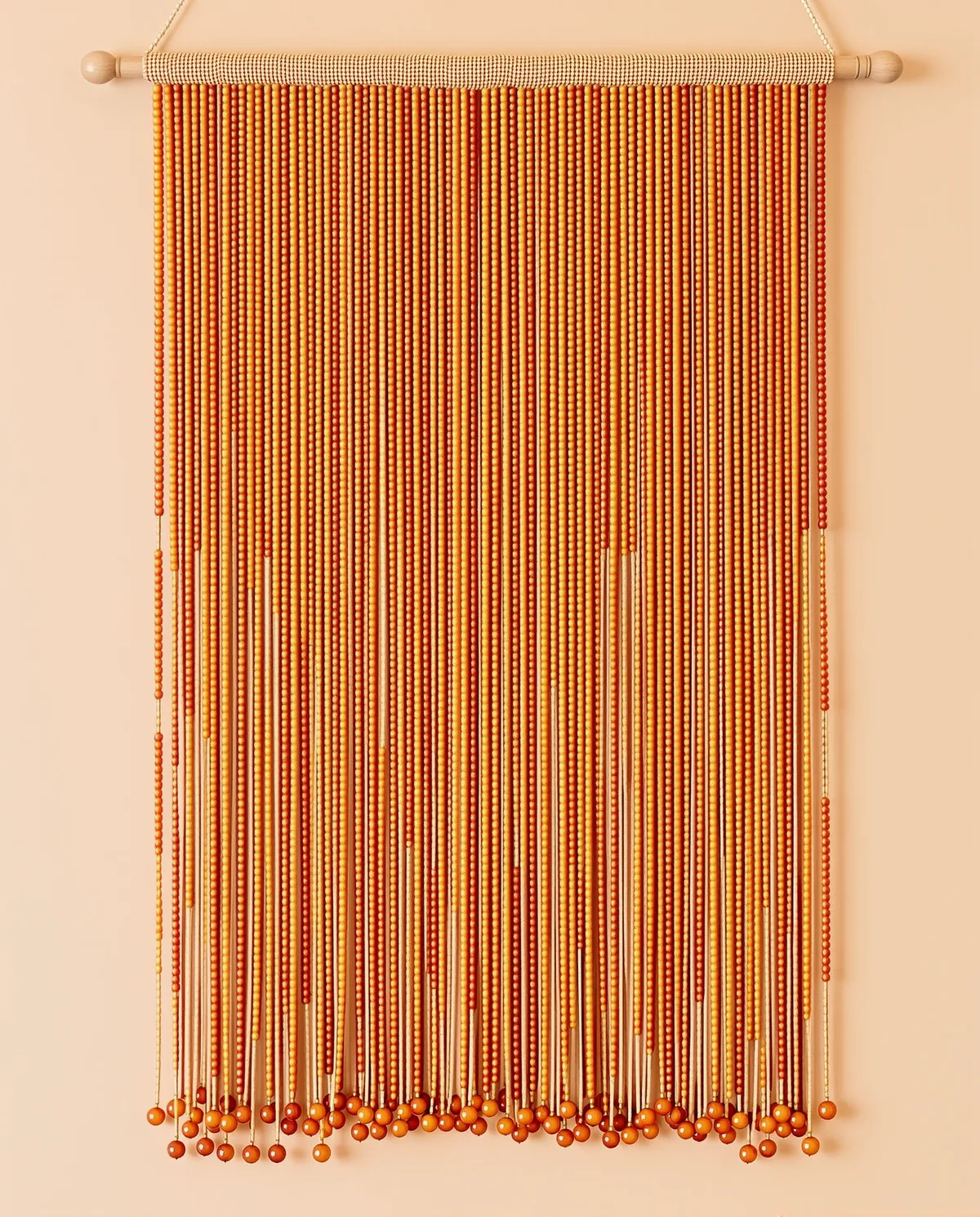
Amber glass gives saturation, wood gives warmth without weight, bone gives an off-white with no finish on it. Each is there for a property the others do not have.
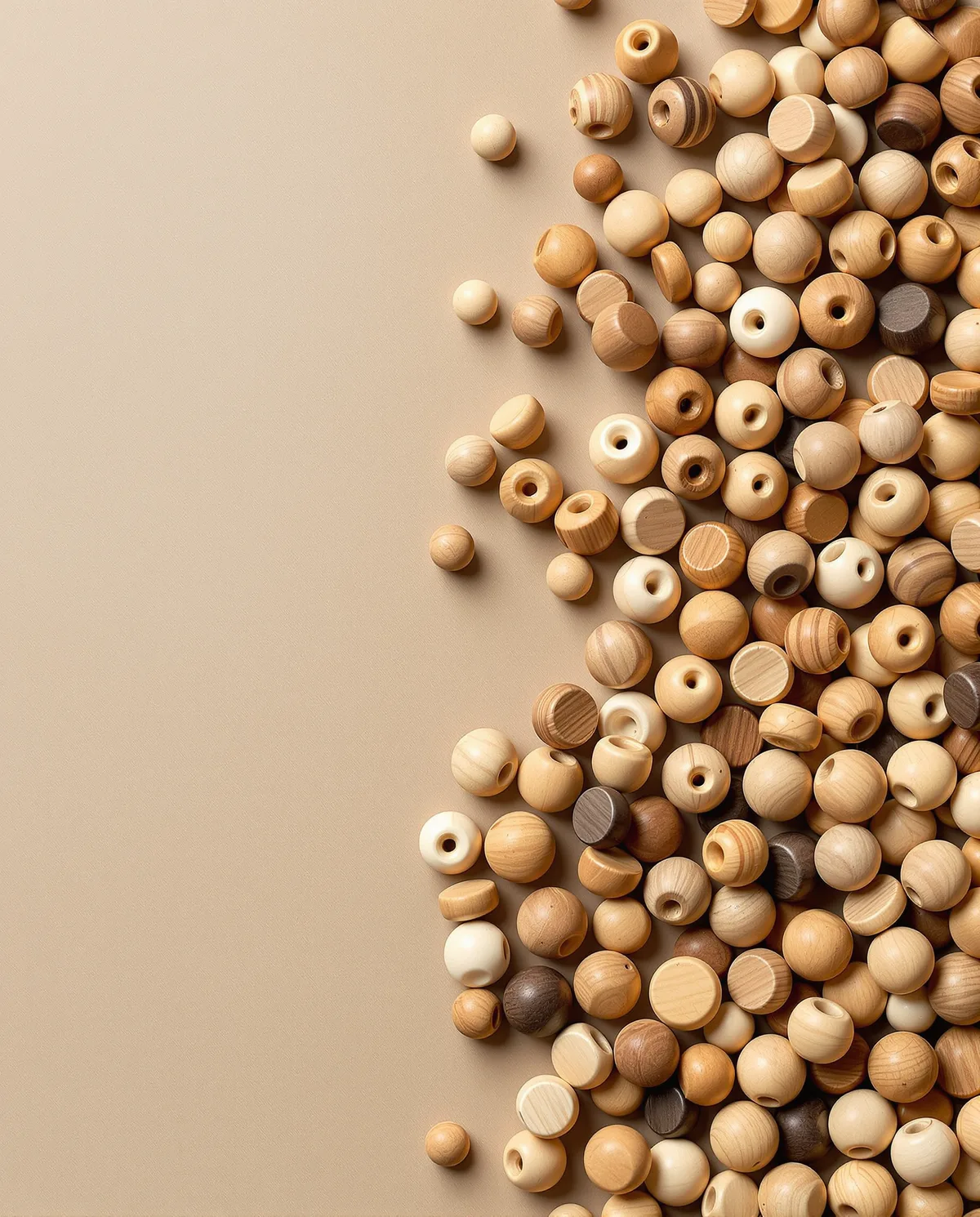
Wood grain varies by nature, so what is approved on the sample is a tone range rather than a colour. Production is then held inside that range.

A mixed strand is a sequence, not a scatter. Material order is written on the count sheet so every strand repeats and the three materials stay in proportion.
Usually less than an all-glass strand of the same size and density, which is the commercial reason the story exists. Mixed strands are a common way to add colour and interest while keeping the cost down, and wood and bone are both lighter and cheaper per bead than glass of equivalent size.
Weight falls with cost. As general physical properties rather than measurements of our own beads, glass runs around 2.5 g/cm³, acrylic around 1.2, and most woods below 1. Replace a third of the glass in a strand with wood and the hanging load drops noticeably, which matters on a wide division fixed into plaster.
The wall hanging at 60 × 100 cm, 33 strands, inverted-V hem. And the hanging division at 90 × 180 and 120 × 180 cm, up to 60 strands.
Both are drawn designs. The division is documented here as available to develop, with the development questions named rather than skipped: the edge condition, the hem weight, and how both faces read.
Backlit daylight separates the materials sharply: the amber glass lights up, the wood and bone go opaque and dark, and the piece reads as a pattern of lit and unlit beads. That is the most attractive version and it is what the renders show.
In lamplight from the room side the three materials converge. Glass, wood and bone all return warm reflected light and the palette reads as one continuous warm field. Less dramatic, more liveable, and the version a hallway actually gets.
As the one that looks hand-made, because it visibly is not uniform. Three materials and a varying wood grain mean no two pieces are identical, and on a shelf that reads as craft rather than as a tolerance problem.
It also sells against a warm interior without needing explanation, which the cooler stories do not. The caution is the inverse: it will not photograph as a statement piece, because nothing in it is high-contrast.
Almost all of them, which makes this the most materially flexible story in the library. Wood, bone, horn, ceramic and glass all sit in the palette naturally. Ceramic glazed and fired in our own Khurja plant gives a speckled or reactive amber that none of the others can reproduce.
Acrylic, moulded and dyed to the colour, is the route for a light or impact-resistant build. The only material that fights the palette is anything cold-toned or mirror-finished.
Glass is stock. Wood is specified per design and approved as a tone range. Bone is finished rather than dyed. Where a design calls for an exact amber that no stock line reaches, an acrylic bead moulded and dyed to the colour is the reliable route — and where a design needs a bead shape that does not exist at all, it is moulded to our own dies.
Wall pieces, divisions, and short formats. Anything read at close range, because the point of a three-material strand is that you can see the three materials.
The format it suits least is a very tall doorway. At 200 cm the materials average into one warm tone from across a room and the mix stops paying for itself.
The wood-to-glass ratio, before anything about colour. That single ratio moves weight, cost and how dramatic the backlit version is, all at once. More glass means heavier, more expensive and more luminous; more wood means lighter, cheaper and flatter.
Decide it against the installation rather than against the render. A division fixed to a ceiling track and a wall hanging on two screws have very different tolerance for weight.
Extractable data
| Specification | Value |
|---|---|
| Palette | Amber, ember orange, honey, warm off-white, mid brown |
| Beads that carry it | Turned wood rondelles, cut bone, amber and honey glass |
| Wall design | 60 × 100 cm, 33 strands, inverted-V hem |
| Division drawn | 90 × 180 cm and 120 × 180 cm, up to 60 strands |
| Where the wood is made | Turned in our own Saharanpur wood factory |
| Where the glass is made | Drawn and hand-strung in our own Firozabad glass works |
| Bone | Cut, drilled and finished to specification in our own beadwork studios |
| Colour method | Glass matched to a chip or reference; wood tone range approved on the sample |
| Production | 40 to 60 days after sample approval |
Good to know
Better than most. Warmth reads instantly at any size, and the material mix gives a small piece enough texture to stay interesting at close range. A valance in this palette needs only the hem reconsidered, because an inverted-V at 30 cm is too shallow to register.
Yes, and the material mix is more adaptable than the colours. Any warm palette will carry on the same three materials. Moving to a cool palette is where it breaks down — wood and bone are both warm by nature, and no finish makes them read cold without hiding them.
A strung wall hanging at 60 × 100 cm on 33 strands with an inverted-V hem, and a hanging division drawn at 90 × 180 and 120 × 180 cm. Both are drawn designs, and the division in particular is documented as available to develop.
The glass is stock amber and honey. The wood is specified per design and its tone range is approved on the sample rather than dyed to a reference, because a stain over natural grain varies with the grain. Bone is finished to specification rather than dyed.
Material by material. Glass is held by its bead line. Wood is held to the tone range approved on the sample, which is the mechanism — natural grain varies, so a range rather than a point is what can actually be held. Bone is held the same way.
Wood, bone, horn, ceramic and glass all sit comfortably in this palette, which is unusual — most stories are material-specific. Acrylic can be moulded and dyed to the same amber, and is the right call where a piece has to be light or impact-resistant.
Keep exploring
Design
Colour stories documented by how they are built, not by how they look in a mood board.
Specs and sizesIndex
Twenty-four named looks, each described by the material, palette, pitch and hem that actually produce it.
View the rangeColour story
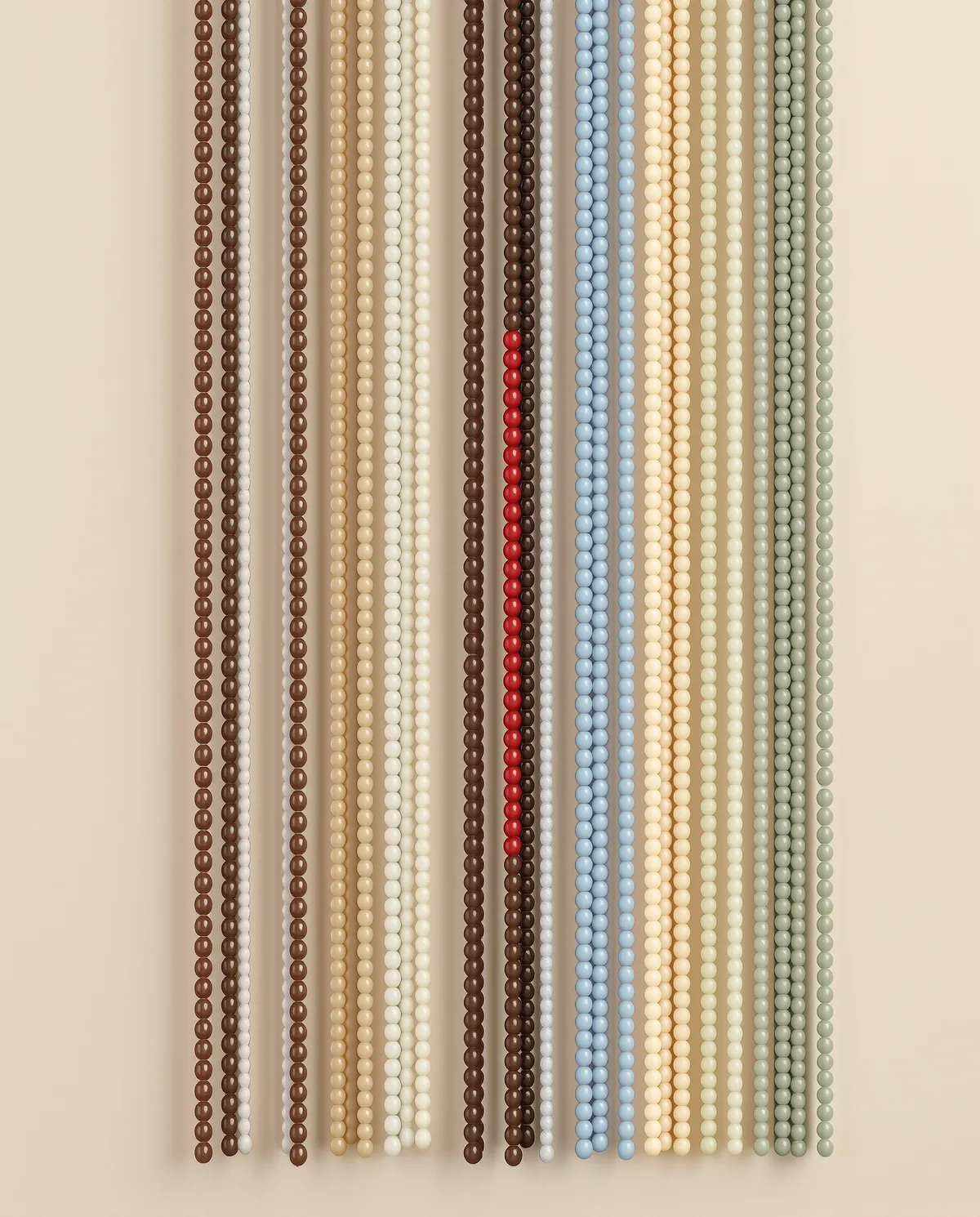
Espresso and cocoa, crema, dusty cornflower and pistachio, with one glossy cherry-red note doing the work of five.
See the detailColour story
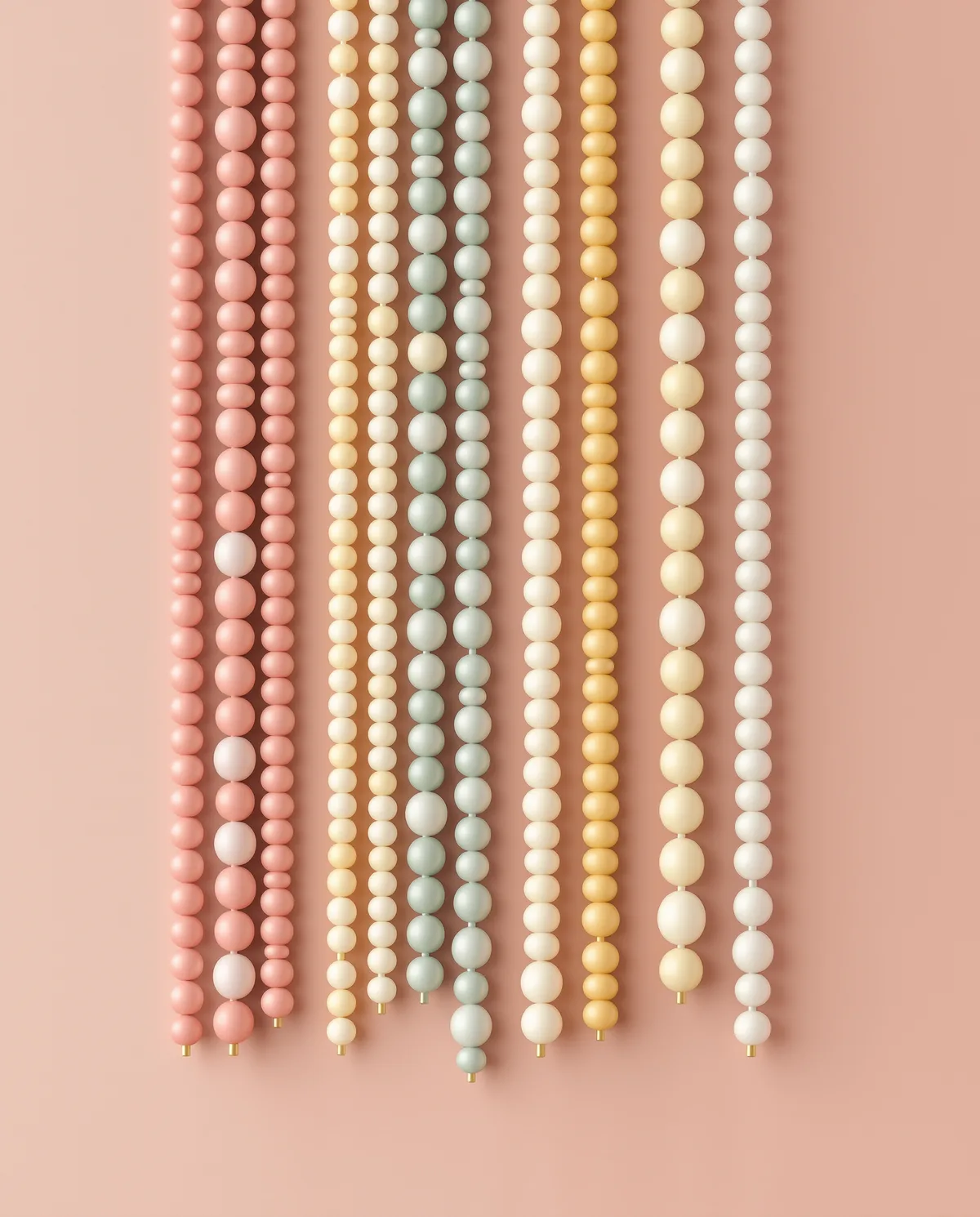
Sun-baked blush, soft sage, butter yellow and milky glaze, built as a linked disc hanging because the palette is matte.
Specs and sizesColour story
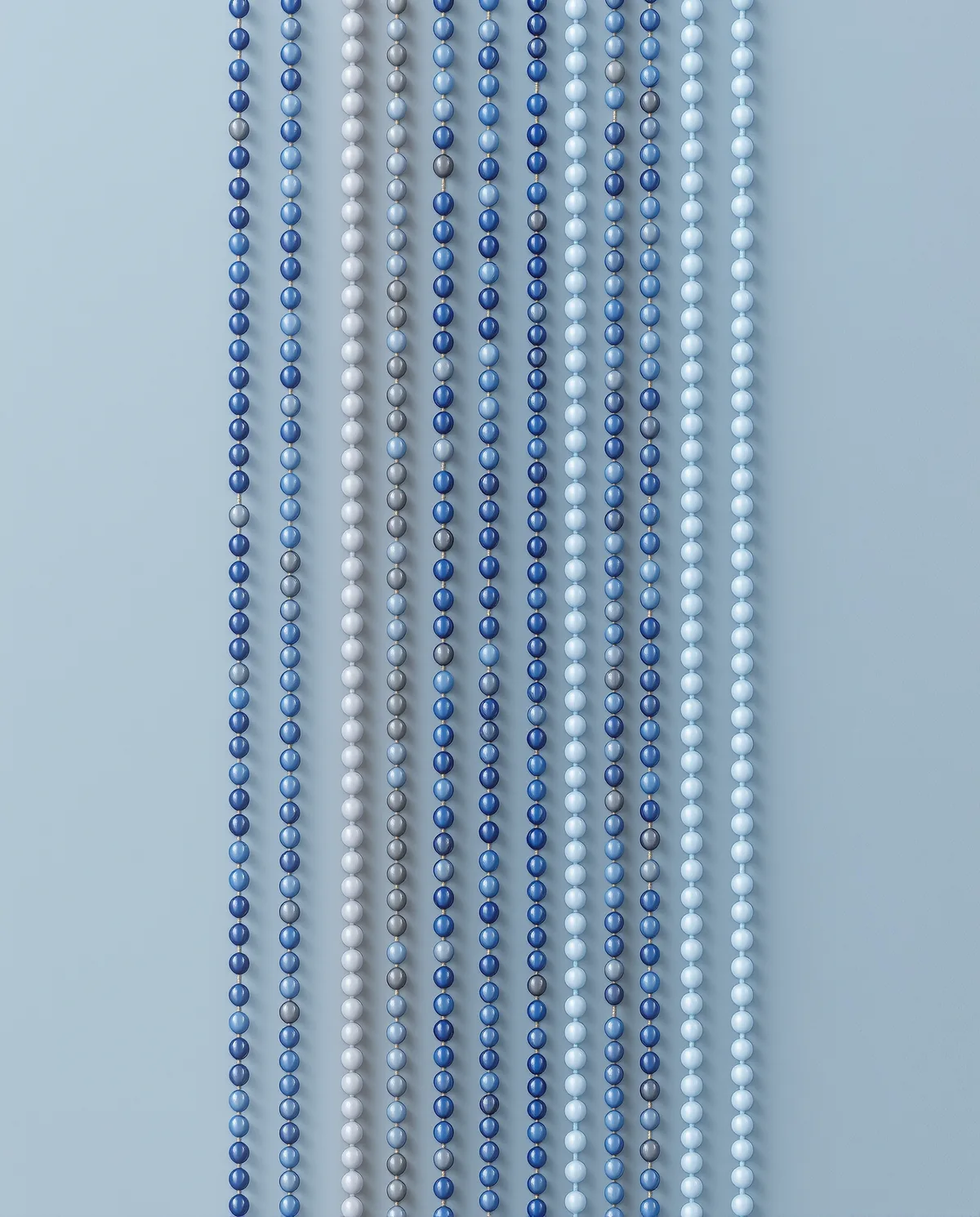
Cobalt and ink glass spaced across 40 strands at about 3,100 beads, where the gaps are as designed as the beads.
Specs and sizesDesign
Wood, bone and amber glass on one strand at 90 × 180 and 120 × 180 cm — a design available to develop, not a current line.
See the detail
Start a conversation
Send a reference, a colour chip or a sketch. Minimums are set per design and confirmed per quote; sampling is quoted separately and usually runs 16 to 20 days from an agreed brief.