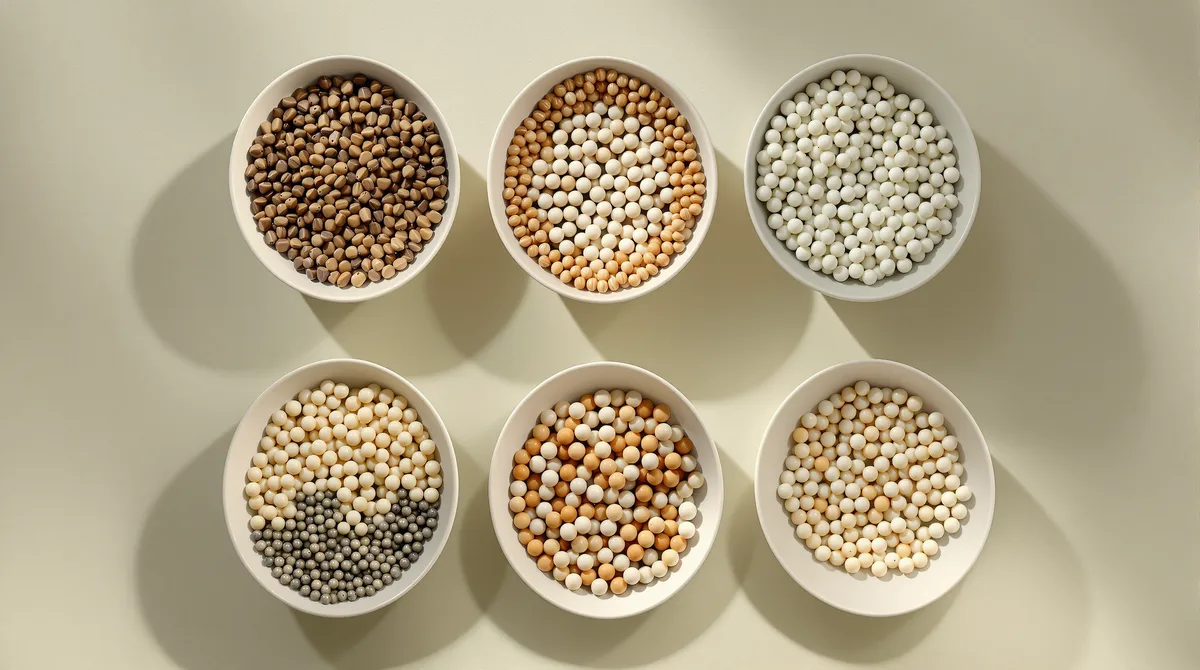
Colour story
Ember & Honey palette
Wood, bone and amber glass mixed on one strand — warmth at a lower weight and cost than an all-glass build.
Read the guide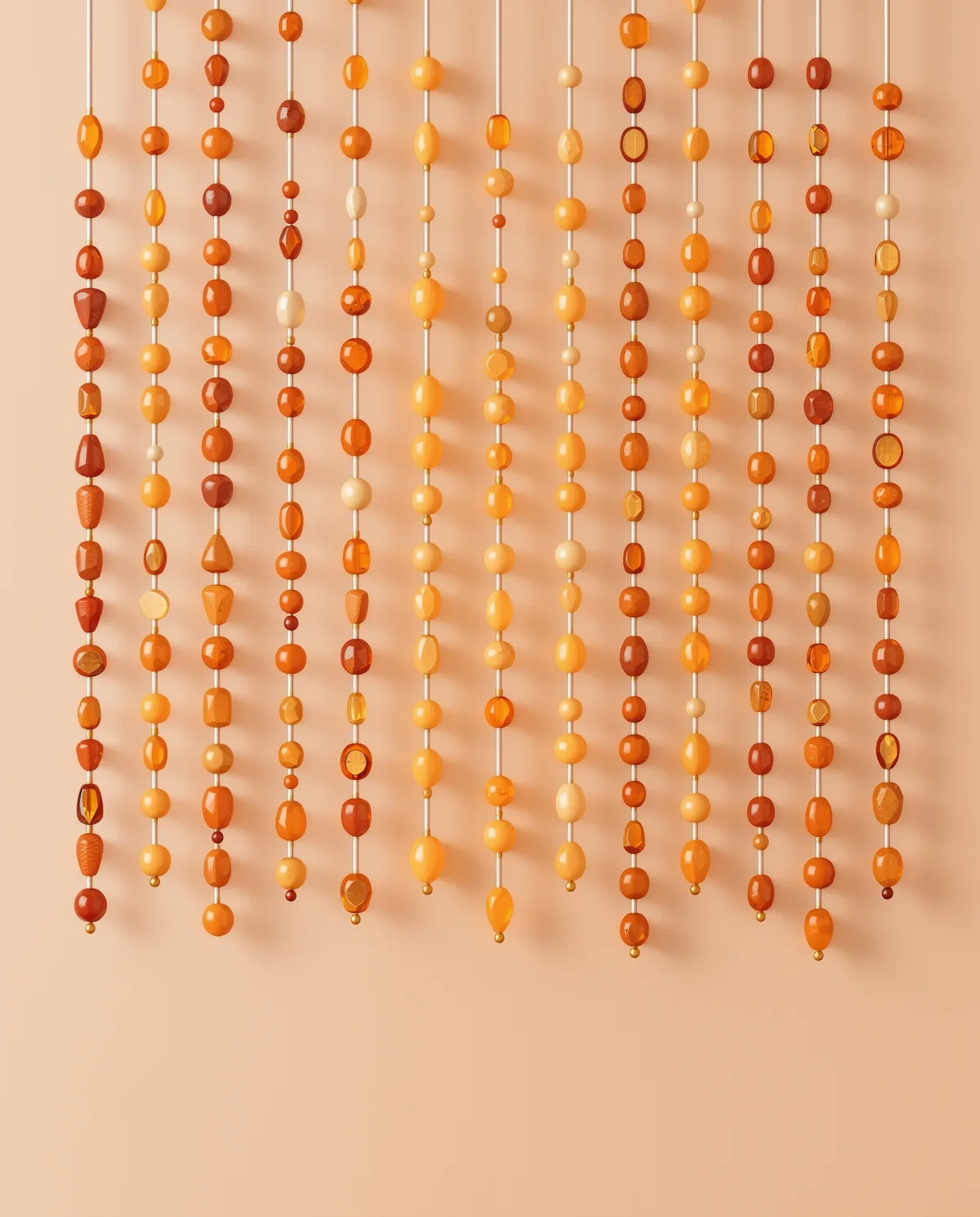
Design · Ember & Honey Room Divider
Drawn at 90 × 180 and 120 × 180 cm, and available to develop, with the development questions named rather than skipped.
Six bead strands in the Ember and Honey palette, rust and burnt orange through amber to honey mustard, light passing through the translucent glass.
The Ember and Honey divider is drawn at 90 × 180 and 120 × 180 cm, with strands running full length across the whole width so the piece screens rather than frames. Each strand mixes turned wood, cut bone and amber glass. It is documented here as a design available to develop at the drawn size rather than as a current product line.
The Ember and Honey divider is drawn at 90 × 180 cm and 120 × 180 cm, with strands running the full width at up to 60 strands. Each strand mixes turned wood, cut bone and amber glass.
It is available to develop. This page documents the drawn design and names what developing it would involve — the edge condition, the hem weight and how both faces read — rather than presenting it as a line you can order.
As a written material sequence rather than a pattern. Wood, bone and glass in a repeating order on the count sheet, so the three materials stay in the same proportion on every strand.
That is a different discipline from a colour sequence. Three materials means three sorted lines at the bench and three different handling behaviours, and the sequence has to be followed strictly or the proportion drifts strand to strand in a way that is visible across a 120 cm width.
At divider scale the sheet leads with load. The panel weight is the first development figure, because a hanging division goes onto a ceiling fixing rather than into a door frame, and ceiling tracks have a stated limit. After that: strand count and pitch for the density, and the material sequence on the colour-count sheet so the three materials stay in proportion.
| Specification | Value |
|---|---|
| Sizes drawn | 90 × 180 cm and 120 × 180 cm |
| Strand count | Up to 60 |
| Strand pitch | About 2 cm at the 120 cm width |
| Function | Screens an area rather than framing an opening |
| Strand build | Turned wood, cut bone and amber glass in a written sequence |
| Hem shape | Straight — every strand the same length |
| Header | Turned wooden dowel or rail, section checked against finished weight |
| Fixing | Specified by the installer; hardware is not supplied |
| Status | A design available to develop at the drawn size |
Interior and hospitality specifiers, principally — the people who ask for a screen rather than a curtain. Restaurants dividing a dining area, salons and spas separating treatment spaces, open-plan residential zoning.
That audience is also why the framing matters. A specifier working to a drawing needs to know that this is a design and not a stocked product, because the lead time, the sampling step and the fixing design all have to go into their programme.
The material lesson rather than the format. A division is a craft category here, available to develop, so what carries across comes from the mixed-strand work in the rest of the library rather than from another divider.
What transfers from adjacent work is the material lesson. Mixed strands are a common way to add colour and interest while keeping cost down, and wood and bone are both lighter and cheaper per bead than glass of equivalent size. As general physical properties, glass runs around 2.5 g/cm³, acrylic around 1.2 and most woods below 1, so replacing a third of the glass in a strand with wood is a genuine reduction in hanging load — which matters more at divider scale than anywhere else in the library.
It would be agreed on the sample. As a direction of travel, strands are kept in order and protected against knocking, then packed to the client's carton, label and packaging specification, and at 120 cm wide the carton is the limiting dimension.
A divider has one packing characteristic a curtain does not: every strand is the same length, so the piece packs more predictably than an arched or shaped design.
It shows the format, the strand count and the material mix as drawn. It shows the design as drawn to size.
The gap is larger here than on most unsampled designs, because the open questions are behavioural rather than visual: how a mixed-material strand settles over a week at 180 cm, how much a wood bead moves against a glass one in a draught, and what the finished weight actually is. None of those can be answered by a render.
The warm mixed-material story, which also holds a wall hanging at 60 × 100 cm on 33 strands with an inverted-V hem. The two share a palette and a material philosophy and nothing else about their construction.
All three, each for a property the others lack. Amber glass transmits light, so it is what makes the piece glow when it is backlit. Wood gives warmth without weight — the warmth is the material rather than a finish on it. Bone gives an off-white that no wood and no glass quite matches.
Straight, with every strand the same length. That is what makes it a division rather than a portal: there is no shortened centre, no opening and no walk-through.
A shaped hem on a divider is possible and usually a mistake. A screen is read as a plane, and a shaped bottom edge makes it read as a curtain that has been hung wrong.
For a design at this scale, establishing the finished weight on a sample is the first development task rather than a detail.
It hangs from a turned wooden dowel or rail, with the section checked against the finished weight — a section that is adequate at 90 cm will deflect at 120 cm. Where a division hangs away from a wall, the fixing is a ceiling track or hooks into a joist, specified by the installer. Hardware is not supplied.
Both, within the material constraint. Any warm palette carries on the same three materials; a cool palette does not, because wood and bone are warm by nature and no finish makes them read cold without hiding them.
Resizing is straightforward in principle, since every strand is the same length and the strand count follows the width. The 120 cm version is the one that needs the header engineering checked rather than copied.
Good to know
Turned wood rondelles, cut bone, and amber and honey glass, on one cord in a written sequence. Wood is turned in our own Saharanpur wood factory, glass is drawn and hand-strung in our own Firozabad glass works, and bone is cut, drilled and finished to specification in our own beadwork studios.
Exclusivity is a commercial decision taken per programme rather than a property of the design. On an unsampled design it is a conversation to have alongside the development itself.
It shows the design as drawn: the format, the strand count and the material mix. The divider is drawn to size and available to develop. Everything about how it behaves hanging at 180 cm is an open question rather than a documented one.
Packing would be agreed on the sample. As a direction of travel, strands are kept in order and protected against knocking, then packed to your carton, label and packaging specification, and at 120 cm wide the carton is the limiting dimension.
Yes, and for a divider that is usually the better route. Send the opening dimensions, the fixing you intend and the degree of screening you want, with a palette, and it becomes a colour-count sheet with a rough cost sheet before any sample is made.
Yes. The glass and the bone finish are specified directly; the wood is approved as a tone range rather than matched to a reference, because natural grain varies and a point colour cannot be held. Any warm palette carries on the same three materials.
Keep exploring
Colour story
Wood, bone and amber glass mixed on one strand — warmth at a lower weight and cost than an all-glass build.
Read the guideSpecification
Ceiling fixing, double-sided reading, strand drift in airflow, and a plain account of what a bead division will not do.
Read moreDesign
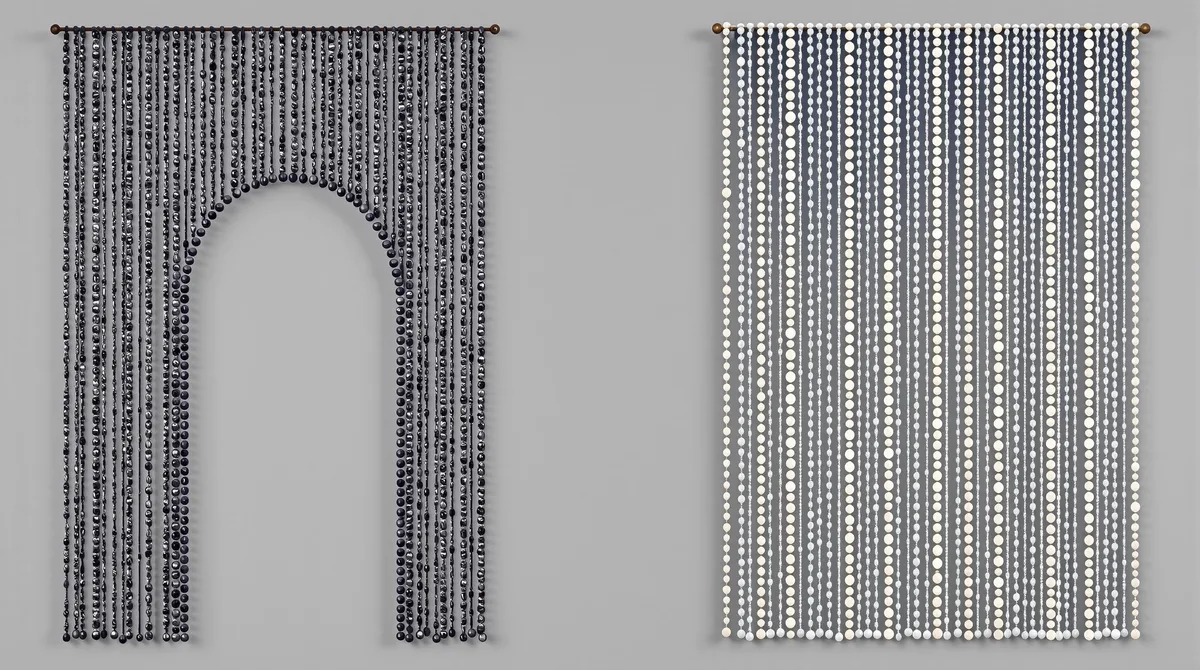
Portals at 76 × 140 cm and hanging divisions at 90 × 180 and 120 × 180 cm, documented by strand count and opening shape.
How it is madeDesign
A legible motif carried across a 76 × 140 cm portal, where bead diameter against strand pitch decides whether the image reads.
See the detailDesign
A scattered accent field on an arched portal, where the arch profile and the scatter map are drawn as one document.
See the detailReference
Nine material families, what each gives in light, weight and colour, and how far our own manufacturing reaches into every one of them.
Specs and sizes
Start a conversation
Send a reference, a colour chip or a sketch. Minimums are set per design and confirmed per quote; sampling is quoted separately and usually runs 16 to 20 days from an agreed brief.