Design
The design library: colour stories, by construction
Colour stories documented by how they are built, not by how they look in a mood board.
Specs and sizes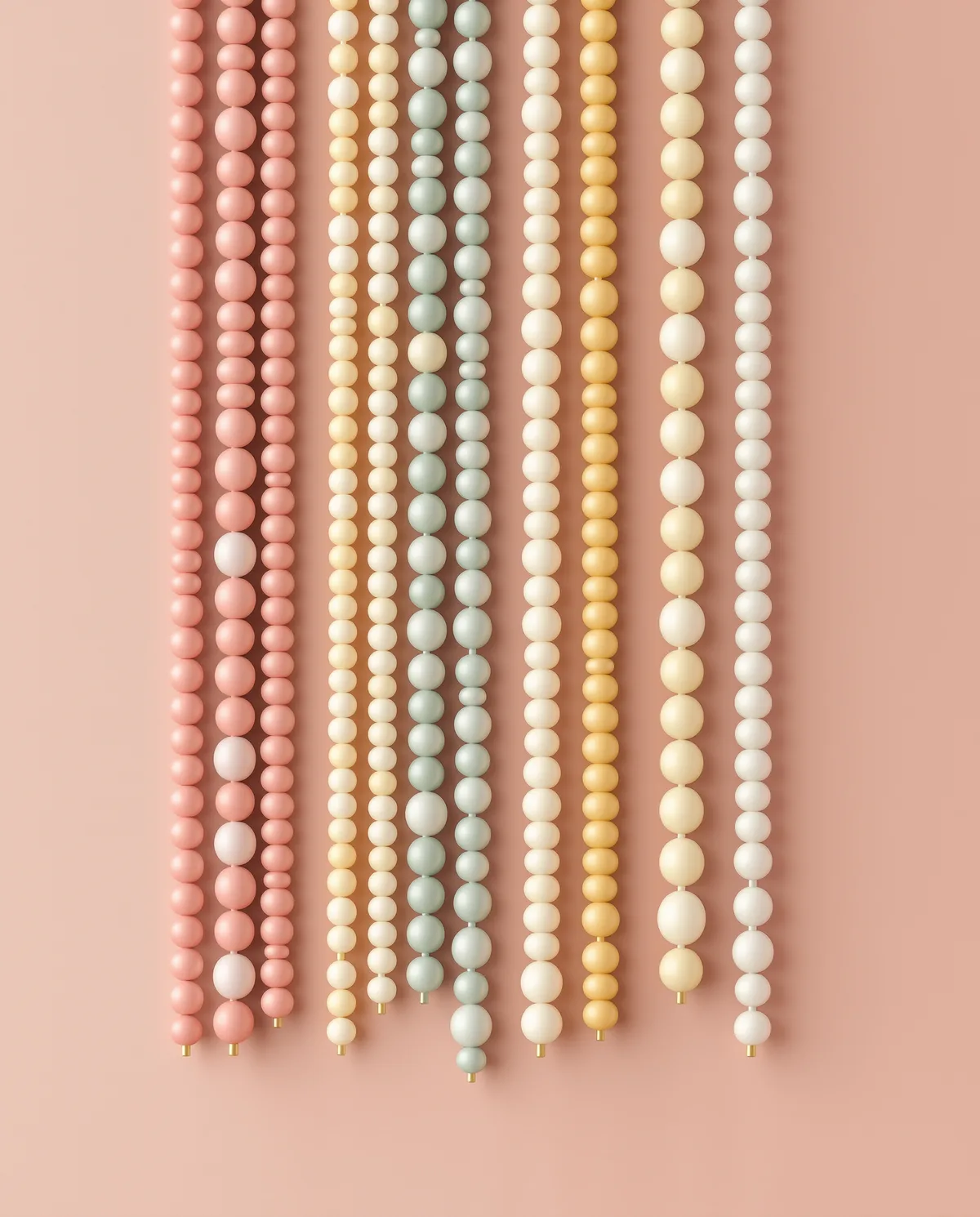
Colour story
A matte and satin palette is awkward in glass and natural in a cast disc. The material follows the finish, not the other way round.
Six bead strands in the Rose Clay Garden palette — sun-baked rose, soft sage, butter yellow and milky glazed white — in matte and satin finishes.
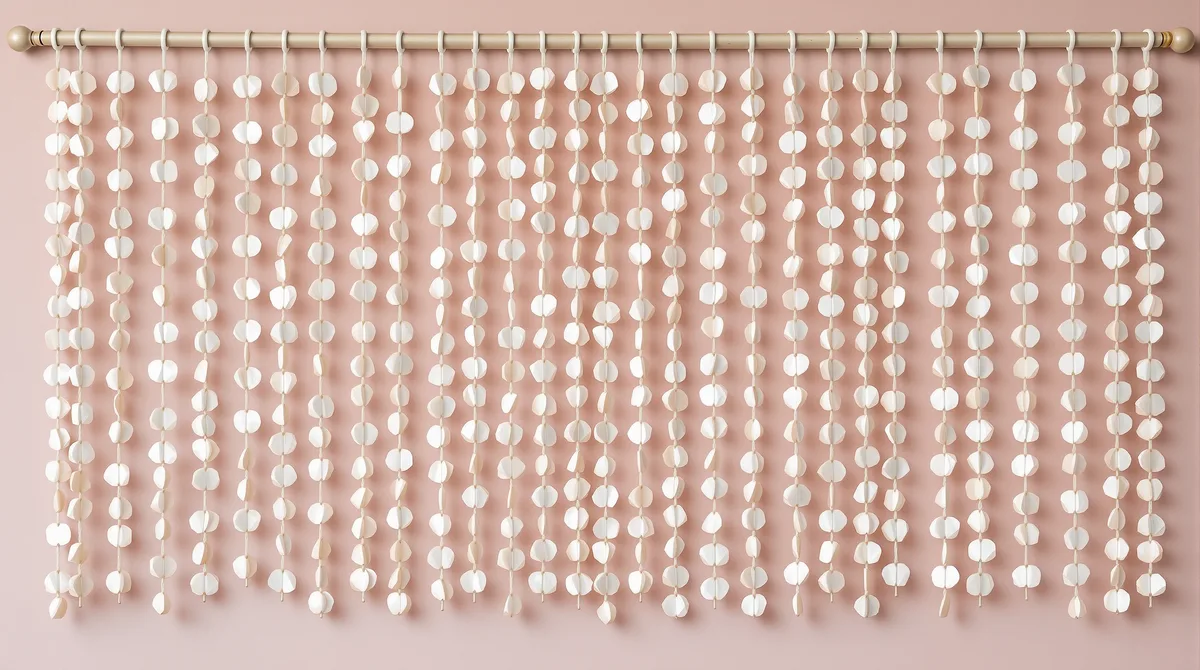
Rose Clay Garden is the matte story: sun-baked riverbank blush, soft sage, butter yellow and a milky glaze, in matte and satin finishes. Its beaded expression is a linked faux-capiz disc hanging at 70 × 130 cm and about 239 discs, because a cast or cut disc arrives matte while a glass bead has to be frosted bead by bead to get there.
Rose Clay Garden is collection 9 in the Gemixx Design Studio, announced in October 2026. Its palette is sun-baked riverbank blush, soft sage, butter yellow and a milky glaze, in matte and satin finishes, with matte rose gold and matte champagne on the metal side.
Most of the collection is tabletop — teaspoons, salad servers, posy napkin rings, party picks. Its beaded expression is one piece: a linked disc hanging at 70 × 130 cm, drawn at around 239 discs.
Faux-capiz discs, and the reason is finish rather than shape. Every colour in this palette is defined by being matte: a glossy blush and a matte blush are different colours to look at, however identical their readings.
A cast resin disc or a dyed cut acrylic disc arrives matte or satin as made. A glass bead does not — glass defaults to gloss, and reaching matte means a frosting operation on every bead. That is possible, since colouring and frosting are both done at our own Firozabad glass works, but it is an added operation on every unit and a second thing to hold consistent.
More easily than a pale palette usually allows, because dyed resin and dyed acrylic are unusually uniform. The colour is through the material rather than sitting on its surface, so batch variation is lower than on a surface-dyed glass bead of the same lightness.
The working method is still the same: dye to a physical chip, approve the disc physically, hold production to the approved sample. The finish is approved at the same time, because matte has degrees and a chip does not record them.
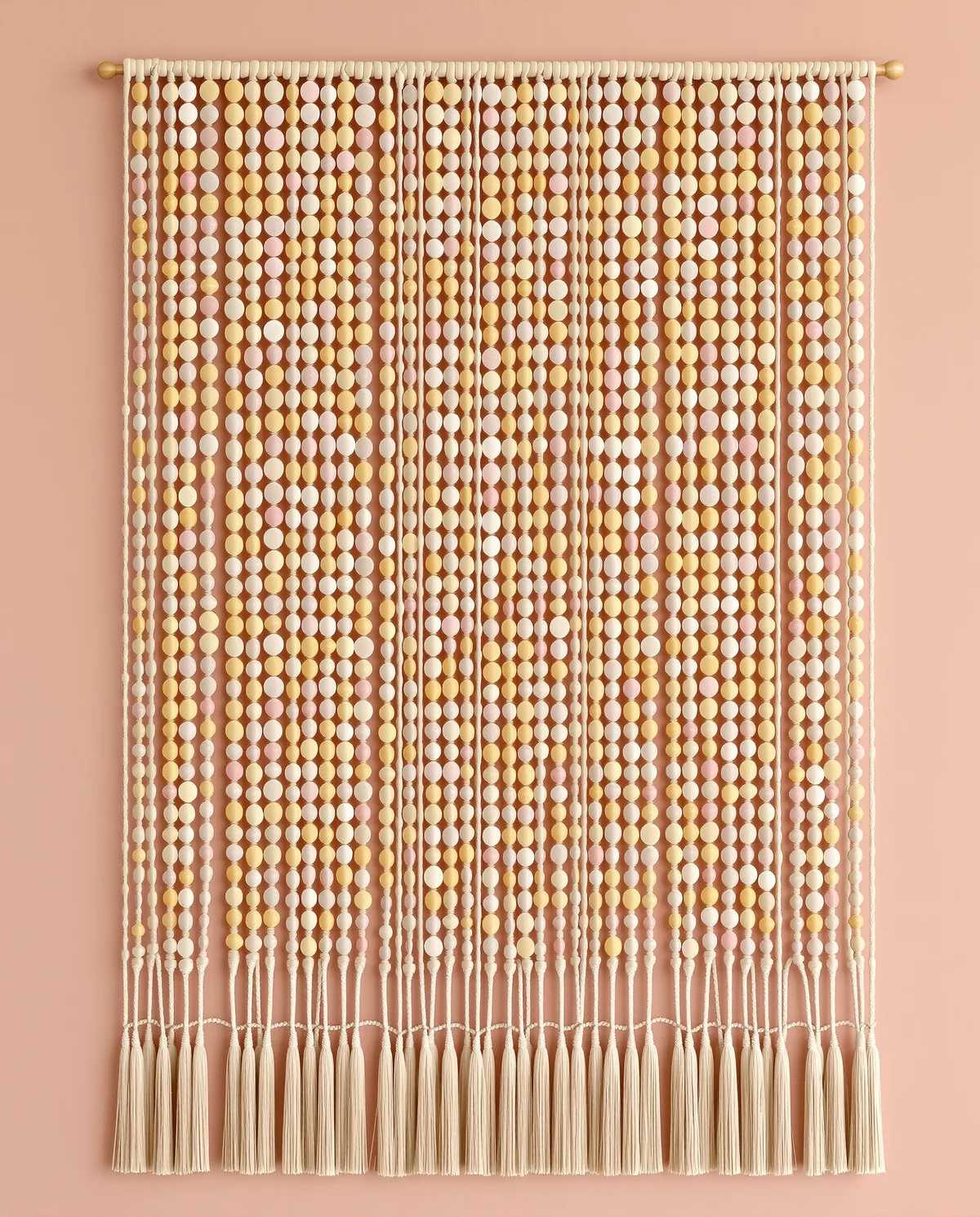
Every colour in the palette is defined by its finish as much as by its hue. A glossy blush is a different colour, visually, from a matte one.
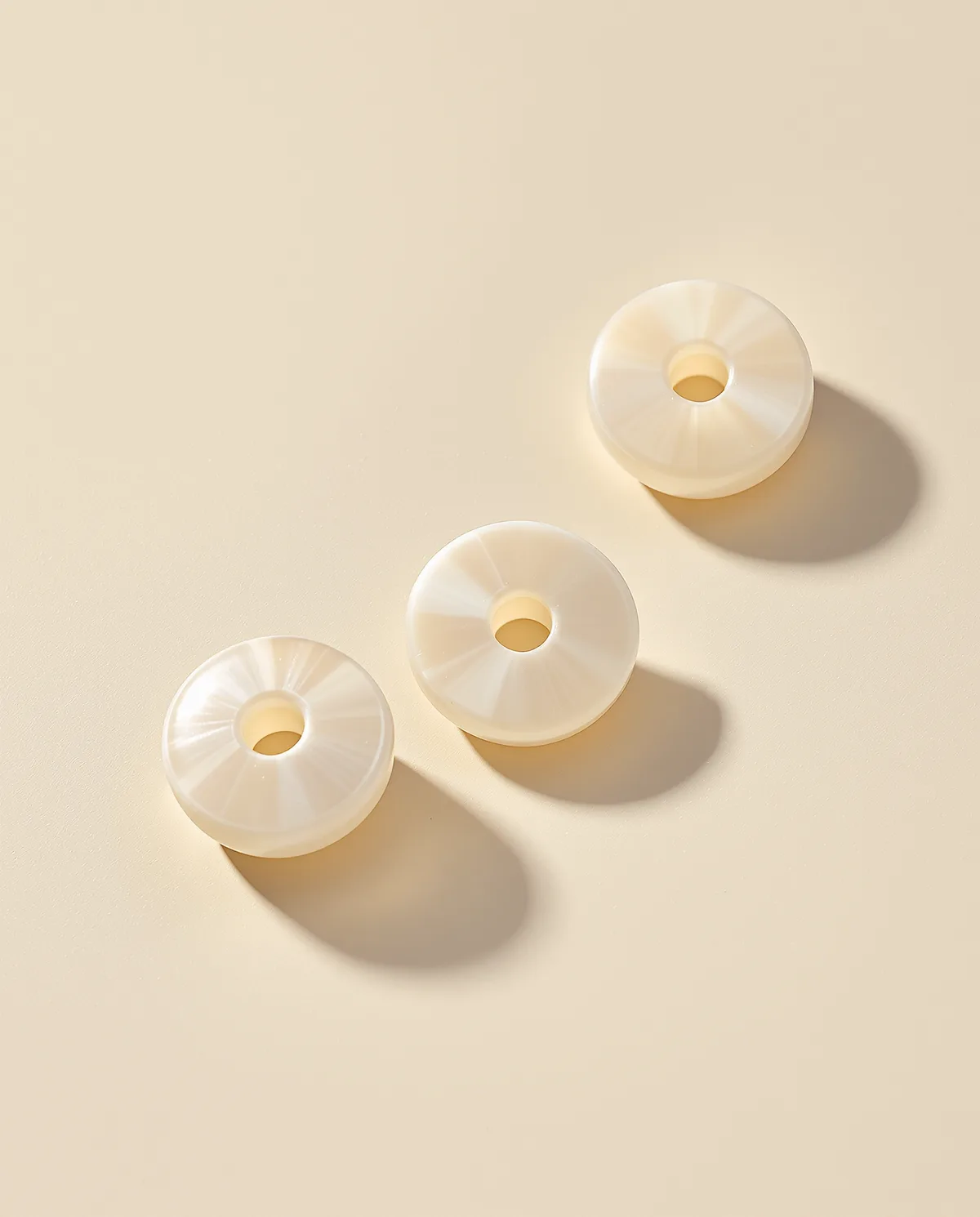
Faux capiz is cast resin or dyed cut acrylic finished to imitate capiz shell. Consistent colour, no shell-import exposure, more durable than the material it imitates.
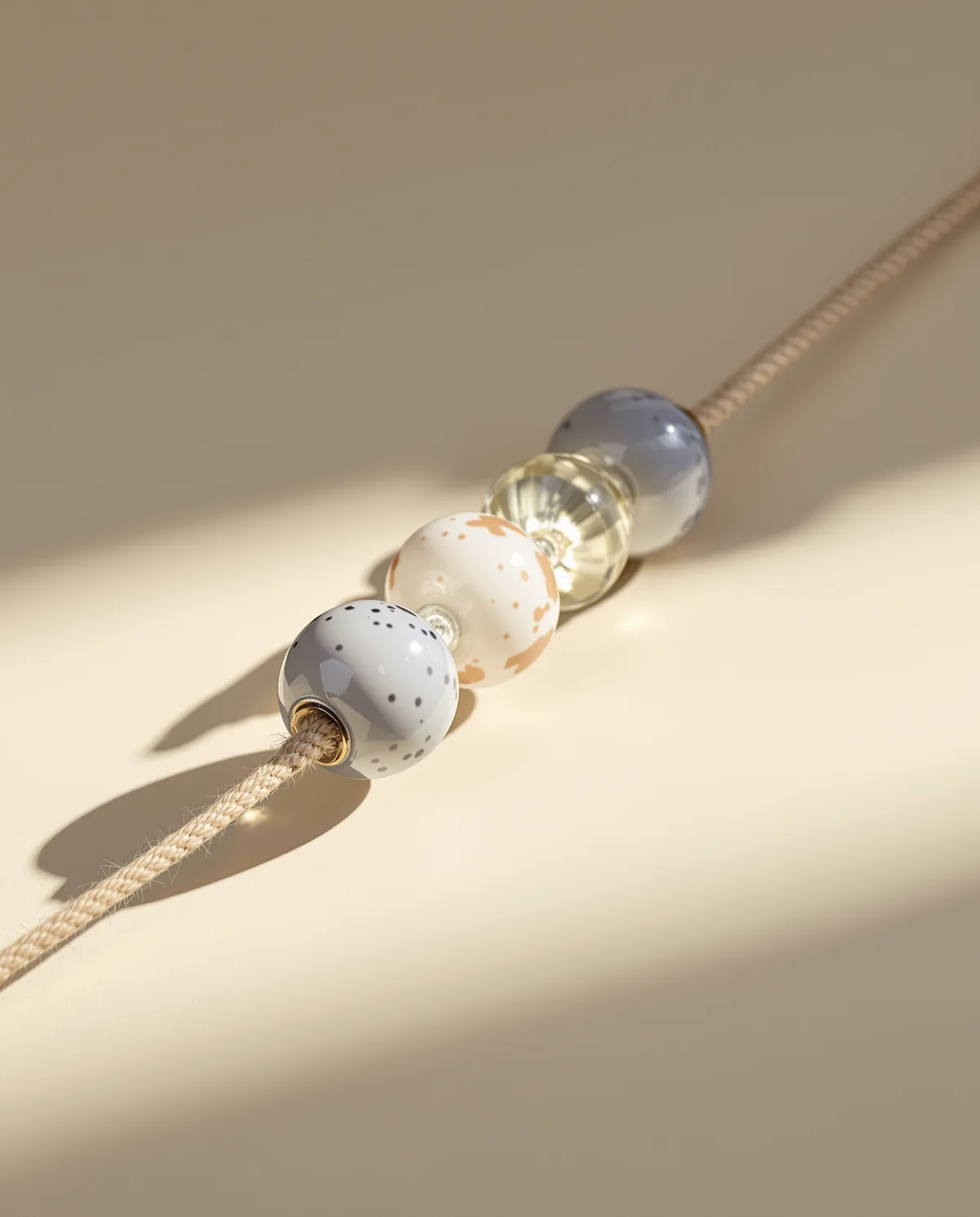
Discs join one below the next into columns, so each link carries the weight of everything beneath it. The disc count, not a strand count, is what a quote is built on.
Cast resin and dyed cut acrylic first, as drawn. Ceramic second, and genuinely competitive — a milky or matte glaze from our own Khurja plant is this palette almost exactly, and a glazed ceramic bead has a density of surface that a resin disc does not.
Glass third, with frosting. Wood and bone cannot reach the blush or the butter yellow without a paint finish, which defeats the point of using them.
Nearly everything is dyed, and that is the story's commercial advantage rather than a cost. A disc has no natural colour, so there is no stock colour to compromise with — every colour is a decision, and every decision can be matched exactly.
For a buyer with a fixed brand palette, this is the easiest story in the library to hit precisely. Glass stories trade colour accuracy for depth; a disc story does not have to.
Linked disc hangings and panels, as drawn, and tabletop beadwork where the palette already lives. A matte palette is read in reflected light, so anything that hangs against a wall rather than in a window suits it.
The format it suits least is a window-hung piece. A matte disc does not transmit, so a backlit Rose Clay Garden panel is a silhouette and the palette disappears entirely.
The disc size, and specify it carefully. The drawn design uses 25 mm and 50 mm discs. Faux-capiz disc sampling so far covers 10 to 30 mm, so the 25 mm size is inside sampled experience and the 50 mm is not.
A 50 mm disc is heavier, catches more air and puts more load on each link point, and those are development questions rather than specification questions. If a programme needs certainty, start at 25 mm.
As the softest and the most interior-design-facing palette here. It photographs well under flat lighting, which is rare in this library and is a direct consequence of being matte — there are no highlights to blow out.
It also groups well. Beside Cherry Blossom and the paler neutrals it reads as a deliberate family rather than as a single piece.
It is not comparable to a strand at all, which is the most important commercial fact on this page. A linked-disc build has no cord and no stringing sequence; it has a disc count, a link operation per disc, and a column count.
At around 239 discs it is a moderate quantity for the build type — the largest linked design in the library runs to roughly 497 discs at 90 × 200 cm. The cost driver is the disc, its size and its dye, and then the link operation.
One beaded design: the linked disc hanging at 70 × 130 cm. The rest of collection 9 is tabletop.
The Design Studio link for this collection is confirmed — app.gemixx.com/?c=rose-clay-garden — so the design opens as your own copy to recolour, resize and send back for costing. Sampling usually runs 16 to 20 days from an agreed brief and is quoted separately.
It is the most light-independent palette in the library, because nothing in it is transmissive and nothing in it is specular. Daylight, lamplight and a flat photograph all give much the same object.
That stability is the quiet argument for the whole story. A buyer approving a matte disc panel on a sample photograph gets what they approved, which is not true of a frosted glass panel or a foil-lined one.
Extractable data
| Specification | Value |
|---|---|
| Palette | Sun-baked riverbank blush, soft sage, butter yellow, milky glaze |
| Finish | Matte and satin, with matte rose gold and matte champagne on the metal side |
| Collection | Design Studio collection 9, announced October 2026 |
| Beaded design | Linked disc hanging, 70 × 130 cm, about 239 discs |
| Disc material | Faux capiz — cast resin or dyed cut acrylic, never shell |
| Disc sizes drawn | 25 mm and 50 mm |
| Sampled disc range | 10 to 30 mm — the 50 mm size sits outside it |
| Studio link | Confirmed collection slug — app.gemixx.com/?c=rose-clay-garden |
| Production | 40 to 60 days after sample approval |
Good to know
Cast resin and dyed cut acrylic, naturally, because both arrive matte. Ceramic glazed and fired in our own Khurja plant is the other strong fit — a matte or milky glaze is exactly this palette. Glass needs frosting on every bead to reach the same place, which is a cost and a consistency question.
Yes. The palette is low-contrast but the finish gives it enough interest to hold at close range, and a linked-disc piece at 70 × 130 cm is already towards the small end of that build type. A smaller version mainly reduces the column count.
Easily, and dyeing is where the disc build earns its place — both cast resin and cut acrylic take dye well and uniformly. The one thing to preserve is the matte finish, because a glossy version of these colours is a different story.
A linked faux-capiz disc hanging at 70 × 130 cm with roughly 239 discs. The rest of collection 9 is tabletop — teaspoons, salad servers, posy napkin rings, party picks — so the beaded expression is one piece rather than a family.
Mostly dyed, and that is an advantage rather than a cost. A cast or cut disc has no natural colour to work from, so every colour in this palette is a dye decision, and a dye decision can be matched exactly to a physical chip and confirmed on the sample.
By approving a dyed disc physically and holding production to it. Dyed resin and dyed acrylic are both more uniform than dyed glass, because the colour is through the material rather than on its surface, so this palette is easier to hold than its paleness suggests.
Keep exploring
Design
Colour stories documented by how they are built, not by how they look in a mood board.
Specs and sizesIndex
Twenty-four named looks, each described by the material, palette, pitch and hem that actually produce it.
How it is madeColour story
Five-petal faux capiz blossoms cut to shape, each held by a spacer bead dyed to match, in a sampled and approved build.
Compare the optionsColour story
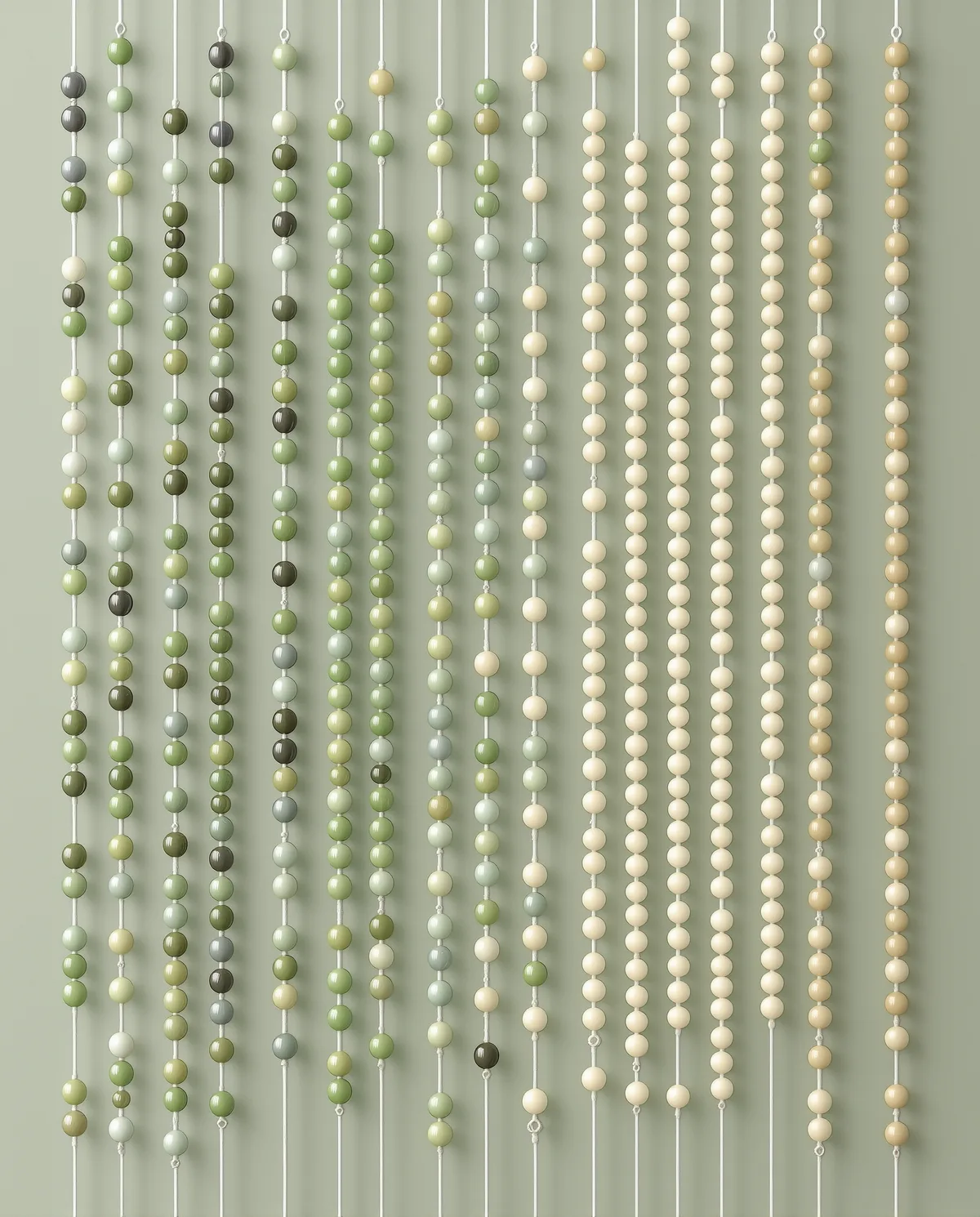
Olive and sage glass in a grove palette, built as a valance first because green needs restraint at scale.
Read the guideColour story
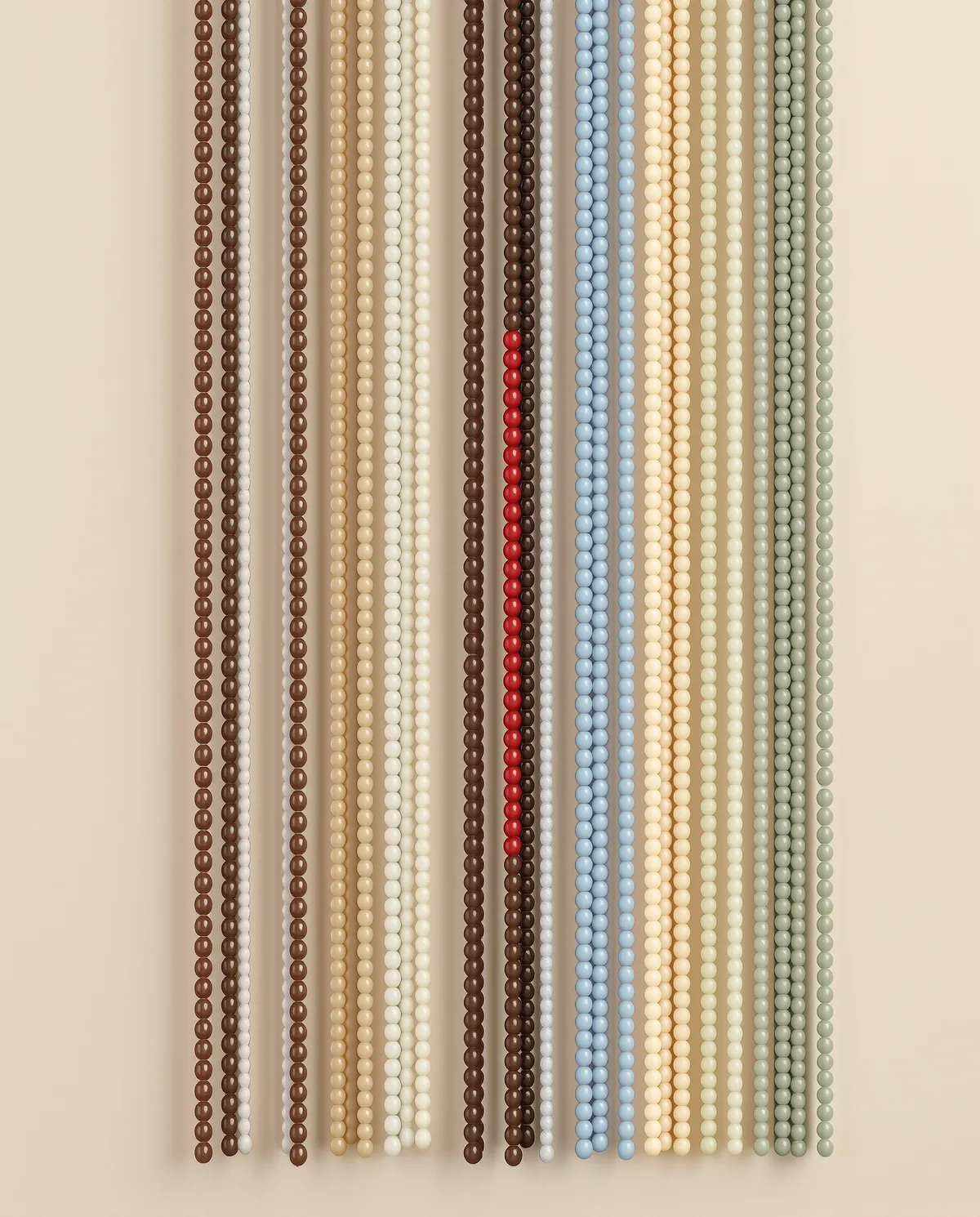
Espresso and cocoa, crema, dusty cornflower and pistachio, with one glossy cherry-red note doing the work of five.
Compare the optionsDesign
70 × 130 cm at about 239 matte faux-capiz discs — the smaller, lighter end of linked-disc construction.
How it is made
Start a conversation
Send a reference, a colour chip or a sketch. Minimums are set per design and confirmed per quote; sampling is quoted separately and usually runs 16 to 20 days from an agreed brief.