Material
Glass seed beads: sizes, dye lots and cord
How seed beads are drawn, why dye lots are quoted per run, what the drill hole limits, and where seed-bead work earns its cost.
Compare the optionsGlossary
Three letters on a tech pack that decide whether a scattered accent reads as the subject of a panel or fights its own background.
Dyed to match, written DTM on a tech pack, means dyeing one component to the colour of another component in the same build rather than to an external swatch. In beadwork it almost always means dyeing the base or seed beads to the accent bead, so the accent reads as the subject of the piece instead of competing with its background.
DTM next to a component means: dye this to match that, where that is another component in the same build. It is a relationship, not an absolute. The matched component is deliberately subordinate — it becomes the field that something else sits on, which on most panels means the glass seed beads carrying a larger accent.
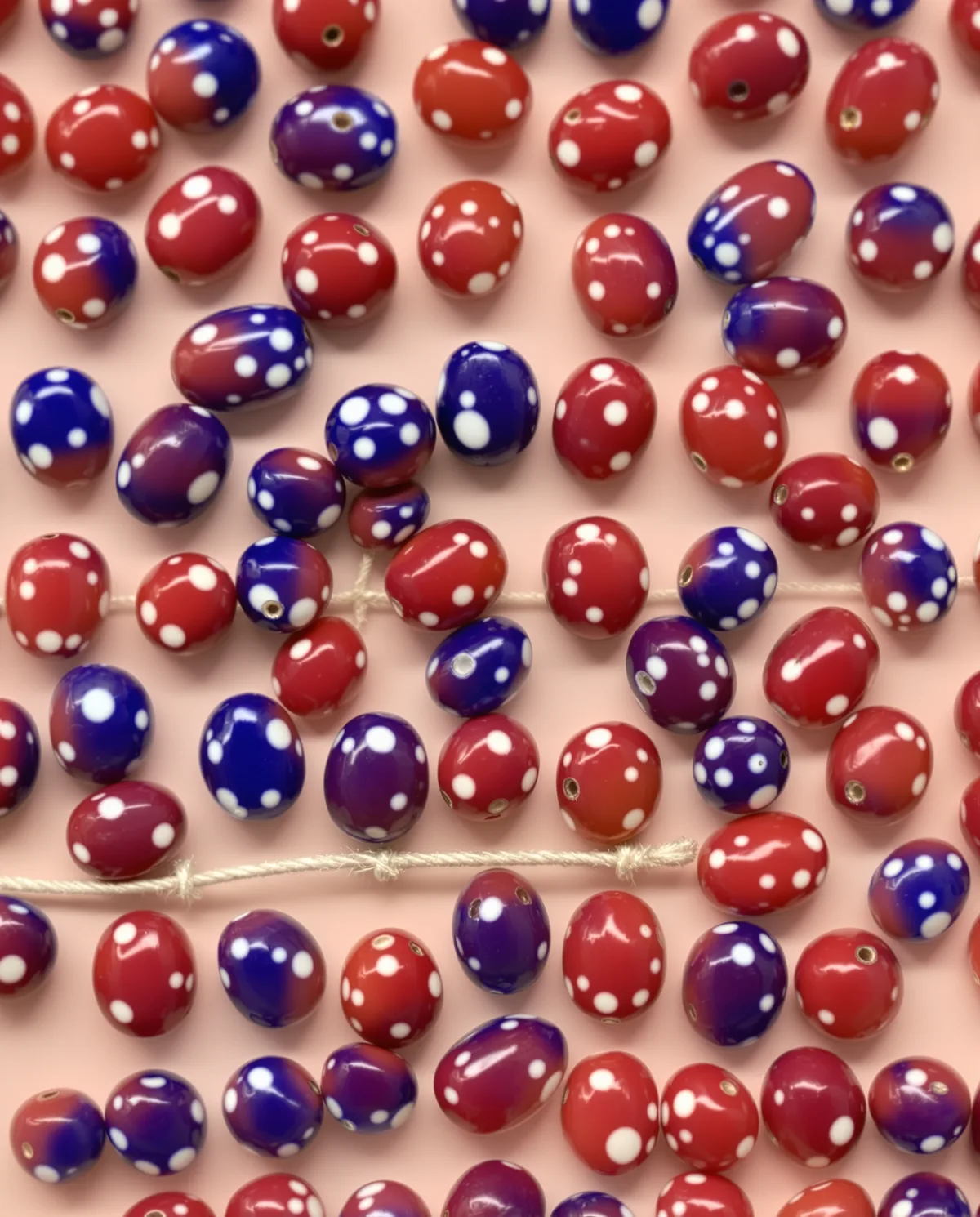
A scattered accent only works if its background is quiet, and hand-strung strands depends on that relationship more than any other construction. On our dotted portal construction the base seed beads are dyed to match the dot colours; on the mushroom construction a cream and amber base carries the figurative accent. Beadwork on the table uses the same relationship between motif and ground. In both cases, specifying the ground as an independent colour would produce two colours arguing and no subject.
It does not promise repeatability across runs. Surface-dyed glass colour is a property of the batch, and dye lots move — unlike pressed glass, whose colour is set in the body at the press. DTM fixes the relationship at approval; holding it across a repeat order is a separate decision about whether to reserve the lot or to allow a stated variation.
Name the reference component explicitly — "base seed beads DTM accent dot" — rather than writing DTM on its own. Then state the dye-lot policy. Bead sizes and stringing specifications is where the rest of the values that belong beside it live, and which bead material you are dyeing decides whether it can be dyed at all.
Good to know
No, and conflating them causes real problems. A colour reference points at an external target. Dyed to match points at another part of the same build, so the target moves with whatever that component actually came out as. One is an absolute, the other is a relationship.
The base or seed beads. The accent bead is usually the expensive, moulded or hand-made one whose colour is set in the glass body, so the cheap, high-volume component is the one that moves to meet it.
It guarantees they are matched at approval, on the approved sample. It does not guarantee a later dye lot will land in the same place, because surface-dyed colour is a batch property. For a repeat programme, either hold the dye lot or write the acceptable variation into the specification.
Because they are usually different materials made by different processes. A pressed-glass accent takes its colour in the body at the press; a seed bead takes a surface dye. Asking for one named colour across both is asking two different trades to hit the same point by coincidence.
Keep exploring
Material
How seed beads are drawn, why dye lots are quoted per run, what the drill hole limits, and where seed-bead work earns its cost.
Compare the optionsTechnique
The bead map, the cord, thirty strands on a dowel, hem shapes, suspension loops — and the three levers that move the cost.
Compare the optionsGuide
Resolution, weight, repeatability, cost per covered area and breakage risk, with the working figures from production.
Specs and sizes
Start a conversation
Send a reference, a colour chip or a sketch. Minimums are set per design and confirmed per quote; sampling is quoted separately and usually runs 16 to 20 days from an agreed brief.