Material
Drawn glass seed beads
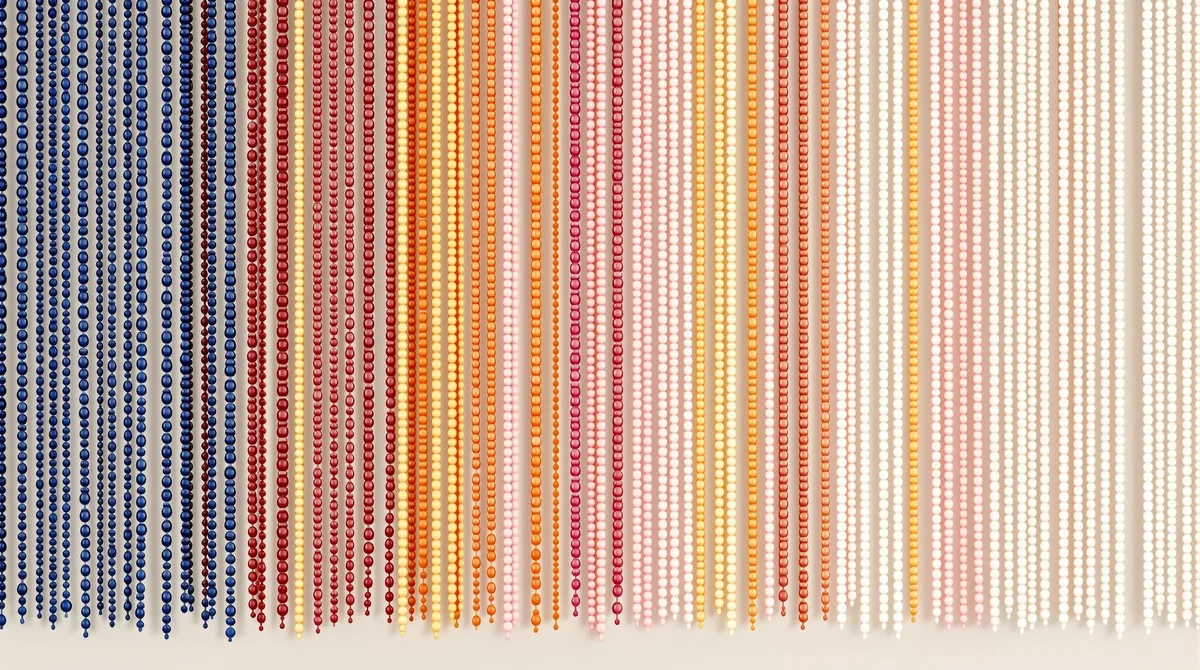
How seed beads are drawn, why dye lots are quoted per run, what the drill hole limits, and where seed-bead work earns its cost.
Read more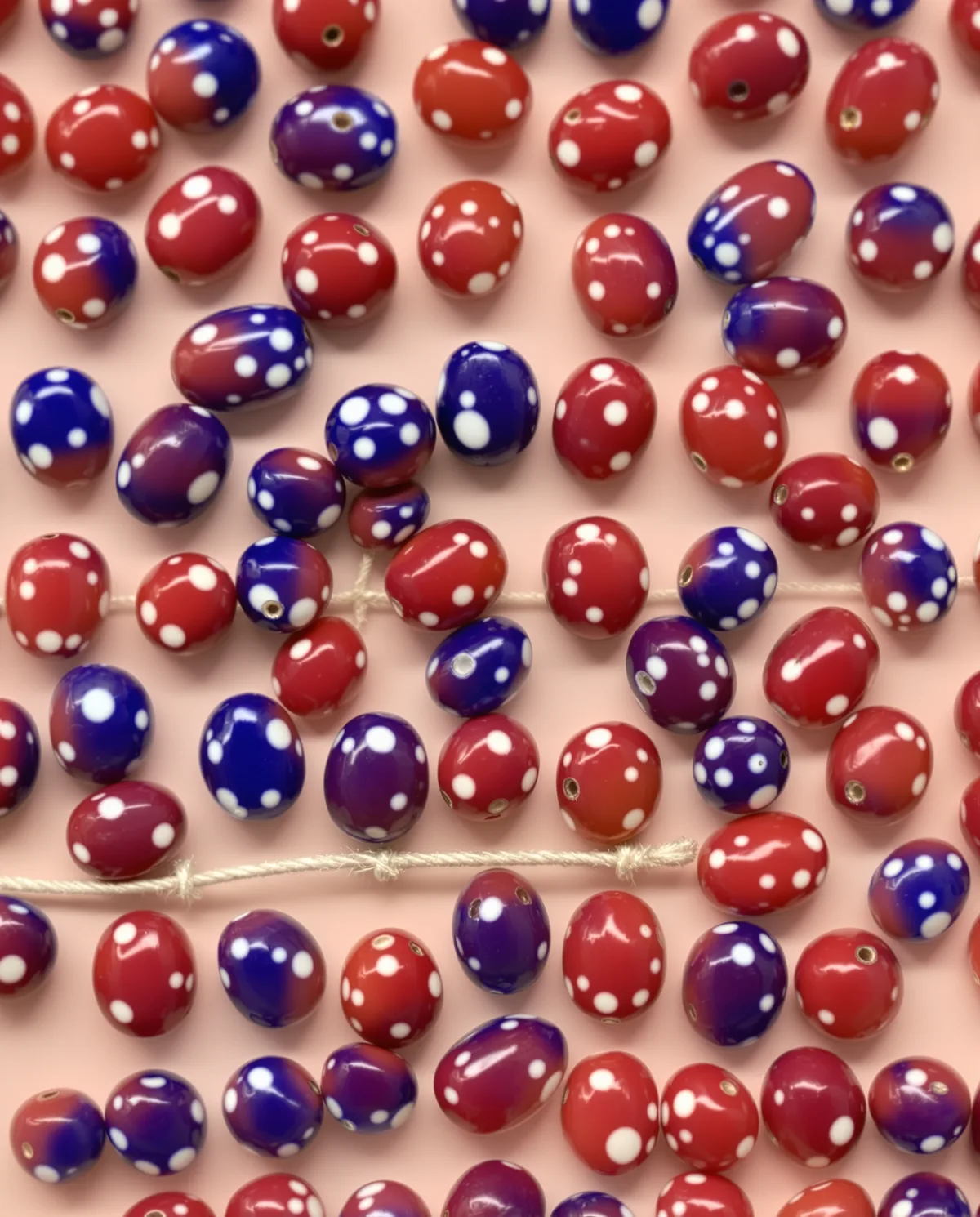
Guide · Specifying glass
They are both glass and they are not alternatives. One is a material you pour; the other is an object you place. Choosing wrongly is the most expensive mistake available at the specification stage.
Dotted oval pressed glass beads, thirteen by twenty-two millimetres, in cherry red and cobalt with raised white dots, loose beside a threaded sample strand.
Specify seed beads when the design needs resolution — a motif, a letter, a figure, or a tonal field built from tiny units. Specify pressed glass when the design needs a repeatable shape at volume, such as a dotted oval accent or a moulded blossom. Most strong designs use both: a seed-bead ground carrying a pressed-glass accent.

A seed bead is a unit of a material. A pressed bead is an object. Everything else follows from that, including the cost behaviour, the repeat accuracy and what the design can actually depict. Both sit inside the glass family in the bead materials index, and neither is a substitute for the other.
If the brief contains a motif, a letter, a figure or any image the eye is supposed to resolve, the answer is seed beads and it is not really a choice. Beadwork on the table is almost entirely this case. Glass seed beads at one to three millimetres behave like pixels: enough of them laid side by side stop reading as beads and start reading as a picture. Nothing larger can do this.
If the brief contains a shape that must be identical a thousand times — a dotted oval, a blossom, a drop — then it is pressed glass, and the shape comes out of a mould. A new shape means a mould, which is a tooling conversation rather than a catalogue selection. We have funded our own dies where a design justified it, including custom moulded almond beads used as daisy connectors.
| Specification | Glass seed beads | Pressed glass beads |
|---|---|---|
| Made by | Cut from drawn glass cane and tumbled | Pressed into a mould |
| Working size in décor | About 1–3 mm | Up to about 13 × 22 mm for a dotted oval accent |
| New shape | Not applicable — size is the variable | Requires a mould; a tooling conversation |
| Image resolution | High: the beads behave like pixels | None: the bead is the object |
| Cost per covered area | High — many units, long stringing time | Low — far fewer units for the same area |
| Weight per covered area | Moderate | Higher per bead, lower per area |
| Colour method | Body colour, surface dye, or dyed to match | Body colour, usually set at the press |
| Repeat accuracy | Dye lots shift between runs | Shape repeats exactly from the mould |
| Typical role | The ground, the base strand, the gradient | The accent, the motif bead, the subject |
A seed bead is cheap and a pressed bead is not, which misleads people constantly. Filling a given area takes hundreds of seed beads and a long stringing time, or a handful of pressed beads and very little. Per covered area, pressed glass wins heavily.
The practical consequence: if a field of colour is doing the work, use a larger bead. If an image is doing the work, pay for the seed beads. De-densifying a seed-bead infill — tight outline, open fill — usually saves more than any other single change and is invisible at arm's length. It is the same lever that moves the cost of a coaster programme.
Seed-bead colour is frequently a surface dye, so it is a batch property and dye lots shift between runs, and it is the component normally dyed to match an accent rather than the other way round. Pressed-glass colour is usually in the body of the glass and set at the press, so it repeats with the mould. On a repeat programme that difference matters more than the price gap.
Glass strength is colour-dependent. Large hand-made beads in certain colours will chip where they knock against beads of another colour in a hanging panel — a failure mode that only appears once the piece is hanging and moving. The fix is a furnace-process change, annealing, and in one case revising the palette so the incompatible colours were not adjacent. Raise it at sampling, not after the first container — and note that it is a hanging-panel failure, so it does not apply to flat work.
If the design is a gradient rather than a motif, neither bead is doing the work: the grade is. Grading bead size down the drop gives a tonal fall with no dye gradient to hold, which is how the honey ombre colour story is built, and it works with seed beads and pressed rounds alike. Specify the mechanism before you specify the bead.
The structure that works is a seed-bead ground carrying a pressed-glass accent, with the ground dyed to match the accent so the accent is unmistakably the subject. The dotted and mushroom portal constructions are both built this way: a fine base strand doing the colour work, and a large moulded bead scattered three or four to a strand, never aligned, doing the drawing. Hand-strung construction is where that scatter is actually planned, and the stringing specifications carry the dimensions for every bead named on this page.
Name the glass trade, not just "glass". Name the bead size and the drill hole. Say whether the ground is dyed to match the accent. Say whether the piece hangs or lies flat, because the technique families divide on exactly that line. With those five settled, a sample is a short conversation; without them it is a guess, and the guess is usually wrong in the direction of too much labour.
Good to know
No. They are different trades. A pressed bead is not a cheap seed bead and a seed bead is not a failed pressed bead. Quality questions in glass are about annealing, colour stability and hole consistency, and those apply to both — see the material library for how the glass family divides.
Per bead, a seed bead. Per covered area, pressed glass, by a wide margin — fewer units and far less stringing time to fill the same space. That is why de-densifying a seed-bead field, or moving to a larger bead for a flat area, is the first cost lever we reach for.
Yes, with a mould behind it. We have funded our own dies for custom moulded beads, including three-inch almond beads used as daisy connectors. It is a real conversation about tooling and volume, not a catalogue swap.
They can, and the cause is usually not handling. Glass strength is colour-dependent, and some colours knocking against others in a hanging panel will chip. On one Venetian-glass portal we changed the furnace process, annealed the beads and revised the palette so that incompatible colours were not clinking together.
Lampwork is the third glass trade: each bead shaped by hand at the torch, so the catalogue is whatever can be drawn rather than whatever is in a mould. It is the route for figurative beads — our food and holiday icon beads, finished as wine charms, were made this way. It carries the highest per-bead cost of the three.
Surface-dyed seed beads, yes, routinely — that is the normal way a ground is tied to an accent. Pressed glass colour is usually set in the body at the press, so matching there is a question of specifying the right glass rather than dyeing after the fact.
Keep exploring
Material
How seed beads are drawn, why dye lots are quoted per run, what the drill hole limits, and where seed-bead work earns its cost.
Read moreTechnique
The bead map, the cord, thirty strands on a dowel, hem shapes, suspension loops — and the three levers that move the cost.
How it is madeSpecification
Diameters, drill holes, cord selection, strand counts and format dimensions — the sheet to copy into a tech pack.
How it is madeGlossary
Dyeing one bead to another bead's colour rather than to a swatch — why it is used, and what it does not promise.
Open the referenceColour story
Cornsilk to deep amber down the drop, with the colour change landing on a change of bead size rather than on a dyed gradient.
Open the reference
Start a conversation
Send a reference, a colour chip or a sketch. Minimums are set per design and confirmed per quote; sampling is quoted separately and usually runs 16 to 20 days from an agreed brief.