Glossary
DTM, defined
Dyeing one bead to another bead's colour rather than to a swatch — why it is used, and what it does not promise.
Compare the options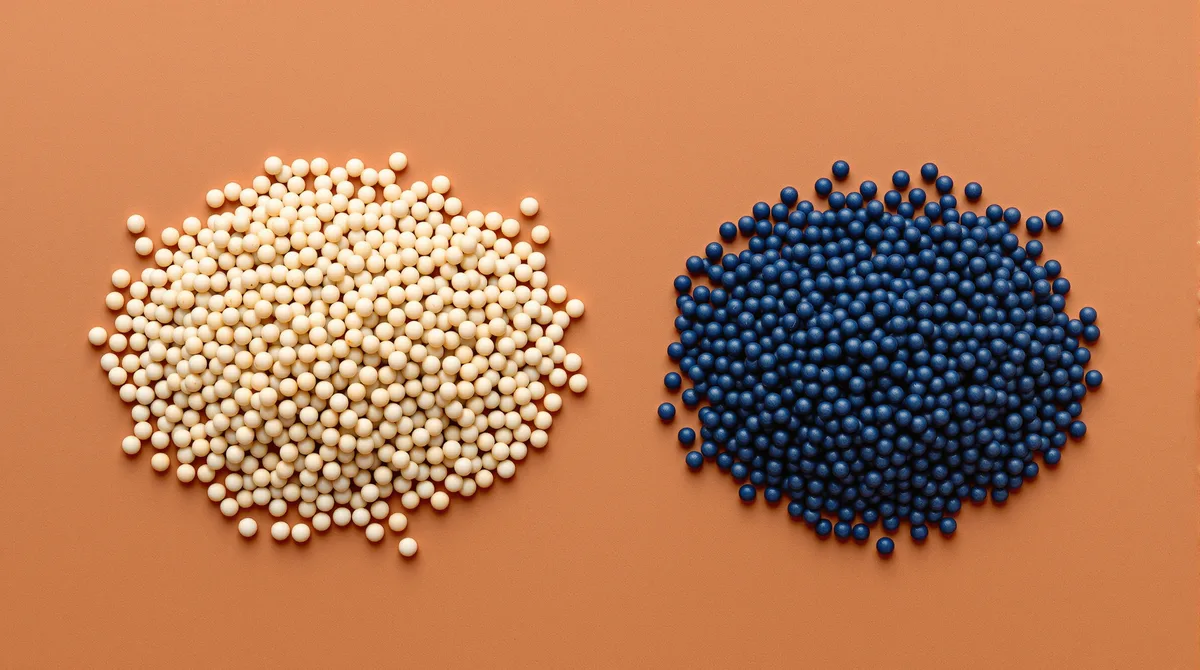
Process · Dyeing
There are three different things people mean by a coloured bead, and they fade at three different rates. Knowing which one is in a design is the difference between a programme that reorders cleanly and one that argues every season.
The same small round bead in two states: a pile left in its natural cream, and a pile dyed through to a deep even indigo.
Beads are dyed by matching to a colour reference or a physical chip and confirming the colour on the approved sample. Colourfastness then depends on where the colour sits: body colour in glass or ceramic glaze does not fade, a dyed polymer body is stable but a dye bath is a batch, and a dyed or coated surface is the only route that genuinely wears.
It is the process of bringing a bead to a colour after the bead exists. That separation is the whole subject. A glass bead's body colour is decided in the melt, before there is a bead at all; a ceramic bead's colour is a glaze fired onto it; but an acrylic, resin or faux capiz bead can be made first and coloured second, and so can a glass bead if you are willing to accept a surface dye.
Which of those applies decides everything a specification can say about fade, about reorders and about what a scuff looks like.
Seven stages, and the one buyers find surprising is the third. On most designs there is a bead whose colour cannot move — a pressed accent in a stock glass colour, a hand-made lampwork feature, a fired glaze — and the correct procedure is to let that bead lead and dye everything else to it. Trying to drag the immovable bead to the palette is how colour development stalls.
A design that holds together. The mechanism has a name in our own tech packs — dyed to match, usually written DTM — and it does a specific job: the base strand is dyed to the accent bead's colour so the accent reads as the subject of the panel instead of fighting its ground.
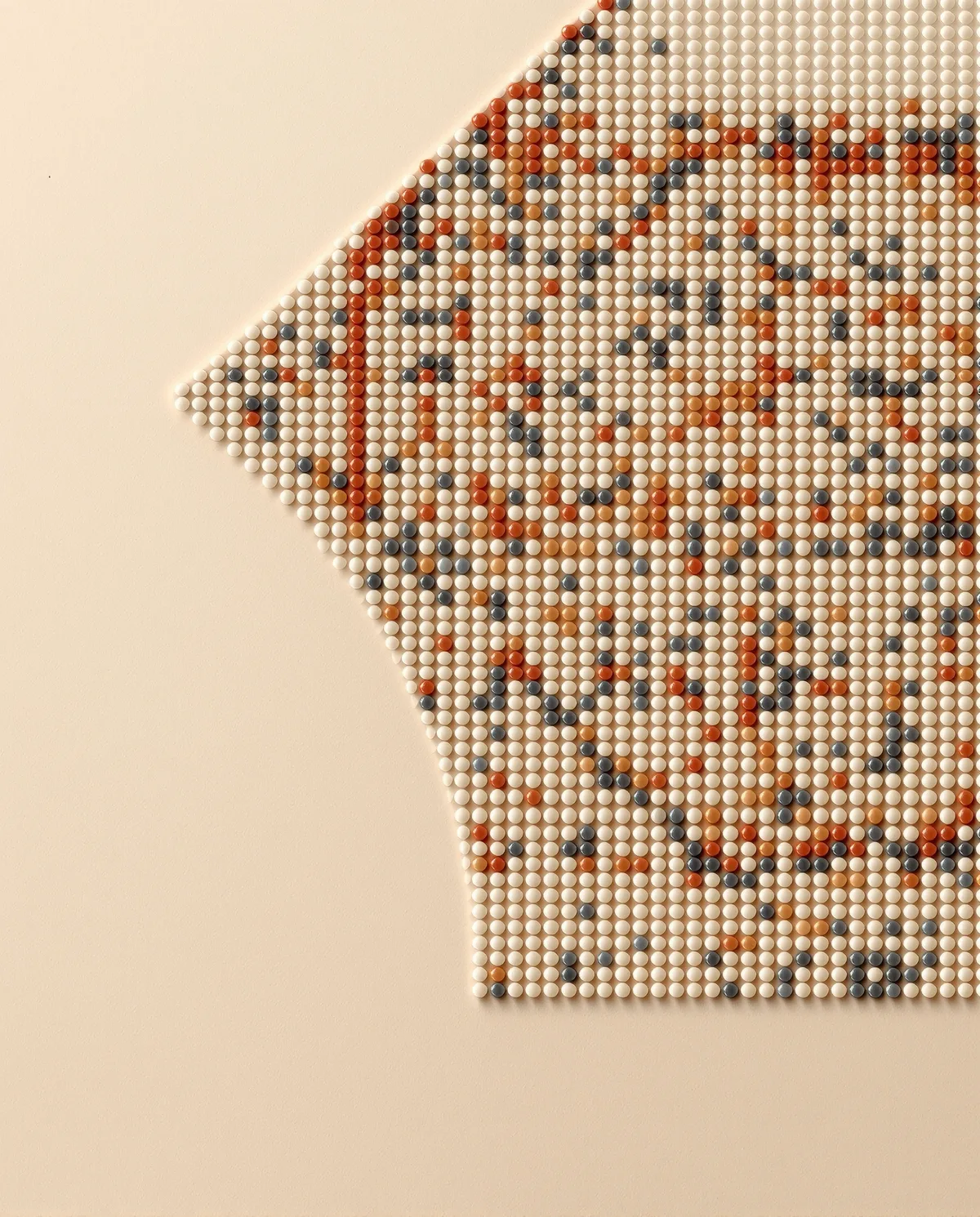
On our dotted portal construction the base seed beads are dyed to match the dot colours precisely so the scattered accents carry the design. On the cherry blossom wall hanging the small spacer bead at each blossom centre is dyed to match the blossom, so the thing that stops the petal sliding disappears into it.
Most of them, at the base. In our own record: a dotted construction with the base strand dyed to four separate accent colours and made in both transparent and opaque versions; a cherry blossom hanging with spacer beads dyed to the blossom; a daisy café curtain where the moulded connector beads and the beaded strands were dyed to one tonal family; and the acrylic portals, where the whole proposition is acrylic dyed to the buyer's colour.
In the 2027 design library, every colour story is a dyeing brief as much as a design one — but the strand and bead counts on those pages come from the renders rather than from shipped goods, and are labelled that way.
Bead names in positions, which is exactly why dyeing has to be recorded against it. A colour-count sheet that says "base bead, colour A" is useless on a reorder if nobody wrote down what colour A was dyed against and which lot it came from.
The sheet should therefore carry, for each dyed bead: the route, the reference, the retained-sample identifier, and the dye-lot policy. That is four short entries that save an argument a season later.
Acrylic and resin best, because the dye goes through the body: a scuffed edge shows the same colour instead of a pale substrate. Faux capiz dyes through for the same reason, which is the engineering argument against real shell.
Glass takes a surface dye only, and that is the least stable colour in the library. Wood takes a stain and gives a tone range. Bone, horn and shell take a tint that darkens and evens rather than recolouring. Fired ceramic glaze and glass body colour are not dyeing at all, and both are more colourfast than anything that is.
Not the bath — the matching. Dyeing a quantity of beads is a batch process and the time per bead is small. What takes time is arriving at the colour: a first dye, a view against the chip, an adjustment, a second dye.
A dyed acrylic colour is one of the quickest loops in the library. A new glass body colour is one of the slowest, because it needs furnace trials and an annealing check before any bead exists. That difference, not the bead price, is what usually decides which material a colour-led programme is built in.
Against a retained approved bead. The original reference is where the conversation started; the approved sample is what was agreed; and the second is the only fair standard to inspect against, because it is the thing the buyer looked at and signed.
That matters most where a programme reorders across seasons. A specification pointing at a reference alone will not settle a disagreement about whether a reorder matches, because the first run was itself a batch.
Four. Uneven coverage on a surface-dyed bead, which shows as a mottled strand. Visible drift between dye lots in one shipment, which is the one that gets found on a shop floor rather than at inspection. A base bead that does not actually match its accent, which reads as a muddy ground rather than as a wrong colour. And a stain on an uneven substrate presented as a colour match, which is what happens when wood is specified as though it were acrylic.
The first and third are rejected at the bench. The second is caught by lot discipline rather than by inspection, which is why the dye-lot policy is a specification entry and not a note.
Dyeing itself is cheap. What costs is iteration and lot discipline. Every extra round of colour matching is time at the front of the sample loop, and holding a dye lot across a long programme constrains when orders can be placed, which has its own cost in flexibility.
The lever is the number of colourways. A wide colourway set off one design in dyed acrylic is a short, cheap set of loops. The same set with one bead in body-coloured glass is a separate furnace conversation for every colour.
Dyeing and colour approval run in our own beadwork studios, where the beads are also strung, and glass colour is set upstream in our own Firozabad glass works. Beads are matched to a colour reference or a physical chip and confirmed on the sample. No agents, no brokers.
Colour is matched to your reference and approved on the sample, and what this page describes about fade is material behaviour rather than a warranty figure.
Extractable data
| Route | Where the colour sits | What it can promise |
|---|---|---|
| Body colour in glass | In the melt chemistry, through the glass | Does not fade; cannot be adjusted after the melt |
| Fired glaze on ceramic | Glass fused to the clay surface | Does not fade; developed and fired, not matched to a chip |
| Dyed through a polymer body | Through the acrylic or resin body | Stable in normal interior use; a scuff shows the same colour |
| Surface dye on glass | On the outside of the bead only | Batch-dependent and the least stable finish in the library |
| Surface coating, iridescent or metallic | A layer on the bead | Shifts with angle; abrades where beads knock |
| Dye on wood | Absorbed unevenly into grain | A tone range, never a colour match |
| Dye on natural shell, bone or horn | A tint over structural or natural colour | Darkens and evens; does not recolour |
| Dyed to match | Whichever route the base bead allows | Makes the accent the subject; still carries that route's fade behaviour |
Good to know
The bath is equipment and the process is controlled, but the decision is human and it is made against a physical chip in daylight. There is no instrument reading that overrules a buyer looking at a bead next to their chip, which is why colour is always approved on the sample.
It sits inside the normal sampling loop, which runs about sixteen to twenty days from an agreed brief, with photographs approved before the sample ships. A dyed acrylic colour is one of the shorter loops in the library; a new glass body colour needs furnace trials first and is longer.
The colour-count sheet is the bead-by-bead plan for every strand. Dyeing meets it at the bead names: the sheet calls for a specific dyed bead in a specific position, so a dye-lot change has to be recorded against the sheet or a reorder will not match.
Acrylic and resin dye through the body, which is the strongest route. Faux capiz dyes through. Glass takes a surface dye, which is the least stable finish here. Wood takes a stain that gives a tone range rather than a match. Bone, horn and shell take a tint that darkens rather than recolours. Fired ceramic glaze and glass body colour are not dyeing at all.
Against a retained approved bead, not against the original reference. The retained bead is what the buyer signed off, so it is the only fair standard — and it is what makes a dispute about a reorder resolvable rather than a matter of recollection.
Uneven coverage on a surface-dyed bead. Visible drift between dye lots on a large single-colour field. A dyed base that does not actually match the accent it was supposed to match, which shows up as a muddy ground rather than as a wrong colour. And dye on a substrate that could not take it evenly, which is what a stained wood bead looks like when it was specified as a colour match.
Body-coloured glass and fired ceramic will not. A dyed polymer body is stable in normal interior use. A surface-dyed glass bead or a coated iridescent finish is the one that will move in sustained direct sunlight, so for a south-facing window the specification uses body colour or a dyed-through polymer. Colour is matched to your reference and approved on the sample, so treat this as material behaviour rather than a warranty figure.
Keep exploring
Glossary
Dyeing one bead to another bead's colour rather than to a swatch — why it is used, and what it does not promise.
Compare the optionsMaterial
Moulded to our dies and dyed to the reference: the widest colour latitude in the library, half the weight of glass, and no shatter risk.
How it is madeMaterial
How seed beads are drawn, why dye lots are quoted per run, what the drill hole limits, and where seed-bead work earns its cost.
Open the referenceTechnique
What a bead map records, why a scattered accent has to be drawn rather than left to the bench, and why a reorder lives or dies on this one document.
How it is madeReference
Five craft families — strung, embroidered, wire-wrapped, knotted and wrapped fibre — and what each one is good for.
Open the reference
Start a conversation
Send a reference, a colour chip or a sketch. Minimums are set per design and confirmed per quote; sampling is quoted separately and usually runs 16 to 20 days from an agreed brief.