Technique
Hand-strung construction
The bead map, the cord, thirty strands on a dowel, hem shapes, suspension loops — and the three levers that move the cost.
See the detail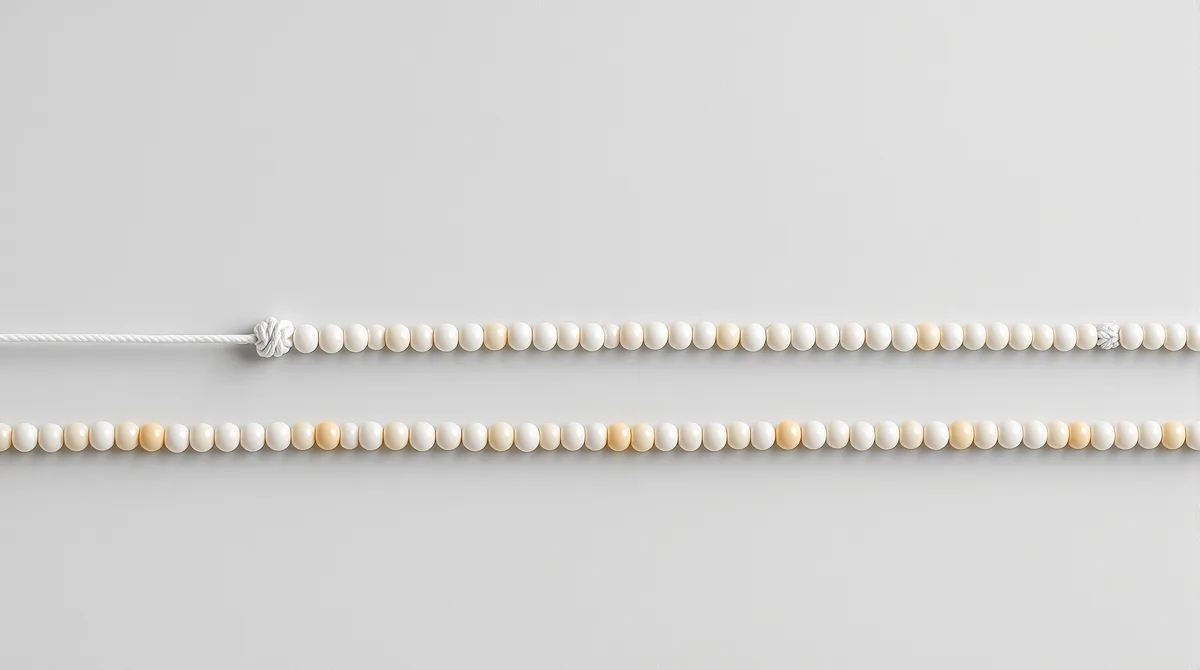
Process · Comparison
A machine can thread beads onto cord. What it cannot do is decide. Everything that separates the two constructions comes down to that one limitation, and it shows up in pattern, in hem, in repair and in price.
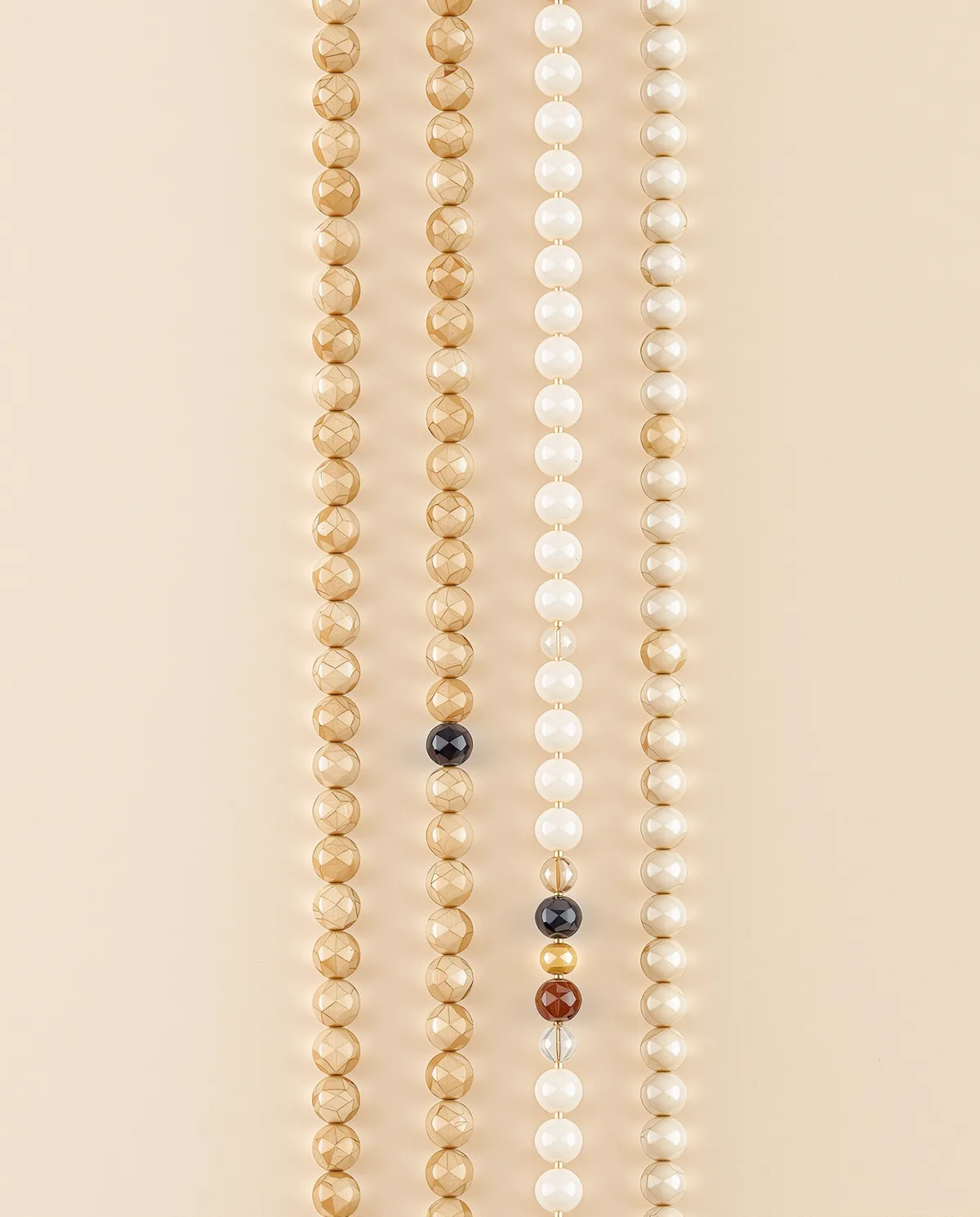
Two hand-strung strands laid parallel for comparison: the upper one knotted between every bead so each sits apart, the lower one unknotted with its beads pushed solid against one…
A machine can thread a simple repeating sequence of uniform beads onto cord at speed. It cannot place a scattered accent, grade a bead size down a drop, cut a shaped hem, or mix bead families with different hole diameters. Everything our own record ships is hand-strung, because every design in it needs at least one of those four things.

A machine can thread beads onto cord. It cannot decide which bead, or where. Feeding is a mechanical repetition of one sequence; stringing a designed panel is a series of judgements made against a drawing.
Everything in our own shipped record is hand-strung, and that is not a positioning choice. It is because every design in it contains at least one feature a feeder cannot produce.
Machine stringing feeds uniform beads from a hopper onto cord in a fixed repeat. It needs beads of one family with one hole diameter, a sequence that does not vary, and a constant strand length. Within those constraints it is fast.
Hand stringing threads beads one at a time in the order a colour-count sheet specifies. Hand-strung strand construction sets out the full sequence: bead map, colour match, cord sized to the smallest hole, stringing, gathering on the dowel, hem, mount.
| Question | Machine-strung | Hand-strung |
|---|---|---|
| Uniform repeating sequence | Yes, and quickly | Yes |
| Mixed bead families in one strand | No — needs one hole diameter | Yes, cord sized from the smallest hole |
| Scattered accent, no two level | No | Yes — drawn into the bead map, 3–4 per strand |
| Ombre graded by bead size | No | Yes |
| Shaped hem: diagonal, scalloped, arched | No — every strand a different count | Yes |
| A figure or motif | No | Yes, by manual assembly from a reference |
| Bead count on a dense 90 × 200 cm panel | Not applicable | About 11,800, each placed by hand |
| Repair of a broken strand | Replace the panel | Re-strung from the colour-count sheet |
Four rows in that table decide almost every real case. Mixed bead families: a feeder needs one hole diameter and a designed panel almost never has one. Placed accents. Graded bead sizes. And a shaped hem, which means a different bead count on every strand.
That the four exclusions are not edge cases. A dotted portal construction places 90 to 120 oval glass accents three to four per strand, scattered, never aligned. A mushroom construction does the same with up to four accents per strand on a seed-bead base. A valance carries a scalloped arch hem, fullest at the sides, with the longest strand at 24 inches and the shortest at 10. An ombre curtain is graded by bead size rather than dyed.
And one design was pattern-mapped by hand from a reference image because no artwork file was supplied — a continuous line motif with graded shading, assembled manually. There is no feeder on earth that produces that.
Hand stringing, and we would say why in the quotation rather than leaving it implied. Where a design genuinely is a plain single-bead strand on a straight hem, we would say that too, and cost it as the simple construction it is — because pretending a plain panel is complicated is the fastest way to lose the comparison on price.
The useful move for a buyer is to ask which of those features their design has. That question converts a vague "why is handmade more expensive" into a list.
Neither construction changes the weight, which is worth saying because it is the first thing people assume. Weight follows bead material and bead count: a 10 mm round works out near 1.2 g in glass, 0.6 g in acrylic and 0.4 to 0.5 g in most woods — arithmetic from nominal densities, not weighed figures.
What construction does change is where weight can be put. A hand-strung strand can carry a heavier bead low down to pull the drop straight, and a graded build can put the largest beads at the hem. A uniform fed strand has the same bead everywhere by definition.
Neither, and the question belongs to the bead rather than the build. Body-coloured glass and fired ceramic glaze do not fade. A dyed polymer body is stable in interior use. A surface-dyed glass bead or a coated iridescent finish is the one that moves.
The construction only enters at one point. A hand-strung panel built to a count sheet can have a faded strand replaced; a panel with no sheet cannot.
Hand stringing, and the cost is placement hours. A densely patterned 90 by 200 cm curtain holds about 11,800 beads and every one is placed by hand. That single figure is the most persuasive thing in this whole category, because it reframes the price from "a curtain" to "eleven thousand eight hundred decisions".
Because the cost is in the placements, the levers are all bead-count levers: a larger bead on any flat field, a scattered accent instead of a covered strand, or a shorter drop. Cutting the width saves least, because the header work does not shrink with it. On our own record a valance was brought to its target by reducing its height from 30 to 26 inches, and a pillow development by de-densifying its infills.
Identical, for the same construction and the same beads. Freight is material and count. Where the two constructions diverge is in what they allow you to do about freight: a hand-strung design can be re-specified in a lighter bead or at a wider spacing and still be the same design, because the count sheet absorbs the change.
Both fail at the cord, and both can shed a strand. The real asymmetry is repair. A hand-strung panel with a colour-count sheet behind it can be re-strung bead for bead, which is why a broken strand is a repair rather than a write-off. A panel without a sheet has no repair route.
That is a construction difference in practice if not in principle, because the kind of work that gets machine-fed is also the kind that does not get documented.
A buyer whose design is a plain uniform strand, in one bead, with a straight hem, at very high volume and at the lowest achievable price, is describing something a feeder can make. That buyer should say so plainly and should not be sold hand work.
Every other buyer — a retailer wanting a named style with an accent, a designer specifying a gradient, a hospitality project wanting a shaped portal opening — is describing hand work, and the only question left is which cost lever to pull.
Rarely usefully. Feeding a plain base and then placing accents into it means opening the strand again, which costs more than stringing it once in the right order.
Where mixing does work is at the component level rather than the strand level. A café curtain with a cotton header band and a three-inch rod pocket is a sewn textile part plus a strung bead part, made separately and assembled — and our own café constructions are built exactly that way, with a beaded top band above hand-strung strands.
Good to know
They are not competing for the same work. A machine is good at a uniform repeat of identical beads, and nothing we ship is that. Every design in our record needs at least one of four things a feeder cannot do: a mixed bead family, a placed accent, a graded size, or a shaped hem.
Specify the design and let the construction follow. If the design is a plain single-bead strand with a straight hem, say so and it will be costed as the simple thing it is. If it has an accent, a gradient or a shaped edge, it is hand work and the quote should be read as buying hours rather than buying beads.
Hand stringing costs more, and the cost is hours of placement. On a densely patterned 90 by 200 cm curtain there are about 11,800 beads and every one is placed by hand. That is why the cost levers reduce bead count — a larger bead, a scattered accent instead of a fully covered strand, a shorter drop — rather than trying to remove the hands.
In principle a plain base strand could be fed and the accents placed afterwards, and in practice it is rarely worth it. Placing an accent into an existing strand means opening it, which costs more than stringing the strand in one pass. Where the base and the accent are genuinely separate components — a cotton header band with a beaded trim, for instance — the parts are made separately and assembled, which is a different thing.
Neither. Colour is a bead property, not a construction one, and it is set by the colour route: body colour in glass, dyed through a polymer body, or a dyed surface. Bead dyeing and colourfastness sets out which of those move and why.
Also neither, for the same reason. Freight follows bead material and bead count. Glass is about twice acrylic for the same volume and acrylic is about twice most woods, and strand spacing multiplies whichever you chose.
The difference is in repair rather than in failure. Both constructions fail at the cord, and both can shed a strand. A hand-strung panel built to a colour-count sheet can be re-strung from that sheet, bead for bead, which is why care and cleaning treats a broken strand as a repair. A panel with no sheet behind it has no repair route, whatever made it.
Keep exploring
Technique
The bead map, the cord, thirty strands on a dowel, hem shapes, suspension loops — and the three levers that move the cost.
See the detailTechnique
What a bead map records, why a scattered accent has to be drawn rather than left to the bench, and why a reorder lives or dies on this one document.
Open the referenceMaterial
How seed beads are drawn, why dye lots are quoted per run, what the drill hole limits, and where seed-bead work earns its cost.
Read moreColour story
Cornsilk to deep amber down the drop, with the colour change landing on a change of bead size rather than on a dyed gradient.
See the detailReference
Five craft families — strung, embroidered, wire-wrapped, knotted and wrapped fibre — and what each one is good for.
Specs and sizes
Start a conversation
Send a reference, a colour chip or a sketch. Minimums are set per design and confirmed per quote; sampling is quoted separately and usually runs 16 to 20 days from an agreed brief.