Technique
How a panel is strung
The bead map, the cord, thirty strands on a dowel, hem shapes, suspension loops — and the three levers that move the cost.
View the range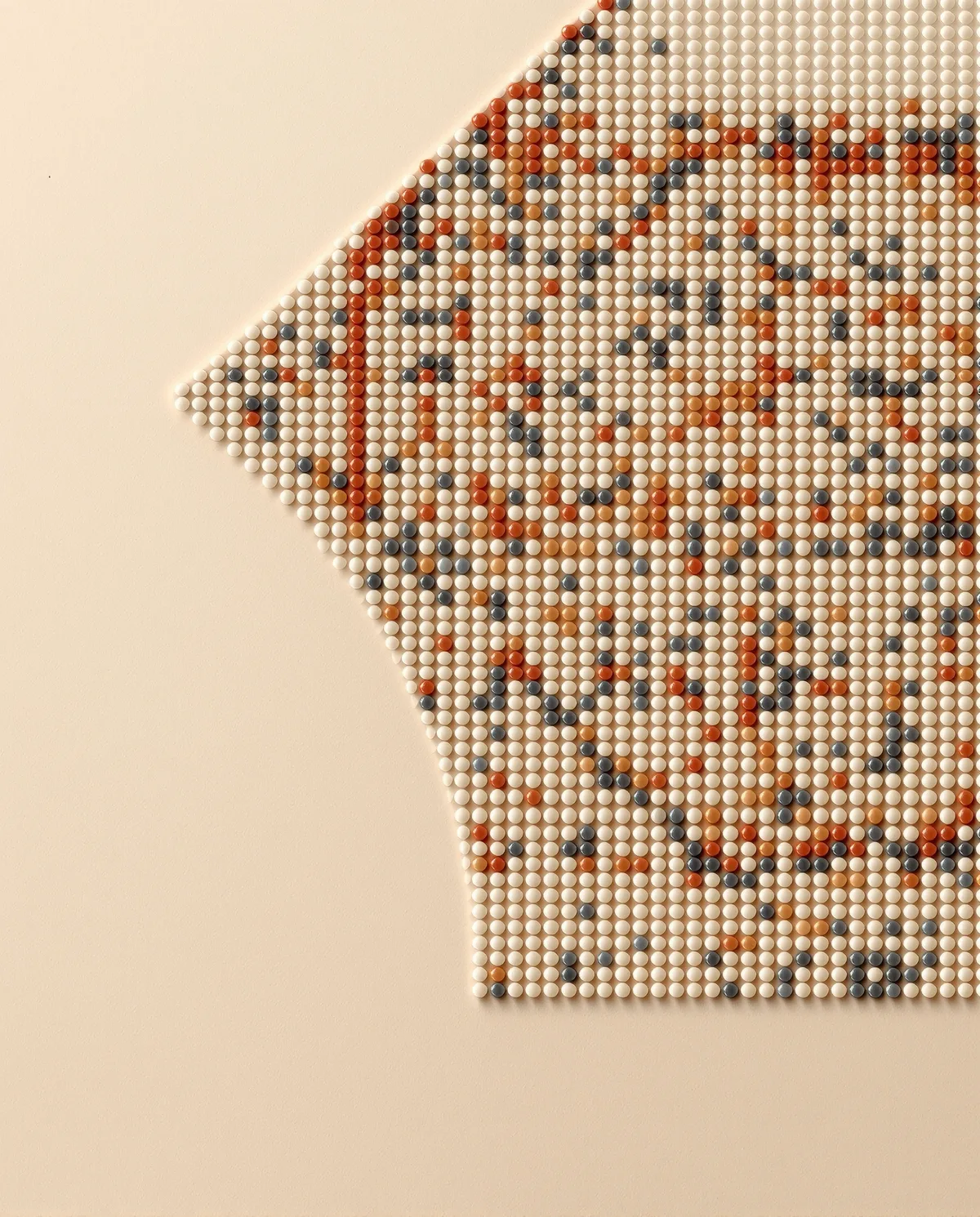
Technique · Documentation
Everything else in a beaded programme can be reconstructed. The colour-count sheet cannot. It is the bead-by-bead plan for every strand, and it is the only reason a second production run looks like the first.
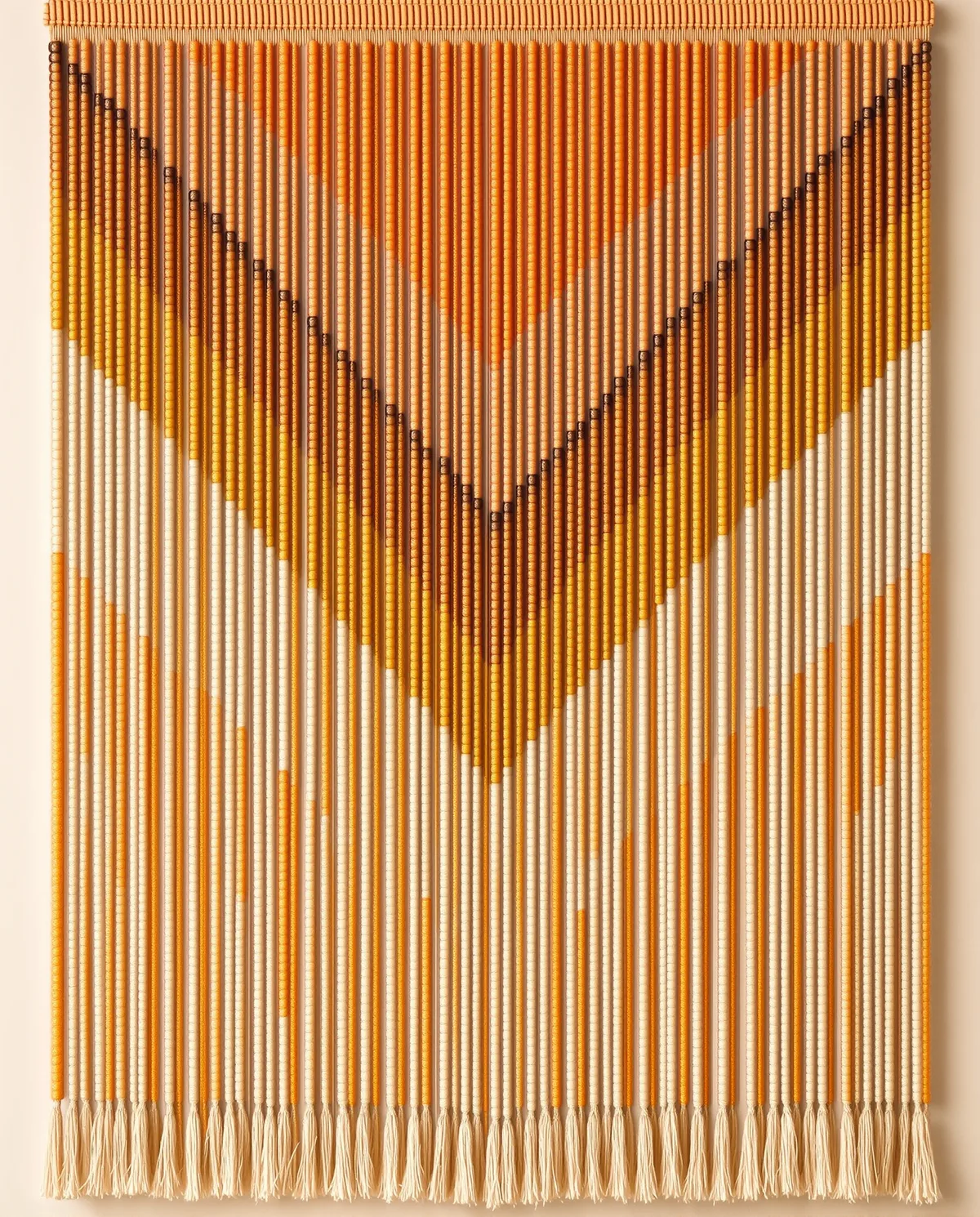
A bead map worked out in beads themselves: one bead to a grid position, the flat geometric repeat that a beadworker follows strand by strand.
A colour-count sheet, also called a stringing sheet, is the bead-by-bead plan for every strand in a piece: which bead, in which colour, in which position, on how many strands, to what drop. It is what makes a pattern repeat exactly across a production run and keeps strand lengths identical, and it is the document a reorder is held to.
It is the drawing a beadworker follows. Before any bead goes onto cord, the sheet fixes every bead position — strand by strand, position by position — and records which bead material sits where. The salvaged terminology in our own corpus calls it the colour-count sheet or the stringing sheet, and treats it as the central concept of the whole category, which is correct.
Two names, two uses. The bead map is the visual grid; the colour-count sheet is the tabular version, with counts per colour, per strand and per piece. A bench works from one and a costing from the other.
Seven stages, and the order matters more than it looks. Size and hem come before strands, because a shaped hem is a set of strand lengths. Pitch comes before count, because pitch is what survives a resize. Bead identity comes before layout, because the layout depends on the bead's real dimensions, not on the drawing's.
A second production run. That is the answer, and it is worth stating bluntly: every other document in a beaded programme can be reconstructed from the goods, and this one cannot. A finished panel tells you what it looks like. It does not tell you the pitch, the drop set, which of two similar beads was used, or what the offsets were.
It also makes repair possible. A broken strand on a shipped panel is re-strung from the sheet, which is why care and cleaning treats a broken strand as a re-string rather than a write-off.

By being the thing inspection measures. Strand count, drop lengths, bead identity in sampled positions, accent distribution — each is an entry on the sheet, so each is checkable. A first-article inspection against a sheet is a measurement; the same inspection against a photograph is an opinion.
Colour is the one entry that cannot live on the sheet alone. The sheet points at a retained approved bead, because a dyed colour is a batch property and a colour word settles nothing.
The worst one is alignment. Where accents are meant to look scattered, any drift towards a row destroys the effect — an aligned accent reads as a stripe, and from two metres a stripe is all you see. That is why the scatter is drawn in with offsets rather than described as "random": asked to place beads randomly, a careful beadworker will produce something regular, because regular is what careful looks like.
After that: uneven drop lengths, which make the hem waver; bead substitution mid-run; and a reorder built from a reconstructed pitch.
The sheet is a few days of work on a simple design and a substantial fraction of the development on a complex one. It is a one-off cost that pays back on every reorder, which is why it is written even for a single-season style.
The lever worth knowing is pattern type. A repeating pattern is quick to document and quick to string. A gradient is slow to document and slow to hold. On one of our own 2025 wall-art developments the cost was brought down specifically by replacing a gradient with a repeating pattern — the same arithmetic that makes a size-graded ombre cheaper than a dyed one.
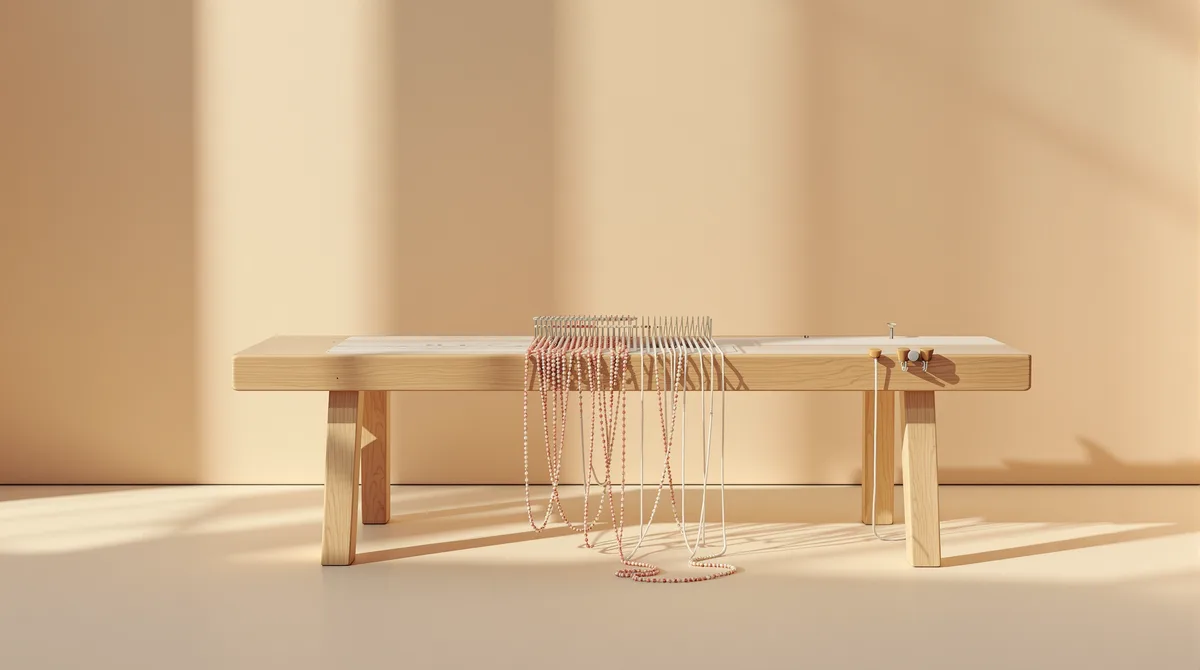
In our own studios, on a grid or loom layout, with calipers and the retained sample beads to hand. Our archive includes pattern drafts worked out as pixel grids — one bead to a cell — for the portal designs, which is the same discipline a loom pattern uses.
The newest route in is the Design Studio: a design built there is assembled from named beads, so the render already carries its own bead list. From a render to a costed tech pack follows what happens next.
None inherent to the document, and that is the point of recording pitch. In our own 2027 figures a 90 cm curtain runs about 40 strands at roughly 2.25 cm pitch and a 120 cm curtain about 60 strands at roughly 2 cm — design-library figures, confirmed at sampling, and they show the principle: hold the pitch and the design scales.
Where limits do appear they are physical rather than documentary. Flat bead embroidery is worked on a frame, and the frame sets the practical maximum width; above it the format is a strung one rather than an embroidered one. No sheet can argue with that.
Against the sheet, in a fixed order: dimensions, strand count, drop set, header and end treatment, then bead identity and accent distribution by sampling rather than exhaustively. Colour last, against the retained bead in daylight.
Inspection and export packing for our beaded work run through our own Greater Noida quality and packaging house, whose capability list covers first-article and lot inspection, assembly and kitting, and export packing and labelling.
Enough to let the sheet be written: product type, finished size with the longest and shortest drop, strand count or pitch — or a reference photograph showing the density wanted — the bead material, shape and size for the main bead and any accents, the colours as references or physical chips, the pattern as artwork or a reference image, the top fixing, the edge shape, and the packing.
Everything on that list is in our own spec-sheet template, and the one entry buyers most often leave out is pitch or density. Without it the manufacturer chooses, and the manufacturer's choice will be reasonable rather than yours.
All of them, including the ones that look least planned. The dotted and mushroom portal constructions place their accents three to four per strand, randomly, specifically so that no two land level across neighbouring strands — and that randomness is drawn into the bead map rather than left to the bench. The cherry blossom hanging records two different blossom counts for its two header versions, because the dowel and rod-pocket builds are not the same piece.
In the 2027 design library every design carries a strand count and a bead count; those are derived from the renders rather than from shipped goods, and the design pages say so.
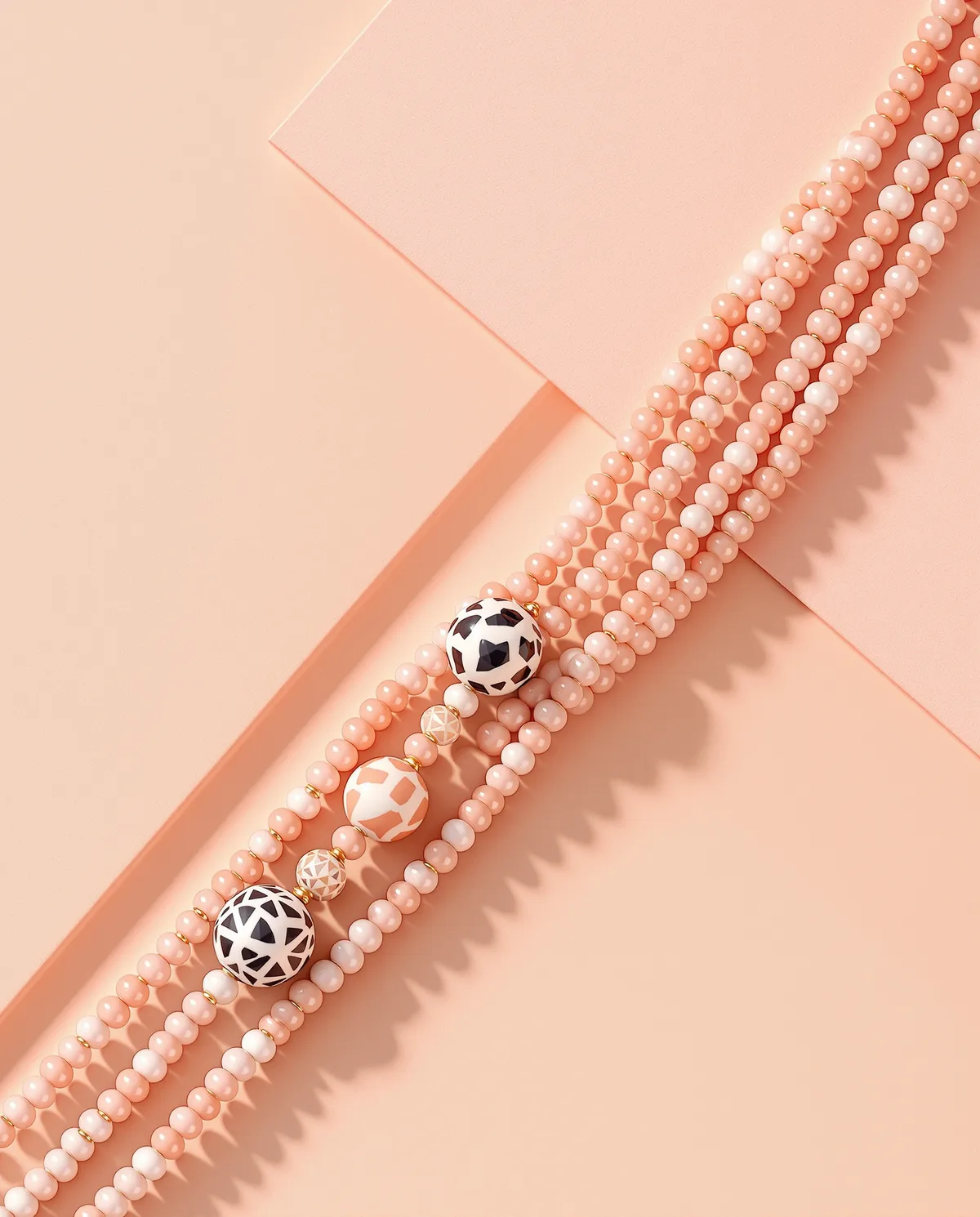
Every material in the library, because the sheet documents construction rather than substance. A glass seed-bead ground, a dyed acrylic field, a wooden bead curtain and a linked faux capiz disc hanging all use the same structure.
The only thing that changes is the unit. A strung panel counts beads per strand; a linked disc hanging counts discs per column and columns per piece. Linked disc construction sets out why those are genuinely different builds rather than the same one at a different scale.
Extractable data
| Entry | Why it is there | What goes wrong without it |
|---|---|---|
| Finished width and longest drop | Sets the piece | Nothing can be cut to length |
| Shortest drop, where the hem is shaped | Defines a scalloped, diagonal or arched edge | Hem shape becomes a beadworker's judgement |
| Strand pitch and strand count | Pitch reproduces density at any width | A re-sized piece changes character |
| Bead identity per position | Material, shape, size, drill hole, colour route | The wrong bead in the right place |
| Retained-sample reference | Colour is held to a bead, not a word | A reorder cannot be measured against anything |
| Accent positions with offsets | Makes a scatter read as a scatter | Accents drift into rows and the design is lost |
| Cord specification | Sized from the smallest hole in the build | The piece cannot be assembled |
| Top fixing and end treatment | Dowel, rod pocket, suspension loops, end bead | The panel hangs unevenly |
Good to know
The sheet is what inspection measures against. A finished piece is checked for strand count, drop lengths, bead identity in sampled positions and accent distribution, and each of those is an entry on the sheet. Without it an inspector is comparing a piece to a photograph, which settles nothing.
Accents drifting into rows, which is the commonest and the most damaging. Strand lengths that vary so the hem wavers. The wrong bead substituted mid-run. And a reorder that reads as a different style because the pitch was reconstructed rather than recorded.
Yes, and that is the main reason it records pitch rather than only strand count. A 90 cm piece at a given pitch and a 120 cm piece at the same pitch read as the same design at two sizes. Keep the strand count and change the width and you change the design.
The grid layout can be drawn on a loom or pattern tool, and the Design Studio produces a bead list straight out of a render. The judgement — where the scatter sits, which bead leads the colour, how the hem resolves — is human, and the sheet is where that judgement is written down.
It depends entirely on the pattern. A plain-strand panel is a short document. A graphic pattern with a figure in it is slow, because every position has to be resolved: one of our smiley designs was pattern-mapped by hand from a reference image because no artwork file existed, and that mapping was the bulk of the development.
All of them, because it is a construction document rather than a material one. The same sheet structure serves a glass seed-bead ground, a dyed acrylic panel, a wooden bead curtain or a linked faux capiz disc hanging — only the bead identities and the column logic change.
In practice they are two views of the same thing. The bead map is the visual layout — a grid showing where each bead sits. The colour-count sheet is the tabular version a bench and a costing can both use: counts per colour, per strand, per piece. One is for the eye and one is for the arithmetic.
Keep exploring
Technique
The bead map, the cord, thirty strands on a dowel, hem shapes, suspension loops — and the three levers that move the cost.
View the rangeGuide
The bead list becomes a colour-count sheet, the sheet becomes a costing, the costing becomes a sample — and what each stage needs from you.
Specs and sizesSpecification
Diameters, drill holes, cord selection, strand counts and format dimensions — the sheet to copy into a tech pack.
Read the guideProcess
Colour through the body, colour in a dye bath, colour on a surface — what each one promises, what a dye lot is, and what direct sun does to all three.
Read the guideReference
Five craft families — strung, embroidered, wire-wrapped, knotted and wrapped fibre — and what each one is good for.
View the range
Start a conversation
Send a reference, a colour chip or a sketch. Minimums are set per design and confirmed per quote; sampling is quoted separately and usually runs 16 to 20 days from an agreed brief.