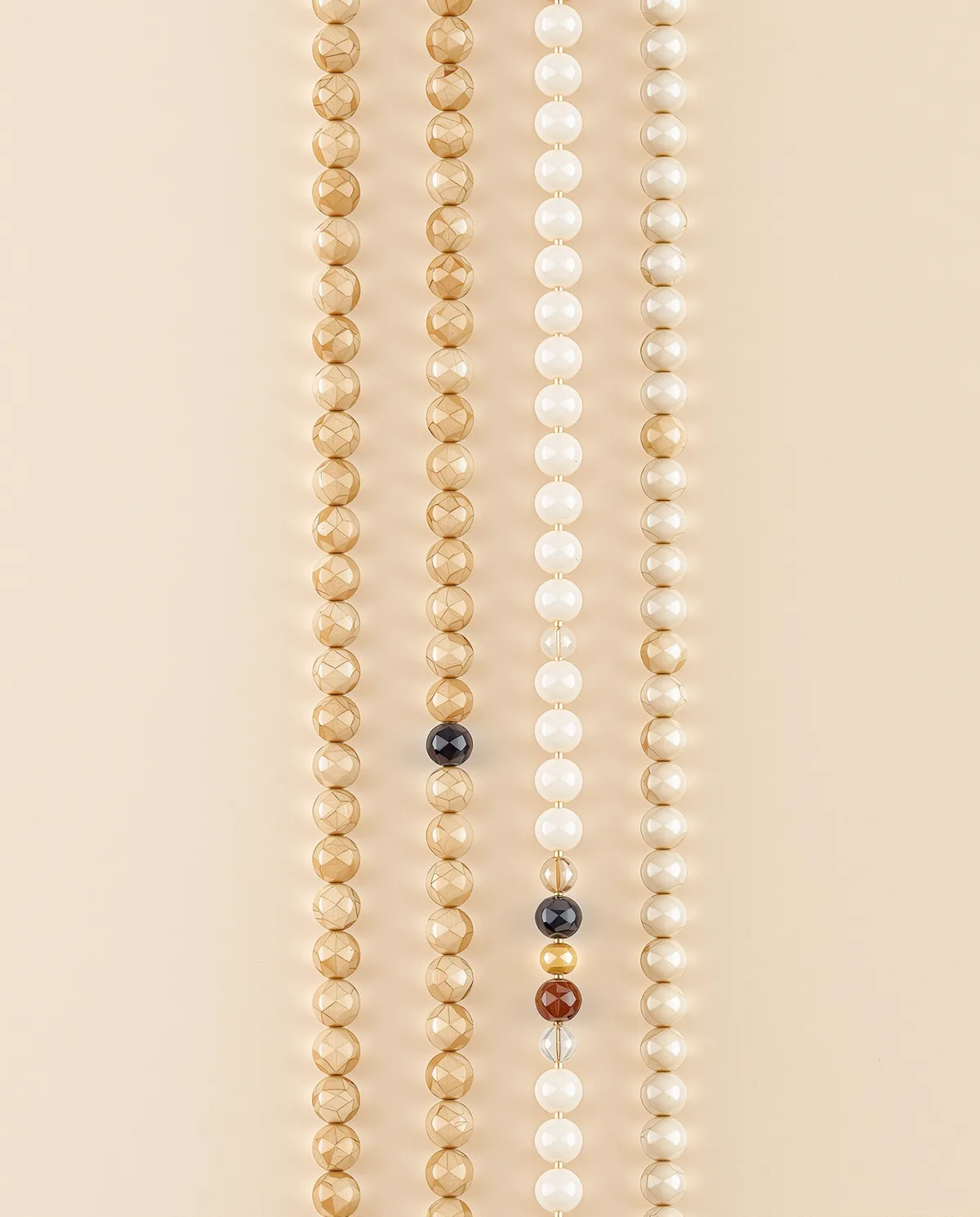
Specification
Panel density
Width divided by pitch gives the strand count — the value that sets density, weight, view-through and cost together.
Compare the optionsReference · Bead count
Two panels of identical dimensions can differ in bead count by a factor of nearly four. That spread is why minimums and prices are quoted per design.
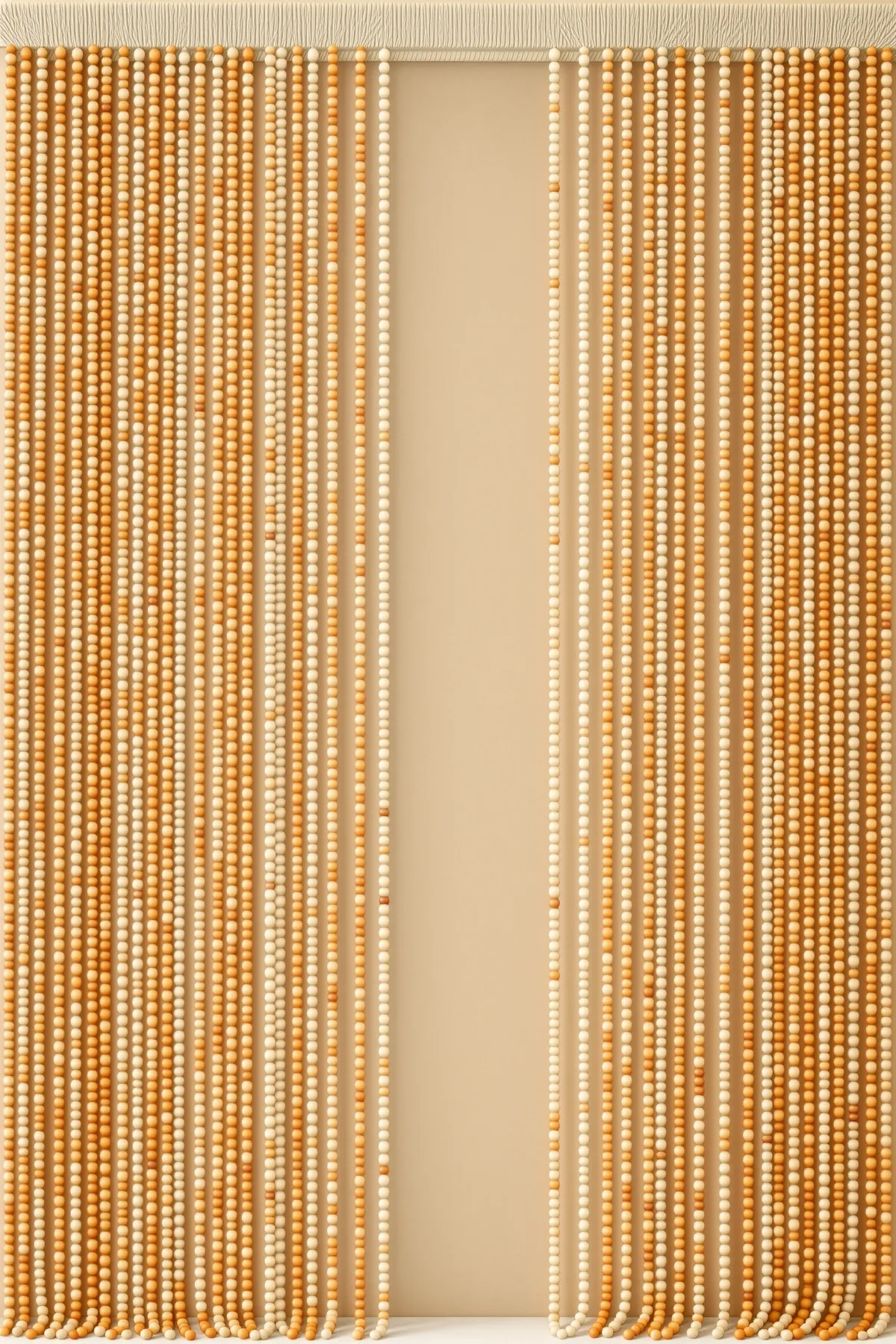
Bead count follows three values: strand count, drop and bead outside diameter. A densely patterned 90 by 200 cm curtain can hold about 11,800 beads, while a spaced panel of the same dimensions in the design library holds about 3,100. That near-fourfold spread at one size is why minimums and prices are quoted per design.
Not a number from the buyer. Bead count is an output. What the specification has to contain is the four inputs that produce it: strand count, drop, bead outside diameter and the pattern.
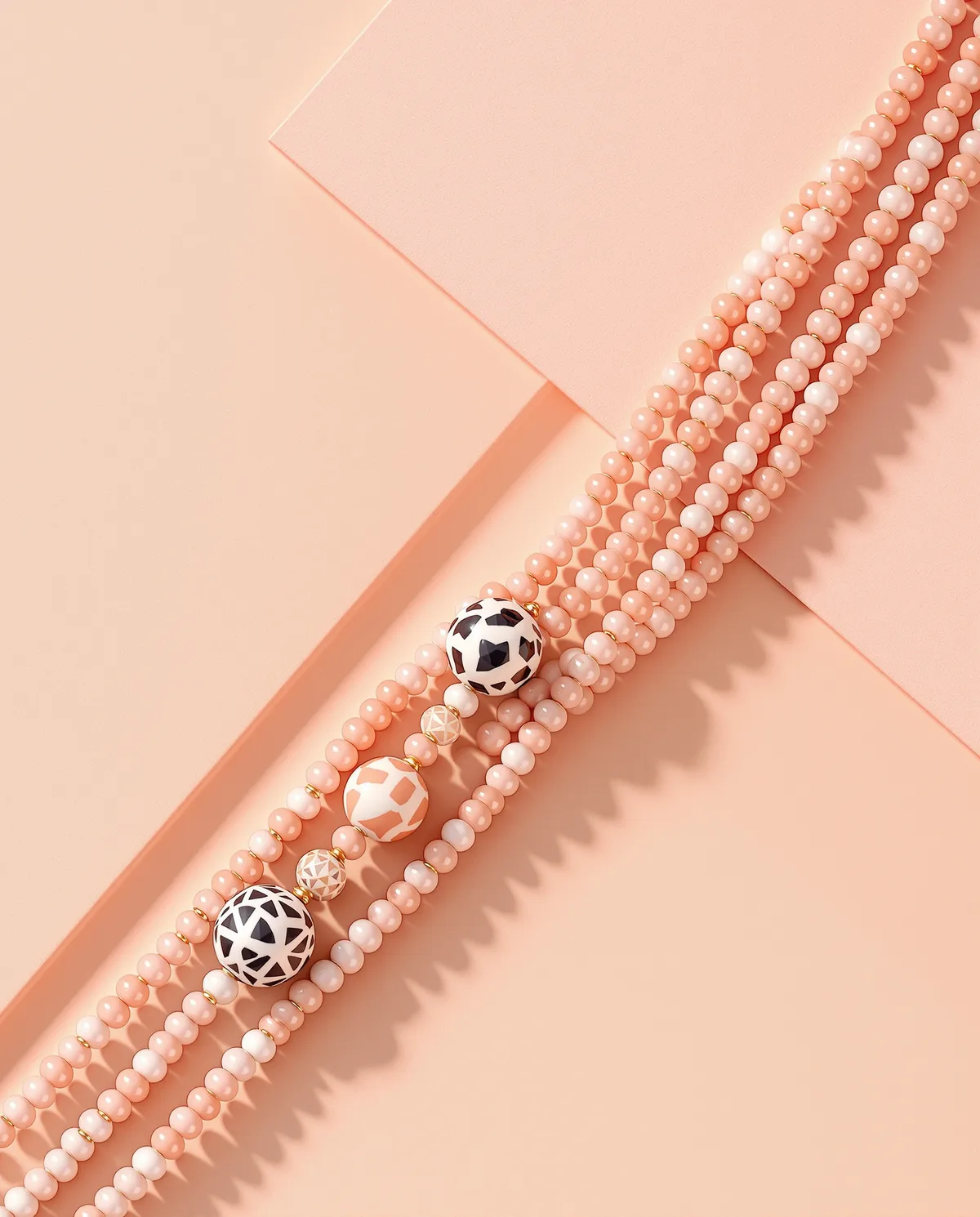
Given those, the count can be estimated before anything is made, which is what lets a rough cost sheet exist before a sample does.
| Format and density | Bead count | Origin |
|---|---|---|
| 90 × 200 cm, densely patterned | About 11,800 | Record |
| 90 × 200 cm, spaced strands | About 3,100 | Library |
| Full-length panel, 90 × 200 to 120 × 210 cm | About 3,100–5,600 | Library |
| Café curtain, 76 × 76 cm | About 1,800 | Library |
| Valance, 120 × 30 to 40 cm | About 900–2,000 | Library |
| Dotted oval accents, 13 × 22 mm | About 90–120 per panel, 3–4 per strand | Record |
| Glass mushroom accents | About 120 per panel, up to 4 per strand | Record |
| Laser-cut blossoms, 18 × 30 in hanging | 130 on a rod pocket, 155–170 on a dowel | Record |
| Linked faux-capiz discs | About 239–497 discs | Library |
The firm figure is the dense one. A densely patterned 90 by 200 cm curtain can hold about 11,800 beads, and every one of them is placed by hand. That is a production-record number.
The range figures come from the 2027 design library — drawn designs rather than measured sampled product. A spaced 90 by 200 cm panel at 40 strands comes out around 3,100 beads, and the full-length library range sits between about 3,100 and 5,600.
Beads per strand is the drop divided by the bead outside diameter, less any planned bare cord. Multiply by the strand count and you have the panel. For a mixed-size strand the calculation is done in segments, one per bead size.
After mapping, the count is not estimated at all — it is read off the colour-count sheet, which records every bead in every position. That is the number a quote is built on.
Directly, in two places. It is the material line, and it is the stringing hours. A graphic panel at over eleven thousand beads carries both at the top of their range, which is the real answer to why beaded panels cost what they do.
It is also the lever most available to a buyer who needs a price down. De-densifying — planning bare cord into the strands rather than filling them — reduces the count while keeping the format, the pitch and the apparent scale of the piece. Changing a gradient to a repeating pattern does something similar by reducing the number of distinct bead colours that have to be held and sequenced.
That accent counts are small and the base counts are large. On a dotted portal, the 13 by 22 mm oval dotted glass beads run about 90 to 120 per curtain, scattered three to four per strand. On a mushroom portal, about 120 glass mushroom beads per curtain, up to four per strand.
Those accents are what the design is about and are a fraction of a per cent of the bead count. The thousands of beads are the base seed-bead strands carrying them, which is why a dyed-to-match base is the economical way to make an accent read.
As a derived figure, not a requirement. The pack states the drop, pitch, bead diameters and pattern; the count appears alongside as information, usually once the colour-count sheet exists.
Where a buyer has a target cost rather than a design, the count is the number both sides negotiate against. That is the conversation a rough cost sheet is for: showing where the cost sits before any sample is made, so look can be traded against price early.
The colour-count sheet, by counting. Selected strands are read position by position on the opening pieces at first-article inspection, and the longest and shortest drops are measured.
On scattered-accent builds there is a second check that matters more than the count: accent placement. The accents are specified to fall randomly and never to align in a row across the panel, and a run where they have drifted into rows has failed even if the count is right.
Beads per centimetre. A 3 mm bead does not give three beads per centimetre — it gives about three and a third, and over a two-metre drop that difference is nearly seventy beads per strand. On thirty strands it is two thousand beads.
The other is assuming count scales with area. It does not: it scales with strand count times drop, so halving the width halves the count while halving the drop also halves it, and a buyer trimming width to save money often saves less than expected.
The spec table above. It is organised by format and density together, because neither alone predicts a count.
Read it against the strand count and pitch sheet, which supplies the pitch figures the counts were derived from, and the formats sheet, which supplies the drops.
A bead count per format. The format does not determine the count — the design does — and the two record figures at 90 by 200 cm differ by nearly a factor of four.
Bead weight, beads per kilogram and price per thousand all follow from the bead actually specified, so they are confirmed with your quote.
Nothing breaks, because count is derived. What breaks is the cost expectation: a buyer who has not thought about density has not thought about the single biggest driver of their price.
The useful first question on any bead brief is not how big but how full, and this page exists to give that question numbers.
Through diameter, and sharply. Glass seed beads at 1 to 3 mm outside diameter give the highest counts and the densest fields. Frosted sea-glass beads at about 4 to 5 mm give a mid count with a soft surface. A 13 by 22 mm pressed oval gives very few per strand and is used as an accent for exactly that reason.
A moulded almond bead about 3 inches long, used as a connector to form a 6 inch motif, is the extreme: a handful per panel, each one doing the work of dozens of small beads.
Good to know
Because bead count belongs to the design rather than to the format. A densely patterned 90 by 200 cm panel holds about 11,800 beads and a spaced one of the same dimensions about 3,100. Publishing one number for that format would mislead by a factor of nearly four.
The only figure with a firm record behind it is that a densely patterned 90 by 200 cm curtain can hold about 11,800 beads, every one placed by hand. Everything else on this page is either a design-library estimate or an accent count from a specific build.
Estimated before sampling, counted after. The estimate is strand count multiplied by beads per strand, where beads per strand is the drop divided by the bead outside diameter, less any planned bare cord. The actual count comes off the colour-count sheet once the design is mapped.
On an estimate, treat it as plus or minus a bead or two per strand, which on thirty strands is a few dozen beads and does not move a cost. On a counted sheet the number is exact, because every position is written down.
Sharply, through diameter. A 1 to 3 mm seed bead gives many times the count per centimetre of drop that a 13 by 22 mm oval does. A frosted sea-glass bead at about 4 to 5 mm sits between them, which is why a whole-strand sea-glass field is a mid-count build.
Not a bead count. State the drop, the pitch, the bead diameters and the pattern, and the count falls out of them. A brief that specifies a bead count instead has over-constrained the design and will usually produce a sample that reads wrong.
Selected strands counted against the colour-count sheet, position by position, on the first-article pieces. Accent position is checked too: on a scattered build the accents are placed so no two fall level across the panel, and an accent that has drifted into a row is a defect.
Keep exploring
Specification
Width divided by pitch gives the strand count — the value that sets density, weight, view-through and cost together.
Compare the optionsReference
The five levers that move a bead price, in order of effect, and why cost per square foot does not describe this product.
Open the referenceReference
Specification sheets and definitions — the pages to send a designer before they draw.
View the rangeSpecification
Every format we build with its verified size, and a note on which figures are shipped and which are drawn.
See the detailSpecification
Dowel, stained header rail, sewn rod pocket or suspension loops — what each hangs from and when each fits.
How it is made
Start a conversation
Send a reference, a colour chip or a sketch. Minimums are set per design and confirmed per quote; sampling is quoted separately and usually runs 16 to 20 days from an agreed brief.