Material
Glass seed beads: sizes, dye lots and cord
How seed beads are drawn, why dye lots are quoted per run, what the drill hole limits, and where seed-bead work earns its cost.
Read more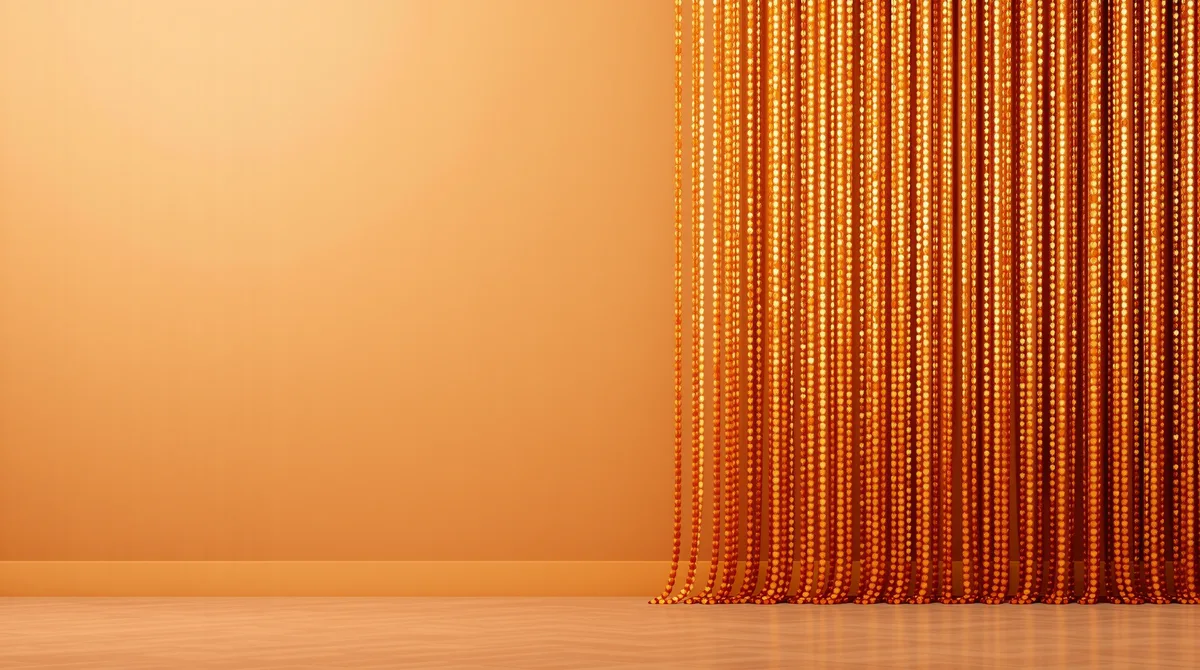
Colour story
Cornsilk at the header, honey through the middle, deep autumn amber at the hem — and not one dyed gradient anywhere in it. The grade is structural.
Editorial frame. The honey ombre colour story, styled for light.
Honey ombre grades three bead sizes down the drop: the smallest and palest beads at the header, medium honey tones through the middle, and the largest and deepest amber beads at the hem. Because the colour change lands on a change of bead size, the gradient is structural and repeats in production without holding a dyed gradient.
Three bead sizes, three colour steps, falling in line down the drop. Smallest and palest at the header. Medium honey through the middle. Largest and deepest amber at the hem. Graduated round beads strung in line on cord, gathered on a single wooden dowel.
It belongs to the group of colour stories in the design library that are named for a mechanism rather than a palette.
The decision that makes this story work is that the colour change and the size change happen in the same place. The eye reads a size step and a tone step as one event, and at viewing distance it resolves into a gradient.
That makes the gradient a property of the bill of materials rather than of a dye bath. Three bead lines, three colours, assembled in order. Nothing has to be held across a run, and nothing has to be dyed to match anything else.
Three bead lines instead of one is three lines on the bill of materials, three sorting operations and three chances to run short mid-production. Against that, the grade removes the need for a patterned accent entirely: there is no scattered bead to place, so the stringing time per strand is the same as a plain panel. In practice a size-graded panel sits close to a plain one on labour and slightly above it on materials, which is why it is the cheapest way to make a plain construction look designed.

Where two bead sizes meet is where the colour steps. Putting both changes in the same place is what makes it read as one gradient.
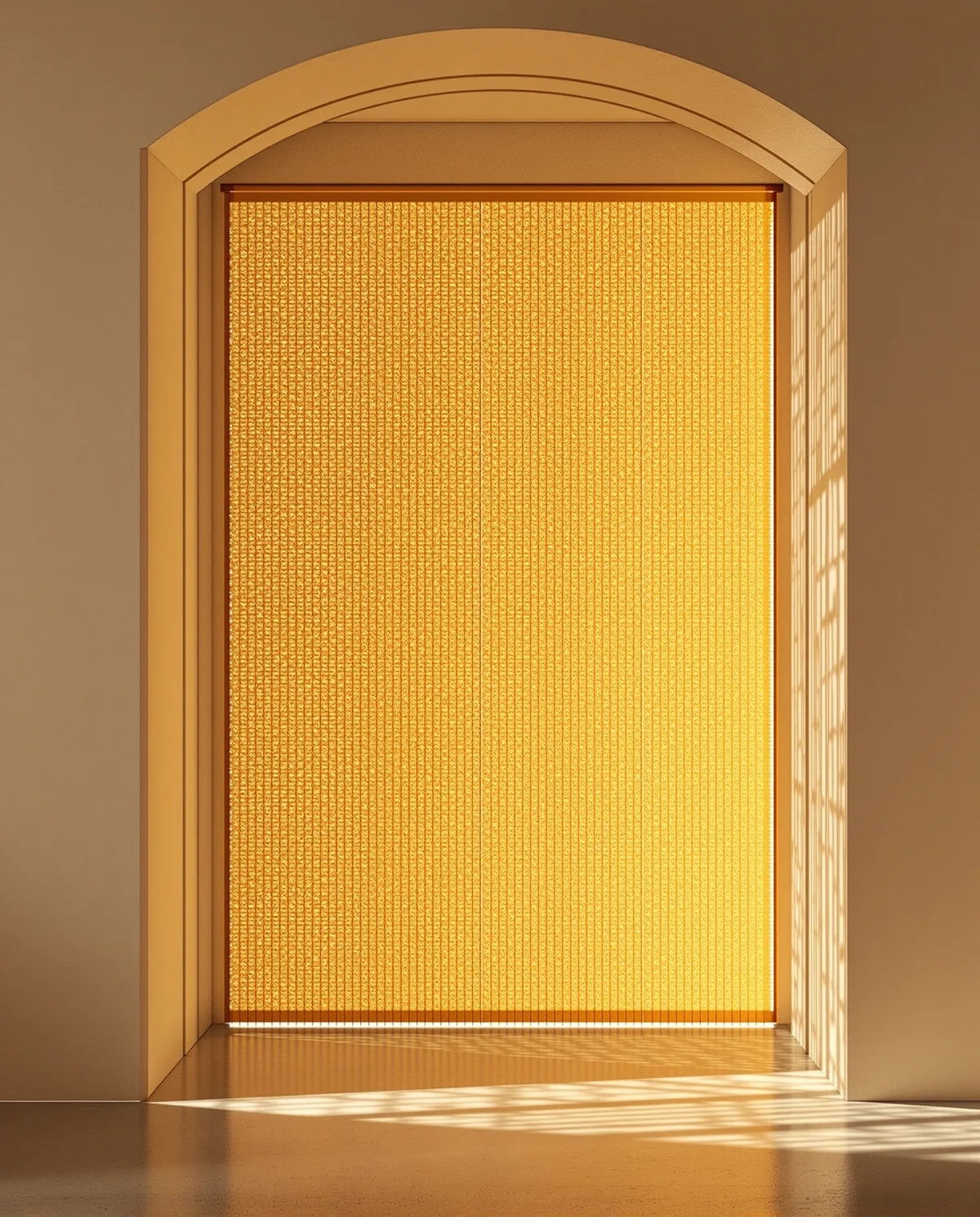
Backlit, the grade reads top to bottom. Front-lit, it reads as three bands. Both are correct; specify which one the room gives you.

Grading seed-bead size achieves a finer version of the effect, at a much higher bead count.
A dyed gradient has to be produced, approved and then reproduced, and surface-dyed glass colour is a batch property — the reason dye lots are quoted per run on glass seed beads. A reorder six months later will not land in the same place. A size grade has no such exposure: the beads are the beads.
The accent-bead alternative has the same problem in a different place. Pressed glass repeats its shape exactly from the mould, so a dotted or figurative story reorders well, but it needs its ground matched to it and it adds a bead-placement rule to every strand.
Backlit, the panel reads as one continuous fall and the amber at the hem glows. Front-lit, it reads as three bands with visible transitions. Both are true, and the brief should say which the installation actually gets, because a north-facing interior will show the bands.
Graduated round beads go onto cord in bead-map order and the strands are gathered on a single turned dowel. In the portal version the hem is an arched-cut drop so the centre opens for a walk-through. Hand-strung strands covers the sequence, including why the transition rows are mapped rather than judged at the bench.
Name the mechanism first — ombre graded by bead size, three steps — then the three bead sizes, then the three colours against a physical chip, then the header and the hem shape. Bead sizes and stringing specifications is the sheet those values belong on.
A graded panel shows dust unevenly, because the largest beads at the hem collect most of it and sit at eye level for anyone sitting down. Dry dusting downwards, strand by strand, is the whole of routine care; cleaning a beaded curtain covers why the cord, not the glass, sets the service interval.
The colour is described in words here deliberately, and matched to whatever you bring: a Pantone reference, a physical chip, a fabric swatch. Prices and minimums are set per design and confirmed with your quote.
Extractable data
| Specification | Value |
|---|---|
| Mechanism | Ombre graded by bead size, in three steps |
| Bead type | Graduated round beads, strung in line on cord |
| Step 1, header | Smallest bead, palest cornsilk tone |
| Step 2, middle | Medium bead, honey tone |
| Step 3, hem | Largest bead, deep autumn amber |
| Header | Single turned wooden dowel |
| Related format | Also built as a two-tone green story on a seed-bead base with spaced rounds |
| Hem | Arched-cut drop in the portal version |
| Colour method | Body and surface colour agreed against a physical chip, confirmed on the sample |
| Production | 40–60 days after sample approval |
Good to know
Because a size grade is repeatable and a dyed gradient is not. Surface-dyed colour is a batch property, so holding a smooth dyed transition across a production run, and then across a reorder, is unreliable. Three discrete bead sizes in three colours give the same visual result and reproduce exactly.
Three is enough at normal viewing distance. Two reads as a two-tone panel rather than a gradient. More than three adds bead lines to the bill of materials and stock complexity for an effect the eye does not separate.
Yes — the mechanism is independent of the colours. Honey is one expression of it. The related green story runs lime seed beads with spaced forest-green rounds, which is the same idea with the contrast carried by bead type instead of bead size.
No, but it should run with the light. A grade that gets deeper towards the hem reads as weight settling and looks natural; the inverse reads as a mistake in most rooms, because the eye expects the darker mass at the bottom.
Yes. The portal version uses an arched-cut drop so the centre opens for a walk-through. A scalloped arch, fullest at the sides, is the other option, and it suits the grade well because the longest strands carry the most of the deepest colour.
Keep exploring
Material
How seed beads are drawn, why dye lots are quoted per run, what the drill hole limits, and where seed-bead work earns its cost.
Read moreTechnique
The bead map, the cord, thirty strands on a dowel, hem shapes, suspension loops — and the three levers that move the cost.
View the rangeDesign
Colour stories documented by how they are built, not by how they look in a mood board.
Compare the optionsGuide
Resolution, weight, repeatability, cost per covered area and breakage risk, with the working figures from production.
Read the guideSpecification
Diameters, drill holes, cord selection, strand counts and format dimensions — the sheet to copy into a tech pack.
Specs and sizes
Start a conversation
Send a reference, a colour chip or a sketch. Minimums are set per design and confirmed per quote; sampling is quoted separately and usually runs 16 to 20 days from an agreed brief.