Material
Metal, in detail
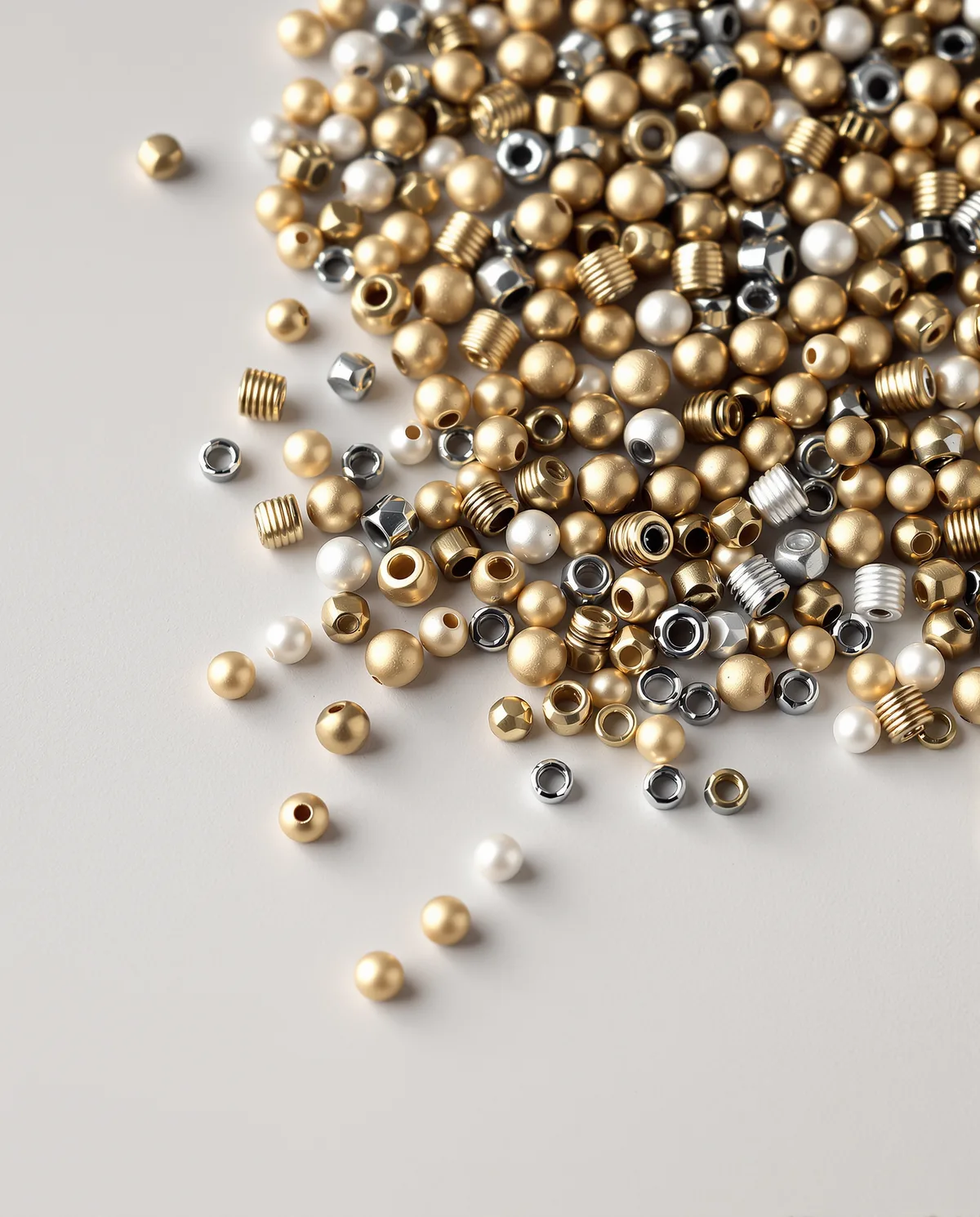
Finished and plated in our own metal plants: eight standard finishes, why metal reads as an accent rather than a field, and what plating does to wear.
Compare the options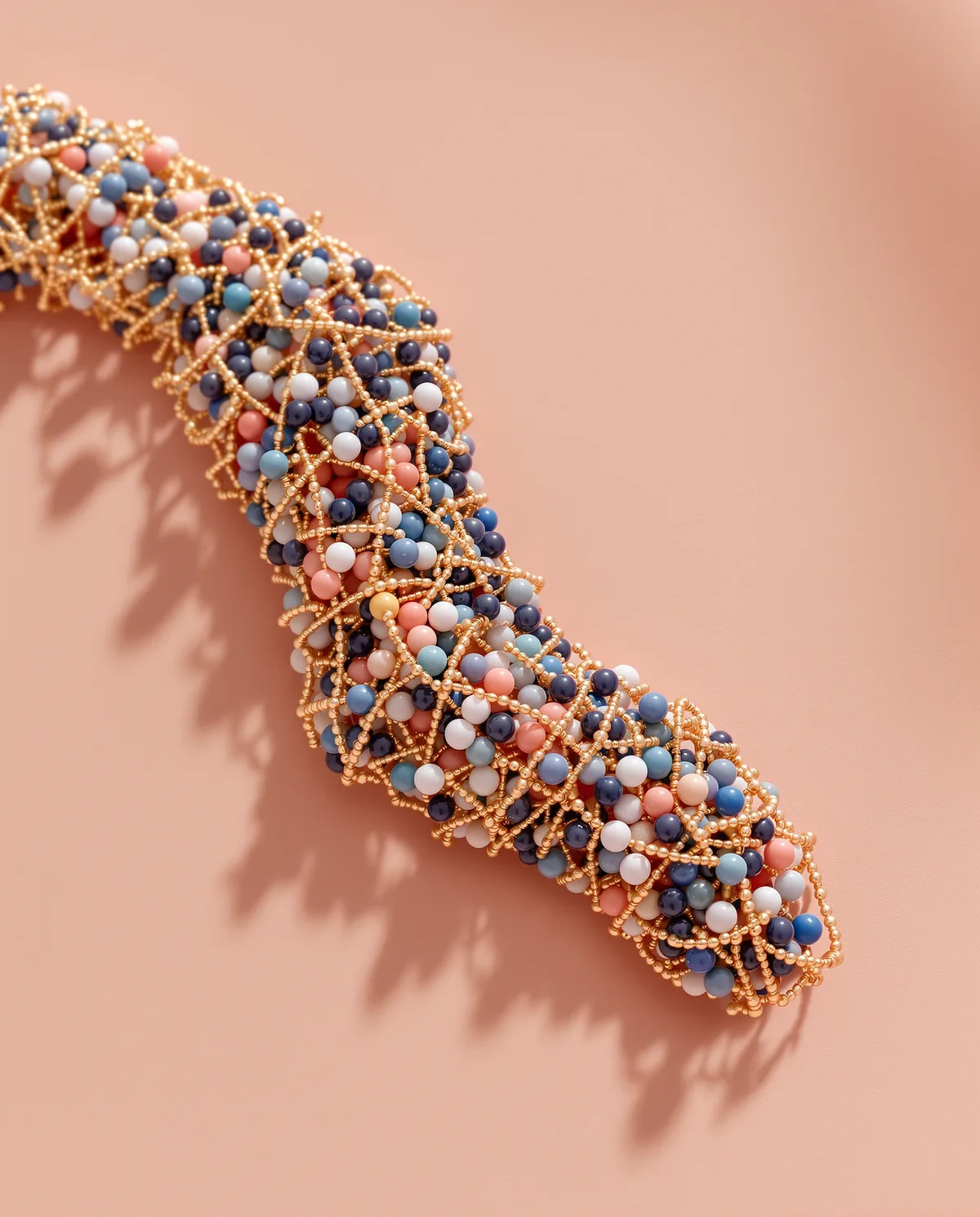
Technique · Wire work
Strung work hangs and embroidered work lies flat. Wire-wrapped work is the construction that stands up on its own — because the shape is held by a brass wire skeleton, and the beads are the skin.
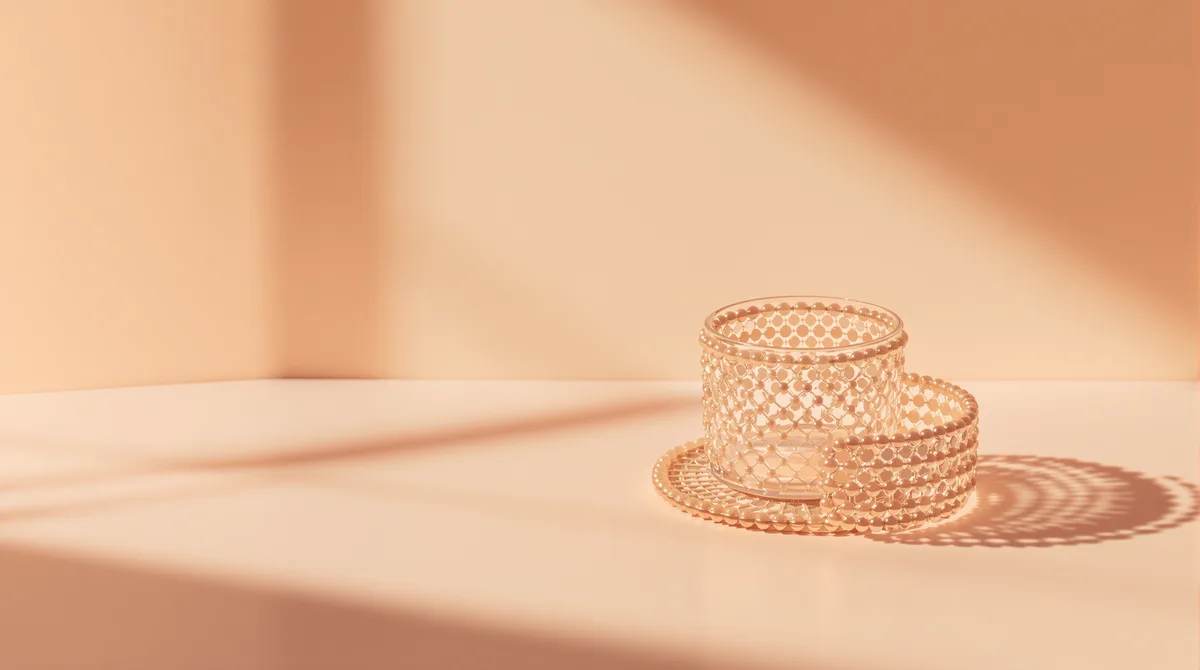
Glass seed beads threaded on fine brass wire and wrapped turn against turn over a shaped armature, the wire openwork visible between the beads.
Wire-wrapped beadwork threads beads onto brass wire and wraps that wire over a shaped armature, so the armature holds the form and the wrap holds the beads. A flat-back wrap suits rings and bands; a full three-dimensional wrap suits figural pieces. The documented family runs from 6 cm rings to 18 cm figures, every one of them wrapped by hand in our own studios.
It is beadwork with a skeleton. A heavier brass wire is bent into the outline of the finished object — a ring, a hoop, a bird, a leaf — and that wire carries the whole structural load. Beads are then threaded onto a finer wire, and that beaded wire is wrapped around the armature and anchored at intervals so it becomes the surface.
Two wires, two jobs. The armature holds the shape. The bead wire holds the beads. Confuse the two and the piece either collapses or cannot be assembled.
Seven stages, and the decision that governs all of them is the second: the two wire gauges. An armature a gauge too light gives a ring that will not return to its circle after the first use. An armature a gauge too heavy cannot be bent accurately into a figure. And a bead wire a gauge too heavy will not pass the beads at all.
Shapes that stand up. Strung work falls — gravity does the aligning, which is why hand-strung strands can hold pattern but not form. Embroidered work lies on a ground. Wire-wrapped work is the only construction in the five craft families that produces a self-supporting three-dimensional object out of beads.
That is why a beaded napkin ring is a wire-wrapped piece rather than a strung one. The ring has to be a ring when nobody is holding it.
A sagging shape, which is an armature-gauge failure and cannot be fixed after assembly. Slipped bead runs, which is an anchor-interval failure: a long unanchored wrap will work its way loose around a curve. Visible armature on a piece specified as a full wrap. A protruding wire end, which on a table piece is a safety reject rather than a cosmetic note. And cracked beads, where the wrap was tightened past what the bead would take.
Four of the five are specification failures rather than workmanship ones, which is why gauge and anchor interval belong on the sheet.

Anchor points. Each one is a separate hand operation with pliers, and the count rises with every curve and every direction change. A simple band with four anchors is quick; a figural bird with thirty is not.
The levers, in order: simplify the outline, because a simpler armature needs fewer anchors; choose flat-back over full wrap where only one face is seen, which roughly halves the covered surface; and move up a bead size, which covers the same wire length with fewer units. Reducing the overall size helps least, because the armature forming does not shrink proportionally.
In our own beadwork studios, with pliers, cutters and a forming jig or mandrel. The brass itself connects to the oldest part of the company: metal finishing and plating are capabilities of our own Moradabad plants, which is where the brass discipline comes from and why a specified finish on an armature is something we can hold.
The family is documented as glass seed and bugle beads on brass wire, strung and wrapped over a shaped brass-wire armature, with a flat-back wrap for rings and a full three-dimensional wrap for figural pieces.
Documented at 6 to 9 cm for napkin rings, 7 to 10 cm for charms, and 12 to 18 cm for figural birds and animals, across the whole wrapped family.
The upper limit is structural rather than commercial. As a piece grows, the armature has to get heavier to hold its shape, and heavier wire is harder to form accurately and harder to wrap. Somewhere past the figural range the answer is a different construction — a framed shape, or a strung piece on a wire frame of the kind used for knotted wall hangings.
By hand as well as by eye. Dimensions and shape first. Then the wire ends, which must be turned in and dressed flat with nothing protruding. Then the bead surface, sampled against the map. Then the load test: the piece is flexed, and it has to return to its shape.
That last check is the one that distinguishes this construction. A strung panel is inspected hanging; a wire-wrapped piece is inspected by being pushed on.
Six entries. The outline, as a drawing or a reference. The finished dimensions. The two wire gauges, or an instruction that they be specified and recorded. Flat-back or full wrap. The beads, by material, size and colour. And the anchor interval.
Gauge and anchor interval are the two that make the difference between a piece that lasts and one that does not, and they are almost never in an incoming brief.
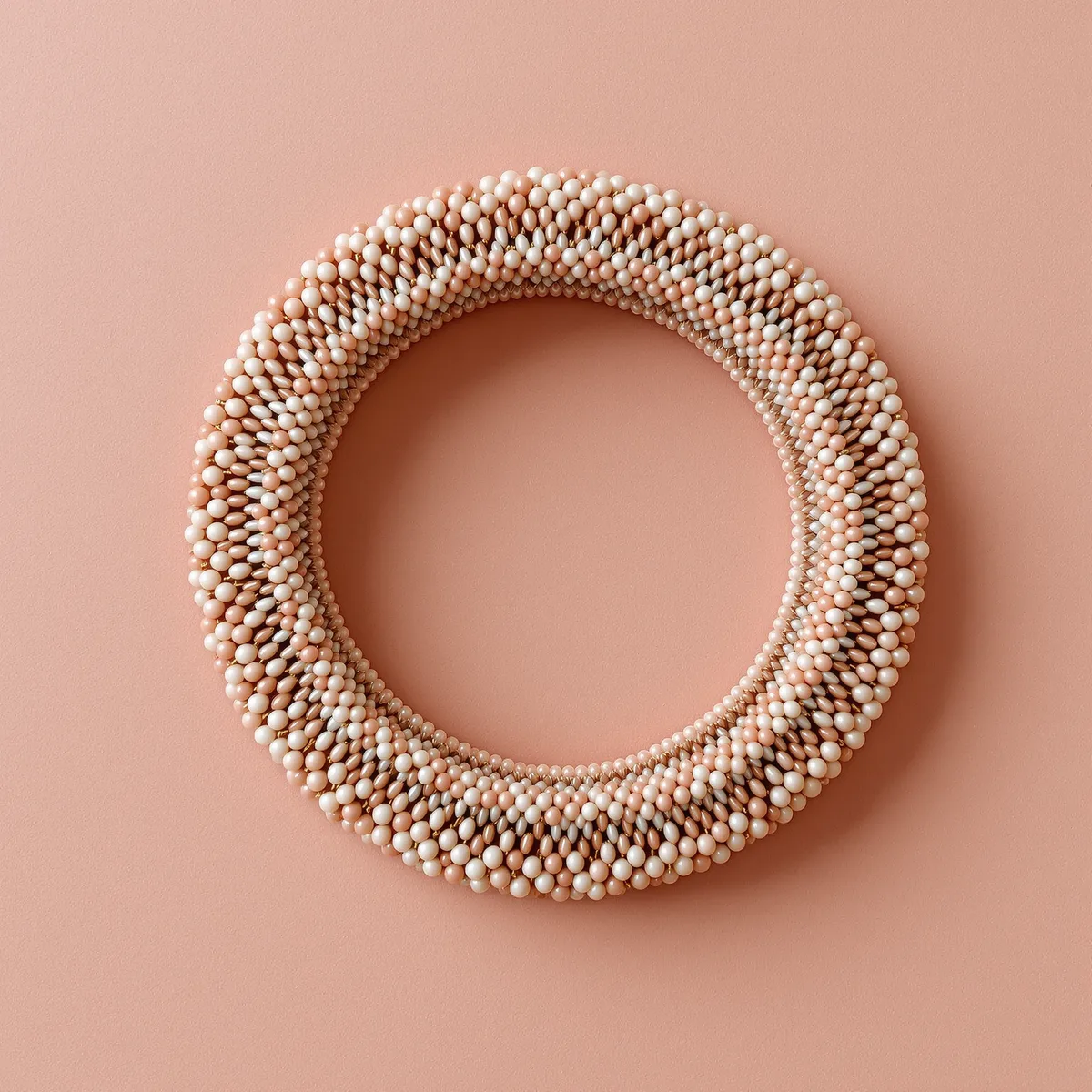
The table and charm work. Napkin rings are the clearest case: a flat-back wrap on a formed ring, so the inner face stays smooth against the napkin. Beyond those, our reference catalogue documents charms at 7 to 10 cm and figural birds and animals at 12 to 18 cm, and our Q3 2026 offers carry keychains and bag charms built the same way.
In hanging work the technique appears as a supporting construction rather than as the whole piece — a framed shape with beads wired across it, which is also how our picture-frame design work holds beads to a core.
Runs rather than strands. The sheet records the bead sequence for each section of armature, because the beads are threaded in lengths matched to the section they cover rather than as one continuous strand. It also carries the anchor positions, which on a curve are a drawing rather than a number.
Beyond that it is the same document described in bead maps and colour-count sheets: bead identity per position, the retained-sample reference for colour, and enough detail that a reorder and a repair both work from it.
Glass seed and bugle beads on brass wire, which is the documented pairing and not an accident. The bead has to tolerate being pulled tight against metal, so it needs to be small, thick-walled relative to its size, and strong — which describes a drawn glass seed bead exactly.
What does not work: thin-walled feature beads, which crack under the wrap; large beads, which leave the armature visible between them; and anything with a hole too small to pass the bead wire. On a mixed design the bead wire gauge is chosen from the smallest hole, the same rule cord follows on a strung panel.
Extractable data
| Stage | What drives the labour | What is rejected here |
|---|---|---|
| Form the armature | Complexity of the outline | A shape the gauge cannot hold |
| Fix the gauges | One decision, made on the sample | A gauge that sags or will not wrap |
| String the bead wire | Bead count per section | Bead holes that will not pass the wire |
| Wrap and anchor | Number of anchor points — the dominant cost | Long unanchored runs that slip |
| Flat-back or full wrap | Full wrap roughly doubles the covered surface | Visible armature where it should be covered |
| Close and dress the ends | One pass | Any protruding wire end |
| Documented formats | Napkin rings 6–9 cm; charms 7–10 cm; figural birds and animals 12–18 cm | Pieces outside the range need a new armature design |
Good to know
It scales with anchor points rather than with bead count. A six-centimetre napkin ring is a short piece of bench work; a twelve to eighteen centimetre figural bird is substantially longer, because every curve needs the beaded wire tied down three or four times to stop it slipping.
The same document as elsewhere, with bead runs instead of strands. It names each bead by material, size and colour, gives the run sequence per section of armature, and adds the two wire gauges and the anchor intervals — which are the entries unique to this construction.
Glass seed and bugle beads are the documented pairing, on brass wire. The constraint is that the bead must tolerate being pulled tight against wire, so thin-walled and brittle shapes are out and small, strong beads are in. The armature is brass because it bends predictably and holds its bend.
By the retained approved piece plus the two wire gauges written down. Gauge is the entry that decides whether the second run feels like the first: the beads can be identical and the piece will still be wrong if the armature is a gauge lighter.
A sagging shape, from too light an armature. Slipped bead runs, from too few anchor points. Visible armature on a piece that was supposed to be fully wrapped. A protruding wire end, which is a safety reject on a table piece. And cracked beads, where the wrap was pulled tighter than the bead could take.
Only so far. The armature has to get heavier as the piece grows, and a heavier armature is harder to wrap and harder to bend accurately, so labour rises faster than size. Our documented range tops out around eighteen centimetres for a figural piece, and above that a different construction is the answer.
The armature can be specified in a finish from our standard metal set, which is finished and plated in our own Moradabad plants. What cannot be done is plating the finished piece, because that would coat the beads too.
Keep exploring
Material
Finished and plated in our own metal plants: eight standard finishes, why metal reads as an accent rather than a field, and what plating does to wear.
Compare the optionsMaterial
How seed beads are drawn, why dye lots are quoted per run, what the drill hole limits, and where seed-bead work earns its cost.
Compare the optionsMaterial
Cut long instead of short: how a tube gives beadwork direction, where it outperforms a round, and why the cut ends decide the thread.
Open the referencePillar
The table cluster: coasters, placemats and chargers, runners and napkin rings, with the construction and ground material each one needs.
See the detailReference
Five craft families — strung, embroidered, wire-wrapped, knotted and wrapped fibre — and what each one is good for.
View the range
Start a conversation
Send a reference, a colour chip or a sketch. Minimums are set per design and confirmed per quote; sampling is quoted separately and usually runs 16 to 20 days from an agreed brief.