Material
Drawn glass seed beads
How seed beads are drawn, why dye lots are quoted per run, what the drill hole limits, and where seed-bead work earns its cost.
Read the guide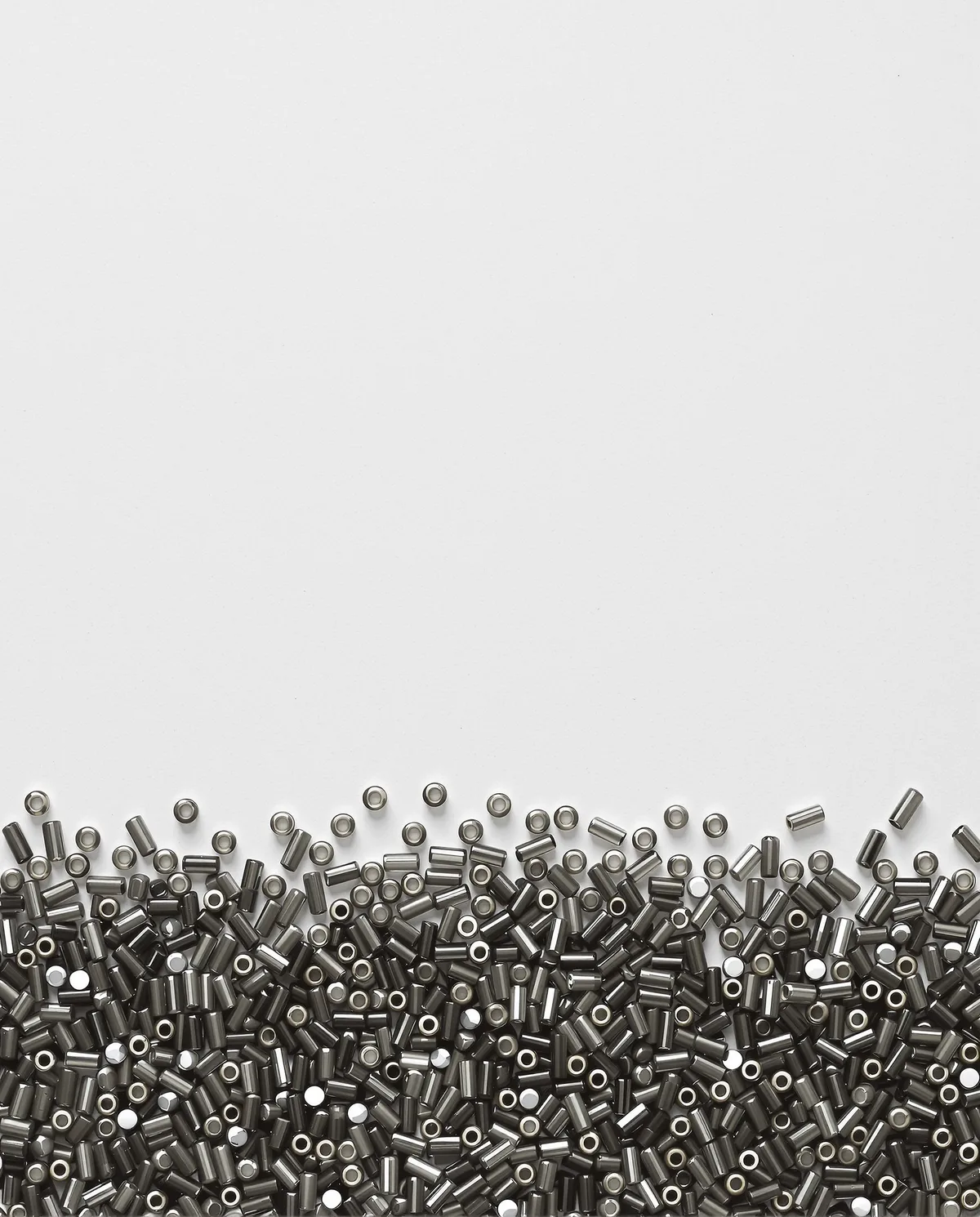
Material · Glass
A bugle bead is a seed bead that was not cut short. The extra length gives beadwork something a round bead cannot: direction. It also gives it two cut ends, which is the one thing to design around.
Glass bugle beads in silver-lined pewter, bronze and smoke grey, cut tubes from six to twenty millimetres long shown loose beside a threaded sample strand.
A bugle bead is a length of drawn glass cane cut long rather than short — a tube instead of a near-sphere. That length gives beadwork direction: a bugle lies along a line and reads as a stroke, where a round bead reads as a point. Ours are drawn and cut in our own Firozabad glass works, from the same cane as seed beads.
A bugle bead is a cut length of drawn glass cane with the hole running the full length of the piece. It is the same object as a glass seed bead, made on the same bench from the same cane; the difference is entirely in where the cane was cut. Cut it short and tumble it and the ends round over into a near-sphere. Cut it long and it stays a tube.
Because the wall of the cane is thin, a bugle is light for its size and surprisingly strong along its axis. Across its axis it is not strong at all, which is why a bugle that gets bent in a tight stitch snaps rather than flexes.
Draw, cut, finish. Molten glass is drawn into a long hollow cane in our own Firozabad glass works; the cane is cut to the specified bugle length; and the cut ends are then rounded, either by tumbling or by a brief return to heat that lets the glass flow over the edge.
That last stage is the one that matters. A freshly cut glass tube has two edges as sharp as any cut glass edge, and those edges sit directly against thread for the life of the piece. Finishing is not cosmetic here — it is the difference between an embroidered coaster that lasts and one that sheds beads in a year.
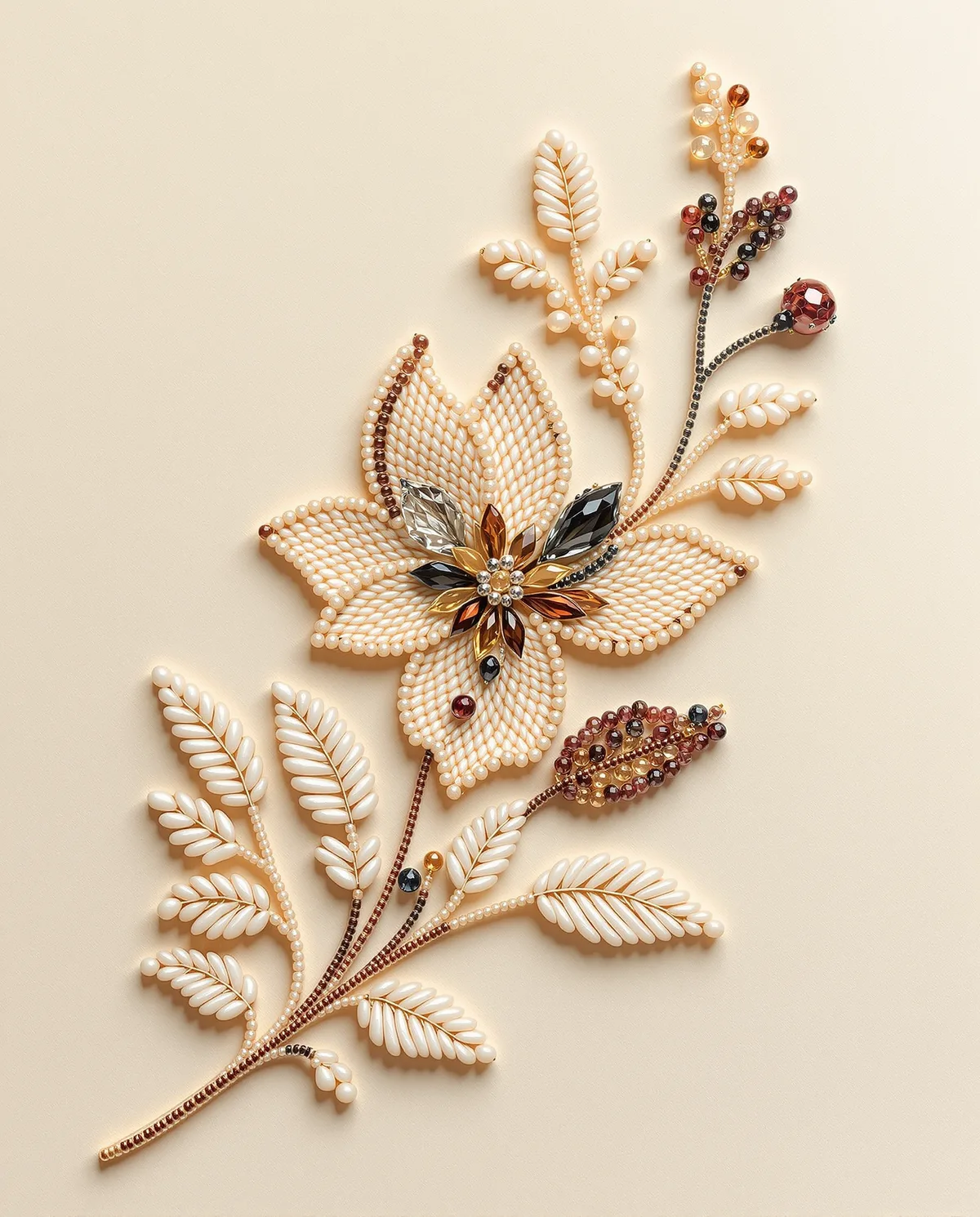
Direction. A round bead is a point: it tells the eye where, not which way. A tube lies along a line and reads as a stroke, so a field of bugles has grain. That is what lets embroidered work imply rays from a centre, the fall of a petal, the run of a stem, or a radiating sunburst — all from bead placement rather than from colour.
It is the one property that cannot be faked with rounds. A curve can be approximated with short bugles or built properly from seed beads, but a straight directional stroke needs a straight bead.
Fine, and it decides the build. The hole is the bore of the original cane, so a bugle of a given outside diameter has roughly the hole of a seed bead of the same diameter — not a hole proportional to its length. On a mixed panel the bugles and seed beads together set the cord, and the large accent beads simply accept it.
Where a bugle end bears directly on thread at a corner or a turn, the construction answer is a guard bead: a small round placed at the end of the bugle so the thread turns against glass that has no edge. That detail belongs on the stringing sheet, not in a beadworker's memory.
Length repeats mechanically and is rarely a problem. Colour is the variable, and specifically surface-dyed colour, which is a property of the batch rather than of the bead. Two runs made to one reference sit slightly apart, and on a large embroidered field the eye finds the join immediately.
Two options, as with any dyed glass. Hold the dye lot for the whole programme and accept the constraint it puts on order timing. Or write the acceptable variation into the specification and accept that a reorder will not be identical to the first run.
Three failure modes, all related to the ends. An unfinished cut end saws through thread. A bugle stitched over a tight curve snaps across its axis. And a long bugle couched at one point rather than two rocks, works its stitch loose and eventually falls.
The construction answers are known and cheap: round the ends, keep bugle length within what the curve can accept, couch anything above a short length at two points, and guard any end that bears on a turn. Bead and thread embroidery sets out how the couching actually runs.
Per bead, a bugle is close to a seed bead. Per unit of covered surface it is markedly cheaper, because one bugle occupies the line that several rounds would and — more importantly — needs one or two stitches where the rounds would need several. On hand embroidery the stitch count is the labour, and the labour is the cost.
That makes bugles a genuine, invisible cost lever on a flat field. Swapping a seed-bead ground for a bugle ground in a direction-neutral area will often save more than changing the colourway, and at normal viewing distance nobody can see which was used.
They suit flat embroidered work, fringe and wire-wrapped pieces. In our own technique reference catalogue, bugles appear across the bead-and-thread embroidery family — coasters, dimensional florals, appliqué patches, brooches — and across the wire-wrapped family, where glass seed and bugle beads are wrapped over a shaped brass armature.
They do not suit a long strung drop on their own. A column of tubes on cord has no give and reads as a stiff rod, and the ends grind against each other as the panel moves. In strung work bugles belong as spacers and accents between rounds, not as the whole strand.
Cut length and outside diameter in millimetres, as two separate figures. End condition — tumbled or fire-polished. Colour method: body colour, surface dye, or dyed to match a named accent. Surface finish. The thread, and any guard bead. For embroidery, the couching interval.
The two most-skipped entries are end condition and couching interval, and they are the two that decide durability rather than appearance.
To the cane. The glass is melted and drawn in our own Firozabad glass works, cut to bugle length there, finished there, and worked into embroidered and wire-wrapped pieces in our own beadwork studios. We own the network; we are not a sourcing office.
The practical value of that is the end condition. It is a process decision inside our own plant rather than an attribute we have to hope for, which is why it can be specified at all.
That the hole scales with the length — it does not, and assuming it does is how a cord gets specified that cannot pass the bead. That bugles are a decorative variant of seed beads: they are a different structural element with different failure modes. And that surface-dyed bugles are colourfast in the way body-coloured glass is. A dyed surface is a surface, and bead dyeing and colourfastness is where that is set out honestly.
Bugles sit in the embroidered and wire-wrapped families rather than in the large hanging formats, so they appear in table and object work: bead-embroidered coasters, dimensional florals, appliqué, brooches, and the wrapped napkin rings and figural charms in the wire-wrap family. Across those two families the documented formats run from coasters at 10 to 11 cm to figural birds and animals at 12 to 18 cm.
In hanging work they appear as spacers inside a seed-bead base, where a short bugle buys height for a fraction of the beads a column of rounds would need.
Very little, because a drawn tube is thin-walled and mostly air. That is an advantage on a flat embroidered piece, where the whole bead load sits on a stiffened ground and a lighter load means less distortion of the cloth over time.
On a dowel it cuts the other way. A light bead does not pull a strand straight, so a bugle-heavy strand will drift and tangle unless something at the hem gives it weight — a glass drop, or simply a heavier end bead. Where the brief is a light panel that still hangs true, that end bead is the whole answer.
| Specification | Working value | Why it matters |
|---|---|---|
| Production method | Drawn glass cane, cut to length, then tumbled or fire-polished | Same bench as seed beads; the cut length is the variable |
| Form | A straight tube with the hole running its full length | Gives direction; cannot describe a curve |
| Typical use | Bead and thread embroidery, fringe, wire-wrapped work | Documented in our embroidery and wire-wrap families |
| End condition | Cut ends must be rounded, by tumbling or fire-polishing | An untreated cut end abrades thread |
| Thread | Thread or fine cord, with a guard bead where an end bears on it | The end condition, not the hole, is the risk |
| Coverage | One bugle covers the line length of several rounds | A real cost lever on a flat field |
| Colour route | Body colour, surface dye, or dyed to match an accent | Dyed colour is a batch property and shifts between lots |
| Made where | Drawn, cut, finished and worked in our own Firozabad glass works and beadwork studios | Length and finish are specification decisions |
Good to know
Flat work above all: bead and thread embroidery for coasters, placemats, appliqué and dimensional florals, where direction is what makes a motif read. They also do good work in fringe and in wire-wrapped pieces, where a tube spans a gap in the armature that a round bead would need three of.
The cut length, the outside diameter, the end condition — tumbled or fire-polished — the colour method, and the thread with any guard bead specified. The end condition is the entry most often omitted and the one that decides whether the piece survives wear.
Yes. They come off the same drawing bench in our own Firozabad glass works as the seed beads, cut to a longer length and then finished. The embroidery and wire-wrapped work that uses them is done in our own beadwork studios.
Body colour out of the melt, a surface dye, or dyed to match a larger accent bead so the ground supports it. Metallic and iridescent surface finishes are common on bugles because the long flat flank catches light along its whole length, which a small round cannot.
A fine one — the hole is the bore of the original drawn cane, so it is comparable to a seed bead of the same diameter rather than to the bead's length. Bugles go on thread or fine cord, and on a mixed build they are usually the bead that decides the cord for everything else.
The cut length is held mechanically, so size repeats well. Surface-dyed colour is a batch property and will shift between runs; on a large embroidered field that shift is visible, so a repeating programme either holds a dye lot or writes the acceptable variation into the specification.
Less per unit of coverage, which is the point. A bugle is a thin-walled tube, so it is light for its length, and one bugle covers the line that several rounds would. On a flat embroidered field that reduces both the bead count and the stitch count, which is where the labour sits.
Keep exploring
Material
How seed beads are drawn, why dye lots are quoted per run, what the drill hole limits, and where seed-bead work earns its cost.
Read the guideTechnique
Seed and bugle bead couched onto a stiffened ground in the zardozi tradition: the stitch, the interval, the failure modes and why images live here.
Open the referenceMaterial
Why a mould, not a draw: how a pressed shape repeats across a run, what the mould seam costs you, and where a feature bead earns its weight.
See the detailTechnique
Bead wrapped over a shaped brass armature: flat-back for rings, full three-dimensional for figural work, and why the wire gauge is the real specification.
Read the guideReference
Nine material families, what each gives in light, weight and colour, and how far our own manufacturing reaches into every one of them.
Specs and sizes
Start a conversation
Send a reference, a colour chip or a sketch. Minimums are set per design and confirmed per quote; sampling is quoted separately and usually runs 16 to 20 days from an agreed brief.