Material
Drawn glass seed beads
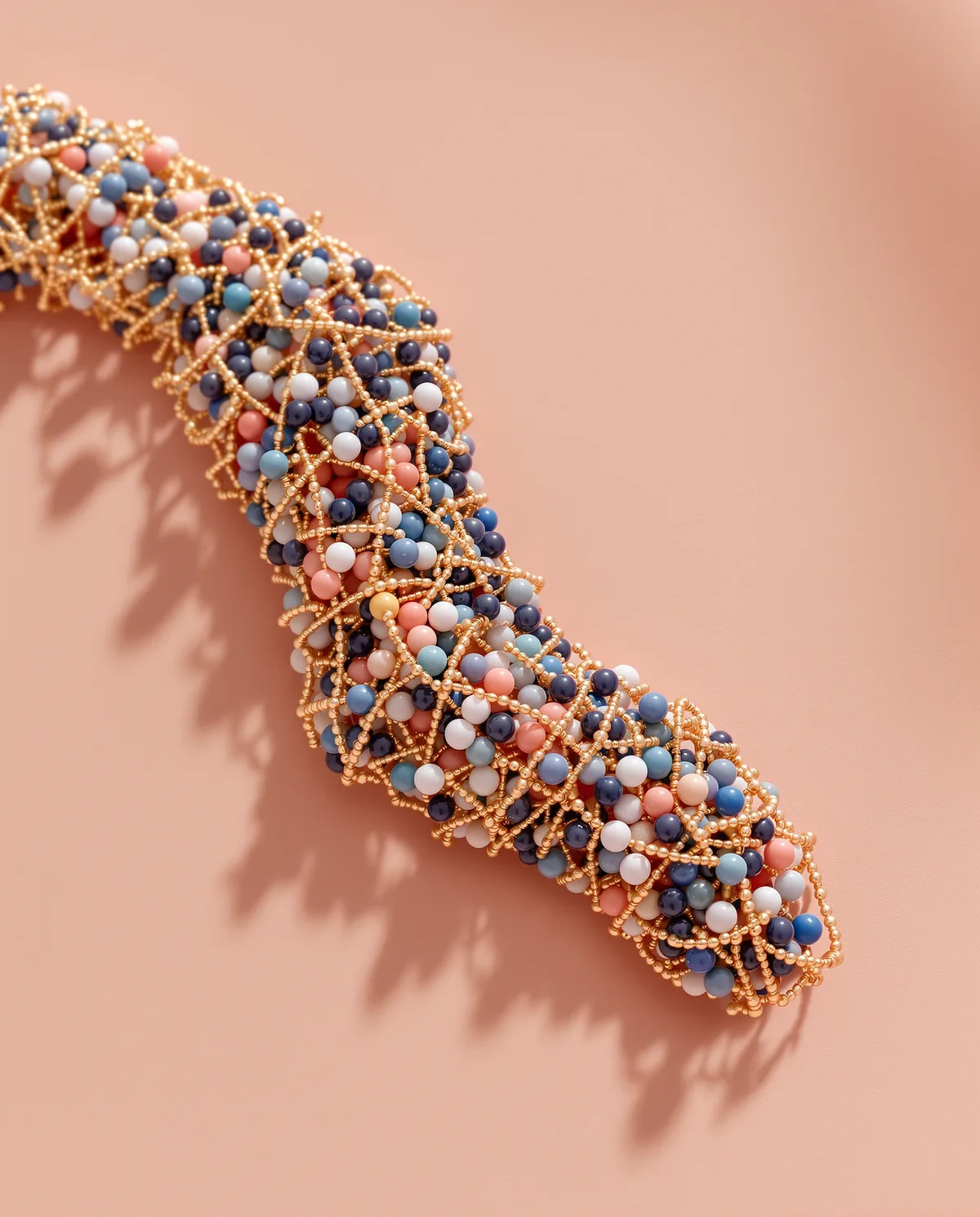
How seed beads are drawn, why dye lots are quoted per run, what the drill hole limits, and where seed-bead work earns its cost.
Read more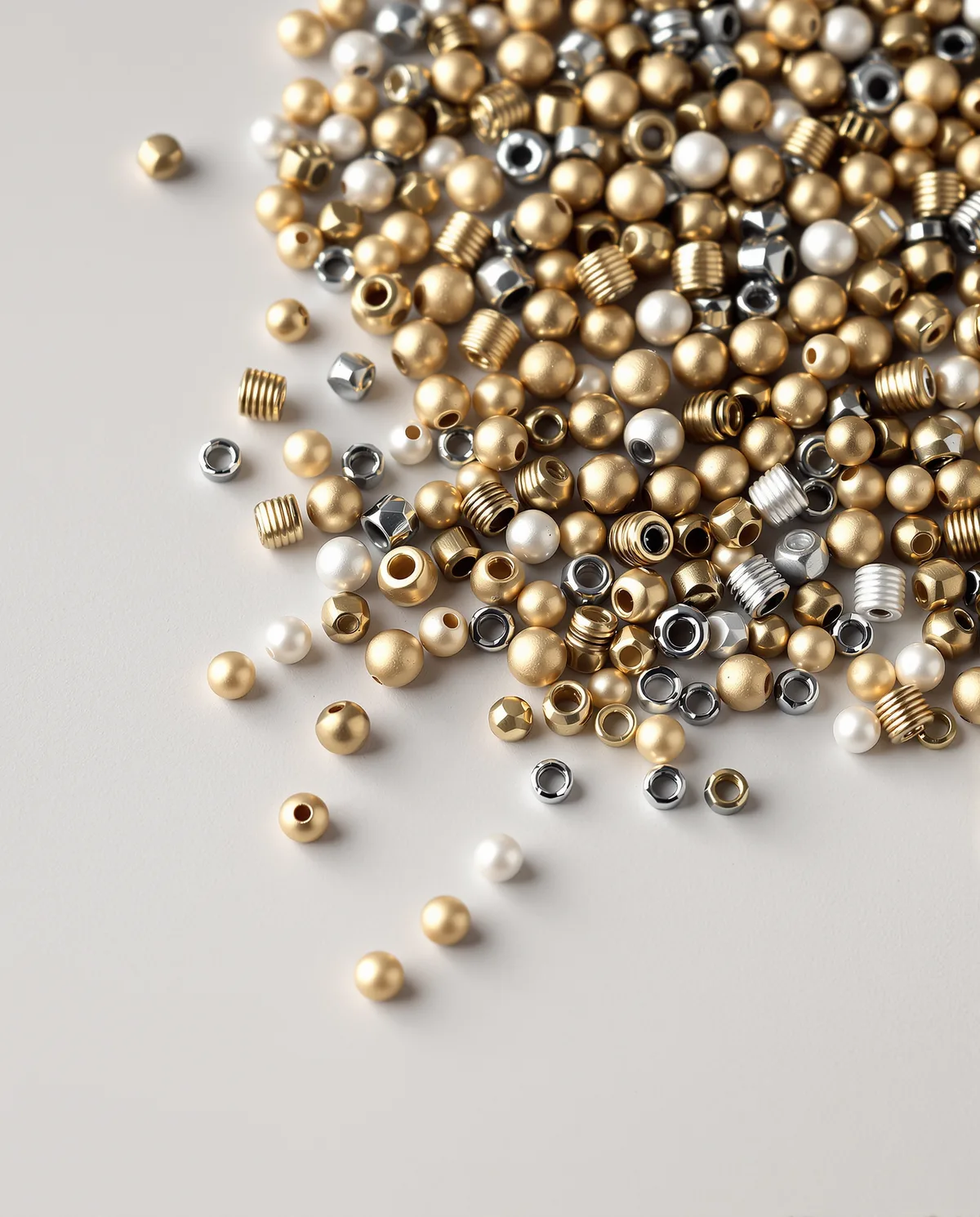
Material · Metal
Metal is the one bead material that reflects rather than transmits. That makes it the strongest accent in the library and the wrong choice for a whole panel — a metal field goes dark in the same light that makes glass glow.
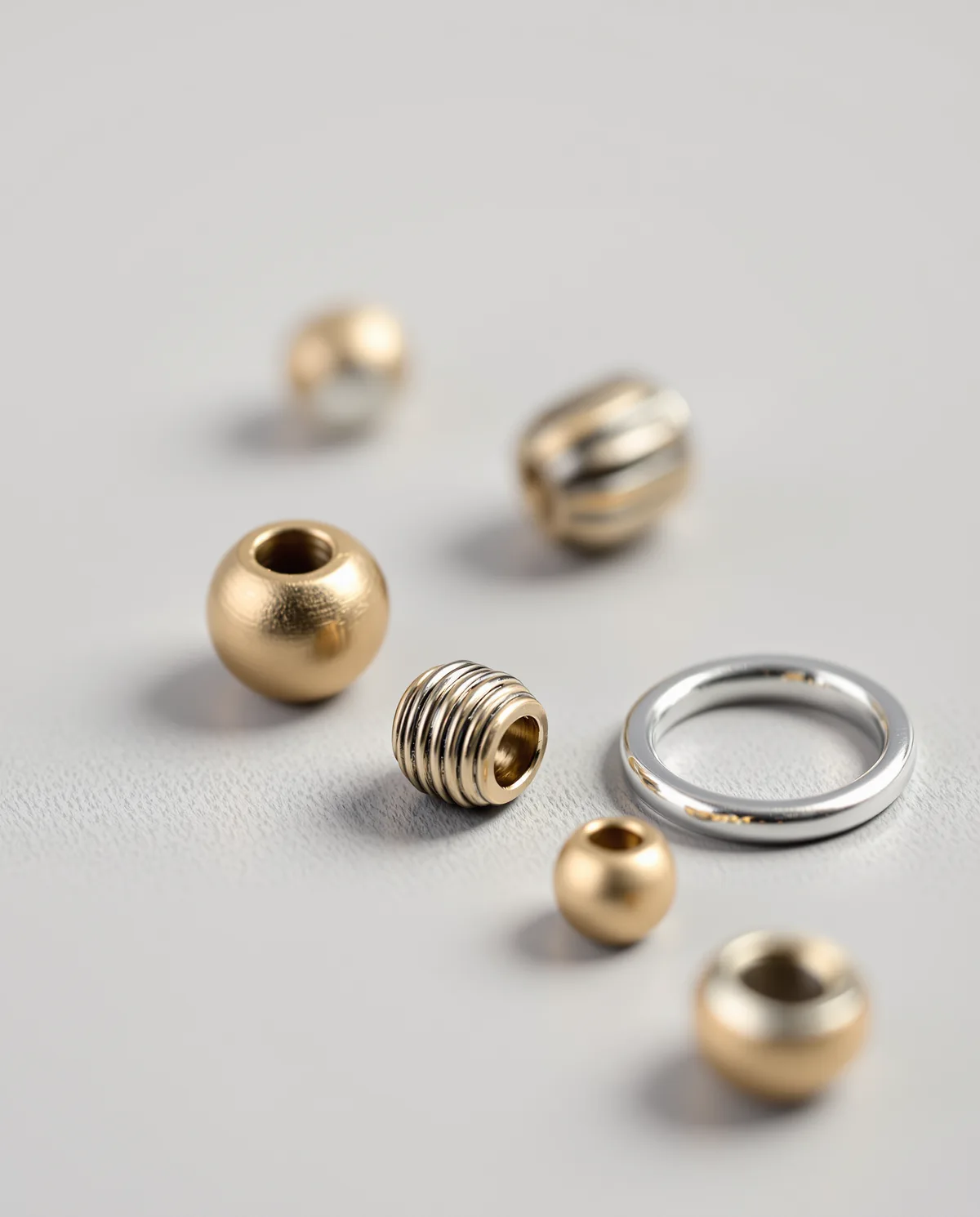
Finished and plated metal beads: brushed brass rounds, antique gold corrugated barrels and polished steel spacer rings.
Metal beads and spacers are finished and plated in our own Moradabad plants, in the eight standard Gemixx finishes plus custom work. Metal reflects light rather than passing it, so it reads as a bright accent inside a bead field and goes flat as a whole panel. It is also the heaviest material per unit volume in the library.
A metal bead is a formed brass or copper component with a hole through it, finished at the surface. It may be stamped and closed into a hollow sphere, turned solid, or cast. The important physical fact is not the forming route but the surface: a metal bead is opaque and specular, so the entire optical contribution happens at the outside.
Every other family in the library does something with the light that enters it. Glass refracts it, resin diffuses it, a faux capiz disc passes it through. Metal returns it.
Form, finish, plate. Forming happens by stamping, turning or casting depending on the shape. Finishing is mechanical or chemical texture. Plating is the last stage, and the one that decides what the bead looks like.
All of it runs in our own Moradabad metal plants, which is the company's oldest discipline — Gemixx began as a family metal-finishing business there. Their published capability list covers sand, lost-wax and die casting, metal spinning, forging, stamping and pressing, turning, machining and laser etching, and plating, physical vapour deposition and powder coat.
Punctuation. Drop three small metal beads into a strand of matte glass and they read as bright points at a distance where a colour change would not register. That is a real design tool and it costs almost nothing in bead count.
It also gives a finish vocabulary that the rest of the library does not have. A buyer can specify Champagne Gold or Antique Silver by name and get the same thing twice, which is not true of a wood tone or a hand-made glass colour.
Mostly as spacers and in wire-wrapped work. In our own studios the wire-wrapped family is built on glass seed and bugle beads wrapped over a shaped brass wire armature — the metal is the structure, and the beads are the surface. The documented formats are napkin rings from six to nine centimetres, charms from seven to ten, and figural birds and animals from twelve to eighteen.
In hanging work, metal appears as a spacer rather than as a feature, and in our picture-frame design work as pinned rosettes and spacers that keep row spacing even.
An eight-millimetre solid brass round works out near 2.3 g, so a hundred land near 230 g — arithmetic from a nominal 8.5 g/cm³, not weighed figures. Against glass that is roughly triple; against acrylic, closer to six times.
On a panel this is a hard constraint rather than a preference. A strand carrying many solid metal beads will load the dowel beyond what the fixing was designed for, and the routes around it are to use metal small, use it sparingly, or use hollow stamped beads. The weight does have one virtue: a metal bead low on a light strand is an extremely effective weighted end.
Finishes rather than colours, and that distinction matters. The eight published standards — Matte Gold, Matte Black, Rose Gold, Brilliant Gold, Champagne Gold, Antique Silver, Brilliant Silver, Matte Silver — are processes with names, so they can be ordered and re-ordered. Custom work extends that through hand battering, large-grain sand casting, physical vapour deposition and gold plating.
What metal cannot do is take a colour reference the way dyed acrylic can. Asking for a specific warm pink in metal means choosing the nearest plated finish, not matching a chip.
Generous, because metal holds a thin wall without becoming fragile, and a stamped bead's hole is formed rather than drilled. That is useful when a heavier cord is wanted for the hand of a panel.
It does not change the governing rule. Cord is selected from the smallest drill hole in the build, which on a mixed strand is the seed-bead base. A metal spacer with a comfortable hole will not rescue a cord that cannot pass the glass around it.
Plated finishes repeat well, and this is the family's quiet strength. The finish is a named process rather than a colour judgement, so the second run matches the first because it went through the same tank.
Antique and battered finishes are the exception, deliberately. They are irregular by design, so they are approved as a character range on the retained sample rather than as a single appearance — the same mechanism a wood tone range uses.
At the plating. Plating is a surface a few microns thick, and in a hanging panel beads knock against each other thousands of times a season. Where a metal bead sits directly against a harder neighbour, the plating goes first and the base metal shows through as a bright or dull patch.
The design answers are to seat metal beads against softer neighbours rather than against glass, to prefer a matte or antique finish where abrasion is certain because it hides early wear, and to keep metal out of the positions that take the most movement — which on a strung panel means not at the hem.
Highest per unit of covered area, by a wide margin, because the material is dense and the finishing is a separate process on every bead. That is exactly why its proper role is accent: five metal spacers per strand cost very little, and a metal field costs more than any glass one.
Where metal earns its cost outright is in wire-wrapped work, because there the metal is doing structural work. An armature that holds a napkin ring's circle is not a decorative choice; it is the only thing keeping the shape.
Accent positions in strung work, spacers everywhere, wire-wrapped objects, and small table pieces where weight is irrelevant and a plated finish is the point. Napkin rings in particular are a natural fit, because the ring wants to be rigid.
It does not suit a full hanging panel, on weight, on cost and on optics together. A metal curtain in a backlit doorway becomes a silhouette, which is the opposite of what a bead panel is usually bought to do.
Base metal. Bead form, and whether it is solid or hollow — this is the entry that decides the panel weight and it is almost always omitted. Nominal dimensions. Hole diameter. The finish, named from the standard set or described as a process. And for an irregular finish, a pointer to the retained sample.
To the forming and the finish. Metal beads and spacers are formed, finished and plated in plants we own in Moradabad, and the pieces they go into are strung and assembled in our own beadwork studios. We own the network; we are not a sourcing office.
This is also the oldest claim on the property. The metal vertical dates to 1982 and the glass and bead vertical to 1992, which is why metal finishing vocabulary runs through the whole bead catalogue.
| Specification | Working value | Why it matters |
|---|---|---|
| Base metals | Brass and copper | The disciplines our own metal plants are built on |
| Standard finishes | Matte Gold, Matte Black, Rose Gold, Brilliant Gold, Champagne Gold, Antique Silver, Brilliant Silver, Matte Silver | A published set, so a finish can be specified by name |
| Custom finishes | Hand battering, large-grain sand casting, physical vapour deposition, gold plating | Where a standard finish is not the brief |
| Optical behaviour | Reflective, not translucent | Reads as an accent; a metal field loses light rather than catching it |
| Weight behaviour | A solid 8 mm brass round works out near 2.3 g, about 230 g per hundred | Arithmetic from nominal density; the heaviest material here |
| Commonest role | Spacer beads setting the interval between larger beads | A structural function, not a decorative one |
| Wear mode | Plating abrades where beads knock; base metal may then show | Finish choice is a durability decision |
| Made where | Finished and plated in our own Moradabad metal plants, then strung in our own beadwork studios | Plating, PVD and powder coat are all in-plant capabilities |
Good to know
Eight standard finishes are published: Matte Gold, Matte Black, Rose Gold, Brilliant Gold, Champagne Gold, Antique Silver, Brilliant Silver and Matte Silver. Beyond those we do custom work using hand battering, large-grain sand casting, physical vapour deposition and gold plating.
It is formed or drilled to the build and confirmed on the stringing sheet. Metal tolerates a thin wall, so holes can be generous — but the cord is still chosen from the smallest hole in the panel, which on a mixed build is a glass seed bead rather than the metal.
Plated finishes repeat well, because the process is controlled and the standard set is defined by name rather than by a colour word. Antique and battered finishes are deliberately irregular, so those are approved as a character range on the sample in the same way a wood tone range is.
Roughly three times, solid for solid. An eight-millimetre brass round works out near 2.3 g against about 0.6 g for glass at the same size — arithmetic from nominal densities, not weighed. That is why metal is used small, used sparingly, or used hollow.
Accent and spacer roles inside a bead field, wire-wrapped objects such as napkin rings and charms where the armature is already metal, and small table pieces. A full metal hanging panel is not a construction we recommend: it is heavy, it costs more per unit of coverage than anything else, and it goes dark in the light that flatters glass.
Base metal, bead form and whether it is solid or hollow, nominal dimensions, the hole diameter, and the finish named from the standard set or described as a custom process. For an antique or battered finish, the pack should also point at the retained sample for the character range.
Metal is where the company started. Finishing and plating happen in our own Moradabad plants, whose capability list covers turning, machining, stamping and pressing, plating, physical vapour deposition and powder coat, and the beads are strung into finished pieces in our own beadwork studios.
Keep exploring
Material
How seed beads are drawn, why dye lots are quoted per run, what the drill hole limits, and where seed-bead work earns its cost.
Read moreTechnique
Bead wrapped over a shaped brass armature: flat-back for rings, full three-dimensional for figural work, and why the wire gauge is the real specification.
Compare the optionsMaterial
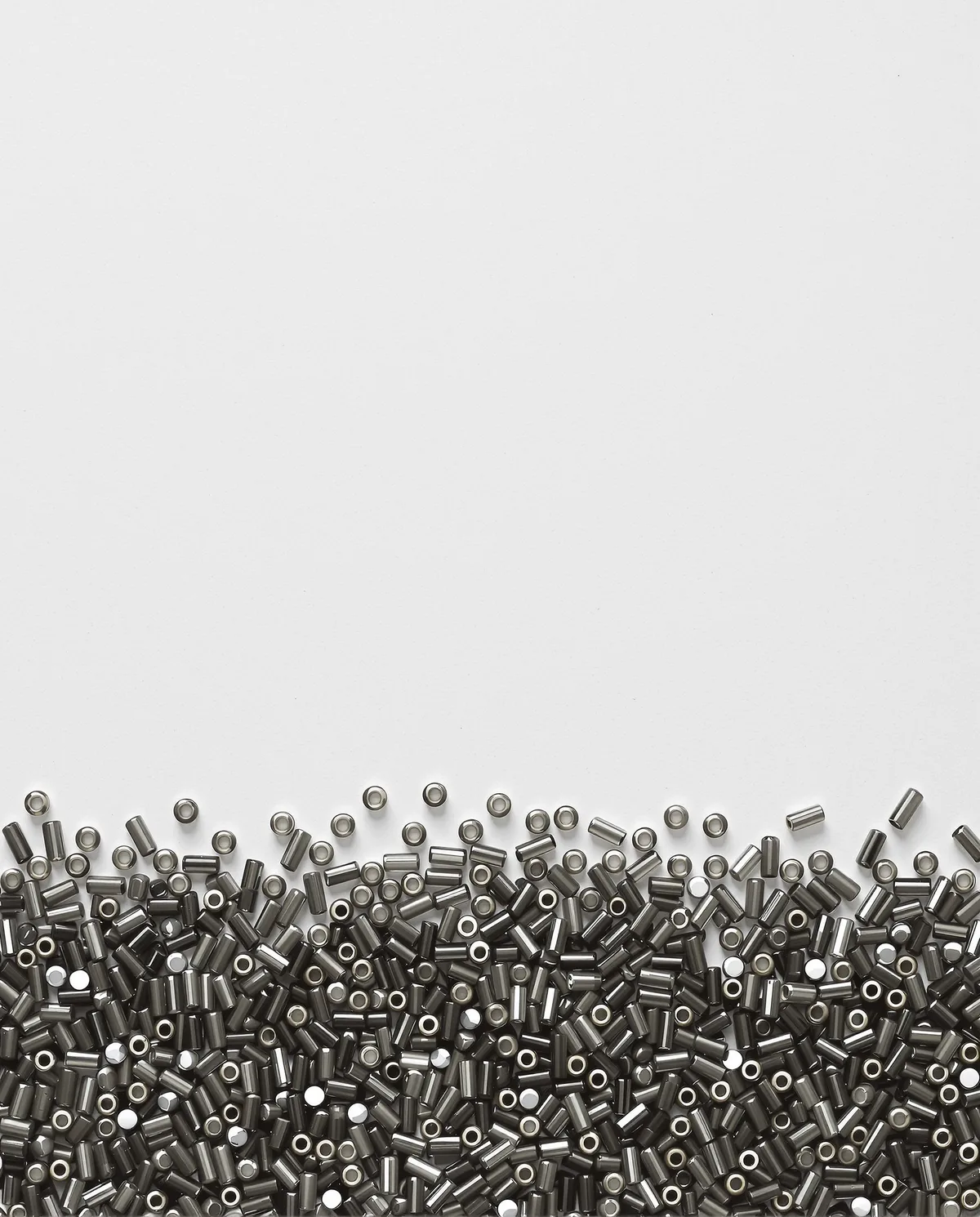
Cut long instead of short: how a tube gives beadwork direction, where it outperforms a round, and why the cut ends decide the thread.
Read the guideMaterial
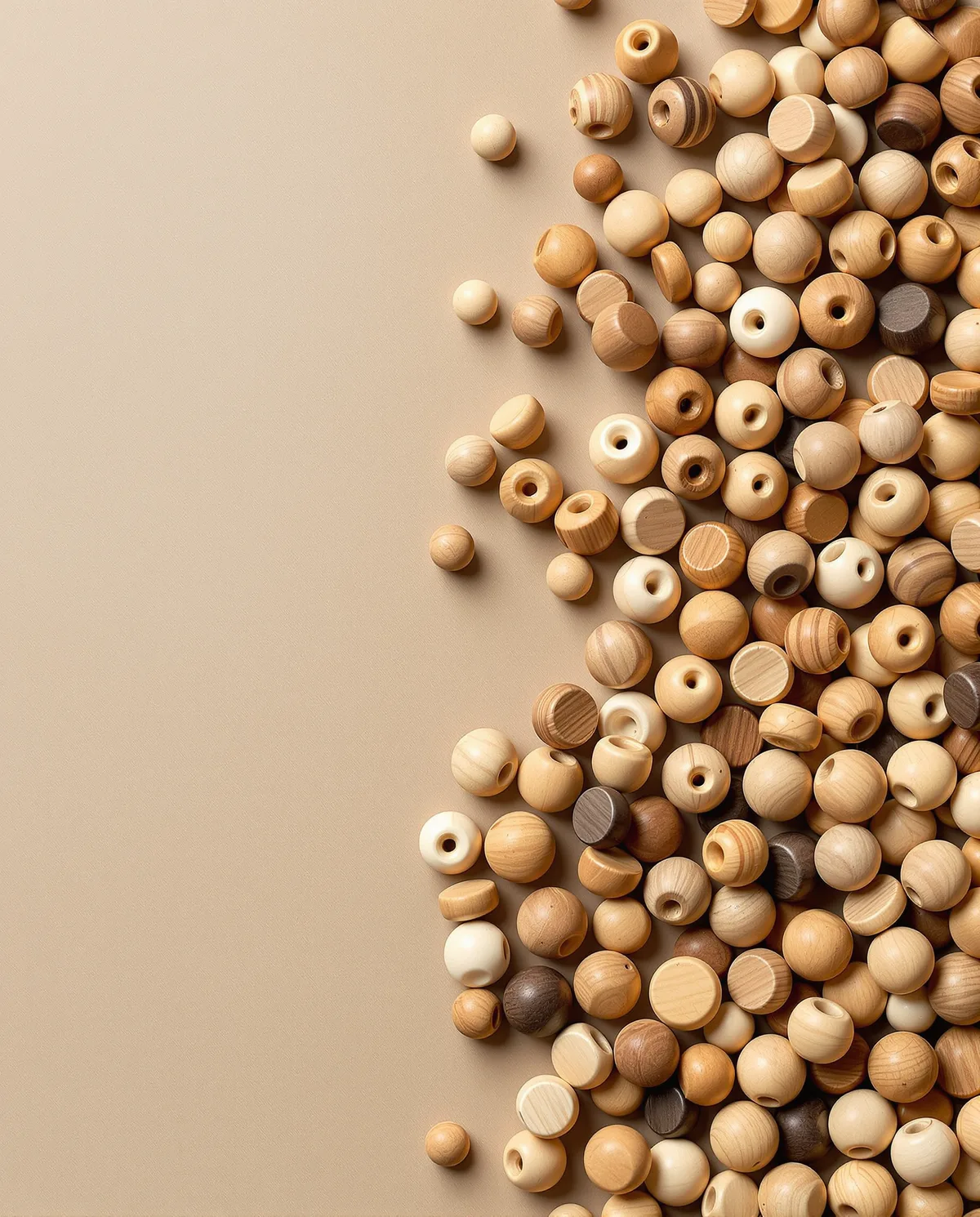
Turned and drilled in our own wood factory: grain variation you approve rather than eliminate, the finishes that hold colour, and the dowel from the same plant.
Specs and sizesReference
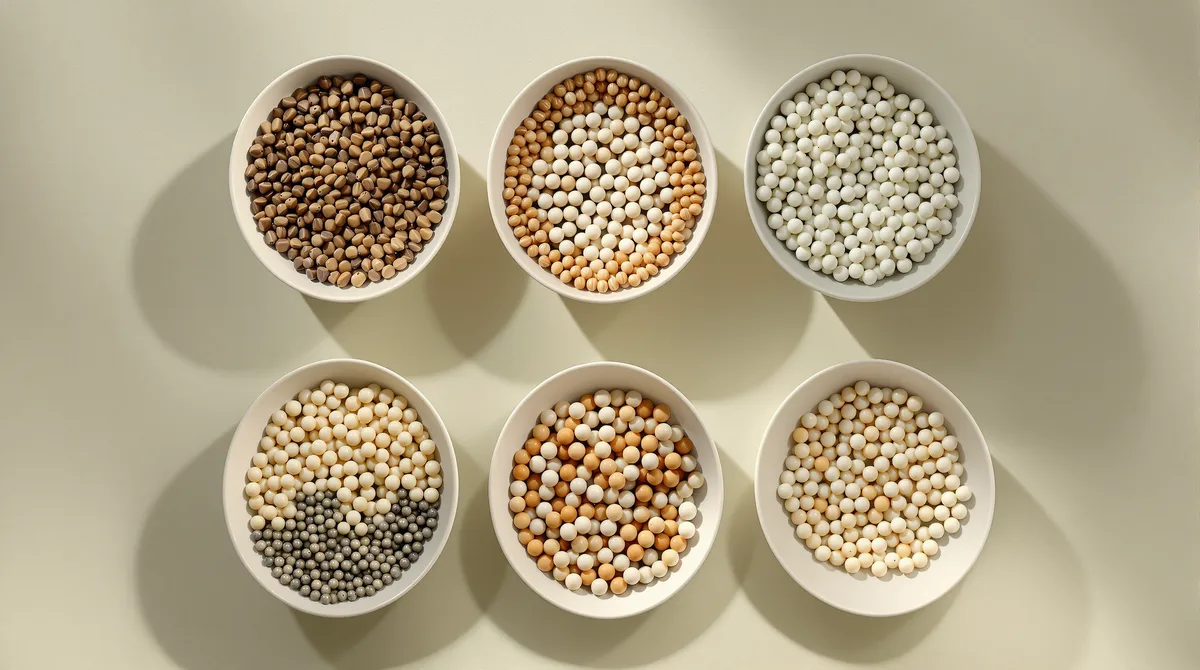
Nine material families, what each gives in light, weight and colour, and how far our own manufacturing reaches into every one of them.
View the range
Start a conversation
Send a reference, a colour chip or a sketch. Minimums are set per design and confirmed per quote; sampling is quoted separately and usually runs 16 to 20 days from an agreed brief.