Design
The design library: colour stories, by construction
Colour stories documented by how they are built, not by how they look in a mood board.
Read more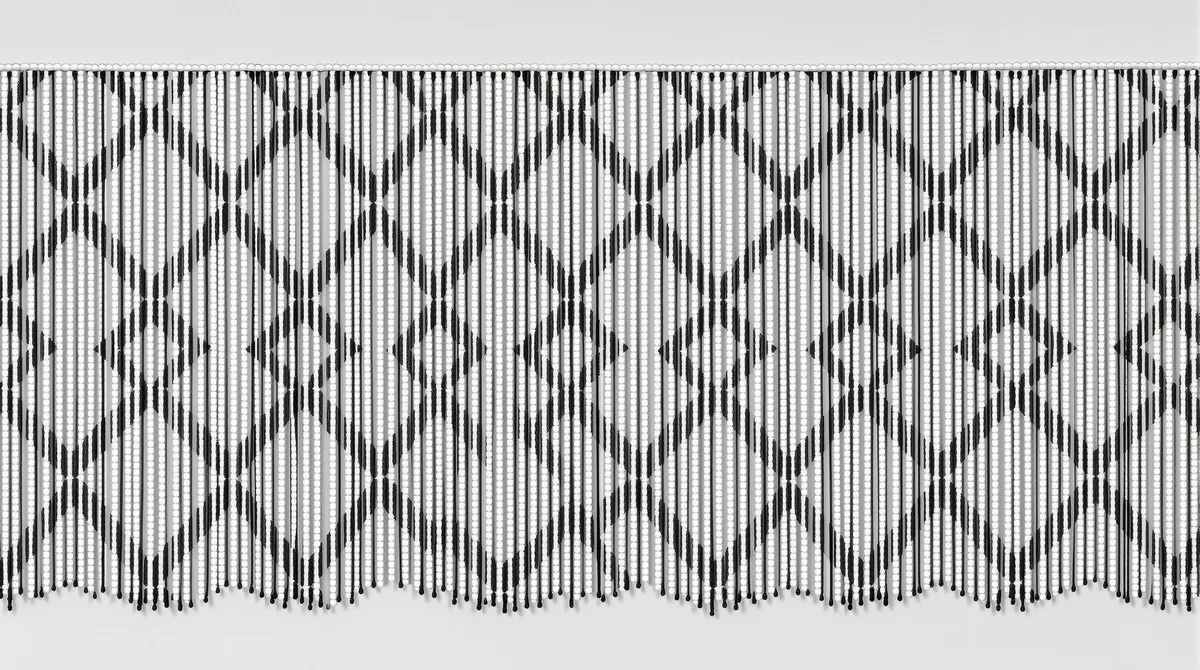
Colour story
Three colours and one bead shape. The pattern is produced by the oval, not by the palette, which is why it cannot be recoloured into something plain.
A beaded panel worked in jet black and chalk white beads so a bold optical diamond lattice steps right across the strands, the hem falling to a shallow scallop.
Op Pennant is the optical story: cream, lagoon and jade glass ovals drawn at 60 × 90 cm on 27 strands with a V-point hem. The pattern comes from the oval itself. Strung through its long axis an oval stacks into a continuous column with no visible gap, so blocks of colour read as solid bands rather than as rows of beads.
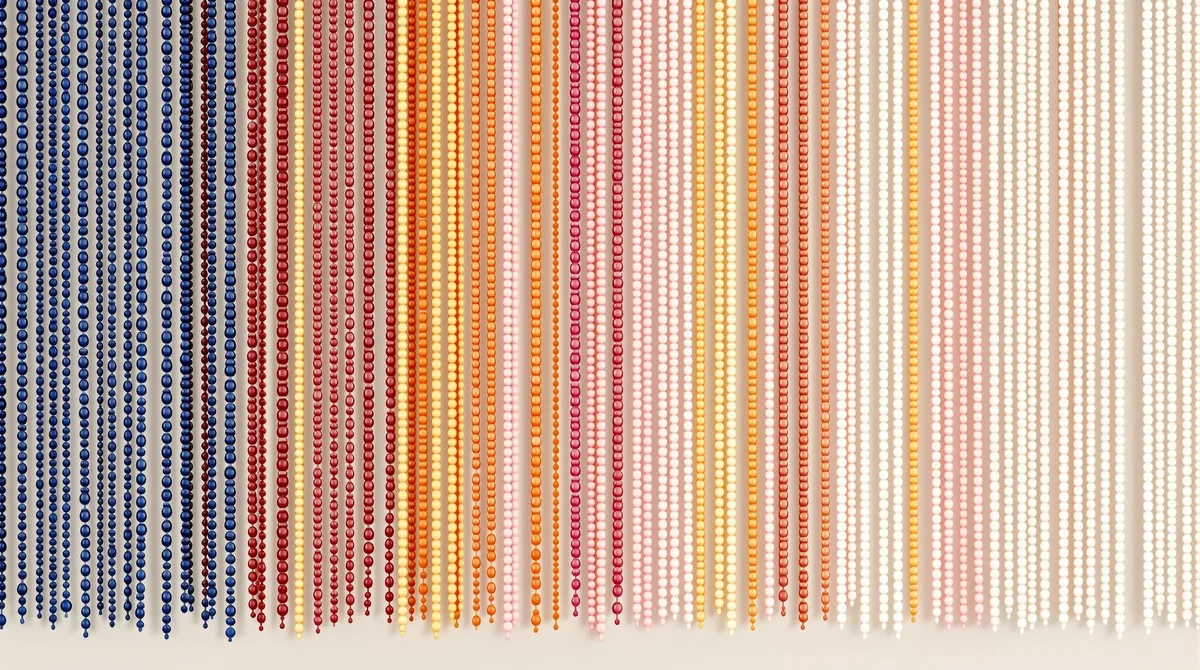
Op Pennant is the optical story among the fourteen named in the 2027 design library: cream, lagoon blue and jade green, on glass ovals.
It is drawn as a wall hanging at 60 × 90 cm on 27 strands with a V-point hem — about a 2.2 cm pitch. What distinguishes it from every other story in the library is that its effect is produced by bead geometry rather than by colour.
One bead shape in three colours. The shape is the design.
An oval strung through its long axis stacks against the next oval with almost no visible waist between them, so a run of one colour on a strand reads as a continuous painted band. A round bead of the same diameter leaves a gap at every junction, and a block of colour built from round beads reads as a dotted line. That single difference is why this story works as a graphic and the others do not.
The colours are the easy part — three stock pressed glass lines hold closely, because the shape comes from a mould and the colour is in the glass.
The pattern is the hard part, and it is held by the bead map. Every strand is written out bead by bead onto the count sheet, so the diagonals land in the same place on the first piece and the thousandth. The alternative — mapping a pattern by hand at the bench from a reference image — has been done, and it is slow and expensive enough to show up as the dominant cost on a piece.
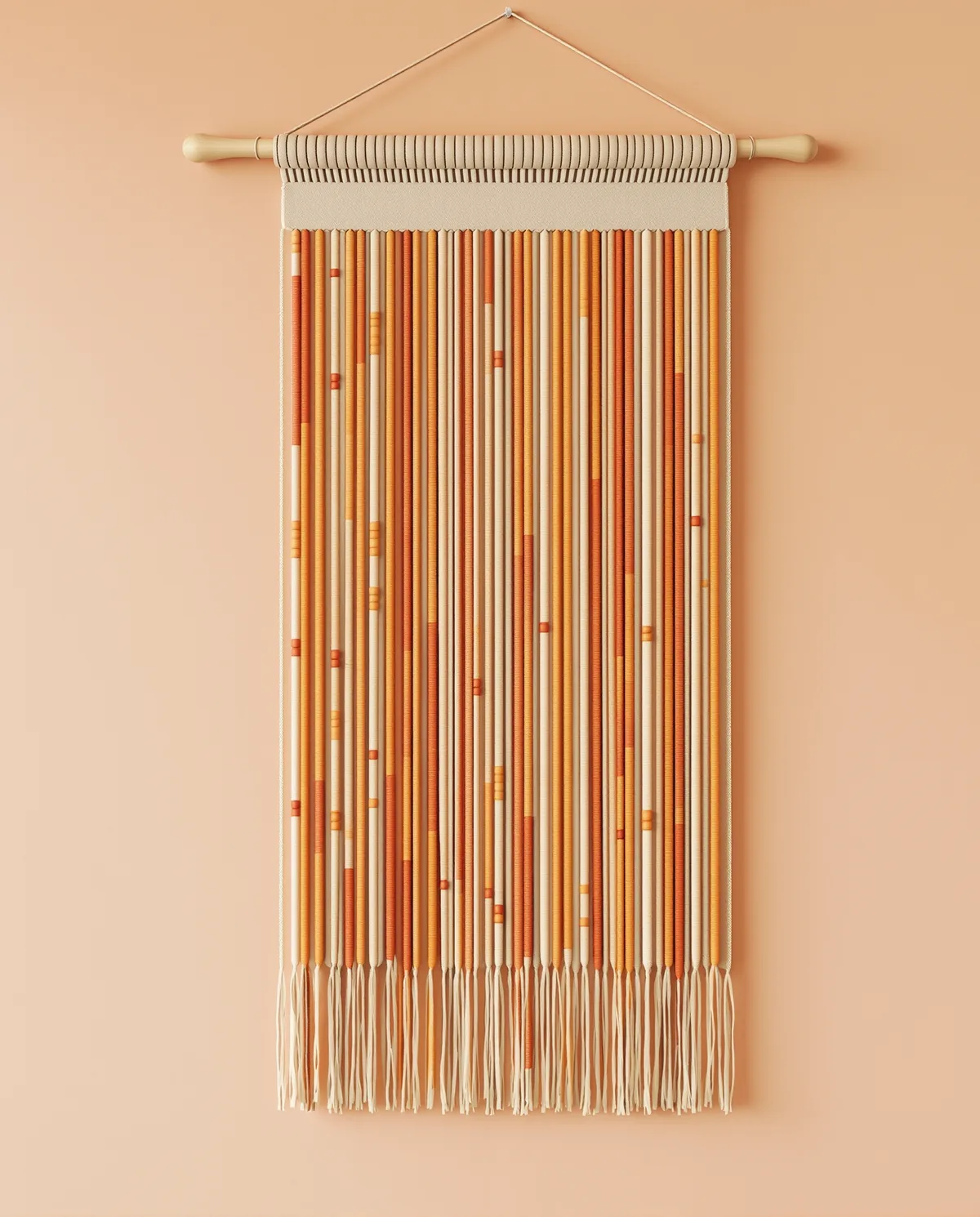
A round bead leaves a visible waist between beads. An oval strung lengthwise does not, so a run of one colour reads as a painted band instead of a dotted line.

An optical pattern only holds if every strand is written out bead by bead. Judged at the bench, the diagonals drift and the effect disappears.
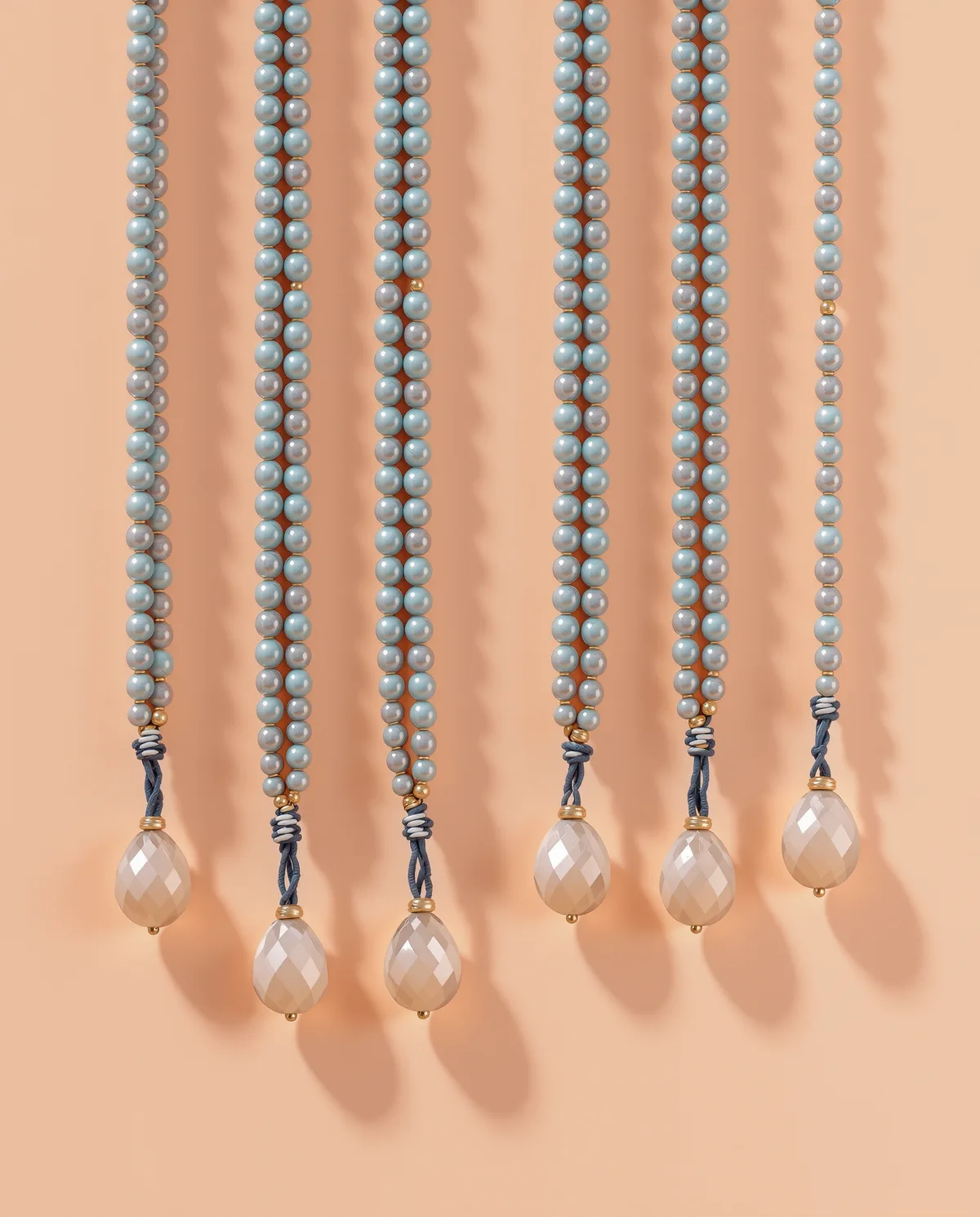
A V-point hem on an optical design is part of the pattern, not a finish. The shortest strand sits at the point, so the pattern has to resolve at two different drops.
As the graphic one, and as the strongest photographer in the library. An optical pattern survives a flat shelf shot, a small on-site photograph and a thumbnail, because nothing about it depends on light behaviour.
That makes it useful as the hero image for a bead range even where the volume sits elsewhere.
Above a plain strand, with the premium in the stringing rather than the beads. Three colours in a mapped sequence means three sorted bead lines at the bench and a sequence to follow on every strand, where a plain panel is one line repeated.
Pressed glass ovals themselves are not a specialty bead. The cost ranking still holds: bead size and material first, then construction, then strand spacing, then the dowel and packing, then height. On this design the construction line is unusually large relative to the material line.
One: the 60 × 90 cm wall hanging at 27 strands. There is no doorway or valance version in the published library, which is a real gap — an optical pattern at doorway scale would be the most striking thing in the range, and nobody has drawn it.
Very little, and that is a feature. The three colours are opaque to semi-opaque pressed glass, so the pattern looks much the same backlit, front-lit and in a photograph. It is the most lighting-independent story in the library.
The one condition that hurts it is a strong raking light across the face, which throws bead shadows onto the beads behind and breaks the clean colour blocks.
Pressed glass, as drawn, and the natural first choice because mould-made shapes repeat. Acrylic moulded and dyed to the colour is the lighter route and gives an equally crisp oval.
Ceramic, glazed and fired in our own Khurja plant, is the interesting alternative. A glazed ceramic oval gives a chalkier, denser colour block than glass does, and a matte or speckle glaze changes the optical read from graphic to textile.
Stock for all three colours in the published version. Where a buyer's palette has to be matched exactly, the efficient route is acrylic moulded and dyed to the colour given, because the geometry stays identical while the colour becomes free.
Worth noting as a comparison: the seed bead against pressed glass question is settled differently here than in most stories. Seed beads cannot do this at all, because a seed bead's proportions leave a waist and the colour blocks come out dotted.
Wall pieces, as drawn, and any flat format read head-on. A valance would work with a redrawn map. A portal would not, because an arched-cut opening removes exactly the part of the pattern a viewer walks towards.
The number of colours, and the answer is almost always to keep it at three. Two colours give stripes; four start to compete and the optical read softens into a mixture.
If more variety is wanted, change the block proportions on the bead map rather than the palette. Longer blocks read as architecture, shorter blocks read as textile, and neither needs a new bead line.
Extractable data
| Specification | Value |
|---|---|
| Palette | Cream, lagoon blue, jade green |
| Beads that carry it | Pressed glass ovals, one shape throughout |
| Bead orientation | Strung through the long axis so the column reads continuous |
| Wall design | 60 × 90 cm, 27 strands, V-point hem |
| Strand pitch | About 2.2 cm centre to centre |
| Pattern control | Bead map written strand by strand, not judged at the bench |
| Colour method | Matched to a physical chip or a colour reference, confirmed on the sample |
| Where it is made | Glass drawn and hand-strung in our own Firozabad glass works |
| Production | 40 to 60 days after sample approval |
Good to know
Yes, with one rule: keep the three colours well separated in value. The optical effect depends on each block reading as a distinct band, and three colours of similar lightness produce a muddle rather than a pattern, however pleasant they are individually.
A strung wall hanging drawn at 60 × 90 cm on 27 strands with a V-point hem. It is available to develop.
The three glass colours are stock lines. Pressed glass is the right material for this story precisely because it repeats — the shape comes from a mould, so an oval made now and an oval made next year stack the same way.
By the bead map more than by the colour. Holding three stock glass colours is straightforward; holding the pattern is the real task, and it is held by writing every strand out bead by bead so a production run repeats exactly rather than approximately.
Pressed glass, first choice, because the oval geometry has to be consistent. Acrylic moulded and dyed to the colour will do it and is lighter. Ceramic, glazed and fired in our own Khurja plant, gives a chalkier version with a genuinely different surface.
Only if the pattern is redrawn, not scaled. An optical pattern has a minimum number of rows below which it stops being a pattern. Cut the drop in half and the design needs a new bead map with fewer, bolder blocks rather than the same map compressed.
Keep exploring
Design
Colour stories documented by how they are built, not by how they look in a mood board.
Read moreIndex
Twenty-four named looks, each described by the material, palette, pitch and hem that actually produce it.
Compare the optionsColour story
Wood rondelles with honey glass and dotted drops on 30 strands — warmth carried by the wood rather than the glass.
Specs and sizesColour story
Five-petal faux capiz blossoms cut to shape, each held by a spacer bead dyed to match, in a sampled and approved build.
Read the guideColour story
Olive and sage glass in a grove palette, built as a valance first because green needs restraint at scale.
Specs and sizesDesign
60 × 90 cm on 27 strands of cream, lagoon and jade glass ovals, where bead geometry carries the optical read.
See the detail
Start a conversation
Send a reference, a colour chip or a sketch. Minimums are set per design and confirmed per quote; sampling is quoted separately and usually runs 16 to 20 days from an agreed brief.