Design
Colour stories, by construction
Colour stories documented by how they are built, not by how they look in a mood board.
Read the guide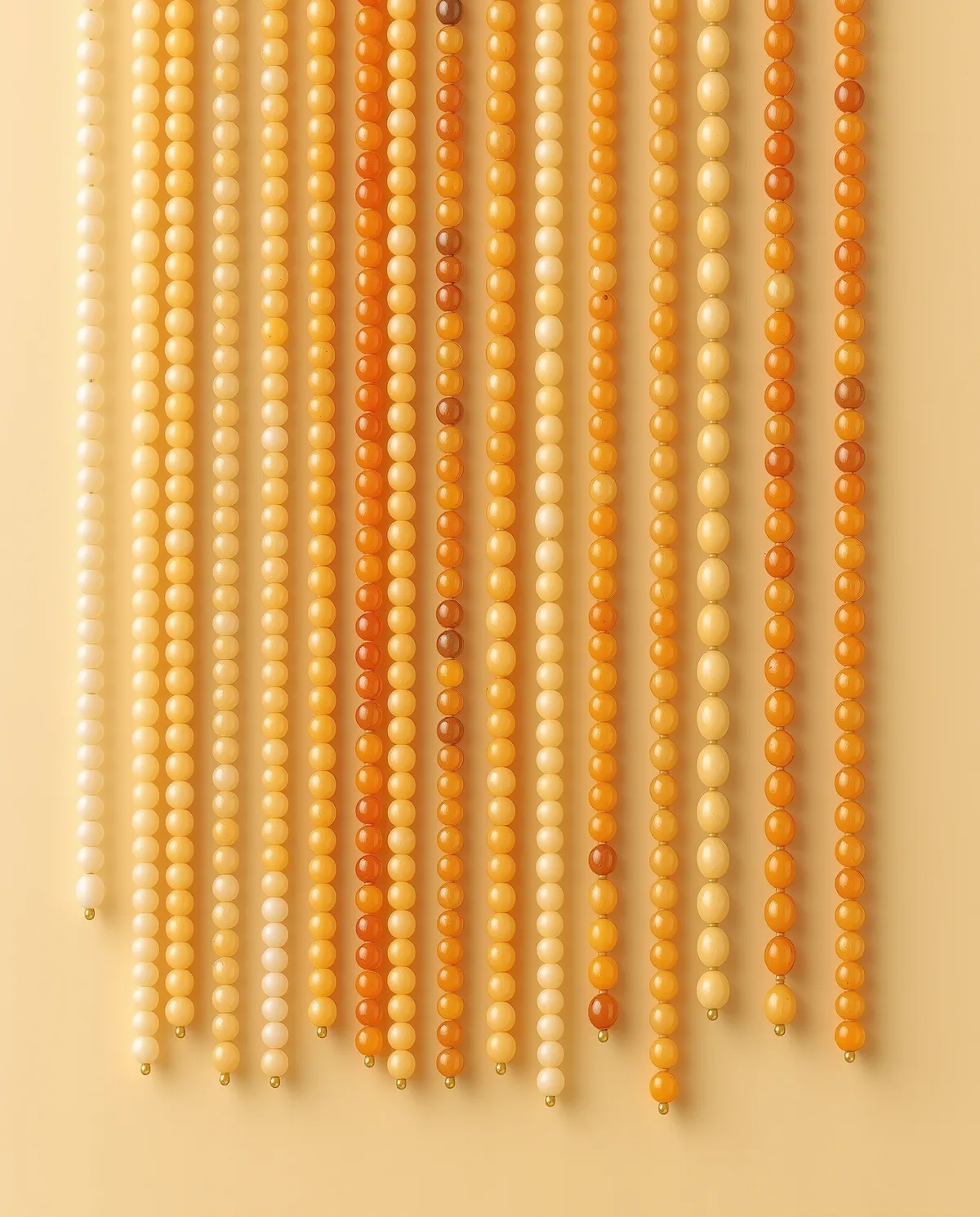
Colour story
The warmth in this story comes from the wood, not from the glass. That is an unusual choice and it changes what the piece weighs, costs and sounds like.
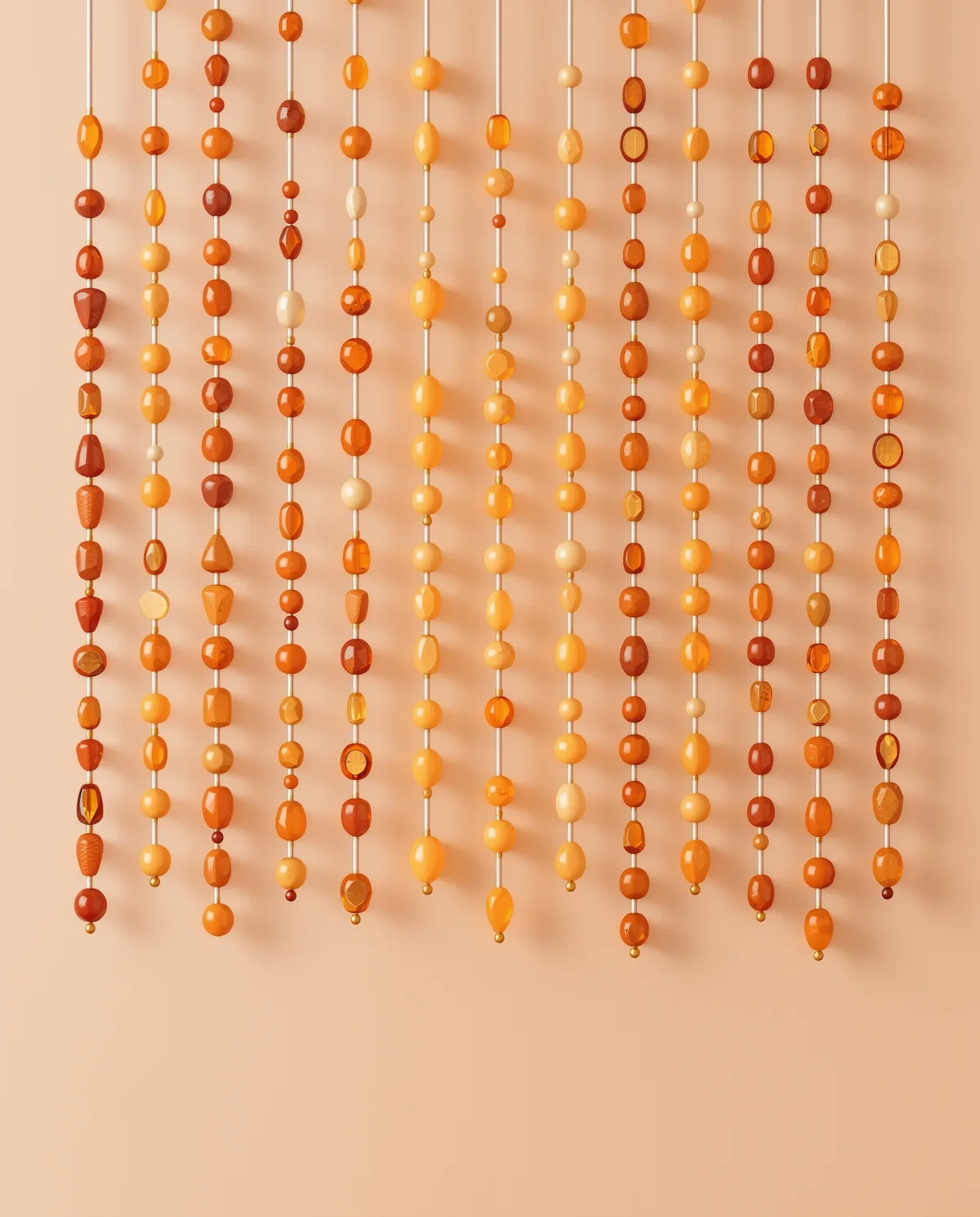
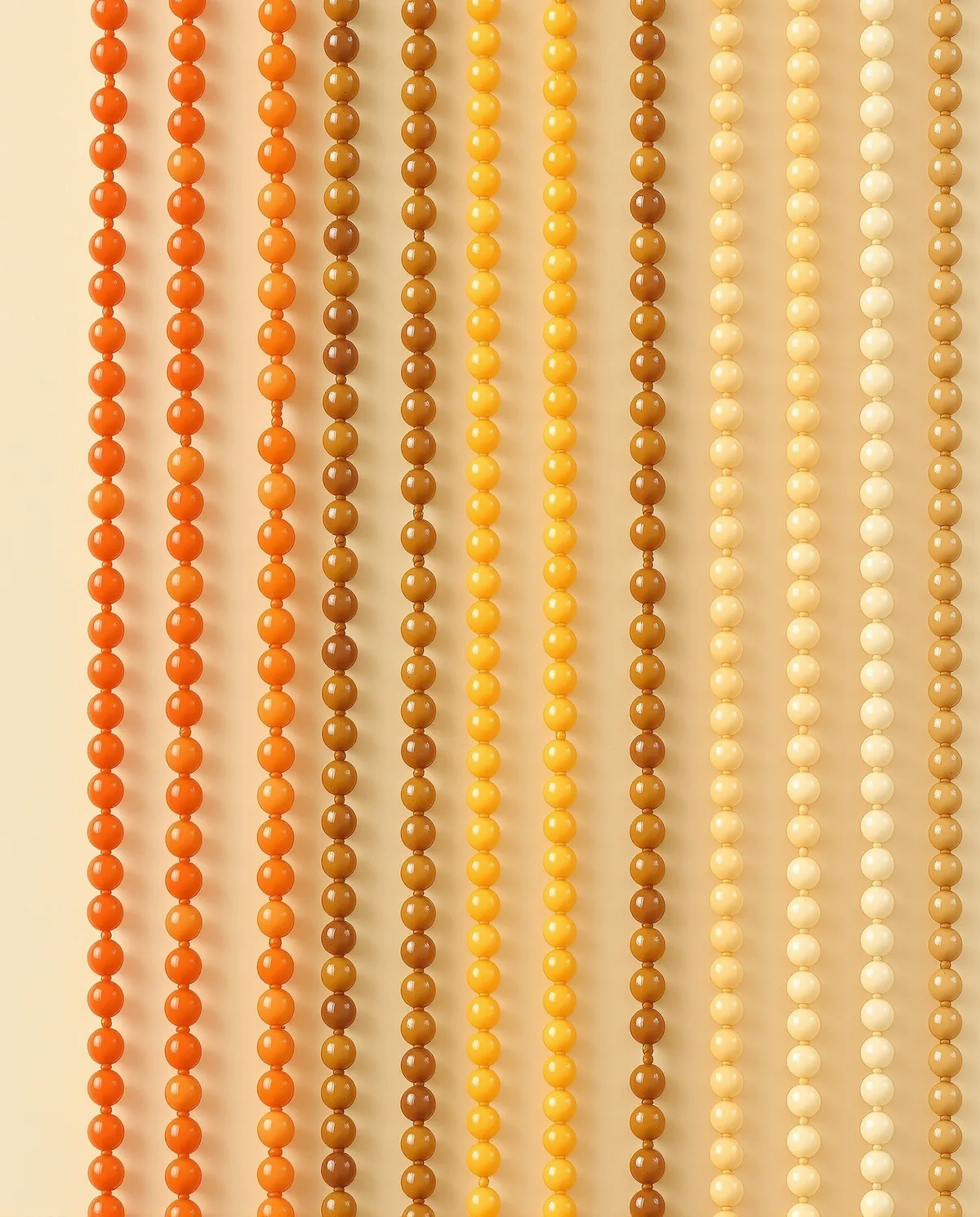
Six bead strands in the Honey Hour palette, each stepping one shade deeper than the last, from cornsilk through honey to deep autumn amber.
Honey Hour is the warm story carried by wood. Turned wood rondelles make up the body of each strand, honey glass supplies the saturated note, and dotted glass drops finish the strand ends. The wall design is drawn at 60 × 90 cm on 30 strands with a V-point hem, which puts its strand pitch at about 2 cm.
Honey Hour is the warm story among the fourteen in the 2027 design library in which the warmth is structural rather than applied. Wood rondelles form the body of each strand; honey glass is the accent; dotted glass drops finish the strand ends.
The drawn design is a wall hanging at 60 × 90 cm on 30 strands with a V-point hem, which puts the strand pitch at about 2 cm.
The rondelle does most of it. A rondelle is wider than it is tall, so it stacks into a flatter, denser column than a round bead of the same diameter — more visual coverage per bead, and fewer beads per strand for the same drop.
Honey glass supplies the one saturated note. Dotted glass drops sit at the strand ends, which is where they do two jobs at once: they finish the V-point hem with something to look at, and they add the weight a light wood strand needs to hang straight rather than drift.
Two mechanisms for two materials. The glass is held by its bead line, and a stock honey repeats closely.
The wood cannot be held that way. Natural grain varies, so the sample establishes a tone range and production is held inside it. That is why on this design the approved sample does more work than the colour reference does — the reference describes an intention, the sample defines the acceptable band.
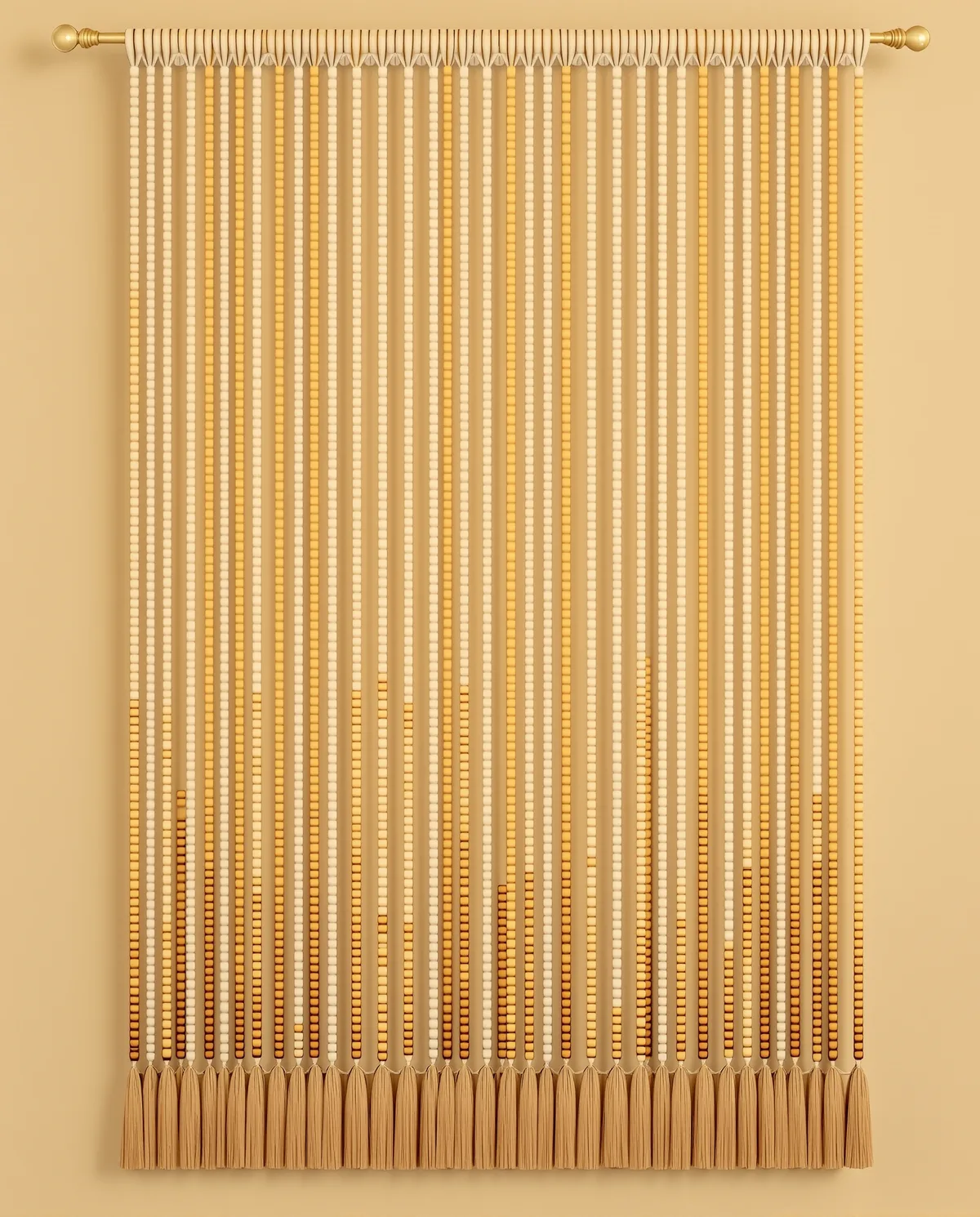
Most warm stories use glass for the body and wood for the accent. This one inverts it, which is why it reads soft rather than jewel-like.
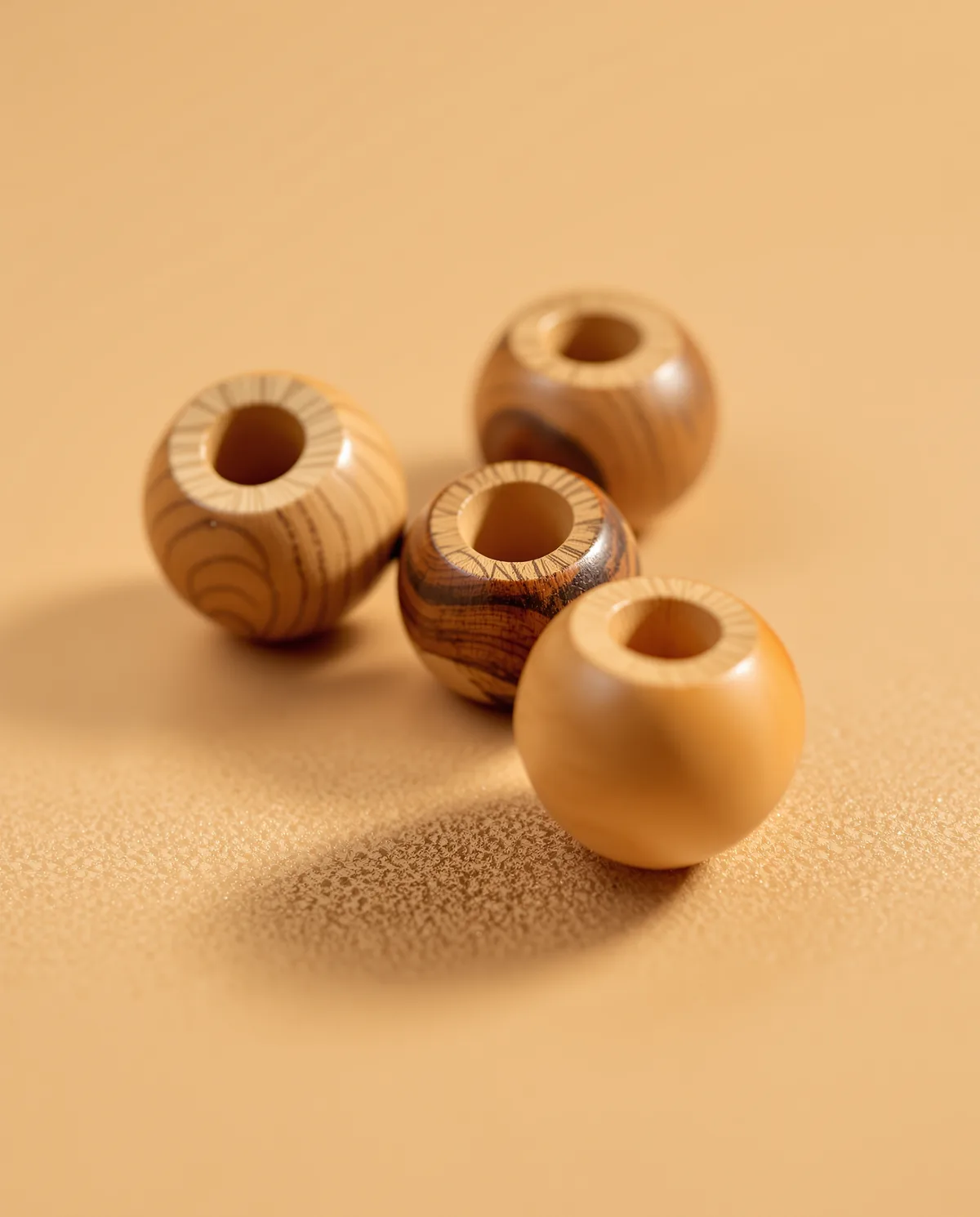
A rondelle is wider than it is tall, so it stacks into a flatter column than a round bead of the same diameter. More coverage per bead, fewer beads per strand.
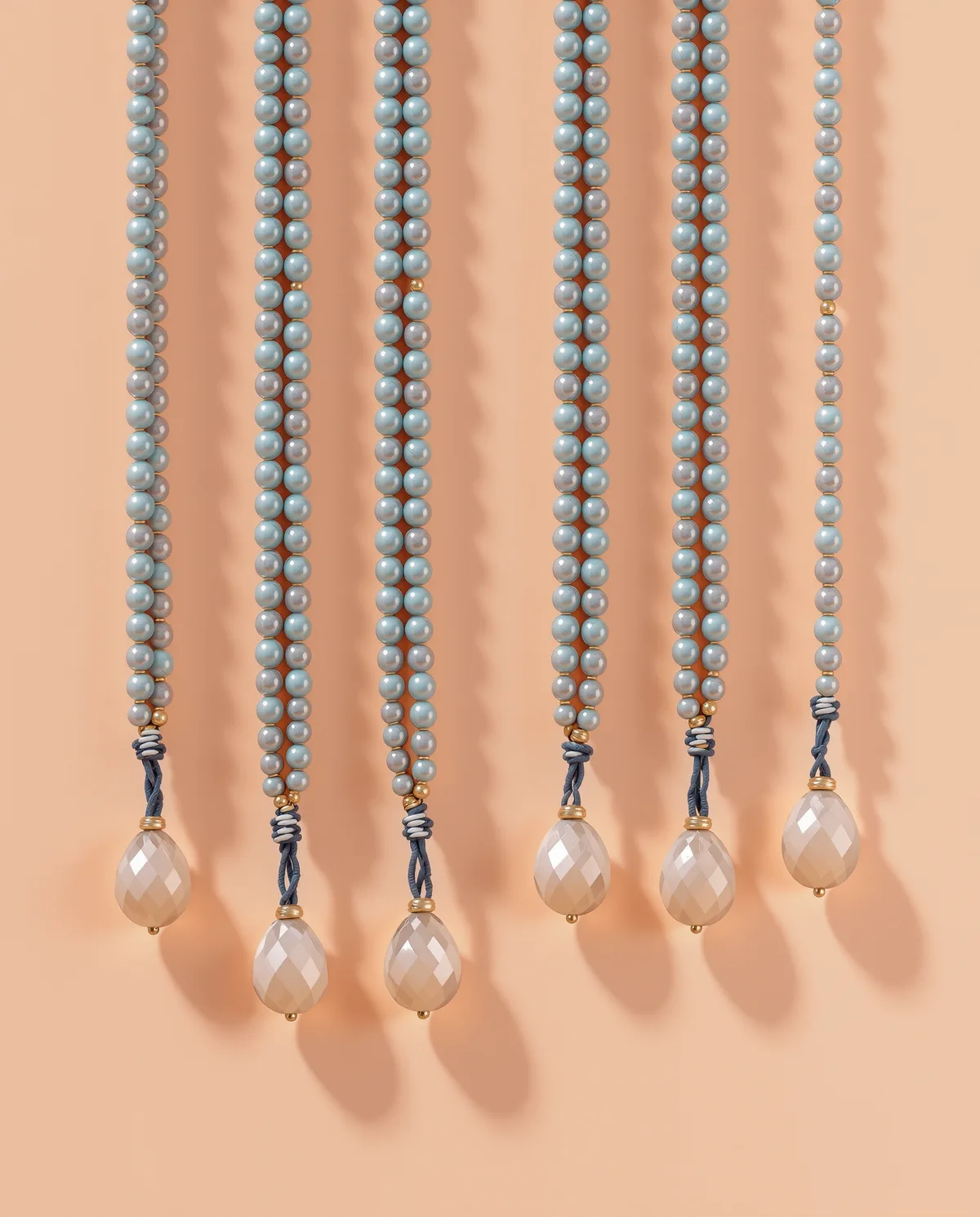
A wood strand is light enough to drift. A heavier dotted glass drop at the end settles it, and finishes the V-point hem with something to look at.
The drop bead. It is the cheapest change on the design and it carries the most character: a dotted drop reads playful, a plain amber drop reads restrained, a faceted drop reads formal. The strand body stays the same in every case.
The second change to consider, and only after the first, is the wood tone. A darker stain pushes the whole story towards chocolate and the honey glass stops reading as honey.
As the approachable one. Wood is the material customers handle without hesitation, and a wood-bodied piece looks durable rather than fragile, which matters on a shelf where a glass piece reads as breakable.
It also photographs reliably, which is not true of every story here. Because the palette does not depend on transmitted light, a flat retail shot looks much like the piece on a wall.
Below an equivalent all-glass strand. Wood is lighter and generally cheaper per bead than glass of the same size, and the rondelle shape covers more drop per bead, so the bead count per strand falls as well.
The cost structure has one quirk worth knowing. Dotted glass drops are a specialty bead, and a specialty bead at the end of every strand is 30 specialty beads a piece. On a 30-strand design that is a small line; scaled to a 60-strand doorway it is the line that moves the quote.
One: the 60 × 90 cm wall hanging at 30 strands. The palette would carry a short format well, and a café curtain or a valance in it is available to develop.
Less than most stories, and that is the point. Wood is opaque, so a backlit Honey Hour piece reads as a silhouette with a few glowing honey beads in it. The transmitted-light version is not the interesting one.
In reflected room light the story comes alive: grain becomes visible, the glass picks up a highlight, and the dotted drops read as pattern. It is one of the few stories in the library designed for a wall in ordinary light rather than for a window.
Wood, bamboo, bone, horn and ceramic all belong in this palette. Bamboo is confirmed per design rather than claimed as a standard offering, and it is very light — a bamboo-bodied version would need a heavier end bead than the wood one.
Glass and acrylic can take the honey note. Acrylic is moulded and dyed to the colour given, which makes it the predictable route if a buyer's palette has to match an existing product in their range.
Stock for the glass and the drops; a tone range for the wood; and a dyed-to-match option only where the design calls for a colour no stock line reaches. There is a sound reason to leave the wood undyed: a stain that is matched to a reference still varies with the grain underneath it, so a matched wood bead delivers less consistency than an unmatched one approved as a range.
Wall pieces first, then short formats. The wood body is read at close range and rewards it. A café curtain or a valance in this palette would work well, with the hem reconsidered — a V-point needs height to read as a point rather than as a notch.
Extractable data
| Specification | Value |
|---|---|
| Palette | Honey, caramel, natural wood tone, with dotted accents |
| Strand body | Turned wood rondelles |
| Accent | Honey glass rounds |
| Strand ends | Dotted glass drop beads |
| Wall design | 60 × 90 cm, 30 strands, V-point hem |
| Strand pitch | About 2 cm centre to centre |
| Where the wood is made | Turned in our own Saharanpur wood factory |
| Colour method | Glass matched to a chip or reference; wood tone range approved on the sample |
| Production | 40 to 60 days after sample approval |
Good to know
Yes, and it is one of the better small-format stories, because wood reads warm at any size and does not depend on transmitted light. A valance version keeps the rondelle body and the dotted drop and loses the V-point, which is too shallow to register at 30 cm.
The glass and the drops, easily. The wood is the constraint: it can be stained darker or lighter within its own warm family, but it will not go cool or go bright. If a buyer wants the same construction in a cool palette, the body bead has to change material.
A strung wall hanging drawn at 60 × 90 cm on 30 strands with a V-point hem. It is available to develop at that size.
The honey glass and the dotted drops are stock lines. The wood is specified per design, and its tone is approved as a range on the sample rather than matched to a reference, because natural grain varies and a point colour cannot be held.
The glass by its bead line, the wood by the approved tone range. Production is held to the sample. That is the reason the sample matters more on a wood-bodied design than on an all-glass one: a wood sample defines a band, and the band is the specification.
Wood, bamboo, bone, horn and ceramic all sit in this palette. Glass and acrylic take the honey note. Bamboo is confirmed per design rather than offered as a standard, and it is very light, so it would need a heavier end bead than the wood version does.
Keep exploring
Design
Colour stories documented by how they are built, not by how they look in a mood board.
Read the guideIndex
Twenty-four named looks, each described by the material, palette, pitch and hem that actually produce it.
Read moreColour story
Cool, low-contrast tones in foil-lined and frosted glass, built as a strung hanging and as a linked disc piece.
Specs and sizesColour story
Wood, bone and amber glass mixed on one strand — warmth at a lower weight and cost than an all-glass build.
Specs and sizesColour story
Glossy orange, canary glass, chocolate brown and cream soda, built as a door curtain, a sunburst valance and a wall hanging.
Compare the optionsDesign
60 × 90 cm on 30 strands, with wood rondelles as the body, honey glass as the accent and dotted drops at the ends.
See the detail
Start a conversation
Send a reference, a colour chip or a sketch. Minimums are set per design and confirmed per quote; sampling is quoted separately and usually runs 16 to 20 days from an agreed brief.