Colour story
The Op Pennant story
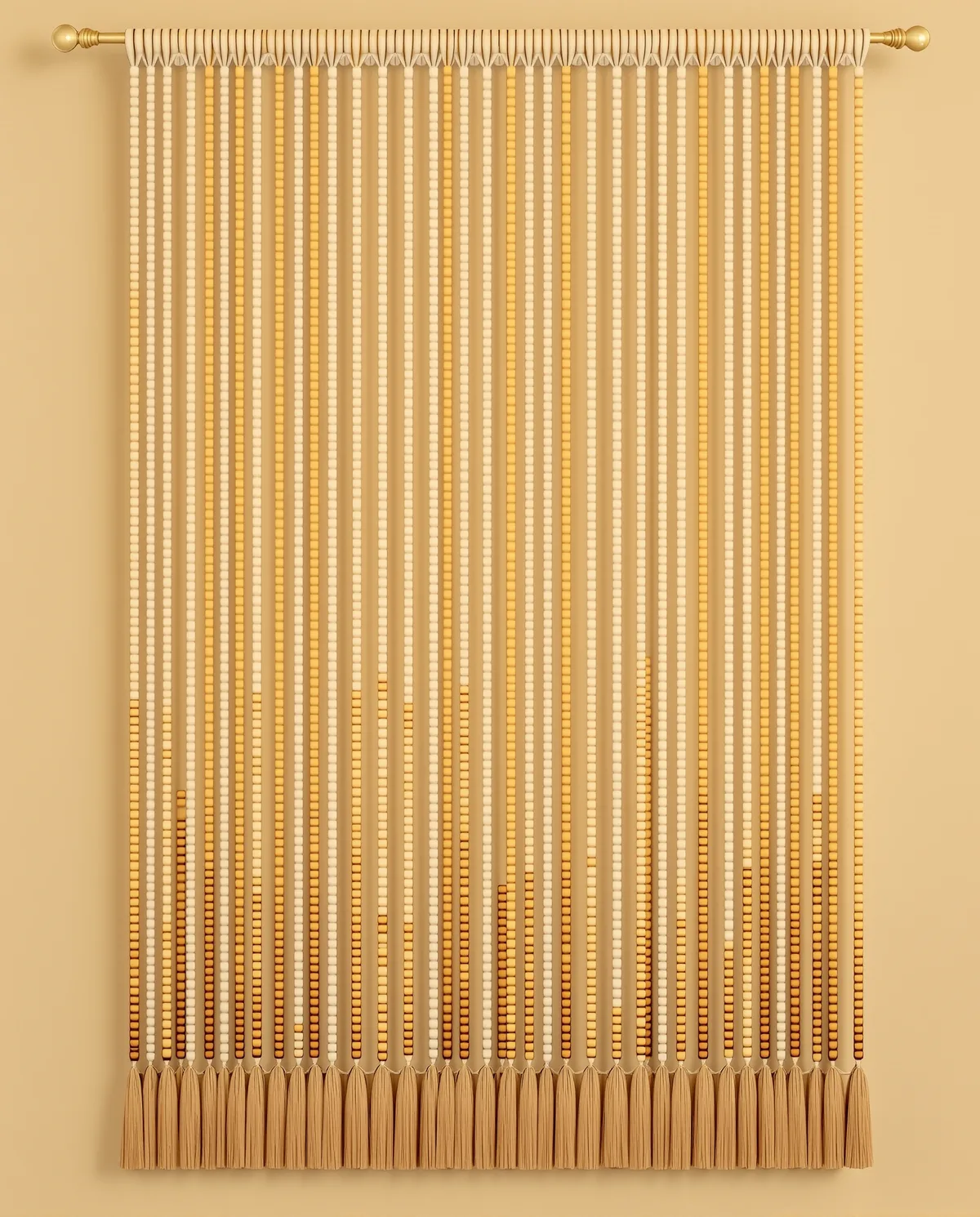
Cream, lagoon and jade glass ovals on 27 strands, where the optical read comes from bead geometry rather than colour.
Read the guide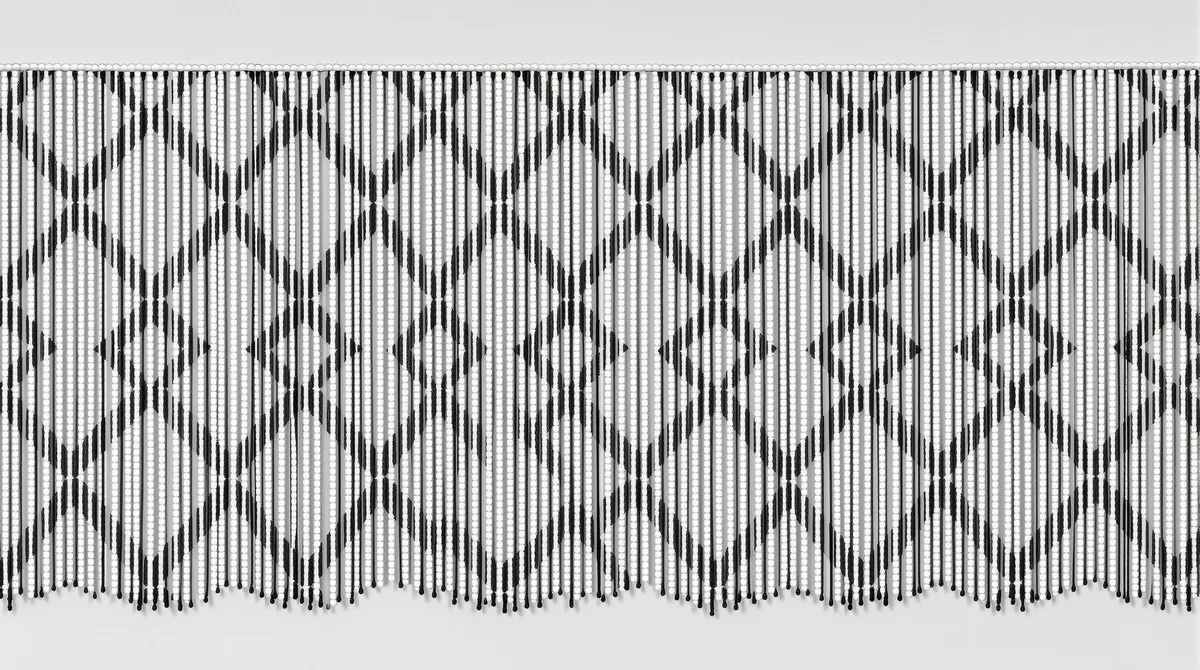
Design · Op Pennant Wall Hanging
The pattern is produced by the shape of the bead. Strung lengthwise, an oval leaves no gap, so a run of one colour reads as a painted band.
A beaded panel worked in jet black and chalk white beads so a bold optical diamond lattice steps right across the strands, the hem falling to a shallow scallop.
The Op Pennant wall hanging is drawn at 60 × 90 cm on 27 strands with a V-point hem, in cream, lagoon and jade glass ovals. Its optical effect comes from the bead shape: an oval strung through its long axis stacks against the next oval with almost no visible waist, so a run of one colour reads as a solid band rather than as a row of beads.
The Op Pennant wall hanging is drawn at 60 × 90 cm on 27 strands with a V-point hem, in cream, lagoon blue and jade green glass ovals. Available to develop.
It is the only piece in the library whose effect is produced by bead geometry rather than by colour, which makes it the most interesting design here to specify and the easiest to get wrong.
Blocks of one colour, run down a strand, with the block boundaries offset strand to strand to form the diagonals.
The mechanism is the oval, and on a wall piece it is doing something a doorway cannot ask of it. A wall hanging is read flat and still, so a continuous band of colour has to hold up at close range — which is exactly where a dotted line built from round beads falls apart. Substitute rounds here and the design does not soften, it stops working.
A patterned piece is specified twice over. The colour-count sheet carries the blocks strand by strand, and the V-point hem carries a longest and shortest drop, and the two have to resolve together — a block that lands cleanly at the centre strand may be cut mid-block at the edge. The first article is checked against the pattern.
| Specification | Value |
|---|---|
| Finished size | 60 × 90 cm |
| Strand count | 27 |
| Strand pitch | About 2.2 cm centre to centre |
| Beads | Pressed glass ovals, one shape throughout |
| Palette | Cream, lagoon blue, jade green |
| Bead orientation | Strung through the long axis so the column reads continuous |
| Hem shape | V-point |
| Pattern control | Bead map written strand by strand |
| Status | A design available to develop at the drawn size |
Retailers and own-label brands, and it is the strongest performer in a photograph of anything in the library — an optical pattern survives a thumbnail, a flat shelf shot and a small on-site photograph, because nothing about it depends on light behaviour.
That makes it useful as the hero image for a beaded range even where the volume sits elsewhere. It is also the design most likely to be asked for in a brand's own colours, because a three-colour graphic is the easiest thing to make look like somebody's house style.
Two lessons carry straight onto this design, and both are about mapping.
A graphic pattern is held on the count sheet: every strand written out bead by bead, so the diagonals land in the same place on the first piece and the thousandth. And a pattern mapped bead by bead at the bench from a reference image, with no artwork file, is the slow route: the mapping becomes the bulk of the work. Send artwork, or budget for the mapping.
On a patterned design strand order is not optional: a strand packed out of sequence breaks the diagonals when the piece is hung, and nothing on the strand itself says where it belongs. So strands are bundled and labelled in sequence, and the hanging instruction is part of the packing.
What it cannot show is how crisply the pattern resolves in a specific bead, because resolution depends on the bead line chosen. That is why an optical design is sampled before it is costed firmly.
The optical story: cream, lagoon and jade. This wall hanging is the only design drawn in it, which is a real gap — an optical pattern at doorway scale would be the most striking thing in the range and nobody has drawn it.
The oval, and the fact that it is pressed. A pattern is a measurement, and a mould-made bead repeats its dimensions where a hand-made bead varies. A millimetre of variation per bead is invisible on one strand and accumulates into skewed rows by the bottom of a 90 cm drop.
Acrylic moulded and dyed to the colour is the equally reliable alternative and is lighter. Ceramic glazed and fired in our own Khurja plant is the interesting third option, because a matte or speckle glaze changes the optical read from graphic to textile.
A V-point, which on this design is part of the pattern rather than a finish. The shortest strands sit at the edges and the longest at the centre, so the pattern has to resolve at 27 different drops — and a block that lands neatly at the centre strand may be cut mid-block at the edge.
Drawing the hem and the pattern together is therefore not optional here. It is the same document.
A turned wooden dowel, made in our own Saharanpur wood factory. At 27 strands this is a mid-weight build for the format: lighter than After Hours's 33 strands, heavier than the cool story's 22.
Recoloured cheaply, because the map does not move — three colours can all change without a single structural change to the count sheet. The only constraint is value separation: three colours of similar lightness dissolve the pattern.
Resized only by redrawing. The useful comparison is with the Honey Hour wall hanging, which shares this design's format almost exactly at 60 × 90 cm on 30 strands with a V-point hem. Same dimensions, same hem, different material — and the two look nothing alike. That is as clean a demonstration as the library offers that material and bead shape, not size, decide what a piece becomes.
Good to know
Yes, and for an optical design artwork is worth sending. We draw the bead map from it, which converts it into a colour-count sheet. Mapping a graphic by eye at the bench from a reference image is the expensive route and it shows in the price.
Yes, with one rule: keep the three colours well separated in value. The optical effect depends on each block reading as a distinct band, and three colours of similar lightness produce a muddle rather than a pattern.
Only redrawn, not scaled. An optical pattern has a minimum resolution in beads, so halving the drop needs a new bead map with fewer, bolder blocks rather than the same map compressed.
Pressed glass ovals in three colours, one shape throughout. Pressed glass is the right material because the shape comes from a mould and therefore repeats — an oval made now and an oval made next year stack the same way.
Exclusivity is a commercial decision taken per programme rather than a property of the design. Name it in the brief and it is quoted alongside the piece.
It shows the size, strand count, hem and the pattern as drawn, built from named beads so the design converts into a colour-count sheet. How crisply the pattern resolves depends on the bead line chosen, which is settled on the sample.
Keep exploring
Colour story
Cream, lagoon and jade glass ovals on 27 strands, where the optical read comes from bead geometry rather than colour.
Read the guideManufacturing
Widths from 50 to 76 cm on a turned dowel, in glass, wood and cast faux capiz — hem shapes, strand counts and what is a shipped format against a concept.
Specs and sizesDesign
Strung wall pieces from 50 × 90 to 60 × 100 cm at 20 to 40 strands, documented by hem shape and bead list.
Specs and sizesDesign
60 × 90 cm on 30 strands, with wood rondelles as the body, honey glass as the accent and dotted drops at the ends.
Read the guideDesign
50 × 90 cm on 20 strands of clear faceted glass with millefiori and lime coin drops, designed for a window rather than a wall.
See the detailGuide
Resolution, weight, repeatability, cost per covered area and breakage risk, with the working figures from production.
Compare the options
Start a conversation
Send a reference, a colour chip or a sketch. Minimums are set per design and confirmed per quote; sampling is quoted separately and usually runs 16 to 20 days from an agreed brief.