Design
Colour stories, by construction
Colour stories documented by how they are built, not by how they look in a mood board.
View the range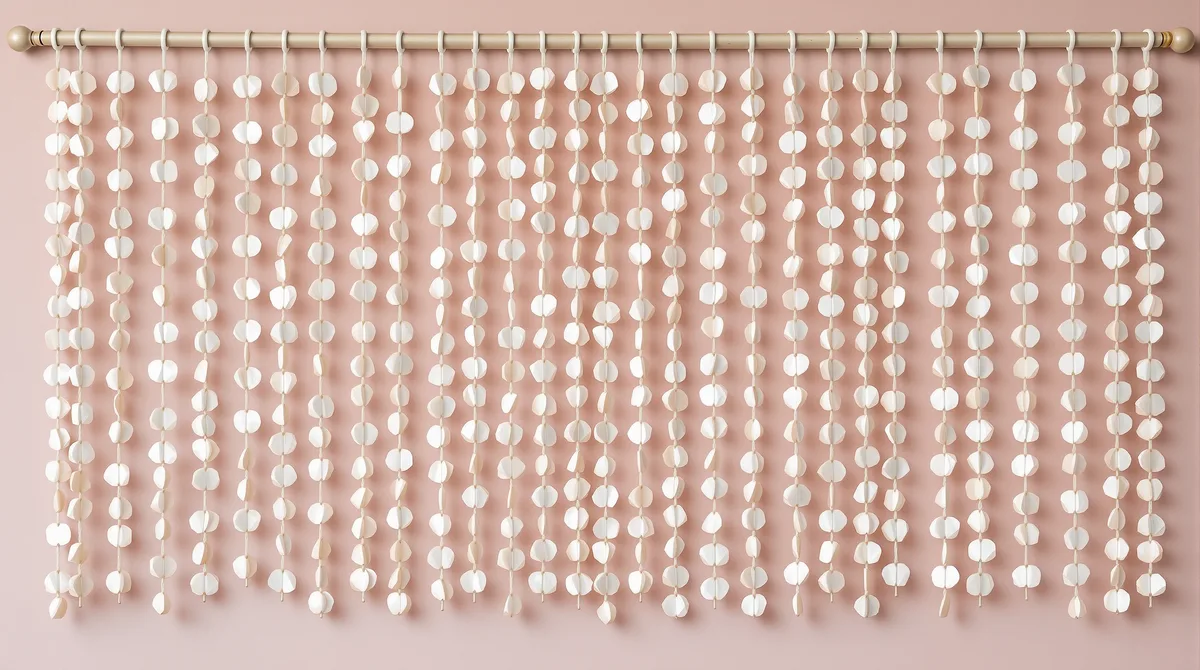
Colour story
The only story in the library whose main element is not a bead. Each blossom is a cut shape, and a small bead at its centre is the only thing holding it in place.
A hanging of flat round discs cast in pearlised resin and dyed acrylic in blossom pink and cream, each disc linked to the next in continuous vertical chains below a slim rail.
Cherry Blossom is the one story in the library whose main element is not a bead. Five-petal blossoms are cut to shape in faux capiz — cast resin or dyed cut acrylic — and each one is held on its cord by a small spacer bead dyed to match it. Without that centre bead the blossom slides down the cord and the pattern collapses.
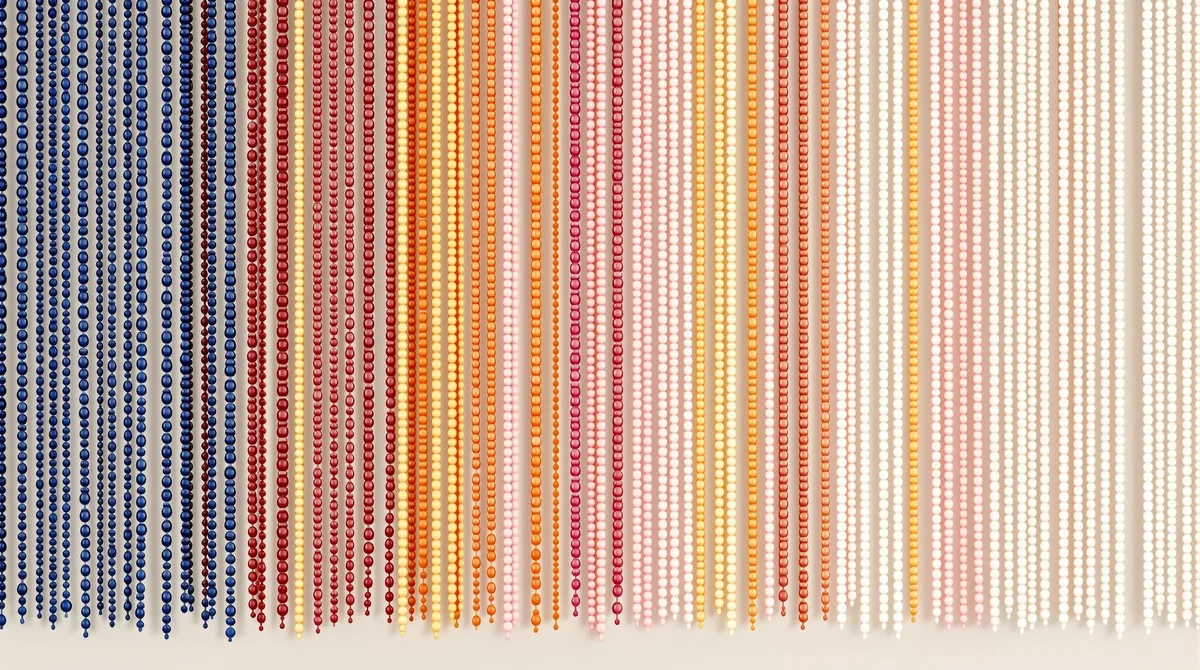
Cherry Blossom is the one story in the design library whose main element is not a bead. Five-petal blossoms are cut to shape in faux capiz and hung on cord, with a small bead at each centre.
It is also one of the best-documented pieces on this property. The 18 × 30 in wall hanging was adopted in August 2026 and approved in September 2026, and the construction decisions behind it are recorded rather than inferred.
Two components and one of them is a bead. The blossoms are faux capiz — cast resin or dyed cut acrylic, finished to imitate capiz shell. There is no shell in it, and that is a strength rather than a compromise: colour is consistent batch to batch, there is no shell-import exposure, and the engineered material is more durable than the shell it imitates.
The second component is a small spacer bead dyed to match the petal. It is the only part of the build that is a bead, and it is doing the most important job in the piece.
By approving the blossom and the spacer as a pair. Both are dyed, so both are matched to a physical reference and confirmed on the sample — but what actually has to hold is the relationship between them, not either colour on its own.
A spacer approved separately against a chip can be a perfect match to the chip and still read as a visible bead at the centre of every flower. The approval that matters is the two together, on the sample, which is then what production is held to.

A blossom is a flat cut shape with a hole at its centre. That is why it needs a stop: nothing about its own geometry keeps it where it was placed.
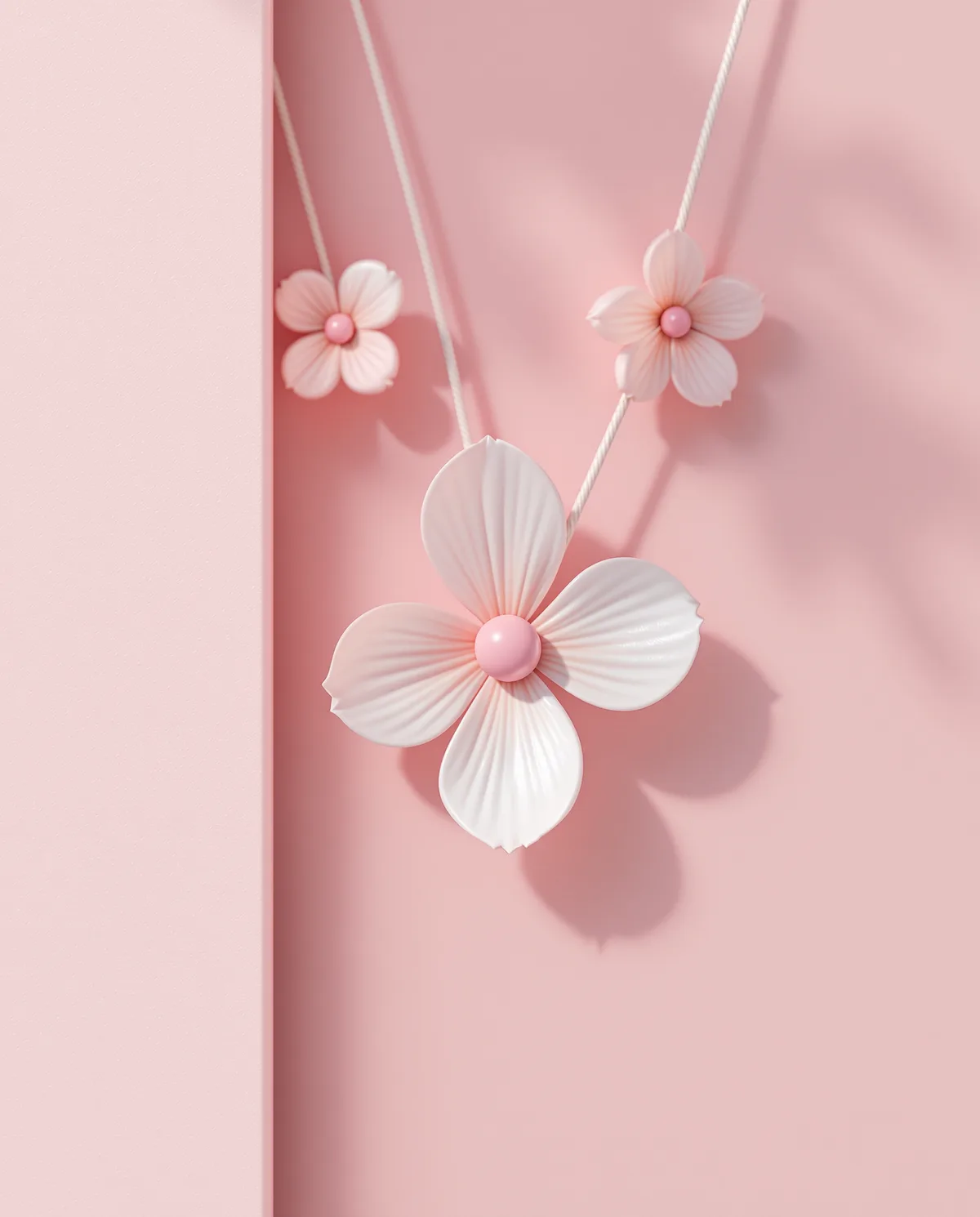
The spacer bead is dyed to the petal colour so it disappears, and it is the only reason the blossom spacing holds through packing, shipping and hanging.
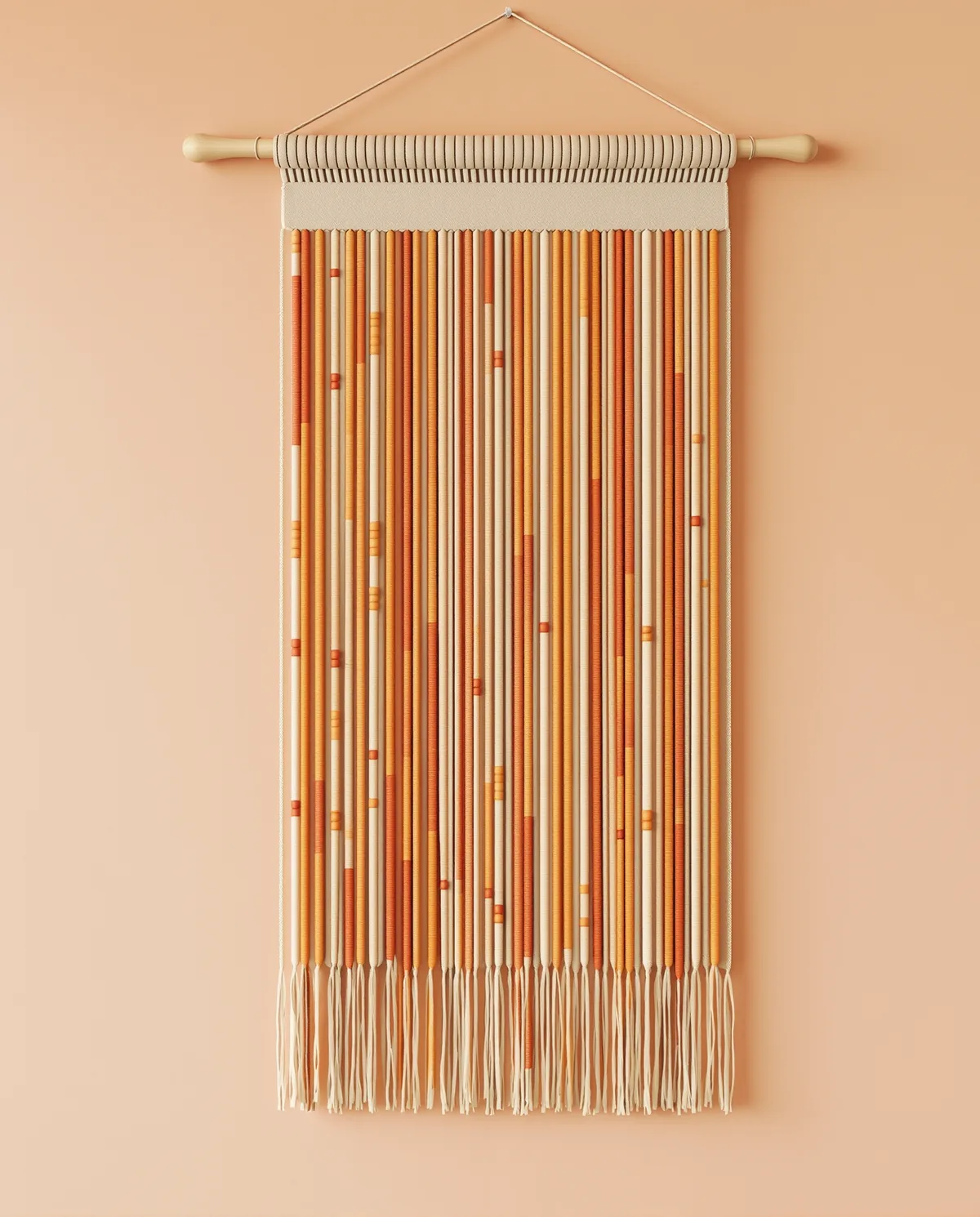
The dowel version carries 155 to 170 blossoms; the rod-pocket version carries 130. A fabric header eats height that would otherwise hold blossoms.
Differently, rather than more. There is no stringing sequence and no bead count in the usual sense; there is a blossom count, a cut or cast operation per blossom, a dye operation, and one spacer bead per blossom.
The cost conversation on this design is therefore about blossom count and mount type rather than about beads. That shows directly in the build: the two mount versions carry 155 to 170 blossoms on a dowel against 130 on a rod pocket, because a fabric header consumes height. The mount is a cost decision as much as a look decision.
The Cherry Blossom name covers two different pieces. This one is the sampled 18 × 30 in hanging in cut faux capiz. The other is a 76 × 46 cm design in the 2027 design library at 40 strands with an uneven hem, in frosted pink hearts with ivory blossom ends — strung beads rather than cut shapes.
So a brief that says Cherry Blossom should name the size as well. The construction, the bill of materials and the price are unrelated between the two, and the size settles which one is meant.
Backlit, faux capiz is at its best: the material is semi-translucent, so a lit blossom glows and the spacer bead at its centre becomes a small dark point. That reads convincingly like the shell it imitates.
In reflected room light the blossoms go opaque and read as a pale pink pattern on the wall. Pleasant, flatter, and the version most hallways give. Specify which the position provides.
Cast resin and dyed cut acrylic, as built, because both take dye uniformly through the material. Those are the two faux-capiz routes and one is chosen per design rather than mixed.
Glass is not a sensible substitute for a cut blossom — a flat five-petal shape in glass is a different manufacturing problem with sharp edges attached to it. Where a blossom motif is wanted in glass, it is made as a moulded bead rather than a cut shape, which is how the moulded daisy connector on the café curtain designs was approached.
Nothing is stock. Both components are dyed, which makes this the most freely recolourable story in the library, and it also means there is no stock colour to fall back on if a sample is rejected — everything goes back to the dye stage.
Wall pieces, as built. The blossoms are read individually at close range, which is exactly what a wall hanging provides and exactly what a full-height doorway does not.
A café curtain would work. A tall curtain would not, because 200 cm of cut blossoms is a very large blossom count and the piece gains weight and tangle risk without gaining anything visually.
The mount, before anything about colour. Dowel or rod pocket is the decision that moves the blossom count by around a quarter and therefore moves the cost, and it is also an installation decision that the room usually dictates.
After that, blossom count per cord. More blossoms is denser and heavier; fewer is airier and cheaper, and a light cord with few blossoms needs an end element to stop it drifting.
As the most immediately likeable thing in the library, and the least negotiable. A cut blossom is recognisable from across a shop, needs no explanation and sells to people who would not buy beadwork.
The caution is that very thin cut shapes can tangle in handling, which is a packing and a merchandising consideration rather than a design flaw. Disc and petal weight is chosen on the sample so the cords hang straight, and the same logic applies on the shelf as on the wall.
Extractable data
| Specification | Value |
|---|---|
| Palette | Blossom pink, with spacer beads dyed to the petal colour |
| Main element | Five-petal blossoms cut to shape in faux capiz |
| Material | Cast resin or dyed cut acrylic, finished to imitate capiz shell |
| Holding method | One spacer bead at each blossom centre, acting as a stop |
| Sampled size | 18 × 30 in |
| Blossom count, dowel version | 155 to 170 |
| Blossom count, rod-pocket version | 130 |
| Render variant | 76 × 46 cm, 40 strands, uneven hem, frosted pink hearts with ivory blossom ends |
| Production | 40 to 60 days after sample approval |
Good to know
A wall hanging at 18 × 30 in that was adopted in August 2026 and approved in September 2026, and a separate 76 × 46 cm design in the 2027 render library at 40 strands with an uneven hem. They share a name and almost nothing else — one is cut blossoms, the other is strung beads.
Everything is dyed. A cut or cast blossom has no natural colour, and the spacer beads are dyed to match the petals so that the stop disappears into the flower. That is the clearest dyed-to-match case in the library: the specification for one component is another component.
By approving a dyed blossom and a dyed spacer together, as a pair, and holding production to the approved sample. Approving them separately is how a programme ends up with a visible bead in the middle of every flower.
Cast resin and dyed cut acrylic, as built. Both take dye uniformly because the colour is through the material. Real capiz shell is the reference material being imitated and is not what we make — we make the engineered version, which gives consistent colour and better durability.
Yes, down to a point set by the blossom. A five-petal blossom has a minimum size below which the petals stop reading as petals, so a small piece reduces the blossom count rather than the blossom size. Below about a third of the sampled area the design needs redrawing.
Entirely, and this is one of the easiest stories to recolour because every element is dyed. Change the petal colour and the spacer follows it. The one constraint worth respecting is tonal: a dark blossom loses the shell-like translucency the material is imitating.
Keep exploring
Design
Colour stories documented by how they are built, not by how they look in a mood board.
View the rangeIndex
Twenty-four named looks, each described by the material, palette, pitch and hem that actually produce it.
Open the referenceColour story
Wood, bone and amber glass mixed on one strand — warmth at a lower weight and cost than an all-glass build.
See the detailColour story
Glossy orange, canary glass, chocolate brown and cream soda, built as a door curtain, a sunburst valance and a wall hanging.
Specs and sizesColour story
Scattered pastel accents across 60 strands at 120 × 180 cm, placed from a bead map rather than by chance.
Specs and sizesDesign
155 to 170 cut faux-capiz blossoms at 18 × 30 in, each held in place by a spacer bead dyed to match the petal.
See the detail
Start a conversation
Send a reference, a colour chip or a sketch. Minimums are set per design and confirmed per quote; sampling is quoted separately and usually runs 16 to 20 days from an agreed brief.