Guide
Cord safety
Where a loop can form on a strung panel, why strands are finished individually, and what to check on an older piece.
View the range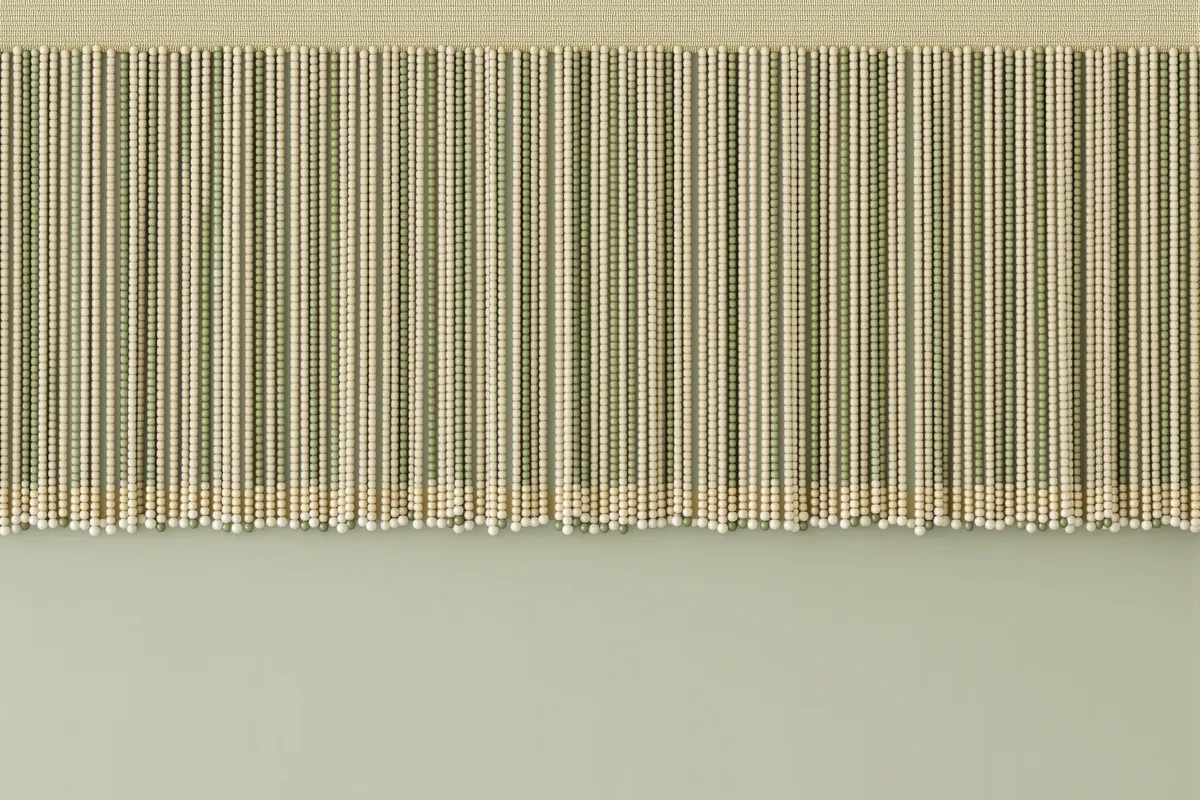
Guide · Safety
A full-length bead panel is reachable along its entire length, which is the point of it. Where that is not wanted, the answer is a shorter piece, not a different bead.
A short beaded valance only thirty centimetres deep, close strands of olive, moss and oatmeal beads below a plain header rail, the hem stepped into a repeating fan arch.
A full-length panel is reachable from floor to header, so height alone cannot make one safe. Where small children are present, the two available answers are a shorter format that finishes above their reach — a valance at 30 to 40 cm deep, or a portal whose centre is cut away — and a construction whose bead attachment has been tested rather than assumed.

You cannot make a full-length bead panel out of reach, because its strands run from the header to just above the floor. That is the format working as intended.
So where reach is the concern, the lever is the format rather than the mounting height. A valance finishes well above head height. A portal has no strands at the centre of the opening. A full curtain has strands everywhere a hand can go, and raising the header only shortens the gap at the floor.
Three different concerns get merged into one question and they have different answers.
The first is whether a child can pull the panel down, which is a fixing question: a panel is a handle at toddler height and a horizontal pull on a header is the load least likely to have been considered. That is about what the header is fixed to.
The second is whether a bead can come off and be swallowed, which is a bead-attachment question and is testable.
The third is whether a strand or a loop can go round a neck, which is a construction question about loops and long free cords rather than about height.
Height is relevant to none of them directly. It is relevant only because a shorter format removes the whole lower part of the panel from the room.
Material changes the consequence. Acrylic does not shatter, which is exactly why it suits children's rooms, events and busy doorways. Glass is heavier, chips, and in a hanging panel large beads in some colours chip where they knock against beads of other colours.
Construction changes the exposure. A portal's arched cut removes the strands from the centre of the opening, which is where a child walks and grabs. A valance at 30 to 40 cm deep, mounted above a door head, is physically out of a toddler's reach. End suspension loops are a construction detail at the header, well above reach, rather than a free loop in the panel.
In two opposite directions, which is why it is worth separating.
Larger beads are harder to swallow and more likely to chip. Smaller beads are less likely to chip and, if detached, are more likely to be a small part for a young child. There is no size that is good on both counts, which is why the question is bead attachment rather than bead size: a bead that cannot come off is not a small part, whatever its diameter.
A detached bead in a room with a crawling child, and a header that can be pulled down.
Both are designed out rather than managed. Bead attachment is testable, and where a programme requires it we test it to the buyer's protocol. A header fixed into timber with hardware rated above the load does not come down. Neither is a function of how high the panel hangs.
The format and the drop, plainly, and where the lowest beads sit relative to the header. "90 × 200 cm, strands to within a few centimetres of the floor" tells a parent what they need.
What it must not carry is an age grading or a child-safe claim. Those follow from a children's-product determination and the testing behind it, made in writing before design — a retail listing is the wrong place to decide a safety designation.
Choose the format for the room. A valance above a nursery doorway rather than a full-length panel across it. A portal rather than a curtain where a child walks through many times a day. Acrylic rather than glass within reach.
And then treat it as furniture: fixed properly, inspected occasionally, and not left as the only thing between a toddler and a staircase.
In a nursery, as a judgement about that room rather than a property of the product. We can tell you what the panel is made of, how the beads are held, what it weighs relative to other builds and what has been tested. Whether a reachable hanging object belongs in a specific nursery is the room's risk assessment, and it is not ours to answer.
In a hotel, the relevant heights are different: a panel in a corridor or a lobby is above a public circulation route, and the question is whether anything can be pulled down by an adult leaning on it. That is a fixing and load question, and it belongs in the project's own fit-out standard.
Where a retail programme requires testing — bead attachment, material compliance, incremental market testing — it is arranged to the buyer's own protocol, against the approved sample, and quoted with the programme.
Reach and height are specified rather than rated: the hem is set short where the design allows, so the lowest beads sit above easy reach, and nothing hangs within reach of a crib, cot or changing table.
By making the formats that answer the question. The published range includes full-length door curtains at about 90 × 200 cm, portals at 76 × 140 cm, a 90 × 67 cm dual wall-hanging and short-portal format, valances at 120 × 30 to 40 cm, and café curtains — and the shorter ones exist because not every opening wants beadwork at floor level.
Construction decisions matter more than any of those dimensions. Mushroom and dotted accent builds place large beads up to three or four to a strand and deliberately never in a row, which is an aesthetic decision with a safety consequence: accents are a minority of the beads rather than the whole panel. Where a build has a cotton header rather than a bare dowel, the rod pocket is three inches deep and sits above the opening, out of reach by construction.
Every format's dimensions, every material, and how the beads are held — which together say what each format puts within reach. Reach and height are then specified rather than rated: the hem is set short where the design allows, so the lowest beads sit above easy reach, and nothing hangs within reach of a crib, cot or changing table.
Where a programme requires it, bead attachment and material compliance are tested to the buyer's protocol and quoted with the programme. Age grading is the buyer's, from marketing, packaging and intended use. A safe height is a fact about a room rather than about a product, which is why this page gives the dimensions and leaves the room to the person who knows it.
Extractable data
| Format | Size | Lowest beads | Reachable by a small child |
|---|---|---|---|
| Full-length door curtain | 90 × 200 cm | Just above the floor | Yes, along the whole drop |
| Wide door curtain | 120 × 200 cm | Just above the floor | Yes |
| Door portal | 76 × 140 cm | Varies; centre cut away | At the sides only |
| Dual wall hanging and short portal | 90 × 67 cm | Depends on mounting height | Only if hung low |
| Valance | 120 × 30 to 40 cm | High, above the opening | No, if mounted above a door head |
| Café curtain | 76 × 76 cm | Mid-window | Depends on sill height |
| Age grading | — | Set by the retailer | The buyer assigns the age grade for its market |
Good to know
Height cannot make a full-length panel out of reach, so where reach matters the answer is a shorter format — a valance or a portal — and a construction whose bead attachment has been tested.
It changes the consequence rather than the reach. Acrylic does not shatter, which is why it is the usual choice for children's rooms, events and busy doorways. Glass is heavier and can chip, so a glass panel within reach of a toddler is a different proposition from an acrylic one.
The format, the drop, and that a full-length panel is reachable along its length. It should not carry an age grading, because that is the buyer's to assign from marketing, packaging and intended use. A listing that states the lowest point of the beadwork relative to the header lets a parent make the decision properly.
Not as a height or reach standard, and no safe-height figure is published for our panels. What is tested, where a retail programme requires it, is bead attachment and material compliance, to the buyer's own protocol and quoted separately. Reach itself is a room decision rather than a product test.
A safe height in centimetres, an age grading, a child-safe designation, and any statement that a beaded panel is suitable for an unsupervised small child. Those are facts about a room rather than about a product: the right move is a wall-mounted piece out of reach, or nothing, and nothing hung within reach of a crib, cot or changing table.
For a nursery, the room's own risk assessment and whoever sets it. For a childcare or hospitality setting, the operator's safety standard, which will have a position on hanging items generally. We can tell you what the panel is and how it is built; what is safe in a specific room is a judgement about that room.
Keep exploring
Guide
Where a loop can form on a strung panel, why strands are finished individually, and what to check on an older piece.
View the rangeGuide
Brushing the floor looks intentional and wears fast; a clear gap of a few centimetres lasts and still reads finished.
Compare the optionsGuides
One guide per question that arrives often enough to be worth answering properly.
Read moreGuide
A detached bead becomes a small part, which is why bead attachment is tested rather than assumed.
View the rangeGuide
Which component carries the fire risk, which materials change it, and how a classification is tested on the specified build.
How it is madeGuide
Three failure causes in order: a fixing into board with nothing behind it, hardware rated below the load, and a dowel that can leave its seat.
Read the guide
Start a conversation
Send a reference, a colour chip or a sketch. Minimums are set per design and confirmed per quote; sampling is quoted separately and usually runs 16 to 20 days from an agreed brief.