Specification
The fixing
Plasterboard with and without a stud, timber, concrete and steel — and why the load has to be known first.
Read the guide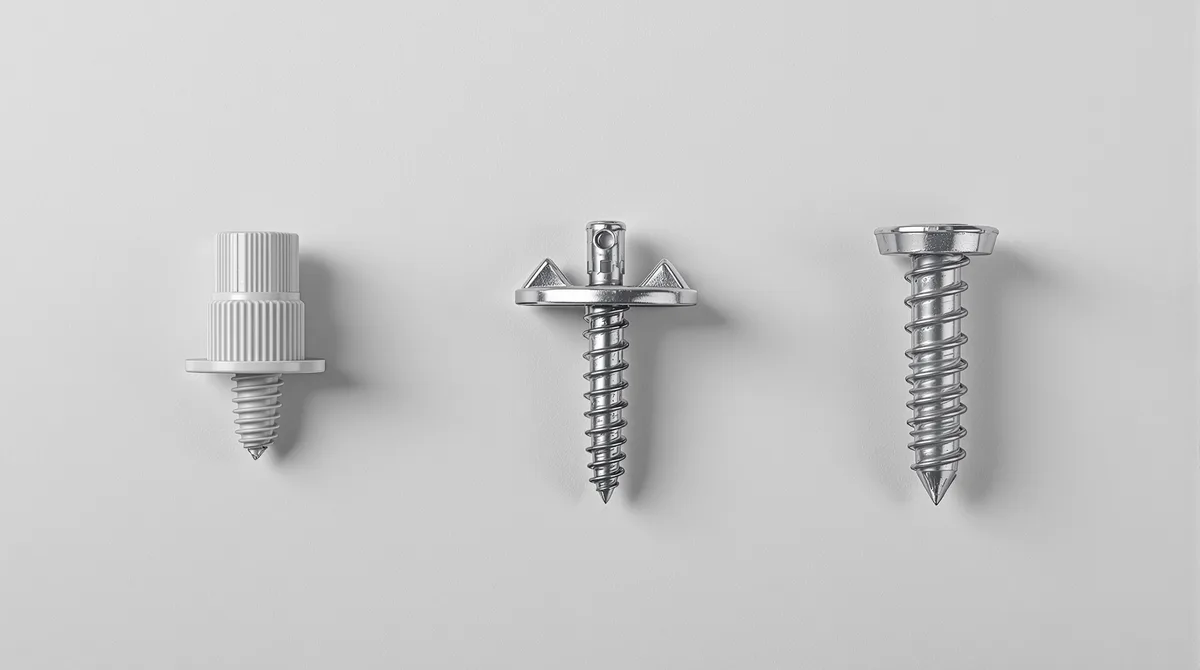
Guide · Safety
A bead panel is a concentrated static load on two small fixings. It is not a heavy object by building standards and it is a demanding one by plasterboard standards.
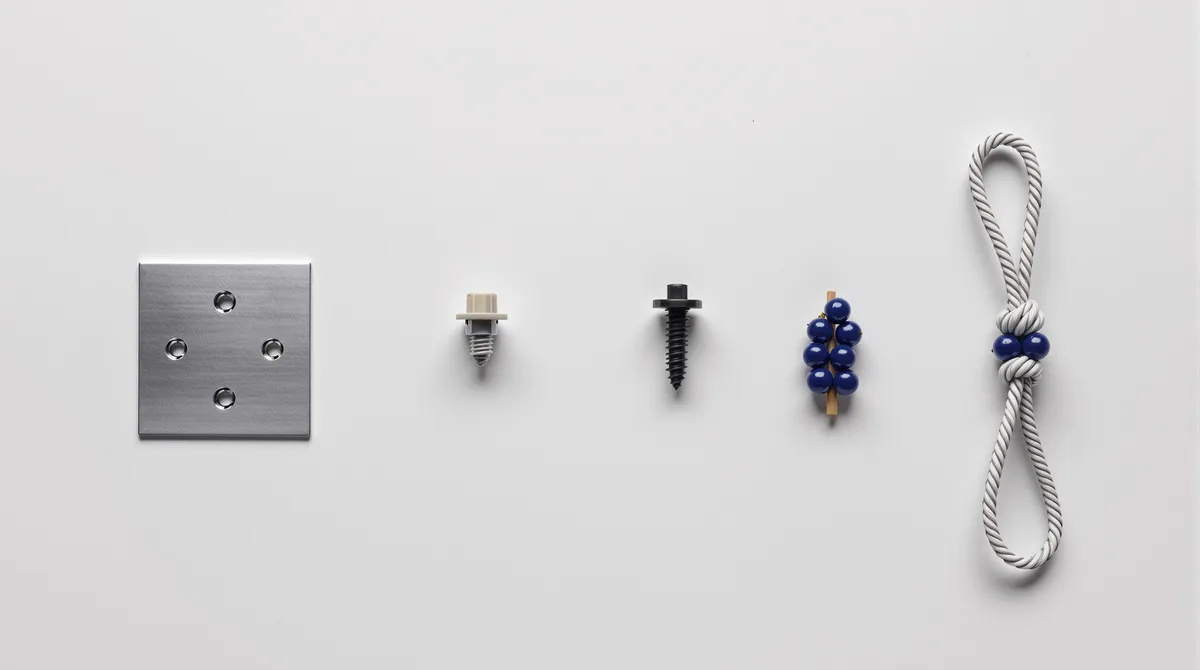
Three wall fixings shown side by side at the same scale: a ribbed plastic wall plug, a steel cavity anchor with its wings sprung open, and a long coarse-threaded coach screw.
Three causes, in order: a fixing driven into plasterboard with no timber or anchor behind it, hardware rated below the panel's weight, and a dowel that can roll or slide out of an open seat. All three are prevented at the fixing rather than at the panel. A load rating belongs to the fixing and the wall, so over-specify the hardware.

Fix into something structural, use hardware rated above the panel's weight, and seat the dowel so it cannot leave its seat.
Three clauses, in the order they are usually got wrong. The wall is the commonest failure, the hardware the second, the seat the third — and all three happen at the fixing. The panel itself is rarely the thing that fails.
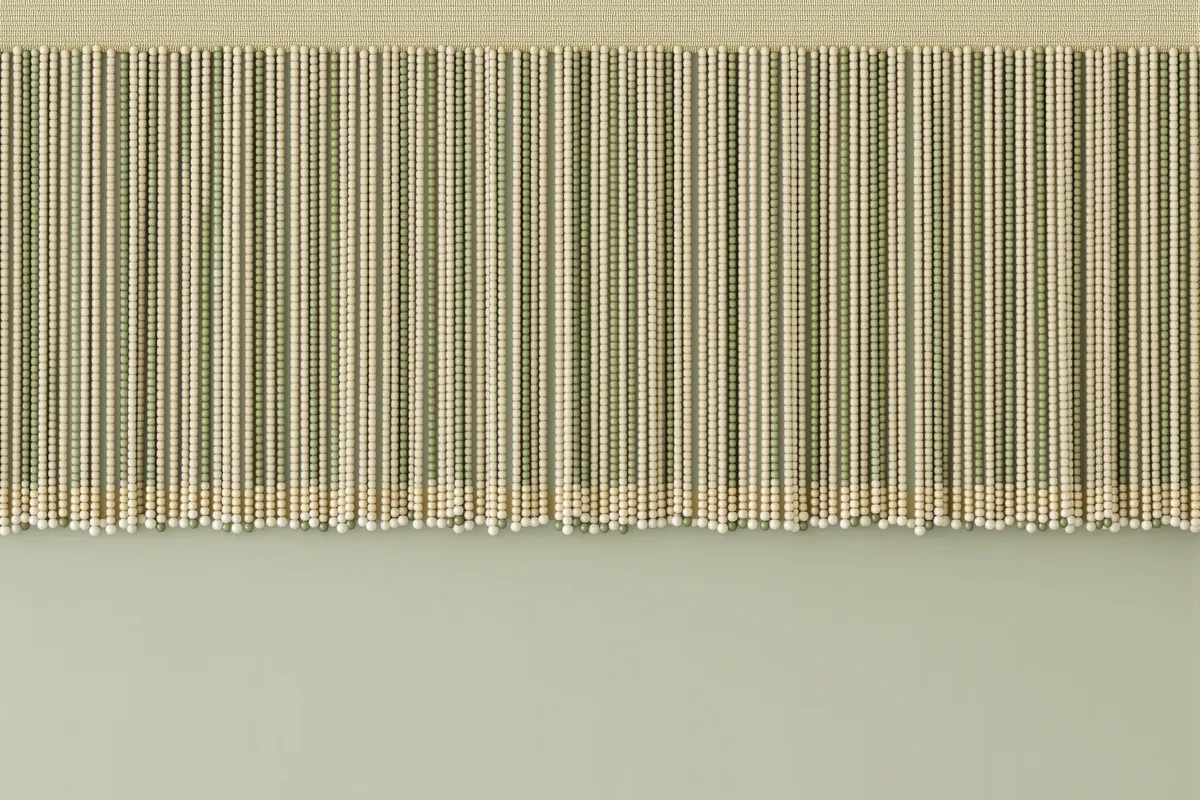
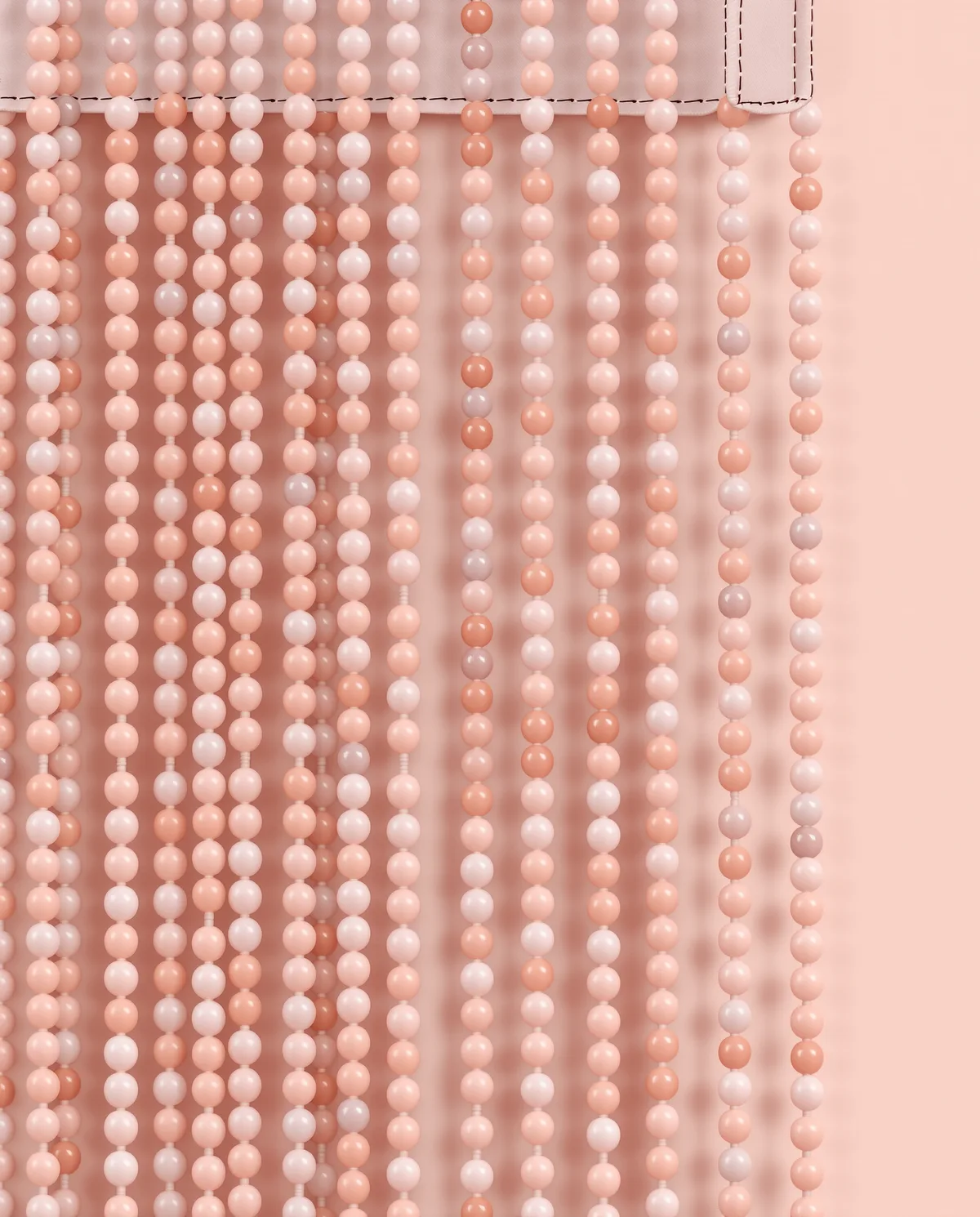
A bead panel is a concentrated static load. Several thousand beads — a densely patterned 90 × 200 cm panel can hold about 11,800 — hang from a dowel supported at two points, and those two points are often small hooks in a frame or a wall.
That is a mild load for a timber frame and a demanding one for plasterboard. Plasterboard has very little pull-out resistance on its own, and the failure is not gradual: a screw in board carries a panel for weeks, develops a hairline crack above it, and then lets go all at once.
The second part of the reasoning is that you cannot judge the weight by looking. Two panels of identical dimensions can differ several times over depending on whether the beads are glass or acrylic and how densely they are strung.
Glass is the heaviest option available, by a wide margin, and a dense glass panel is the case where a tension rod is definitely wrong. Acrylic is light and will not shatter, which also makes the consequences of a fall less serious. Wood and bamboo are light. Faux capiz discs are light but broad, so they catch a draught more than a bead strand does.
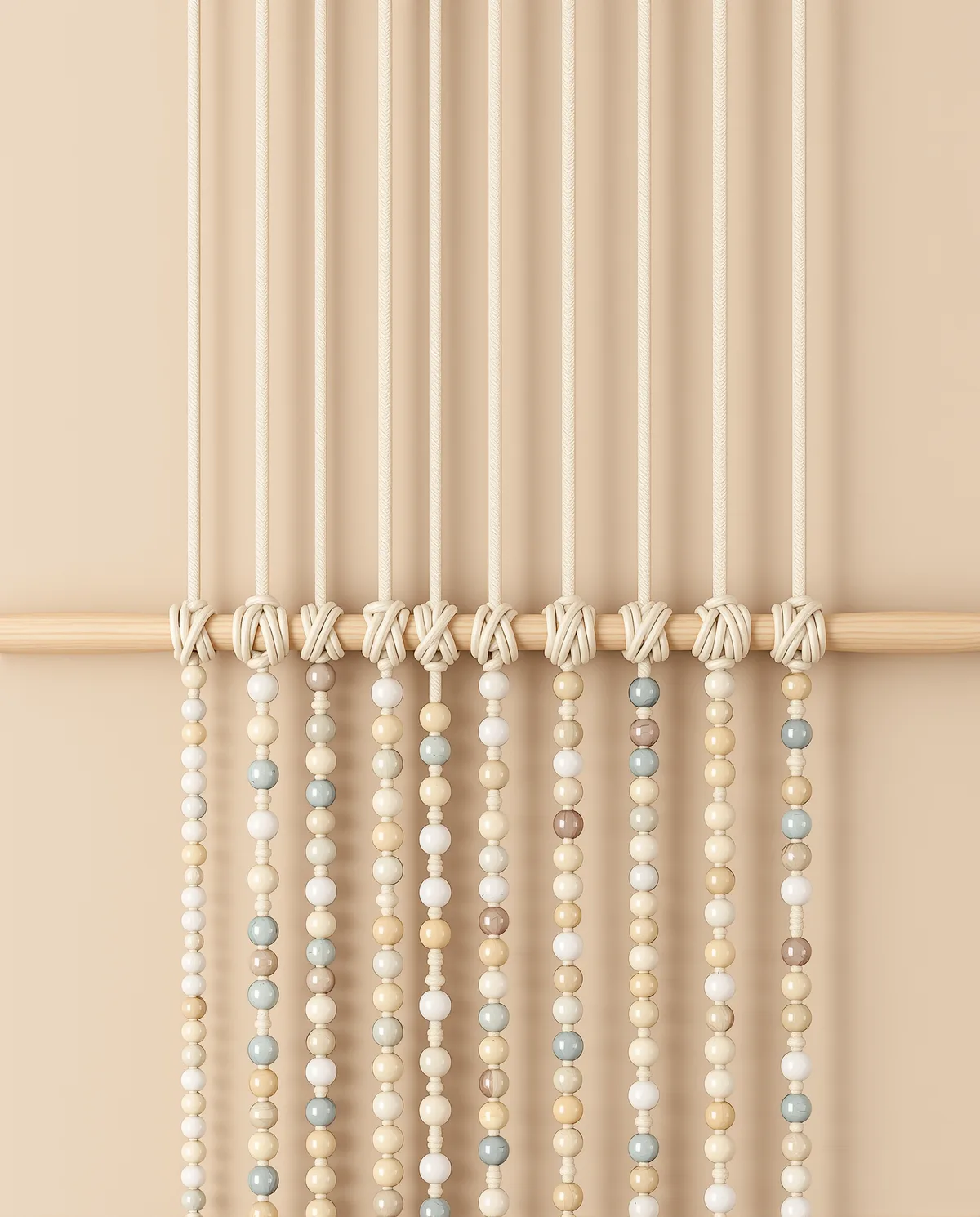
Construction matters as much as material. A stained wooden header rail distributes the load along its length; a single turned dowel concentrates it at two points; end suspension loops distribute it across as many hooks as you fit. A stitched cotton header band on a rod spreads the load along the rod, which is the gentlest arrangement on the wall.
As a crack, then a drop. A hairline crack in the paint above a fixing is the one early warning sign that is reliable, and it means the fixing is already moving in the board.
A hook rated below the load shows differently: it opens. A cup hook carrying too much weight gradually straightens, and because it straightens slowly the panel appears to be sagging rather than the hardware to be failing.
A dowel leaving an open seat has no warning at all. It is fine until somebody walks through the panel briskly and lifts the dowel out of its hooks.
Point loading into non-structural board. That is the one to eliminate at the design stage.
The ways to eliminate it: mount on the frame rather than on the wall, because a door frame is timber. Use a header rail or a rod on brackets so the load spreads. Use a cavity anchor rated for the load if board is unavoidable. Or reduce the load — a lighter bead material, a shorter drop, a lower strand count.
The wall sees the total weight regardless of bead size, so the fixing decision follows the total. What bead size changes is the panel's own internal loading: large heavy beads put more load through each drill hole and each header knot, so a strand of big beads stresses the cord harder than a strand of small ones of the same total weight.
That matters for strand failure rather than for wall failure, but it belongs in the same conversation because both are load questions and both are decided on the sheet.
Mount to timber, always, even if it means moving the panel a few centimetres. Choose hardware with a stated rating and leave generous margin. Use two fixings per bracket so nothing can rotate. Seat the dowel so it cannot be lifted out, and specify end loops rather than a rail if the opening is not square.
And for anything above head height or in a public space, treat it as an installation rather than as a purchase: somebody competent, with the substrate known.
In a nursery the concern is not only that the panel might fall but what a child does to it first — a panel is a handle at that height, and a horizontal pull on a header is the load least likely to have been considered. Fix to timber, and prefer a construction without a loose dowel.
In a hotel or a shop the concern is who installed it and against what drawing. A panel above a lobby seating area is a specification item: the substrate, the fixing and the rated load should all be on a drawing before anybody drills. Where a contract standard demands a tested fixing, that testing is to the project's protocol, not to anything we publish.
Fixing performance is settled on the project rather than by a product rating: the panel is weighed on the approved sample, and the substrate, the fixing and the rated load go on a drawing before anybody drills.
Where a retail or hospitality programme requires testing, it is arranged to the buyer's own protocol, against the approved sample, and quoted with the programme.
The bead material, the header type, and a plain instruction that the fixing must suit both the panel's weight and the wall's construction. Then one negative: a tension rod is for light panels only.
What a listing must not do is imply that any fixing supplied with the panel is rated for any wall. Hardware ratings belong to hardware, and substrate capacity belongs to the building.
By making the mount part of the design rather than an afterthought. The documented options are a stained wooden header rail, a single turned wooden dowel, end suspension loops knotted at the top of each strand for a level door or wall mount, and a stitched cotton header with a three-inch rod pocket.
End loops exist because a real doorway is rarely square, and because spreading the load over more hooks is better for the wall as well as for the level. Dowels are turned in our own wood factory at Saharanpur, and finished panels are checked at first-article and lot inspection before export packing — but what the panel is hung on, and what that wall is made of, is outside anything we can inspect.
The construction of the header, the material of each component, the strand count on a given build, and the published bead count for a dense 90 × 200 cm panel at about 11,800 — plus the one figure that actually sizes a fixing, which is the measured weight of the approved sample.
That is the number worth giving an engineer. Size the fixing above it, into structure rather than into plasterboard, and where a contract standard demands a tested fixing, that testing runs to the project's protocol. A safe fixing is a fact about your wall as much as about the panel, which is why the two go on the drawing together.
Extractable data
| Failure | Cause | Warning sign | Prevention |
|---|---|---|---|
| Fixing pulls out of the wall | Plasterboard with no timber or anchor | Hairline crack above the fixing | Fix into a stud or use a rated anchor |
| Hook straightens | Hook rated below the load | Hook visibly opening | Choose hardware rated above the load |
| Dowel leaves its seat | Open hooks, no retention | Dowel can be lifted or turned by hand | Closed hooks, a notch or a pin |
| Bracket rotates | One screw per bracket | Panel drifts out of level | Two fixings per bracket |
| Tension rod slips | Friction fixing under too much weight | Rod creeps down the reveal | Use for light panels only |
| Panel weight rating | — | Weighed on the approved sample | The fixing is sized to the weighed panel |
Good to know
A weight rating for a panel, a pull-out rating for any fixing, and a safe load for any substrate. The panel is weighed on the approved sample, which is the figure to size a fixing against; the pull-out rating belongs to the hardware manufacturer and the substrate capacity to the wall, so those two come from the project rather than from us.
The hardware manufacturer for the fixing's rated load, and for a commercial installation a competent installer or the building's own fit-out standard. In a hotel or a shop fit, the substrate is a drawing question before it is a décor question.
It changes the load path rather than the total. Larger, heavier beads concentrate weight into fewer drill holes and fewer header knots, so they stress the panel's own construction harder. The wall sees the same total weight either way, so the fixing decision follows the total, not the bead.
Fix into something structural, with hardware rated above the panel's weight, and seat the dowel so it cannot move. Everything else on this page is an elaboration of those three clauses.
Materially, yes. Glass is the heaviest option in the category by a wide margin, and acrylic, wood and bamboo are all much lighter. A fixing that is generous for an acrylic panel can be marginal for a glass panel of exactly the same size, and nothing about the panel's appearance warns you.
The bead material, the header type, and that the fixing must be chosen for the panel's weight and the wall's construction. It should not state a weight rating, because that belongs to the fixing and the wall rather than to the panel, and it should not recommend a tension rod for a glass panel.
Fixing performance is settled on the project rather than by a product rating. The panel is weighed on the approved sample, so the fixing can be sized to a real number, and it goes into structure rather than into plasterboard. Where a contract standard demands a tested fixing, that testing runs to the project's protocol.
Keep exploring
Specification
Plasterboard with and without a stud, timber, concrete and steel — and why the load has to be known first.
Read the guideGuide
How to establish the real load, which fixing class it demands, and why the substrate decides the job.
Compare the optionsGuides
One guide per question that arrives often enough to be worth answering properly.
Read the guideGuide
Where a loop can form on a strung panel, why strands are finished individually, and what to check on an older piece.
Open the referenceGuide
A detached bead becomes a small part, which is why bead attachment is tested rather than assumed.
Open the referenceGuide
How low a panel should hang where small children play, and what to specify when the opening cannot be raised.
Specs and sizesGuide
Sizing one for a reveal, what a friction fixing really carries, and the materials it does and does not suit.
Compare the options
Start a conversation
Send a reference, a colour chip or a sketch. Minimums are set per design and confirmed per quote; sampling is quoted separately and usually runs 16 to 20 days from an agreed brief.