Compliance
NFPA 701: can a beaded panel pass?
What NFPA 701 burns, why the cord and header carry the result, and how a project gets a report against its own build.
How it is made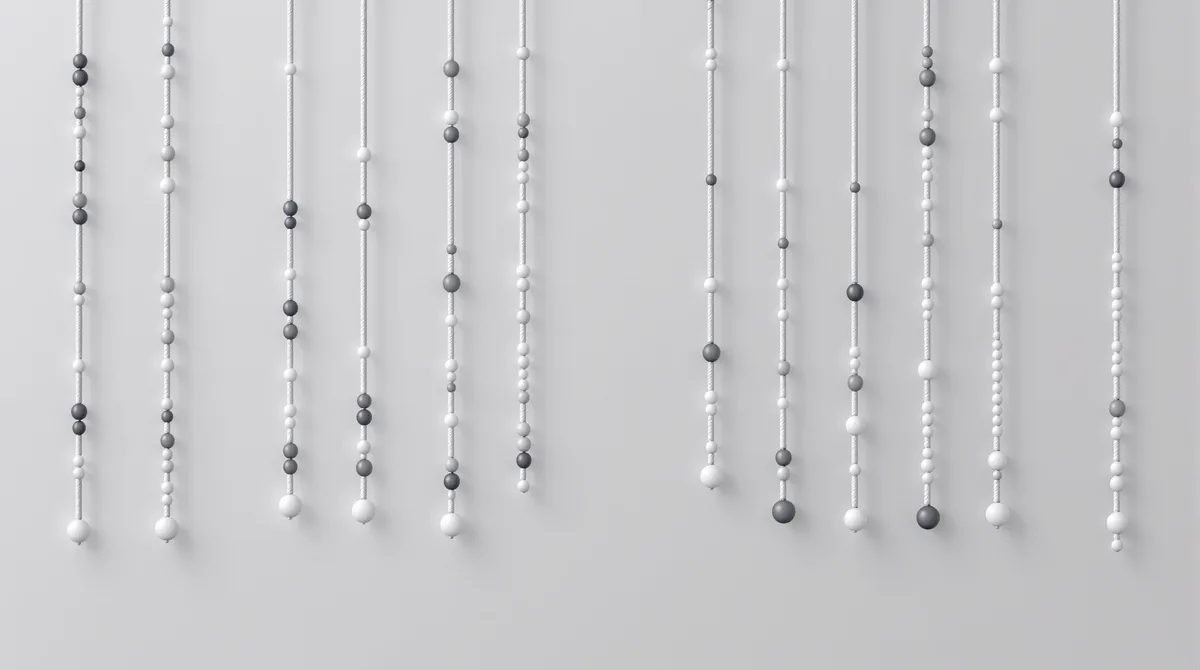
Guide · Safety
The beads are not the question. The cord is, and on some constructions a cotton header is too. No rating has been tested for these builds, and this page says so plainly.
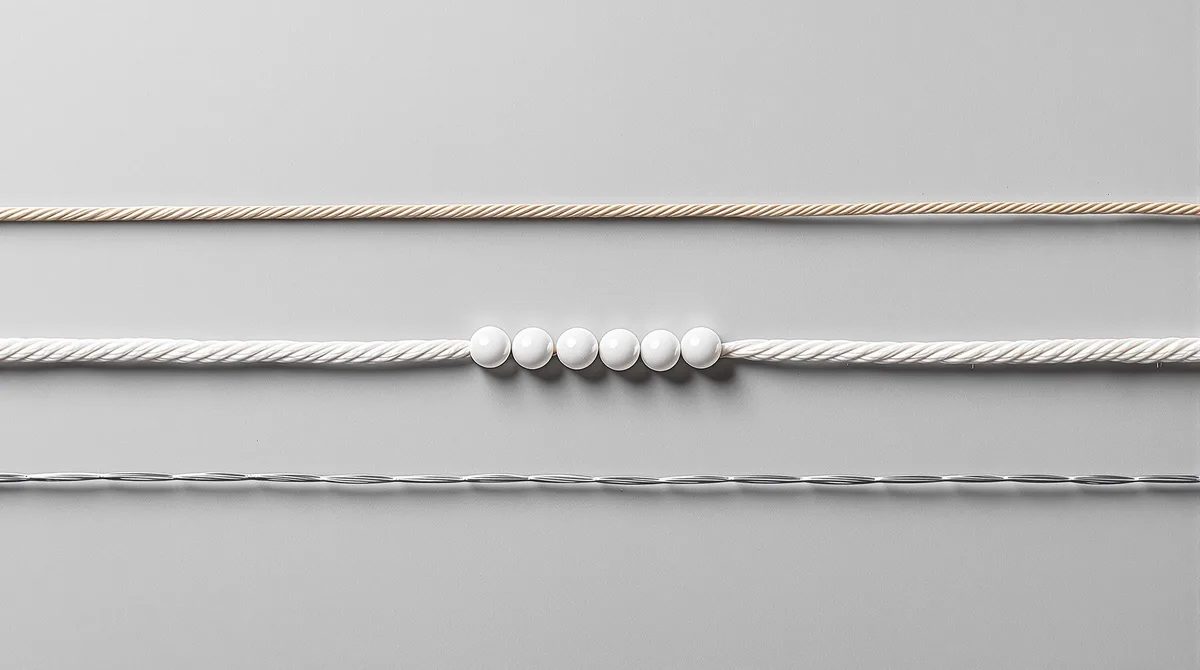
Round chalk-white and smoke-grey glass beads spaced along fine braided polyester stringing cord, the bare braided length between each pair of beads clearly readable.
Glass, ceramic, metal and faux capiz beads do not burn, and acrylic and wood beads will. The part that carries the real fire risk on a strung panel is the cotton cord running through every bead, plus any cotton header or rod pocket. Fire performance is tested on the specified build and quoted with the project.
The beads are mostly not flammable. The cord is, and on café and rod-pocket formats the cotton header is too.
A glass bead panel on cotton cord has one combustible component running through the whole piece — the cord. Nobody should hang any bead panel where an open flame, a candle, a gas hob or a halogen fitting can reach it, regardless of bead material.

A strung panel is not a sheet of material. It is thirty or forty lengths of cord carrying several thousand beads, and the cord passes through the drill hole of every bead on its strand. That makes the cord both the structural element and the continuous combustible path through the piece.
Soda-lime glass will not support combustion; it will crack from thermal shock. So in a flame the glass beads do not burn, they fall, as the cord above them goes. That is the failure sequence worth understanding: a bead panel does not sustain a fire, it collapses into one.
| Component | Combustible | Behaviour in a flame | Notes |
|---|---|---|---|
| Glass beads | No | Does not support combustion; can crack from thermal shock | Drawn and hand-strung in our own Firozabad glass works |
| Ceramic beads | No | Does not support combustion | Glazed and fired in our own Khurja plant |
| Metal beads | No | Conducts heat; does not burn | Finished and plated in our own Moradabad plants |
| Faux capiz, cast resin or dyed cut acrylic | Yes | Softens, deforms, can drip | Engineered imitation of capiz shell, not shell |
| Acrylic beads | Yes | Softens well below glass, deforms, can drip | Moulded and dyed to your colour |
| Wood and bamboo beads | Yes | Chars and burns | Wood turned per design; bamboo confirmed per design |
| Cotton cord | Yes | Burns; the structural failure point | The component that would fail first in a fire |
| Cotton header band or rod pocket | Yes | Burns as a textile | Used on café formats and rod-pocket builds |
| Wooden dowel | Yes | Chars and burns | Turned in our own Saharanpur wood factory |
Only through the ratio of cord to bead. A dense seed-bead panel carries more metres of cord per square metre of panel than a large-bead panel at an open pitch, so it holds more combustible mass in the same area.
On a 90 cm width we normally run forty strands at a pitch of about 2.25 cm; on 120 cm, sixty strands at about 2 cm. An open-pitch large-bead panel is marginally less combustible per area than a dense one, and that difference is far too small to be the basis of a specification.
Proximity, not material. The design decisions that actually matter are where the panel hangs and what is near it.
A doorway panel between a kitchen and a living space should not pass within reach of a hob. A valance over a window should not sit above a candle shelf. A wall hanging should not be hung over a radiator — that is a dust, heat and cord-ageing problem before it is a fire one, but it is all three.
On the construction side, the choice that changes most is the header. A turned wooden dowel burns; so does a cotton rod pocket. Neither is a reason to avoid them, but in a commercial interior a metal rail is a better component and we would recommend it over a timber one.
We build to the specification given and do not add a flame-retardant treatment on our own initiative: a treatment that has not been proved on the specified build buys nothing but a claim.
What we do control is honesty about the assembly. Every tech pack names the cord, the header and the bead material, so a specifier can see every combustible component listed rather than inferring them from a photograph. Where a buyer programme requires flammability testing, that testing is arranged against the actual build and quoted separately, in the same way sampling is quoted separately.
That depends entirely on where the panel hangs, and this is the part most buyers get wrong.
A bead panel in a private home is a decorative object and is generally not subject to a textile flammability standard in the way a mattress or children's sleepwear is. A bead panel in a place of public assembly is a different matter: decorative hanging materials in those settings are commonly specified against a flame-propagation test, and in the United States that is usually NFPA 701. In the United Kingdom and the European Union the equivalent requirement arrives through the project's fire strategy rather than through consumer product law.
What is consistent everywhere is that the test is of the assembly, not of the bead. A result on one build says nothing about another with a different cord.
In a nursery, flammability is the second question and the cord is the first. A hanging panel near a cot or a changing table is a cord question before it is a fire question, and the advice is to hang it in a doorway rather than over furniture.
In a hotel, the panel is almost certainly inside a fire strategy, and the right sequence is: ask the fire engineer what class is required, then ask us to have that test run against the build, then approve a sample. Doing it in the other order produces a lovely panel that cannot be installed.
Three things, in order.
Specify glass, ceramic or metal beads, so the only combustible component is the cord and the header. Specify a metal rail rather than a timber dowel for a commercial interior. Then have the completed assembly tested, with the result held against that build and that cord — not against the design name.
If testing is not in the budget, place the panel where fire behaviour is not load-bearing: an internal doorway away from heat sources, rather than a corridor that forms part of an escape route.
A rating, a class or a standard. Fire performance is tested on the specified build and the report is issued against that build, which is the only form of this evidence a fire officer will accept.
We also will not carry a result across builds. If one construction were tested and passed, that result would belong to that cord, that header, that bead and that density. Extending it to a similar-looking panel would be the kind of claim that looks helpful in a catalogue and fails at the first fire inspection.
The materials, and nothing more. "Glass beads on cotton cord, turned wooden dowel" is complete, accurate and lets a customer reason correctly.
What a listing must not say is fire resistant, flame retardant or non-flammable. It should also carry the practical instruction, which is the sentence that actually prevents harm: keep away from open flames and heat sources.
Anyone specifying for a public interior, and the question goes to the authority having jurisdiction or the project's fire engineer — not to a manufacturer, and not to a retailer. We can tell you exactly what the panel is made of and arrange a test. We cannot tell you what your building requires.
Fire performance is established on the build, not on the category. A rating describes a specific bead, cord, header and mount, so it is tested on the specimen that will actually hang and quoted with the project.
Tested on the same programme, and worth knowing because it shows what testing looks like when it does happen: lead testing against California Proposition 65 appears as a standard line in the retail programmes we run, and incremental testing for the United Kingdom and the European Union is quoted and amortised across the units of an order. That is the mechanism a flammability test would go through too. Until it has, the position is the one on this page: the beads mostly do not burn, the cord does, and no number is available.
Good to know
Name the materials and stop there. "Glass beads on cotton cord with a turned wooden dowel" lets a customer reason about it correctly. Do not write "fire resistant", "flame retardant" or "non-flammable": the beads may not burn but the cord does, and an unqualified claim about the panel is wrong even when it is well meant.
A rating belongs to a build rather than to a product name, so flammability testing is arranged for the specific build a programme buys and quoted with it, as sampling is. That is what makes the report usable: it names the method and the construction it was issued against.
A rating, a class or a standard. Fire performance is a test result for one specific assembly, so it is tested on the build your project specifies and quoted with it. And a result never transfers from one build to another: the cord, the header and the bead material all change the outcome, because the test is of the assembly rather than of the beads.
Your local fire authority or the project's fire engineer, before the specification is written rather than after. For a place of public assembly in the United States, decorative hanging materials are commonly specified against NFPA 701, and the person who can tell you whether that applies to your opening is the authority having jurisdiction, not a manufacturer.
Not for the beads, which are what they are made of at any size. It changes the ratio: a large-bead panel at an open pitch holds less cord per square metre than a dense seed-bead panel, and the cord is the combustible part. A spaced panel is therefore slightly less combustible mass per area, which is a difference of degree and not a safety feature.
The beads mostly are not; the cord and any cotton header are. A glass bead panel on cotton cord is a low mass of combustible material held in an open framework, with no tested rating, and should never be hung where an open flame or a halogen fitting can reach it.
Substantially. A panel in glass, ceramic or metal beads has combustible cord and nothing else. A panel in acrylic, wood, bamboo or cast-resin faux capiz has combustible beads as well. For an opening where fire behaviour matters at all, specify glass and accept the extra weight.
Keep exploring
Compliance
What NFPA 701 burns, why the cord and header carry the result, and how a project gets a report against its own build.
How it is madeGuides
One guide per question that arrives often enough to be worth answering properly.
Open the referenceGuide
Where a loop can form on a strung panel, why strands are finished individually, and what to check on an older piece.
Specs and sizesGuide
A detached bead becomes a small part, which is why bead attachment is tested rather than assumed.
See the detailGuide
The failure sequence under a climbing load, which materials survive claws, and how to hang so the panel gives before the wall does.
Specs and sizes
Start a conversation
Send a reference, a colour chip or a sketch. Minimums are set per design and confirmed per quote; sampling is quoted separately and usually runs 16 to 20 days from an agreed brief.