Guide
Beadwork and toddlers
Pulling, cord loops and loose beads: the three real risks, and the two that are design decisions rather than inevitabilities.
Read the guide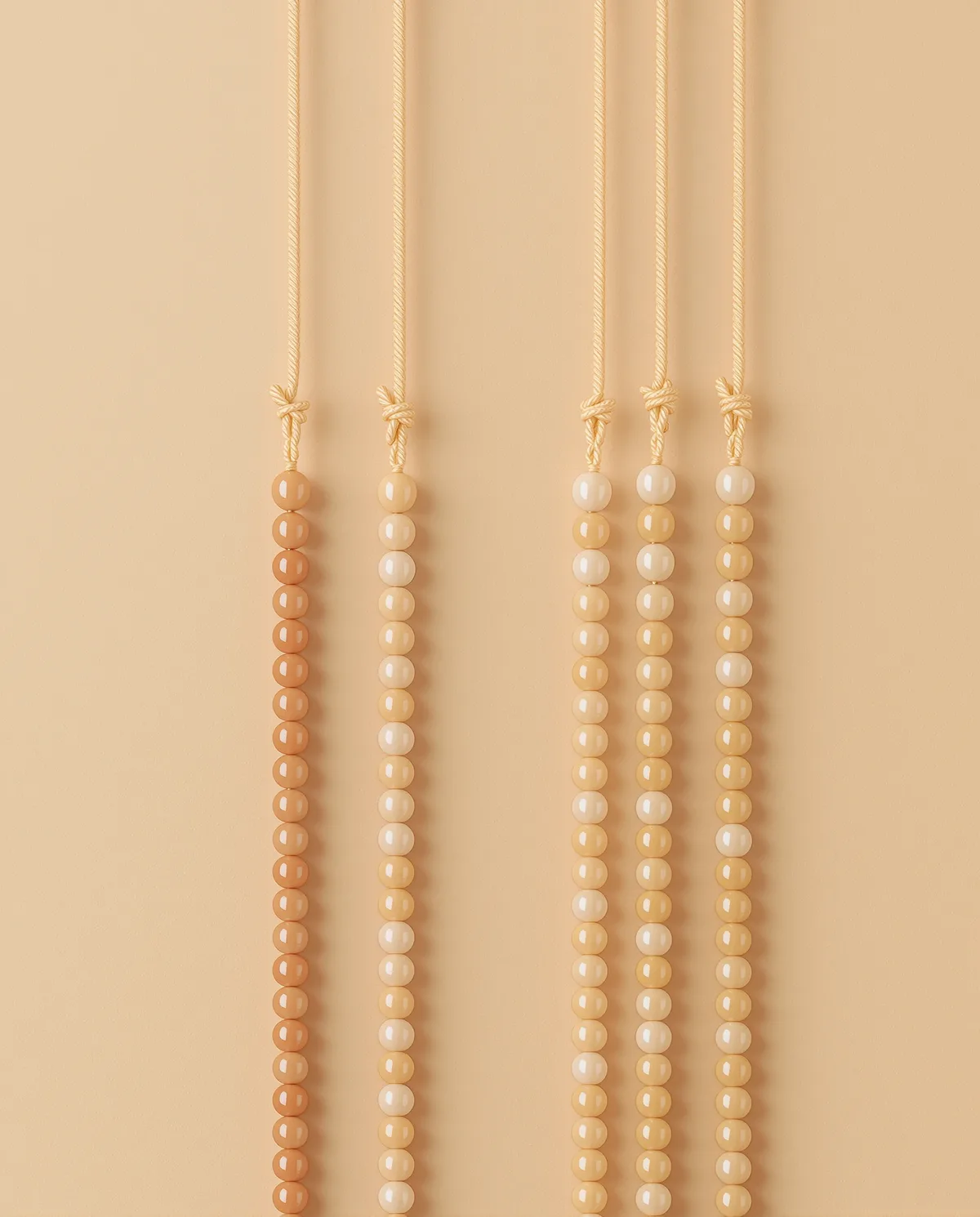
Guide · Safety
Window-covering cord safety is a well-developed field for a reason. A bead panel is mostly cord, so the lessons transfer directly.
End suspension loops knotted at the top of each bead strand so a panel can be hung level from a dowel or a rod.
A strung bead panel has no operating cord, no cord loop and no cleat, which removes the hazard window coverings are regulated for. The loops that do exist are the short suspension loops at the header, each a few centimetres long and individually knotted. The risks worth managing are a long unweighted strand end, a tie left on after hanging, and a crawling child's reach.
A strung bead panel has no operating cord. There is nothing to pull, no continuous loop running down the side, and no cleat on the wall. That removes the hazard that window-covering cord regulation exists to address.
What remains is small and manageable: short closed suspension loops at the header, the transit ties that arrive with the panel, and the question of how high the hem sits in a room with a crawling child.
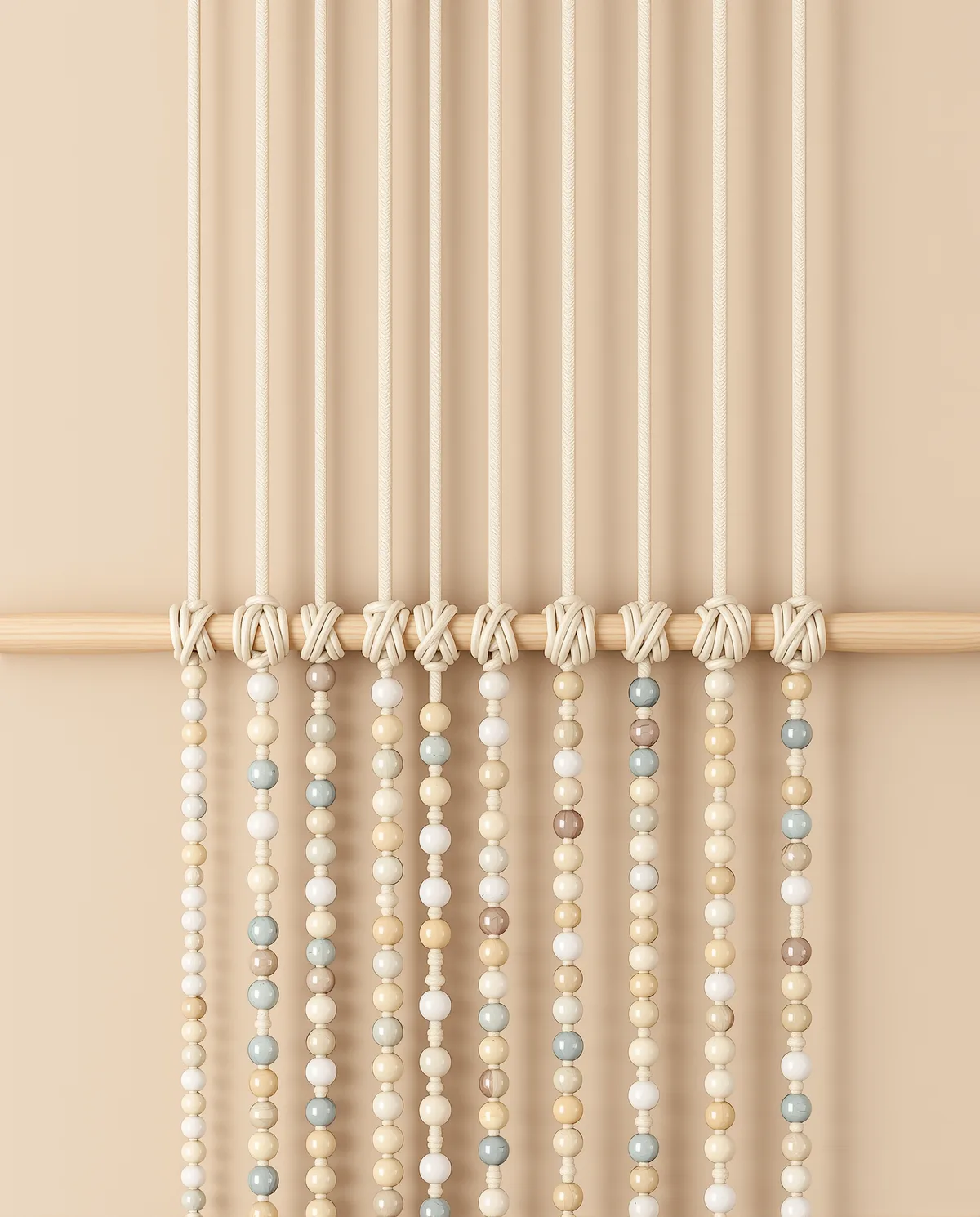
The dangerous geometry in a corded window covering is a long loop under tension that a child can get a head or a limb inside. A bead panel cannot form one, because every strand is a separate length of cord with a free end and nothing connects the strands to each other below the header.
That independence is also why a panel fails gracefully. If one cord parts, one strand drops. Nothing cascades, because there is no shared cord carrying the load.
| Component | Typical length | Loop formed? | Risk and control |
|---|---|---|---|
| Operating or pull cord | None | No | Not present. A strung panel is static and has nothing to operate |
| End suspension loop at the header | A few centimetres | Short, closed | Individually knotted per strand so it cannot pass over a head or a limb |
| Strand cord, header to hem | The full drop | No | Runs inside the beads; exposed only at the drill holes |
| Strand end finish | A knot, crimp or stopper bead | No | A slipped end empties the strand; use a crimp or stopper, not a knot alone |
| Transit ties | Removed on hanging | Yes, temporarily | Hang first, then remove one at a time from the top down |
| Fabric header or rod pocket | Full width | No | A textile sleeve over a pole; no cord involved |
| Hanging cord on a wall piece | Agreed at sample | Can be, if specified long | Specify a short fixed cord or two keyhole points, not a long loop |
Strands are knotted or looped over the header individually, one at a time, in bead-map order. On constructions that need to hang level from either a door or a wall, we knot short end suspension loops at the top of each strand — a few centimetres, closed, and each belonging to a single strand. That detail exists so a panel can be mounted level on hooks without a rail, and its safety behaviour is a side effect of a mounting decision.
The strand end is the other deliberate detail. A knot alone can slip and empty a strand; a crimp or a stopper bead cannot. On a shaped hem the end bead does double duty, adding the weight that steadies a light acrylic or wood strand so it falls straight.
Where a wall piece needs a hanging cord, we agree the cord or hook option at sample. The right answer is nearly always a short fixed cord or two fixing points rather than a long loop, and that is worth stating in the brief rather than leaving to the sampling bench.
The cord geometry does not change with bead size. The small-parts picture does.
A loose glass seed bead at one to three millimetres is the hardest bead in the category to find once dropped and the easiest for a young child to mouth. A pressed oval at about 13 × 22 mm is a different object; a faux-capiz disc at 25 or 50 mm is not a small part at all.
If the room has a child under three, the sensible specification is larger beads, fewer loose accents, and a spare-bead bag that stays sealed and high up.
It says a great deal about window coverings with operating cords and nothing about static decorative panels, and that distinction is the whole regulatory answer.
Corded window-covering rules exist because a long loop under tension can trap a child. They set out how cords must be shortened, tensioned, concealed or eliminated, and they apply to blinds and shades with an operating mechanism. A strung bead panel has no operating cord, no continuous loop and no cleat, so the mechanism those rules address is not present.
What does apply, in some cases, is children's-product law. A bead panel sold and marketed as a children's item is a different regulatory object from the same panel sold as home décor: in the United States that brings the Consumer Product Safety Improvement Act regime with it, and elsewhere it arrives through a retailer's own compliance programme.
The practical reading: do not claim compliance with a cord standard, because none has been applied; and settle the product's classification before the listing copy is written, because that is what decides which rules you are in.
Four decisions, all made before sampling.
Specify the strand end finish explicitly — crimp or stopper bead, not knot alone. Specify a short fixed hanging cord or two fixing points on any wall piece, rather than "a cord for hanging". Specify the mounting method, so the panel does not need improvised string at installation. And specify the hem height relative to the floor, because a hem that stops just above the floor behaves differently from one that pools.
For a childcare setting, add a fifth: establish the regulatory classification of the finished item, because a bead panel sold as a children's product is not the same object in law as the same panel sold as home décor.
Then write three sentences into the listing and the installation note, because they do more good than any reassurance. The panel is static and has no operating cord. The strands are finished with a crimp or stopper bead at each end. In a room with a young child, hang it in a doorway rather than over furniture, and keep spare beads sealed and out of reach.
In a nursery: hang it in a doorway rather than over a cot or a changing table, keep the hem above a crawling reach, and check the header knots annually. The panel itself is a low-risk object; its position is where the risk is decided.
In a hotel, cord safety will be read as part of a wider window-covering policy, and the relevant answer is that this is not a window covering with an operating mechanism — it is a static decorative panel. Say that plainly in the submittal and it usually resolves in one exchange.
In both, the first ten minutes matter more than the design. Panels arrive with their strands fixed to the dowel and kept in order in the packing, sometimes bundled for transit: lay the package flat, open it fully, lift by the dowel, hang the panel, and only then remove the ties one at a time from the top down. Removing them first produces a tangle; leaving one on afterwards leaves a loop where none should be.
The construction itself, which is where cord risk is designed out: strands are finished individually, the header carries short closed loops, and there is no operating cord anywhere in the design. First-article and lot AQL inspection at our quality-control and packaging house in Greater Noida checks that the construction matches the approved sample, and network product issue rates run at a fraction of a percent.
Where a programme is written to a window-covering cord standard, the build is tested to it, to the buyer's protocol, and the testing is quoted with the project. That report belongs to the build it was run on, which is why the standard is named in the specification rather than on a page.
That a bead panel is child-safe. Safety is a property of a product in a position with a particular child, not an attribute a panel can carry on a label.
We also refuse to describe the absence of an operating cord as a safety certification. It is a genuine and significant structural advantage over a corded blind, and it is still a description of a build rather than a test result.
Anyone specifying for a nursery, a school, a childcare setting or a product that will be marketed to children. The questions go to a test laboratory for the bead and the cord, and to the regulator for the classification. In the United States that is the Consumer Product Safety Improvement Act regime; elsewhere it arrives through the retailer's own compliance programme, which is how incremental testing reaches us on most orders.
Good to know
Only three: a transit tie left on after hanging, a long specified hanging cord on a wall piece, and a strand end that was never properly finished. There is no pull cord, no continuous operating loop and no cleat, which is the hazard class that window-covering cord rules exist to address.
The bead material changes the weight on the cord, not the loop geometry. A glass panel puts more tension on every strand and on the header, so cord ageing shows sooner. Acrylic and wood panels are gentler on their own cord. The cord specification should follow the bead weight, which is a design decision made at sampling.
State that the panel is static with no operating cord, state what the strands are finished with, and carry the standard young-child advice about hanging position. A listing that says nothing invites the assumption that a bead panel behaves like a corded blind, which is both wrong and unhelpful to a parent trying to decide.
The construction is where it is answered: strands finished individually, short closed suspension loops at the header, and no operating cord anywhere in the design. Where a programme is written to a window-covering cord standard, the build is tested to it and the testing is quoted with the project.
That a panel is child-safe. No product is child-safe as a property; a product is safer or less safe in a given position with a given child. We will describe the construction precisely and we will not issue a blanket safety assurance that the construction cannot support.
For a childcare setting or a children's product, a test laboratory and the regulator. In the United States, children's products fall under the Consumer Product Safety Improvement Act and a bead panel sold as a children's item is a different regulatory object from the same panel sold as home décor. Ask that question before the listing copy is written.
Not for cords. It matters for small parts: a loose seed bead at one to three millimetres is the easiest thing in the piece for a young child to find and mouth. Where a panel is going into a room with a toddler, specify larger beads and keep the spare-bead bag sealed and out of reach.
Keep exploring
Guide
Pulling, cord loops and loose beads: the three real risks, and the two that are design decisions rather than inevitabilities.
Read the guideCompliance
The children’s-product determination for décor, the four factors it rests on, and what the 100 ppm limit actually covers.
Read the guideGuides
One guide per question that arrives often enough to be worth answering properly.
See the detailGuide
A detached bead becomes a small part, which is why bead attachment is tested rather than assumed.
How it is madeGuide
Which component carries the fire risk, which materials change it, and how a classification is tested on the specified build.
Compare the options
Start a conversation
Send a reference, a colour chip or a sketch. Minimums are set per design and confirmed per quote; sampling is quoted separately and usually runs 16 to 20 days from an agreed brief.