Specification
Measuring an opening for beadwork
Width at three heights, the drop against the floor gap, and the header depth — the measurements a quote needs.
Specs and sizes
Guide · Install
The gap at the floor is the only dimension on a bead panel that is purely a wear decision. Nobody notices it and everybody lives with its consequences.
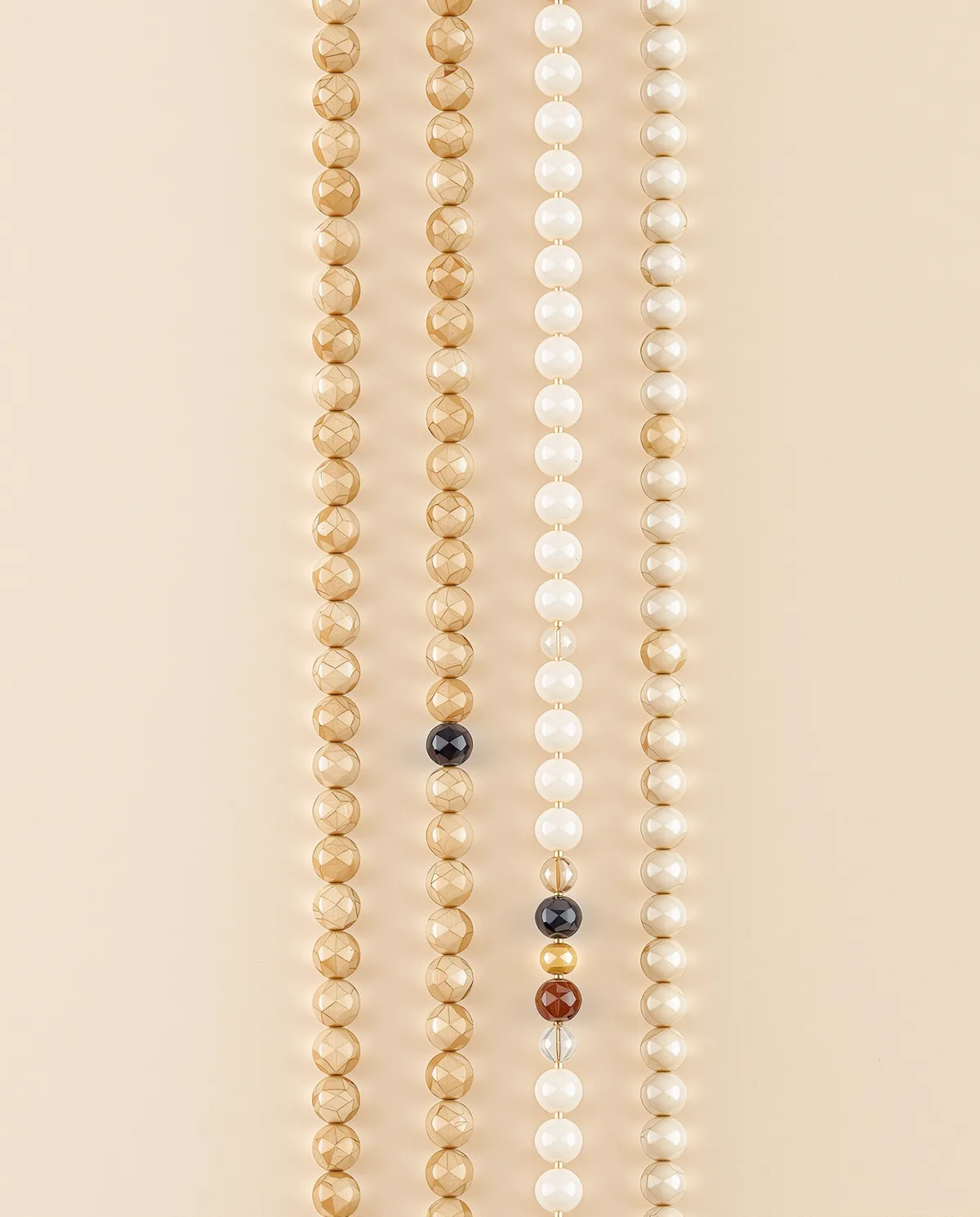
The lower ends of six bead strands, each finishing in a single larger faceted drop knotted below the last seed bead.
Finish the lowest beads clear of the floor rather than brushing it. The published guidance is that full-length strands should stop just above the floor so they hang freely without dragging, and a few centimetres of clearance is what makes that reliable across an uneven floor. Brushing looks deliberate and wears the bottom bead and the end finish.
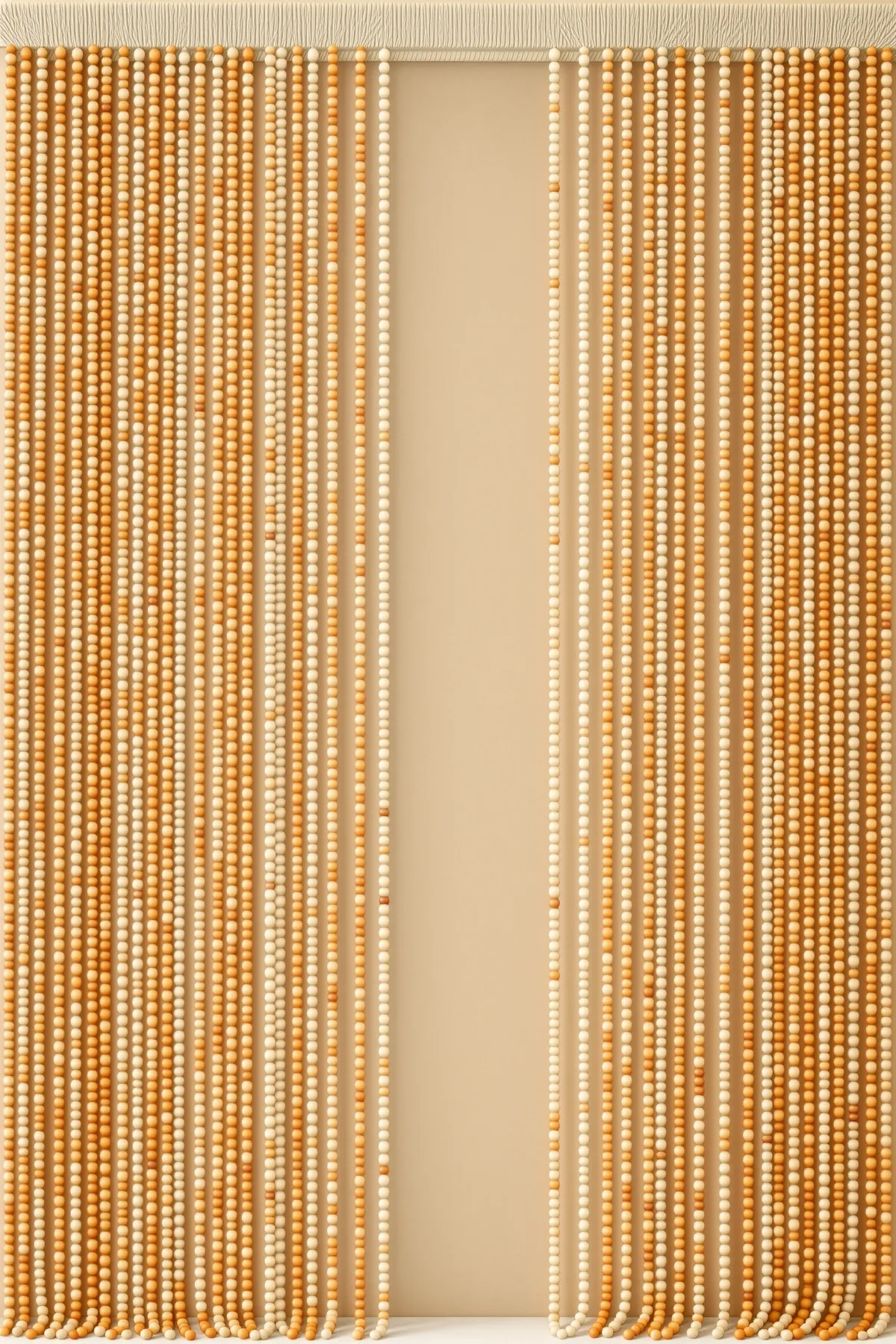
One decision, taken before any measurement: how far the lowest beads finish above the floor.
It sounds trivial and it determines the panel's drop, which is a specified dimension and the main cost lever after bead material and construction. Decide the gap, subtract it from the opening height, and you have the drop to order. Decide it afterwards and you are shortening strands.
The opening height, measured from where the header will sit. A look at the floor across the whole width — not one measurement, because floors slope.
And a spacer: a block, a book, anything of the thickness you want the gap to be. A physical reference beats a measurement at every strand, because a tape held to an uneven floor reads differently at every point.
Because it is where the panel meets a surface. Every pass through a brushing panel drags the bottom bead across the floor, and that does three things: it abrades the bead, it jolts the end finish, and it collects whatever is on the floor and carries it up the strand.
The bead is the visible casualty and the end finish is the important one. A knot or a crimp that takes a small jolt thousands of times is a knot or crimp that eventually lets go, and when it does, the strand empties.
| Floor | Brushing hem | Small gap | Generous gap | Note |
|---|---|---|---|---|
| Hard tile or stone | Chips glass beads | Good | Good | The worst floor for a brushing hem |
| Timber or laminate | Marks the end bead | Good | Good | Also marks the floor finish |
| Short carpet | Collects fibre | Good | Good | Strand ends snag on pile |
| Deep carpet or rug edge | Strands lift and tangle | Marginal | Good | A rug edge is a trip point for strands |
| Uneven floor | Visibly inconsistent | Marginal | Good | The gap absorbs the level error |
| Threshold strip | Catches on every pass | Marginal | Good | Measure the drop to the strip, not the floor |
On tile or stone with glass beads: chipped bottom beads, unevenly, because the strands that are walked through most take the most contact. The chips catch light differently, so they read before the eye works out what it is looking at.
On carpet: fibre wound into the bottom beads and the end finish, and strands that have started to lift rather than hang, because the pile holds them.
On timber: a faint arc of marking on the floor finish, and a dulled bottom bead.
The published guidance is that full-length strands should stop just above the floor so they hang freely without dragging. In practice, a few centimetres is what makes that reliable, because it absorbs three things at once: the floor's own level error, the settling drop in the first day, and the seasonal movement of a timber floor.
Larger gaps are a style decision rather than a wear one. A panel that stops at the top of a skirting line reads as deliberate; one that stops ten centimetres short of the floor reads as a mistake.
Measuring to the floor and forgetting the gap entirely, which produces a brushing panel. Measuring at one point on an uneven floor. And trimming on the day of installation, before settling, which produces a panel that is short by the weekend.
The fourth: a threshold strip or a rug edge inside the opening that nobody measured to, so the panel clears the floor and catches on the strip.
Never shorten strands to make a gap on the evening you hang the panel. Never weight the bottom strands to stop them lifting on carpet — that accelerates the end-finish failure rather than solving it. Never cut strands individually to follow an uneven floor, because the floor will not stay the shape it is and the panel will.
Glass is the material that makes the gap non-negotiable, because it is the only bead family that chips. Acrylic will scuff and not break. Wood will mark and dull. Bamboo marks and does not recover. Faux capiz discs are thin and broad, and a disc dragged on a floor chips at the edge where it is thinnest.
Weight matters too, in a counter-intuitive direction: a heavy glass strand presses harder on the floor at the point of contact, so a brushing glass hem does more damage per pass than a brushing acrylic one.
Nothing, if decided first. If decided after the panel is hanging, the choice is a new header fixing — ten minutes — or shortening every strand, which is a couple of hours and irreversible.
Takes the gap as an input to the drop rather than as an outcome of it. The drop is specified, every strand is built to the bead-by-bead sheet rather than measured against its neighbour, and the finished panel is checked for strand length consistency at first-article and lot inspection before export packing.
That matters because a shaped hem makes the gap more complicated, not less. On a scalloped arch the lowest strands set the gap and the highest ones are a long way off the floor — one valance build runs a longest strand of 24 in against a shortest of 10 in across the same 30-strand header. The gap has to be set against the longest strand, which has to be known before the shape is drawn.
Two lines. Decide the floor gap before measuring the drop. And a panel that brushes the floor will wear at the bottom bead and at the end finish.
If the listing states the drop and the gap the panel was designed for, this is pre-empted — and the panel arrives at a length that works rather than a length that needs an afternoon.
Good to know
A tape, and a spacer. The spacer is the trick: a block of the gap's thickness laid on the floor under the panel gives you a physical reference to mark against, which is far more reliable than measuring from the floor at each strand.
Not the cord directly, but it works the end finish on every pass, and a failed end finish empties the strand. The bead at the bottom takes the abrasion and the knot or crimp takes the repeated small jolt, which over years is the more likely failure of the two.
It becomes more important. Glass is the only bead family that chips, and the bottom bead of a brushing strand strikes a hard floor thousands of times. On tile or stone, a glass panel should never brush the floor; on carpet the consequence is cosmetic rather than structural.
Yes, and a display panel should be hung with a deliberate gap for a practical reason: a shop floor is walked on constantly, and a brushing hem in a shop gathers dust and grit that then abrades every bead it touches. Hang it clear.
Repair it, then look at the gap. A strand that has failed at the bottom on a brushing panel is telling you something about the gap rather than about the strand. The repair is a re-string in the original bead order, re-knotted at the header.
It takes no extra time at all if it is decided before measuring, and an afternoon if it is decided afterwards — because then it means shortening every strand. That asymmetry is the whole argument for deciding it first.
Upwards, easily: raise the header, which costs one new fixing. Downwards, not really: a longer drop means rebuilding the bottom of every strand. Err towards too long rather than too short, because length can be removed and cannot be added.
Keep exploring
Specification
Width at three heights, the drop against the floor gap, and the header depth — the measurements a quote needs.
Specs and sizesGuides
One guide per question that arrives often enough to be worth answering properly.
How it is madeGuide
Three causes in order of likelihood: a header that is not level, a dowel that has rolled, and strands that have not settled yet.
Compare the optionsGuide
What settling is, how long it takes, how to help it along, and why nothing should be cut until it is finished.
Compare the optionsGuide
Where to put the join, how to match pitch across it, and how to get two headers level with each other.
Compare the optionsGuide
Width at three heights, the floor gap, the header depth — and the two decisions that come before any of them.
Compare the options
Start a conversation
Send a reference, a colour chip or a sketch. Minimums are set per design and confirmed per quote; sampling is quoted separately and usually runs 16 to 20 days from an agreed brief.