Process
Injection moulded beads
The tool, the shot, the dye bath — and the arithmetic that decides whether a custom bead shape is worth its die.
Specs and sizes
Material · Acrylic
Acrylic is the material that says yes to a colour. It is moulded and dyed to the reference rather than matched out of a melt, it does not shatter, and it ships at about half the weight of glass — which is why most high-volume beaded programmes are built on it.
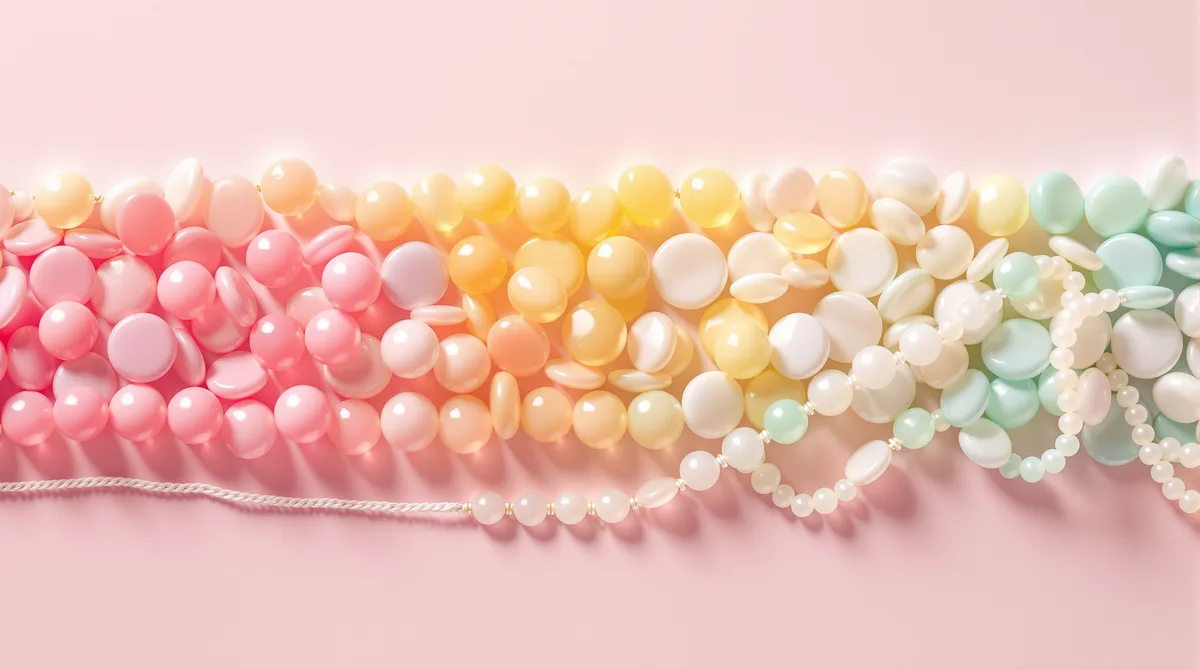
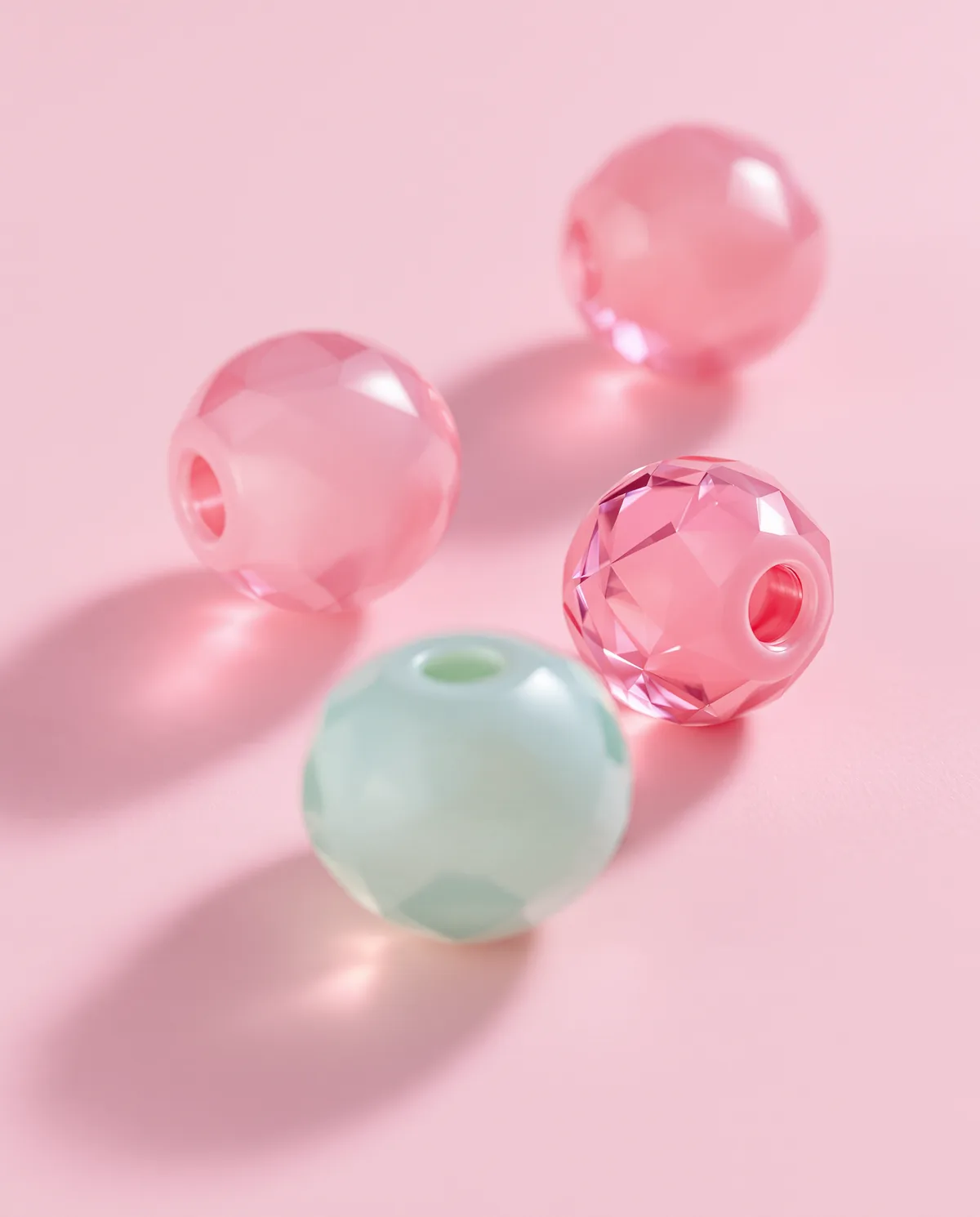
Dyed acrylic beads moulded to a custom die, translucent and opaque, in candy pink, lemon, mint and lilac.
Acrylic beads are moulded to shape and dyed to our colour, to our own dies where a design needs a bead that does not exist yet. They carry the widest colour latitude of any bead family, weigh roughly half what glass does for the same volume, and do not shatter — which is why most high-volume beaded programmes are built on them.
An acrylic bead is a thermoplastic bead formed in a tool: the polymer is forced into a mould cavity under heat and pressure, a core pin forms the hole, and the bead is ejected once it has set. The material is clear in its natural state, which is why the colour conversation is a separate one from the shape conversation.
That separation is the key fact about the family. Shape comes out of a tool; colour goes on afterwards in a dye bath. Glass cannot do this — its colour is decided in the melt, before anything is formed.
Four stages. A tool is cut to the bead drawing. The bead is moulded. The bead is dyed to the colour reference, or run in a stock colour. The bead is strung and finished, by hand, in our own beadwork studios.
Where a design needs a bead that does not exist, the first stage is real work rather than a formality. We have cut dies for exactly that: a three-inch almond connector bead, moulded so six assemble into a six-inch daisy, developed for a café curtain. The tooling was ours. Moulding a bead and cutting a new die goes through the process in order.
Colour latitude, first and most. Because the bead is dyed rather than melted, the achievable palette is effectively whatever can be referenced, and the sample loop is short — a dyed-to-colour acrylic is one of the quickest things in the library to confirm. A programme wanting a wide colourway set off one design gets it here fastest.
Second, weight. Third, toughness of the right kind: acrylic does not shatter, so a panel in a busy doorway, a children's range or an event build does not carry glass's one real risk.
Very. The shape comes out of a tool, so bead-to-bead variation is close to nil and run-to-run variation is nil as long as the tool is the same.
Colour needs the normal discipline. Dye is a batch process, so a large flat field of a single colour can show drift between deliveries, and the handling is the same as for dyed glass: hold the dye lot across a programme, or write the acceptable variation into the specification and accept that a reorder will not be identical.
Not by breaking. Acrylic fails by scratching, by hazing and by going slightly soft at the surface if it meets a solvent or very hot water. A knocked glass panel chips one bead; an acrylic panel cleaned with the wrong thing hazes all over at once, which is worse.
The design answers are a matte finish where handling is heavy, because a matte surface hides fine scratching that a gloss surface advertises, and a care instruction that names what not to use. Lukewarm water and mild soap, no solvents, no very hot water, and the dowel kept dry.
Less per bead than glass, usually markedly less, and less again on freight. Against wood it is comparable per bead and much better on colour. Against resin it overlaps, with resin winning on figural cast shapes and acrylic on colour precision.
The lever that misbehaves is the die. A bead on an existing tool has catalogue economics. A new shape carries the cost of cutting the tool, which lands entirely on the first run and never again — so the comparison between acrylic and glass flips depending on whether the programme runs one season or five.
It suits the full range of hanging work and most object work. In the record it carries the highest-volume constructions we make: translucent acrylic beads on cord, thirty hand-strung strands on a single wooden dowel, in multi, neutral and bright colourways. It also carries acrylic coaster sets, in translucent and opaque versions, and acrylic seed beads on stuffed pieces where glass would be too heavy to live on a cushion face.
It is the wrong choice where the brief wants the specific optical weight of glass. An acrylic bead can be made clear, tinted and glossy, but it does not refract like faceted glass and it does not have glass's cool hand. Where a premium reads through touch, glass earns its cost.
Shape, nominal dimensions, translucent or opaque, matte or gloss, hole diameter, and the colour route stated explicitly: stock colour, dyed to a reference, or dyed to match a named bead. Then the tooling status — existing die, or new die to our drawing.
That last line is the one that moves a timeline. Everything else can be confirmed in a normal sample loop; a new tool cannot.
Less far than it does into glass, and the difference is worth saying out loud rather than blurring. Every finished piece is manufactured by us. For glass, that reaches back to the furnace: we draw the bead. For acrylic, it reaches to the tooling and the colour — the bead is moulded and dyed to our colour, to our own dies where a design needs a custom shape, and then strung and finished by hand in our own beadwork studios.
Our making reaches the tooling and the colour: the bead is moulded and dyed to our colour, to our own dies where a design needs a custom shape, then strung and finished by hand in our own beadwork studios. For glass it reaches further back, to the furnace.
That it is a cheap substitute for glass. It is a different material with a different set of advantages, and on colour and impact it is the better one. That it is unbreakable: it does not shatter, but it scratches and hazes. And that a dyed acrylic bead is as colourfast as body-coloured glass under prolonged direct sunlight — dyed surfaces and dyed bodies both move, and bead dyeing and colourfastness is where that is set out without the marketing.
The highest-volume constructions in our record are acrylic: translucent multi-colour portals on a stained wooden header rail, the neutral wood-tone variant, the bright colourway, and the café-length version of the same construction with a cotton header band. Acrylic also carries the moulded daisy connector café curtain, where the custom bead is the design, and the acrylic coaster sets in translucent and opaque.
In the 2027 design library acrylic appears across the colour stories wherever a palette is graphic rather than optical; the strand and bead counts given there are derived from renders rather than from shipped goods and are labelled that way on those pages.
A ten-millimetre acrylic round works out near 0.6 g, so a hundred land around 60 g — arithmetic from a nominal 1.2 g/cm³, not weighed. Against glass that is roughly half, and the halving compounds across a thirty-strand panel into something a buyer notices in two places: the fixing and the freight.
The cost of being light is that the strand does not pull itself straight. A light strand moves more, settles more slowly and tangles more easily, so acrylic builds lean on a heavier end bead, a larger bead size down the drop, or a few glass beads placed low to give the strand authority. Hand-strung strand construction is where those choices are made.
| Specification | Working value | Why it matters |
|---|---|---|
| Production method | Moulded to shape, then dyed to our colour | Shape from the tool, colour from the dye bath — two separate decisions |
| Custom shapes | Moulded to our own dies where a design needs a bead that does not exist | A new shape is a drawing and a tool, not a hunt through a catalogue |
| Recorded custom bead | A three-inch almond connector bead, moulded to form six-inch daisies | The shape was cut for a design; the tooling was absorbed by us |
| Colour route | Stock colour, dyed to a reference, or dyed to match an accent bead | The widest colour latitude in the library |
| Finish options | Translucent or opaque, matte or gloss | Translucent and opaque versions of one bead read as two beads |
| Weight behaviour | A 10 mm acrylic round works out near 0.6 g, about 60 g per hundred | Arithmetic from nominal density; roughly half glass for the same volume |
| Durability | Does not shatter; will scratch and will haze with solvents | Different failure mode from glass, not a lesser one |
| Made where | Moulded and dyed to our colour, to our own dies, then hand-strung in our own beadwork studios | Our making reaches the dies, the colour and the finishing |
Good to know
Yes, and this is the family to do it in. Acrylic beads are dyed to a colour reference or a physical chip and the colour is confirmed on the sample before production. Where a design has a feature bead whose colour cannot move, the base acrylic is dyed to match that bead instead, so the accent stays the subject.
It is formed with the bead and is confirmed per bead on the stringing sheet rather than published as a range. Moulded holes tend to be generous, which is useful on a mixed build — but the cord is still chosen from the smallest hole anywhere in the panel, and that is usually a glass seed bead rather than the acrylic.
Better than most. The shape comes from a tool, so it repeats exactly, and dyed colour is matched to the retained approved sample rather than to a melt. The residual risk is dye-lot drift on large flat fields of one colour, which is managed the same way as on glass: hold the lot, or write the acceptable variation into the specification.
About half, for the same volume. A ten-millimetre round works out near 0.6 g in acrylic against about 1.2 g in glass — arithmetic from nominal densities rather than weighed figures. Across a thirty-strand door panel that is the difference between a piece that needs a bracketed rod and one that can go on a tension rod.
Nearly all of them, and especially the ones where weight or breakage matters: doorway portals and curtains, café curtains, valances, children's and dorm ranges, event and display work, and any programme shipping long distances where freight is a real line. It is also the right choice for a graphic colour pattern, because the palette is unlimited.
Shape and nominal dimensions, translucent or opaque, matte or gloss, the hole diameter, the colour route — stock, dyed to reference, or dyed to match a named bead — and whether the shape runs on an existing die or needs a new one. The last entry is the one that changes the timeline rather than the price.
It reaches a different depth than it does for glass, and that is worth stating plainly. Glass we draw ourselves, in our own Firozabad works. Acrylic is moulded and dyed to our colour, to our own dies where a design needs a custom bead, and then hand-strung and finished in our own beadwork studios. Our making reaches the tooling, the colour and the finishing; for glass it reaches further back, to the furnace.
Keep exploring
Process
The tool, the shot, the dye bath — and the arithmetic that decides whether a custom bead shape is worth its die.
Specs and sizesManufacturing
Draw the bead, cut the die, mould and dye it: what a custom bead shape costs, what it needs from a buyer, and when it pays.
How it is madeMaterial
Poured, not pressed: why casting makes figural shapes possible, how colour goes through the body, and what the mould line costs you.
Specs and sizesMaterial
How seed beads are drawn, why dye lots are quoted per run, what the drill hole limits, and where seed-bead work earns its cost.
Specs and sizesReference
Nine material families, what each gives in light, weight and colour, and how far our own manufacturing reaches into every one of them.
Read more
Start a conversation
Send a reference, a colour chip or a sketch. Minimums are set per design and confirmed per quote; sampling is quoted separately and usually runs 16 to 20 days from an agreed brief.