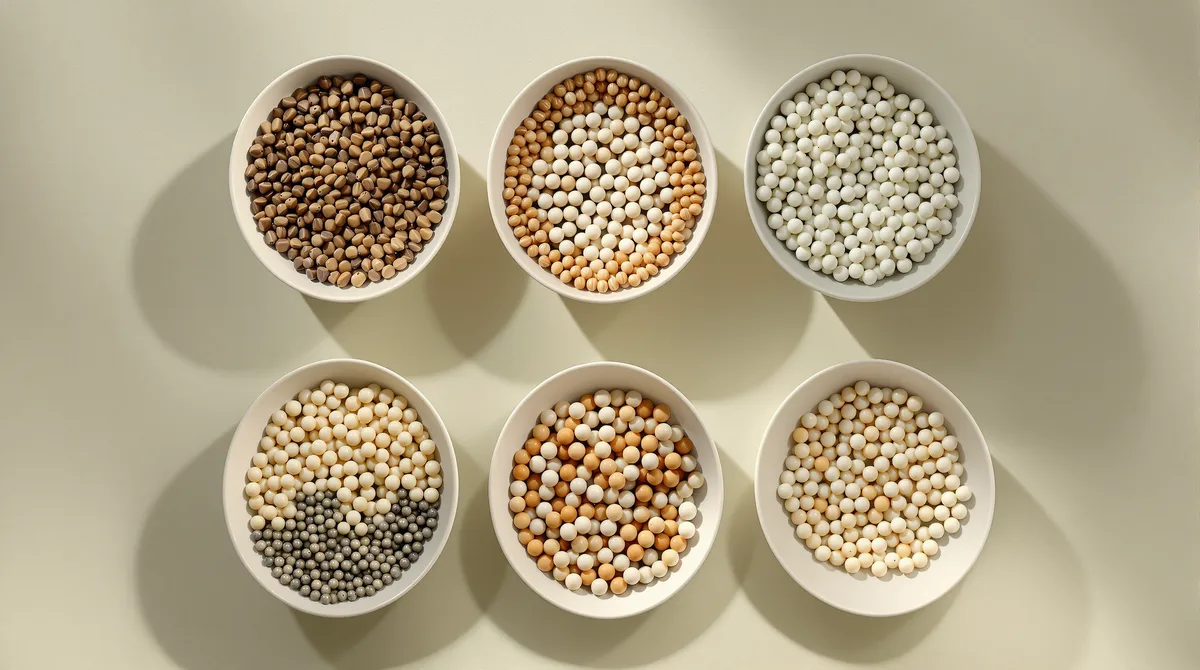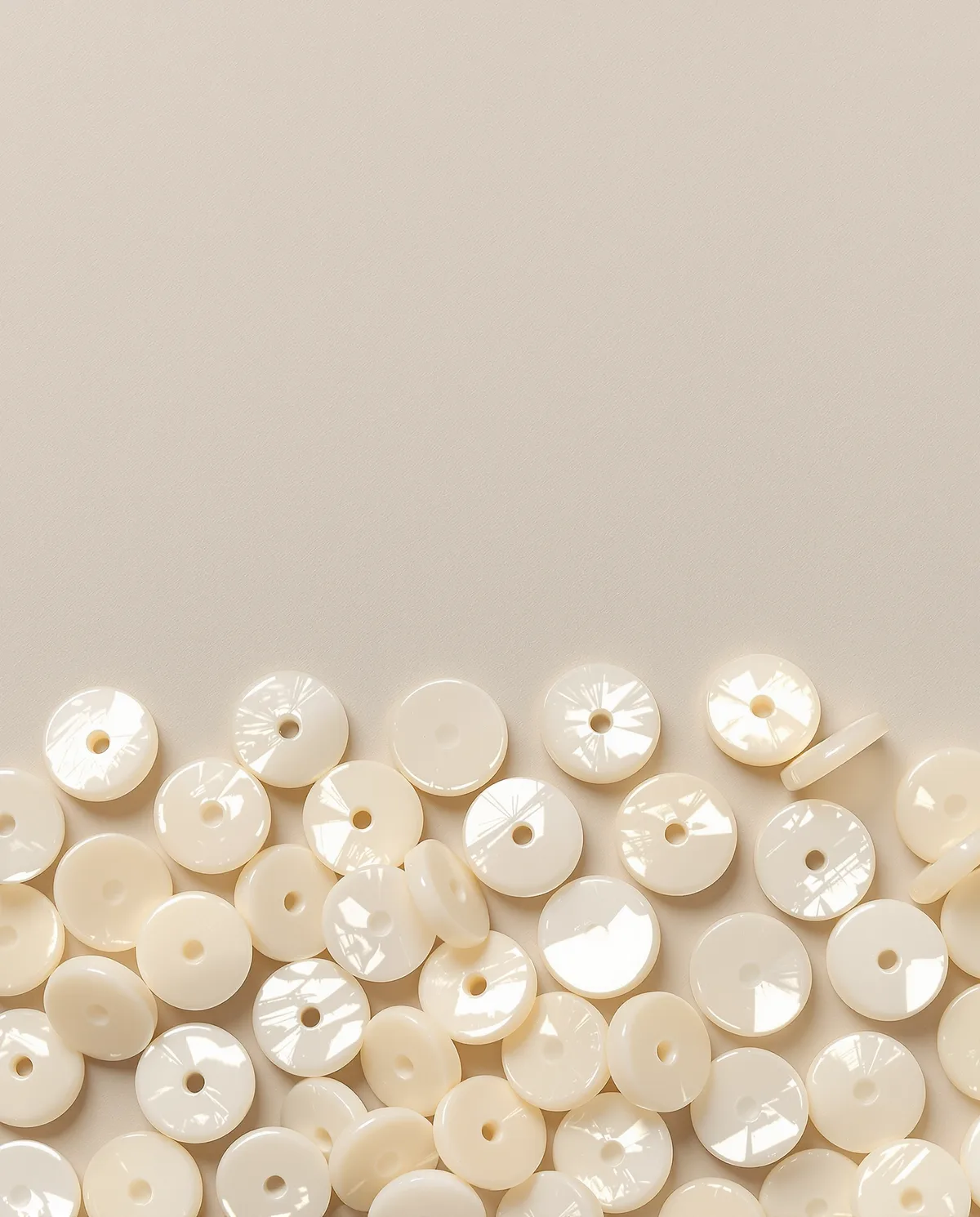
Material
Faux capiz discs
Cast resin or dyed cut acrylic, finished to imitate capiz shell: what it gives that real shell cannot, and why thin discs tangle.
See the detailMaterial · Resin
Resin is the material you reach for when the shape is the design. It is poured into a mould rather than pressed or turned, which means a figure, a petal or an animal can exist at a size and weight that glass would make impossible.
Cast resin is poured into a mould as a liquid and cures to shape, which is why it can hold a figure, a petal or an animal that no pressed or turned bead can. Colour goes through the body rather than onto the surface. Resin shapes are cast and dyed to our colour, to our own dies, and finished in our own beadwork studios.
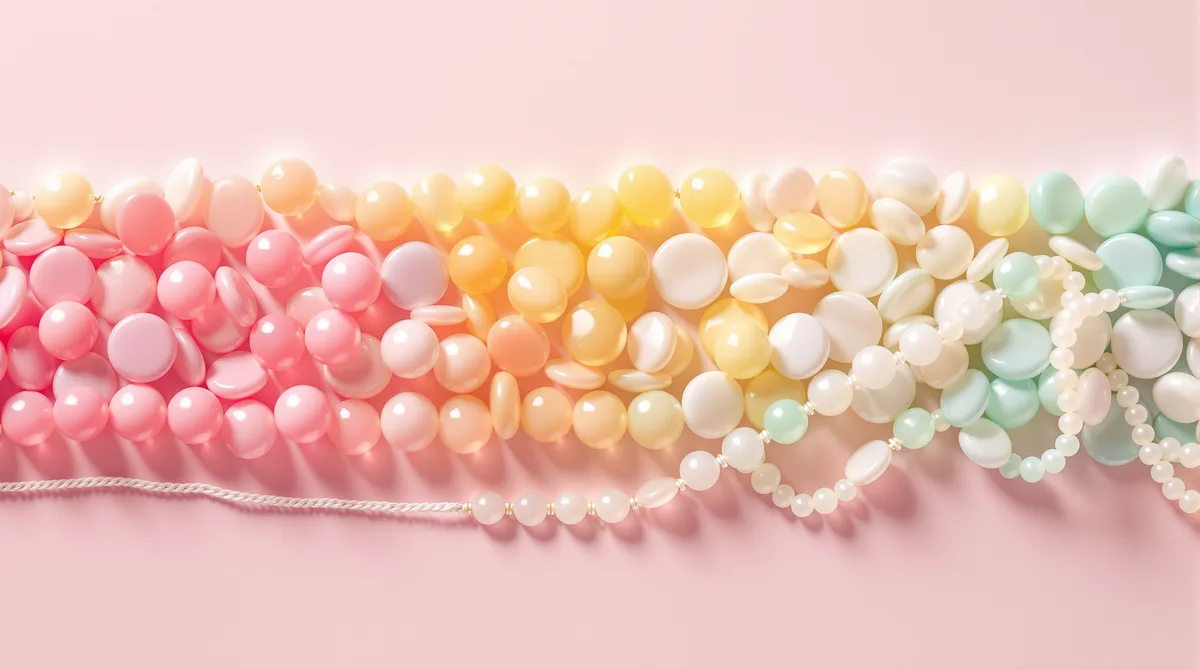
A cast resin piece starts as a liquid. A pigmented resin is poured or injected into a mould cavity at low pressure, left to cure, and then demoulded and finished. Because the material arrives as a liquid it fills the cavity completely, including undercuts and fine relief that a pressed process would not reach.
That single difference is the whole case for the material. Pressing and turning both start from a solid and remove or deform it, so both are limited by what a tool can close around. Casting is limited only by what a mould can be split out of.
Tool, pour, cure, finish. A die is cut to the drawing — on our own developments, to our drawing and on our own tooling. The resin is pigmented and poured. The piece cures. Then it is demoulded, the gate mark and parting line are dressed back, and the piece is drilled or linked and assembled.
The tooling, the colour and the finishing are ours. Moulding a bead and cutting a new die runs through the same bench sequence for both the pressure-moulded and the cast routes.
Shape at scale. A glass bead above about twenty millimetres becomes heavy and fragile; a wood bead at that size becomes a block. A cast resin shape at ten inches is still light enough to hang, which is why a figural wall piece is possible at all. Our own record includes exactly that: a cast resin horse wall hanging, about ten inches head to tail, sampled in 2025.
It also gives relief. A cast petal can have a thinned edge and a raised vein, which is what makes a floral read as a flower rather than as a flat shape.
About half of glass for the same volume, close to acrylic — arithmetic from a nominal 1.1 to 1.3 g/cm³, not weighed figures. The practical reading is that a large cast shape weighs what a much smaller glass bead would, which is the only reason object-scale beadwork hangs from a dowel rather than from hardware.
The cost of that lightness is the same one acrylic pays. A light piece does not settle; it keeps moving. Where a cast shape sits low on a strand, a weighted end bead below it is usually the right answer.
Wide, and with one real advantage over any dyed-surface route: the colour is in the body. A cast piece that gets scuffed in transit shows the same colour at the scuff, where a surface-dyed bead shows its substrate. On a figural shape with an exposed edge that difference decides whether a shipment passes inspection.
Resin also holds translucency convincingly, which is what makes it a substrate for faux capiz. Where an adjacent bead has to disappear into the cast shape, it is dyed to match.
Whatever the shape allows, which is the point and the problem. A cast figure has no natural axis, so the hole has to be placed where the piece will hang the way the drawing shows — and that is a design decision made on the sample, not a dimension picked from a table.
Once placed, the usual rule applies. Cord is chosen from the smallest hole in the whole build, and on a mixed piece that is almost never the cast shape.
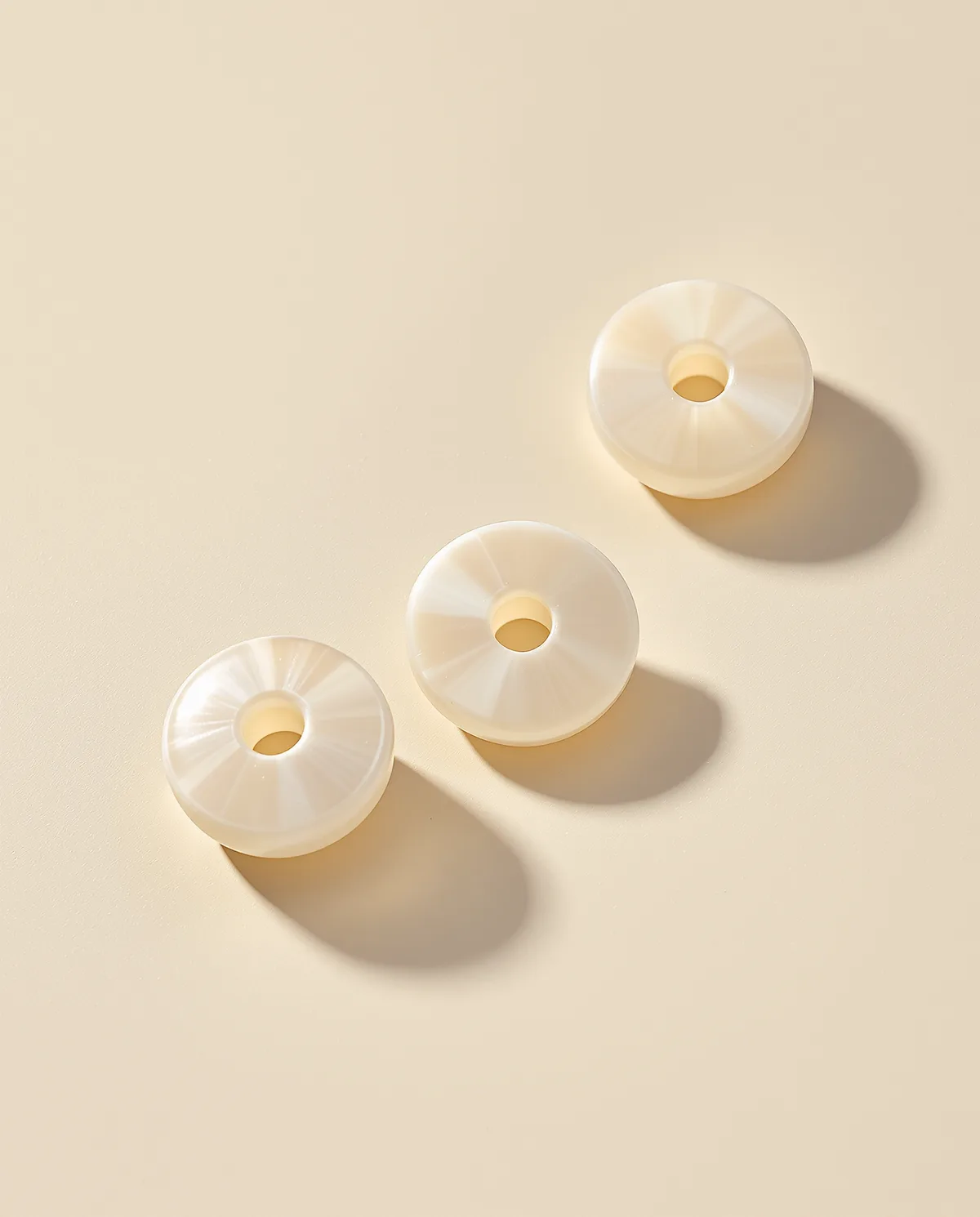
Shape repeats from the tool and colour repeats from the pigment, held against a retained approved sample. What varies more than on a pressed bead is the finish at the gate and the parting line, because dressing those back is hand work.
The fix is to specify it. Name the acceptable finish at the seam and the gate, agree where they sit, and the run can be inspected against something. Leave it and every operator will make a different judgement.
At thin sections and at the surface. A cast shape with a fine edge — a petal tip, an ear, a thin leaf — is where it chips, and the fix is a minimum section thickness written into the specification rather than left to the mould maker. Resin also scuffs more readily than glass, so packing has to separate pieces rather than relying on their own toughness.
It does not shatter, which is the compensating advantage. A dropped resin figure is usually still a figure.
Per piece, more than a plain moulded bead and less than hand-made lampwork glass. Per design, the significant number is the die, which is a first-run cost and does not recur. For a one-season programme that tooling can dominate the comparison; across several seasons it disappears.
Against pressure-moulded acrylic, resin costs more per unit and buys shapes acrylic cannot hold. Against glass it costs less, weighs half and gives up optical depth.
It suits object and accent work: figural wall pieces, cast florals, connector shapes that assemble into a larger motif, and disc forms including faux capiz. Anywhere the shape is the design, this is the material.
It does not suit a plain field. A strung panel of round resin beads is a worse acrylic panel — same weight class, dearer per bead, looser tolerance. And it does not suit embroidery, because cast pieces are not made small enough to behave as a field; that is seed-bead and bugle territory.
The shape, with a drawing or a reference image. Overall dimensions. Minimum section thickness at the thinnest point. Hole position, described relative to the shape rather than as a bare diameter. Colour route and reference. The agreed position and acceptable finish of the parting line and gate mark.
Minimum section and seam finish are the two that get skipped, and they are the two that decide durability and acceptance.
| Specification | Working value | Why it matters |
|---|---|---|
| Production method | Poured into a mould as a liquid, cured, demoulded and finished | Liquid in means undercuts and fine relief are possible |
| Shape latitude | Figural, floral, animal, disc; sizes up to object scale | The reason to choose resin at all |
| Recorded piece | A cast resin horse wall hanging, about ten inches head to tail, sampled 2025 | Our own record of resin at object scale |
| Colour route | Pigmented through the body, or dyed to match an adjacent bead | Body colour does not reveal a pale substrate when scuffed |
| Weight behaviour | Close to acrylic — about half of glass for the same volume | Arithmetic from nominal density; what makes figural scale viable |
| Surface marks | A parting line and a sprue or gate mark | Both are placed deliberately, usually on a back or a seam |
| Failure mode | Chips at a thin edge; will scuff; does not shatter | Thin relief is where a cast shape breaks |
| Made where | Cast and dyed to our colour, to our own dies, then finished and strung in our own beadwork studios | Our making reaches the tooling, the colour and the finishing |
Good to know
Acrylic is forced into a closed tool under pressure as a softened solid; resin is poured in as a liquid and cures. Pressure moulding gives tighter tolerances and faster cycles; casting gives undercuts, fine relief and large shapes. Acrylic is the better bead. Resin is the better object.
About half for the same volume — arithmetic from a nominal 1.1 to 1.3 g/cm³ against 2.5 for glass, not weighed figures. That ratio is what makes a ten-inch cast figure something you can hang on a dowel rather than something that needs a bracket.
Object and accent work above all: figural wall pieces, cast florals, large connector shapes, and disc forms. It is the right material whenever the shape carries the design. It is the wrong one for a plain field of round beads, where moulded acrylic is cheaper and more consistent.
The shape with a drawing or a reference, overall dimensions, the minimum section thickness at thin points, the hole position, the colour route, and the agreed placement of the parting line and gate mark. Minimum section is the entry that decides whether the piece survives packing.
Shape repeats from the tool. Colour repeats from the pigment and is held against a retained sample. What varies more than on a pressed bead is surface finish at the gate and the seam, because those are hand-finished — so the specification should state the acceptable finish rather than assume it.
A wide range, pigmented through the body, and resin also takes translucent and semi-opaque effects that read as depth rather than as surface. Small adjacent beads are routinely dyed to match the cast shape so the shape stays the subject.
It reaches a different depth than it does for glass. Glass we draw in our own Firozabad works. Resin is cast and dyed to our colour, to our own dies, and then finished and assembled in our own beadwork studios. Our making reaches the tooling, the colour and the finishing; for glass it reaches further back, to the furnace.
Keep exploring
Material
Cast resin or dyed cut acrylic, finished to imitate capiz shell: what it gives that real shell cannot, and why thin discs tangle.
See the detailMaterial
Moulded to our dies and dyed to the reference: the widest colour latitude in the library, half the weight of glass, and no shatter risk.
Specs and sizesProcess
The tool, the shot, the dye bath — and the arithmetic that decides whether a custom bead shape is worth its die.
Read the guideManufacturing
Draw the bead, cut the die, mould and dye it: what a custom bead shape costs, what it needs from a buyer, and when it pays.
Open the referenceReference
Nine material families, what each gives in light, weight and colour, and how far our own manufacturing reaches into every one of them.
See the detail
Start a conversation
Send a reference, a colour chip or a sketch. Minimums are set per design and confirmed per quote; sampling is quoted separately and usually runs 16 to 20 days from an agreed brief.