Material
Glass seed beads: sizes, dye lots and cord
How seed beads are drawn, why dye lots are quoted per run, what the drill hole limits, and where seed-bead work earns its cost.
See the detail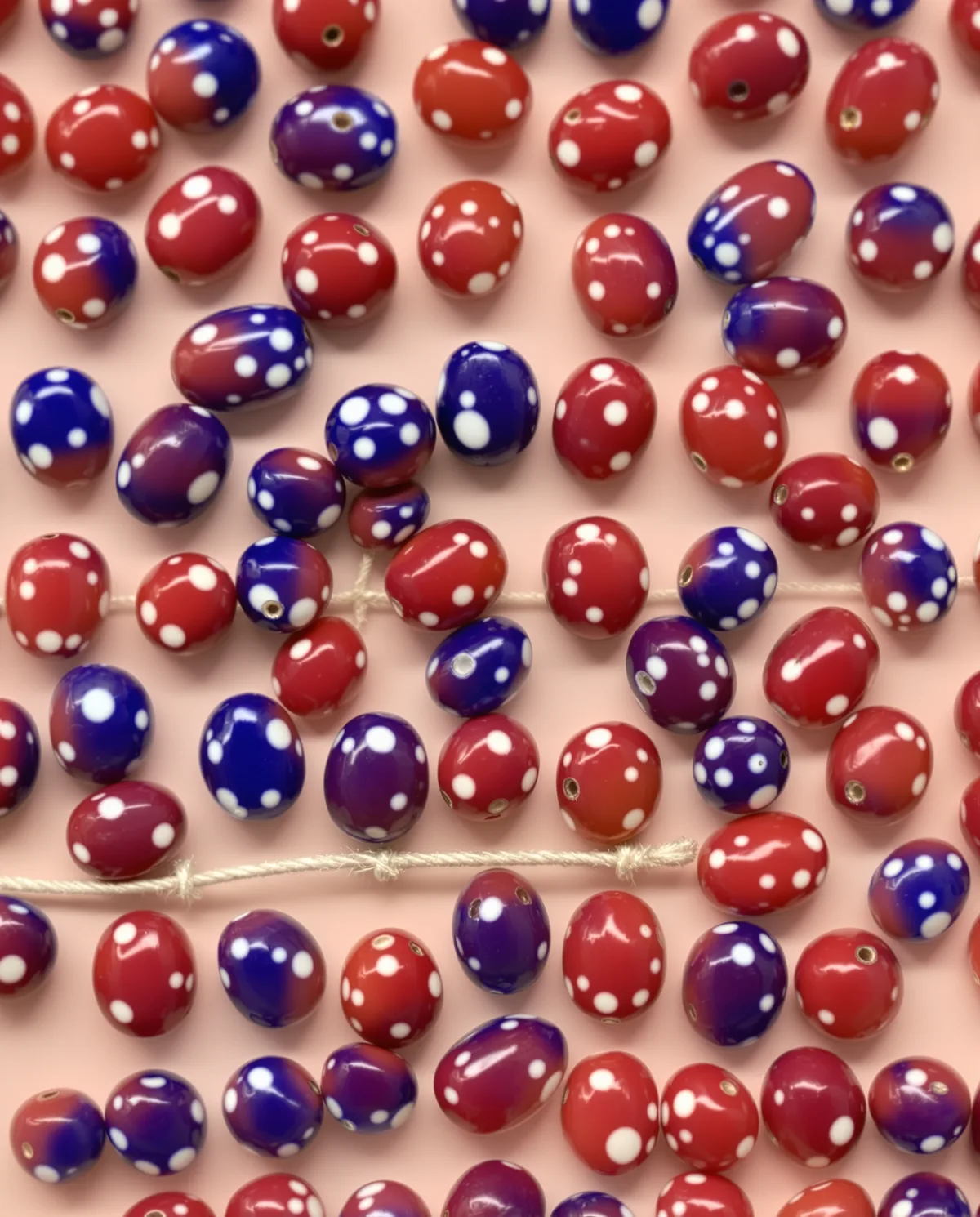
Material · Glass
Drawing glass gives you a tube. Pressing it gives you a shape — a dot, an oval, a leaf, a mushroom — and the same shape again, ten thousand times. That repeatability is the whole reason pressed glass exists in a bead library.
Dotted oval pressed glass beads, thirteen by twenty-two millimetres, in cherry red and cobalt with raised white dots, loose beside a threaded sample strand.
Pressed glass beads are formed by closing a mould around a gather of molten glass, with a pin forming the hole, rather than by drawing and cutting a cane. Pressing is what makes a specific shape — a dotted oval, a faceted drop, a mushroom — repeat identically across a production run. Ours are pressed in our own Firozabad glass works.
A pressed bead is a solid piece of glass squeezed into shape while soft. A gather of molten glass is dropped into the lower half of a two-part steel mould, the upper half closes on it, and a pin held in the tool forms the hole as the glass sets around it. When the mould opens, the bead already has its final geometry — and nothing about that is variable, because the shape is a property of the tool rather than of the maker.
Four stages: the melt, the press, the finish, the anneal. The melt decides colour and working range. The press decides shape and hole. The finish removes the parting line left where the two mould halves met — ground back, or fire-polished until the glass flows over it. The anneal takes the bead back up to a soak temperature and cools it slowly, so the internal stress the press built into it is relieved rather than stored.
All four happen in our own Firozabad glass works, alongside the drawing bench that makes seed beads. A shape, a colour and an annealing schedule are three things we can trial on one sample run.
A subject. Strung work is a field of repeated units, and a field needs something to interrupt it. A pressed bead is the interruption — large enough that the eye stops on it, specific enough in shape that it carries meaning. A dot, a mushroom, a blossom, a faceted drop: each one turns a plain strand into a design with a name. It also gives shape that drawn glass physically cannot: you cannot draw a mushroom, you can only mould one.
Three places. A mould seam left proud saws at cord over a few thousand movements, which is why the finish stage is not cosmetic. Internal stress in a bead that was not properly annealed releases later as a crack months after shipping. And colour: glass strength is colour-dependent, so two colours of one shape in one panel can behave differently when they knock together.
We have had all three. The fix on a large hand-made glass portal was to change the furnace process, anneal the beads and revise the palette so incompatible colours were not clinking together. Annealing and colour strength takes that apart properly.
It sits in the middle, and the reason is tooling. A catalogue shape carries no tool cost, so a pressed accent in an existing mould is barely dearer per bead than a plain round. A new shape carries the cost of cutting a die — a first-run cost that does not recur, and one we have absorbed ourselves on an adopted programme.
Against hand-made lampwork glass, pressed glass is far cheaper per unit and far more repeatable. Against drawn seed beads it is dearer per bead and much cheaper per square centimetre of coverage, because one pressed oval fills the space of dozens.
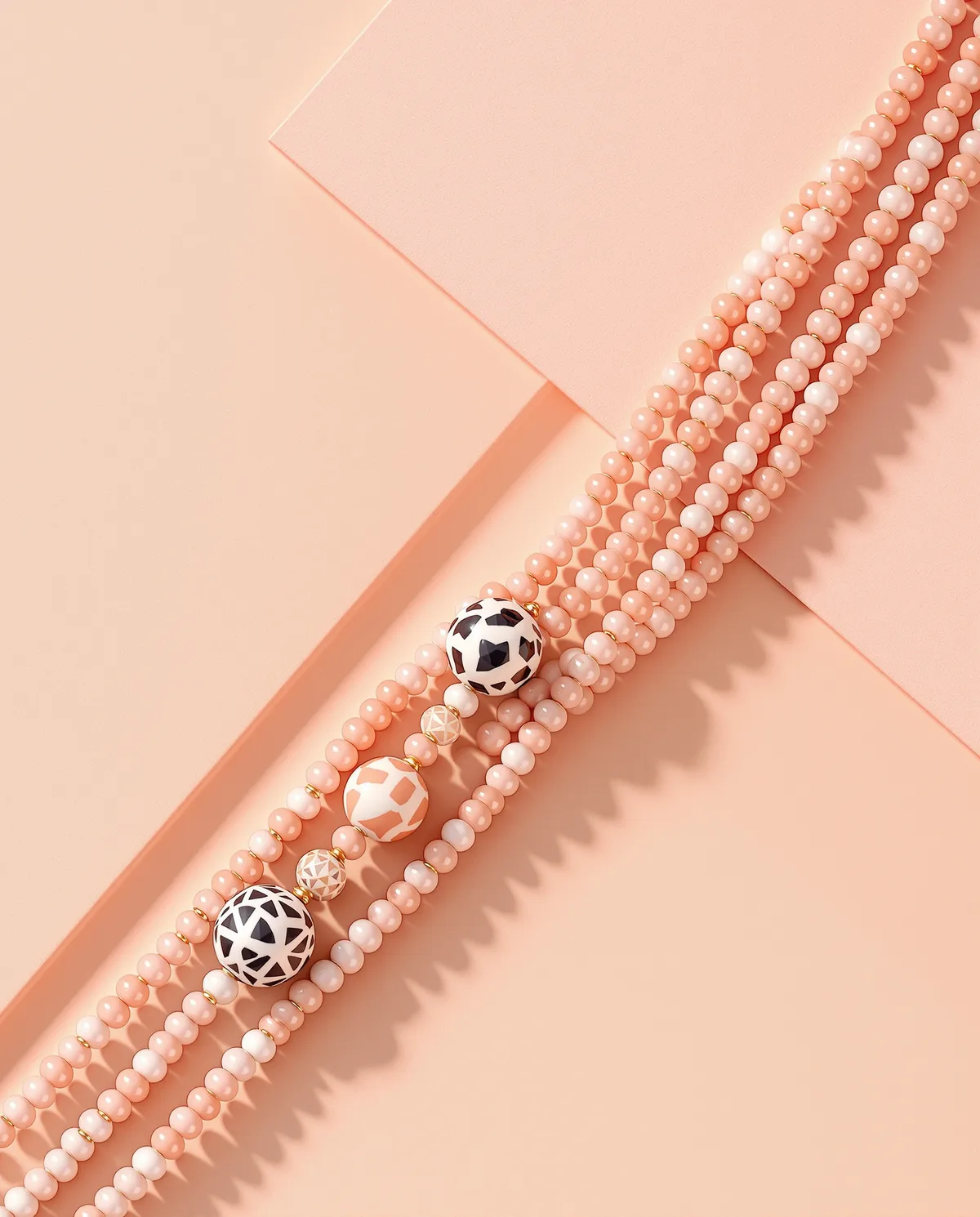
It suits anything that hangs and is read from a metre or more away: doorway portals, door curtains, café curtains, valances, strung wall hangings. On those the accent does its job — three or four per strand, deliberately offset so no two land level across neighbouring strands.
It does not suit flat work that has to hold a drawing. A pressed bead is too large to act as a pixel, so a motif built from pressed glass reads as a cluster of objects. Bead and thread embroidery, in seed and bugle sizes, is the construction for images.
Shape name, nominal length and width in millimetres, transparent or opaque, the surface finish, the hole diameter, the colour method, and the accent count per strand with the word scattered against it. On a feature bead above roughly fifteen millimetres the pack should record that the bead is annealed, because that is a process specification rather than an attribute a buyer can inspect.
Leave the hole out and the stringing specification cannot be completed. Leave scattered out and a beadworker will align them.
All the way to the batch. The glass is melted, pressed, finished, annealed and hand-strung in a plant we own, which means colour, shape, surface and annealing are variables on the table rather than constraints handed to us. We own the network; we are not a sourcing office.
It is worth being precise that this applies to glass. Where a design needs a moulded acrylic or resin shape instead, we own the dies and do the moulding, dyeing and finishing — a real but smaller reach into the component.
That it is crystal: cut and faceted glass is sold into the market under that word and we describe it as glass in every specification. That a pressed bead is hand-made: it is machine-formed to a tool, and the hand work is in the finishing and the stringing. And that colour is infinitely matchable — body colour comes out of a melt, and the route to an exact colour is usually to dye the base beads to match the accent.
The dotted constructions are the clearest case: thirteen-by-twenty-two-millimetre dotted oval glass beads scattered across a seed-bead base, in transparent and opaque versions, with the base beads dyed to match the dot colour. The mushroom portal construction works the same way, with glass mushroom beads as the accent on a cream seed-bead ground. The 2027 design library adds further pressed-glass accents across the colour stories, with strand and bead counts drawn from the design renders and confirmed on the sample when a design is developed.
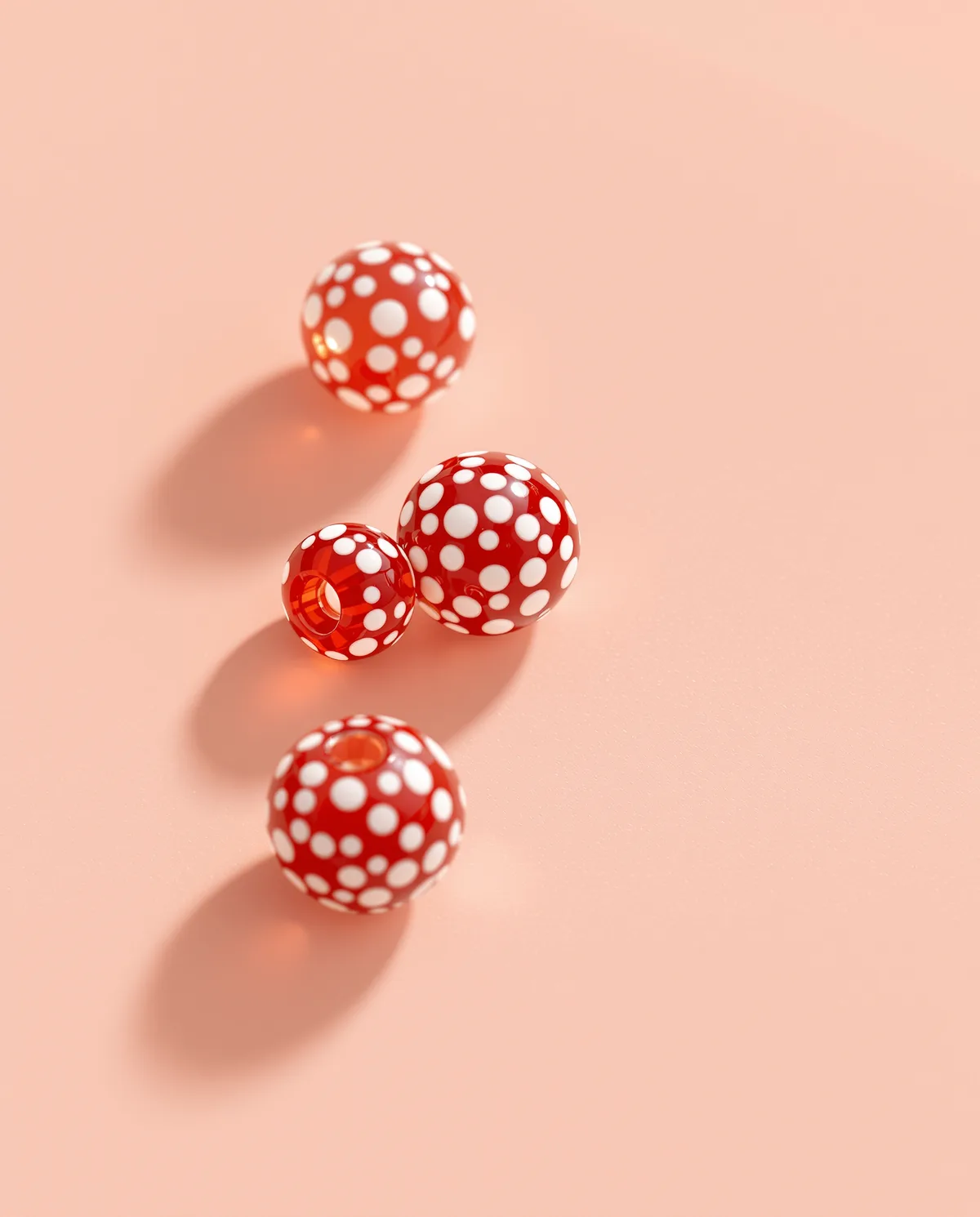
A ten-millimetre pressed round is about 1.2 g once the hole is deducted, so a hundred run near 120 g. Those are arithmetic from a nominal 2.5 g/cm³, not weighed figures, but the ratio is the useful part: glass is roughly twice acrylic and three times most woods for the same volume.
On a panel that cuts two ways. Weight is what makes glass hang straight and settle fast instead of swinging. Weight is also what the dowel, the bracket and the carton have to carry, and it is the figure buyers most often discover at quotation rather than at design.
Wide, within a constraint most buyers do not expect: colour is decided in the melt, so it is a chemistry decision, not a finishing one. Metal oxides in the batch give the body its colour, and the oxide loading also shifts the working range of the glass and its annealing requirement. Changing a pressed colour is therefore a furnace trial, with a lead at the front of the sample loop that a dyed bead does not carry.
Surface routes are quicker: frosting and ribbing change how a bead reads without touching the melt. Where an exact reference has to be hit, dyed to match on the surrounding base beads is the reliable mechanism.
The hole is formed by a pin, so it is generous compared with a drawn seed bead — but generous is not a number, and the only number that governs a build is the smallest hole in it. Cord is selected from that hole, which on a mixed panel is almost always the seed-bead base rather than the pressed accent. Hole diameter is measured on the bead itself and written onto the stringing sheet at specification stage, so the figure that governs a build is the one taken from the beads that build uses.
| Specification | Working value | Why it matters |
|---|---|---|
| Production method | Molten gather pressed in a two-part mould, hole formed by a pin | The shape is in the tool, so it repeats across the run |
| Recorded feature size | Dotted oval glass beads at 13 × 22 mm | The size we have actually run as a scattered accent |
| Accent density | About 90–120 dotted ovals in a 90 × 200 cm portal | Sets the bead budget before anything else is decided |
| Weight behaviour | A 10 mm pressed round works out near 1.2 g, so about 120 g per hundred | Arithmetic from nominal density — it decides the mount, not the look |
| Drill hole | Pin-formed, generous relative to a seed bead; confirmed per bead | Cord is chosen from the smallest hole in the whole build |
| Colour route | Body colour from the melt; surface frosting and ribbing available | Body colour does not fade; it also cannot be adjusted after the melt |
| Finish options | Glossy, frosted, ribbed, opaque or transparent | Opaque and transparent versions of one shape read as two different beads |
| Made where | Pressed, finished and hand-strung in our own Firozabad glass works | Mould, melt and annealing are all specification decisions we control |
Good to know
A drawn bead starts as a hollow cane that is cut into lengths, so the only variable is how long the piece is. A pressed bead is formed in a mould, so the shape itself can be anything the tool holds — a dot, an oval, a leaf, a faceted drop, a mushroom.
The shape is, because it lives in the mould rather than in a pair of hands. The colour is the part that needs holding: body colour comes out of the melt, so a repeat order is matched against the approved sample bead and the furnace record, not against a dye reference.
Roughly twice as much for the same volume. Glass runs near 2.5 g/cm³ against about 1.2 for acrylic, so a ten-millimetre round is about 1.2 g in glass and about 0.6 g in acrylic.
Hanging work, where the bead has room to be read individually: portals, door curtains, valances and wall hangings. It is wrong for anything that has to hold an image, because a large bead cannot resolve a motif.
Shape, nominal dimensions in millimetres, transparent or opaque, surface finish, the hole diameter, the colour method, and the accent count per strand with a note that placement is scattered. On a feature bead above about 15 mm it should also state that the bead is annealed.
Yes. Pressing, colouring, frosting, ribbing and hand-stringing all happen in our own Firozabad glass works. That is also why a mould seam, a colour or an annealing cycle is something we can change on a sample rather than something we have to accept.
Body colour is set by metal oxides in the batch, so the palette is wide but not unlimited — some colours need a melt chemistry that changes how the glass works and how long it must anneal. Where a design needs an exact match, the usual route is to hold the accent in a stock colour and dye the base beads to match it.
Keep exploring
Material
How seed beads are drawn, why dye lots are quoted per run, what the drill hole limits, and where seed-bead work earns its cost.
See the detailGuide
Resolution, weight, repeatability, cost per covered area and breakage risk, with the working figures from production.
Read moreMaterial
Wound at the torch one bead at a time: what that buys in shape freedom, what it costs in hours, and how variation is specified instead of eliminated.
Read the guideProcess
What annealing relieves, why a colourant changes the glass it colours, and how a real breakage problem was solved by changing the furnace and the palette.
Read the guideReference
Nine material families, what each gives in light, weight and colour, and how far our own manufacturing reaches into every one of them.
Read more
Start a conversation
Send a reference, a colour chip or a sketch. Minimums are set per design and confirmed per quote; sampling is quoted separately and usually runs 16 to 20 days from an agreed brief.