Material
Pressed glass beads
Why a mould, not a draw: how a pressed shape repeats across a run, what the mould seam costs you, and where a feature bead earns its weight.
Compare the options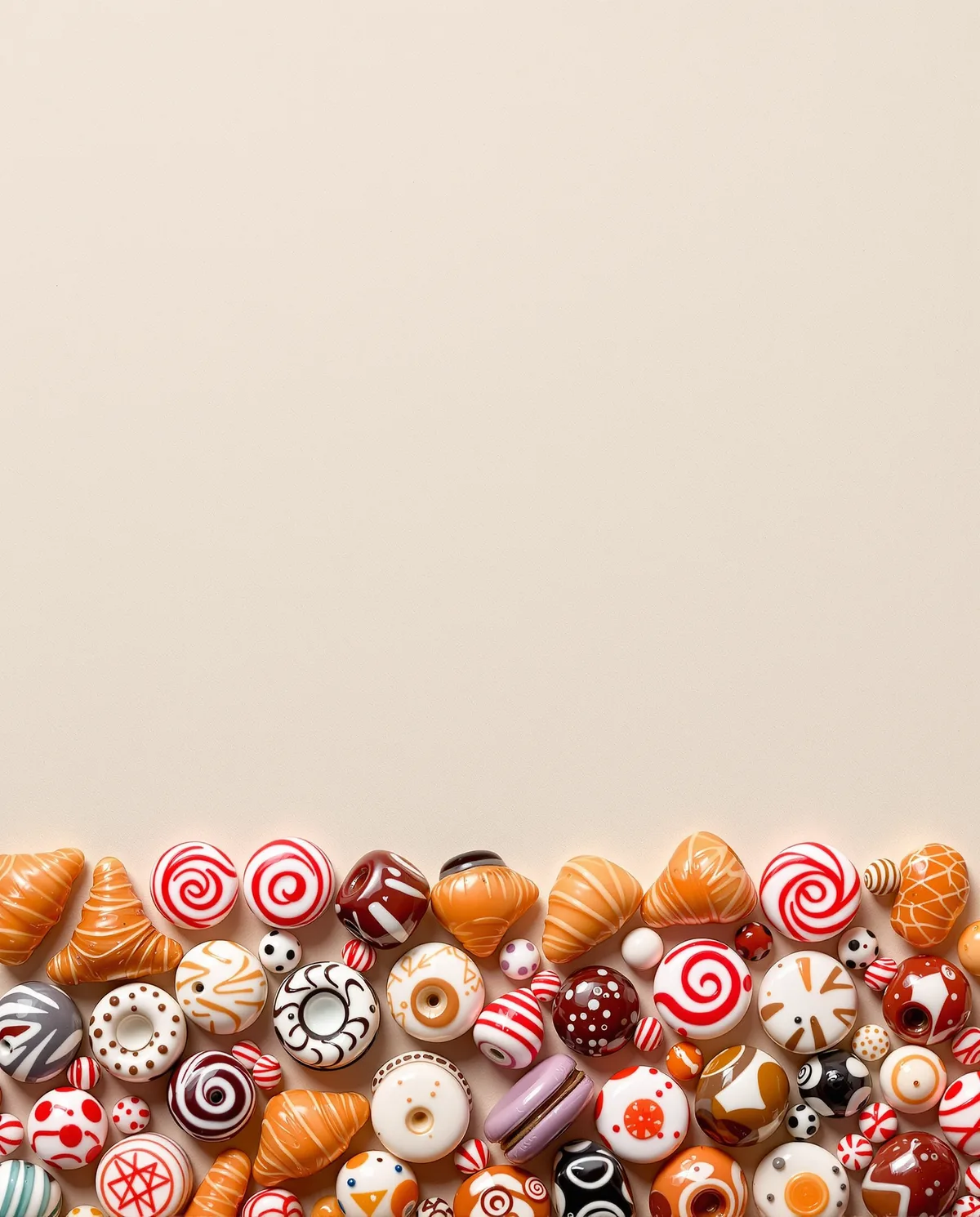
Material · Glass
A lampwork bead is wound, not pressed and not drawn. One artisan, one torch, one bead at a time — which is why the catalogue is whatever can be made rather than whatever has a mould, and why the cost is hours.
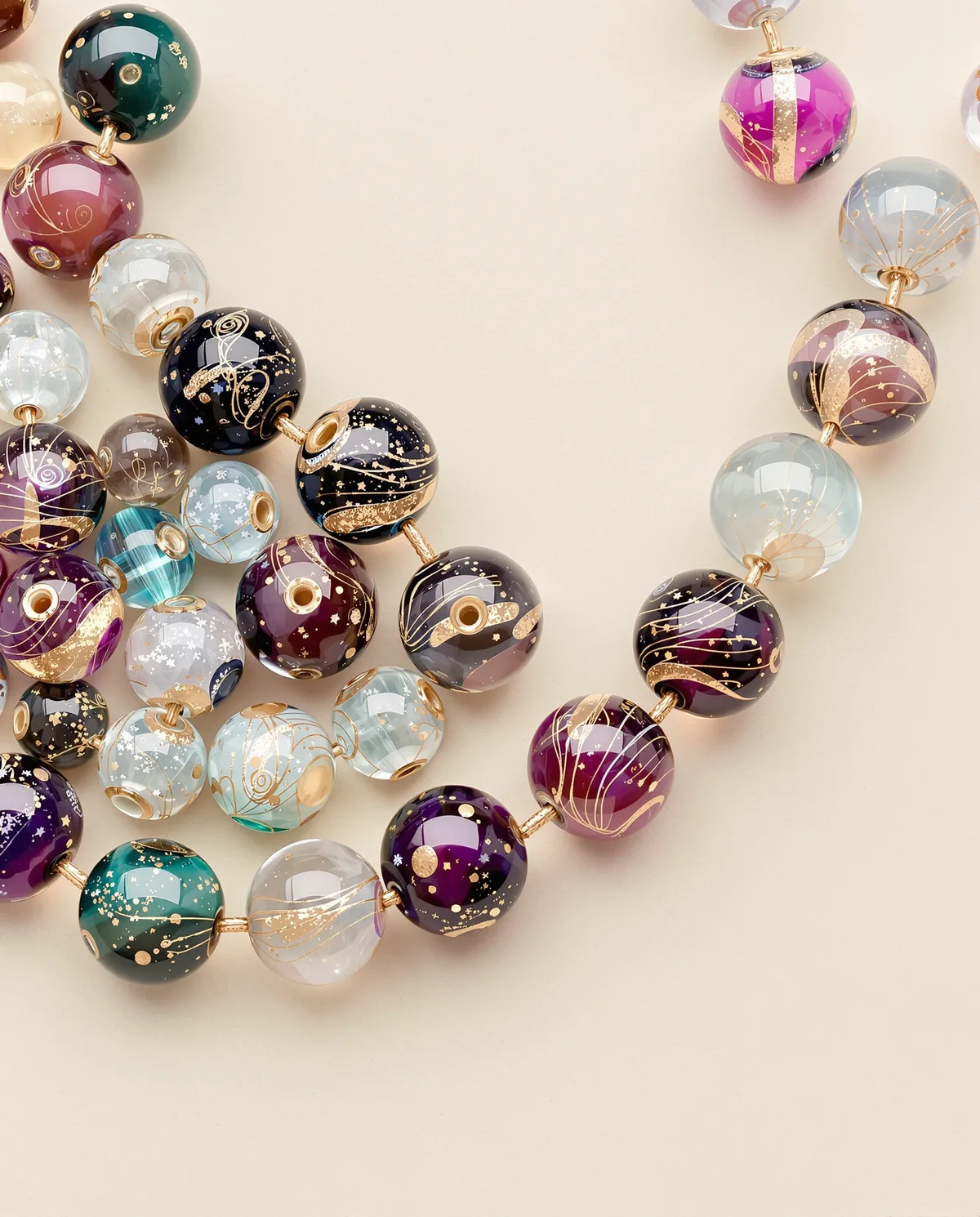
Hand-shaped lampwork glass beads wound at the torch as croissants, macarons, blood orange slices and peppermint swirls, each one slightly different from the next.
Lampwork glass beads are wound by hand at a torch: molten glass is wrapped around a steel mandrel, shaped, decorated and annealed, one bead at a time. Because there is no mould, the shape can be anything an artisan can make — and because there is no mould, no two beads are identical. Cost follows the hours, not the material.
A lampwork bead is glass wound into shape while molten. The artisan holds a steel mandrel in a torch flame and wraps a rod of coloured glass around it, then works the glass with gravity, a paddle and heat until it takes the shape intended. When the bead has cooled and the mandrel is withdrawn, the hole is the space the mandrel occupied.
That is the whole mechanism, and it explains everything downstream. There is no tool defining the shape, which means there is no shape limit and no exact repeat. The hole, by contrast, is the most consistent dimension on the bead, because the mandrel does not vary.
In passes. The first pass winds the body and establishes the form. A second pass applies decoration while the bead is still hot — dots of a second colour, lengths of drawn cane laid on and melted flush, slices of millefiori cane pressed into the surface, swirls raked through with a pick. A third pass, if the design needs it, reshapes or marvers the surface flat. Then the bead goes into an annealing kiln rather than being left to cool in air.
All of it happens at the torch in our own Firozabad glass works, in the same plant that draws seed beads and presses moulded shapes. Hand-made lampwork, pressed glass and drawn seed beads are three separate trades inside one material; specifying "glass beads" without saying which tells a factory almost nothing.
Specificity. A pressed shape is a type — an oval, a leaf, a drop. A lampwork bead can be a croissant. The most recent development out of our glass works was exactly that: food and holiday icon beads, hand-shaped to a story and finished as wine charms, in shapes no mould in the library held.
For a buyer that converts into something practical. A themed range does not need tooling. It needs a brief, a reference image and bench time.
More per bead than anything else in glass, and the gap is hours rather than material. A plain drawn bead leaves the cutting bench by the thousand. A decorated lampwork bead occupies one artisan from the first wind to the kiln. Three decoration passes cost three times what one costs.
The consequence for design is that a lampwork piece is costed on bead count, not on area, and the lever is count rather than size. Reducing the bead from twenty millimetres to fifteen saves glass and almost no time. Reducing twelve lampwork beads to six halves the line.
It suits objects where one bead is the subject and the count is low: wine charms, ornaments, bag charms, napkin rings, feature positions on a hanging panel. On those, the variation between beads reads as craft rather than as inconsistency.
It does not suit a field. Both weight and cost scale linearly with count, and a panel wants thousands of beads. It also does not suit a brief that demands identical units — if a retailer's quality standard treats bead-to-bead difference as a defect, the construction is wrong before the colour is discussed.
Shape, nominal dimensions, the number and type of decoration passes, the hole diameter, and the acceptable variation band. The last of those is the one people leave out and the one that decides whether a run can be accepted. A lampwork specification without a variation band approved on the sample gives an inspector nothing to measure against, and the argument happens at the port instead of at the bench.
Where the bead is above roughly fifteen millimetres, record that it is annealed. That is a process fact a buyer cannot see and should not have to ask for.
To the rod. The winding, the decoration, the annealing and the stringing all happen in a plant we own, by artisans whose craft discipline is the bead itself. That is the deepest reach of any bead family in the library, and it is the reason a new shape is a bench conversation rather than a tooling programme. Factories we own, not vendors we book.
That two beads are the same. They are close, approved as a range, and a brief that pretends otherwise sets up a rejection. That it is Venetian: the term describes a style of hand-made glass bead with swirls and inclusions, and we use it as a description rather than as an origin claim. And that it is cheap at volume — it is the one glass family where volume does not reduce the per-unit labour.
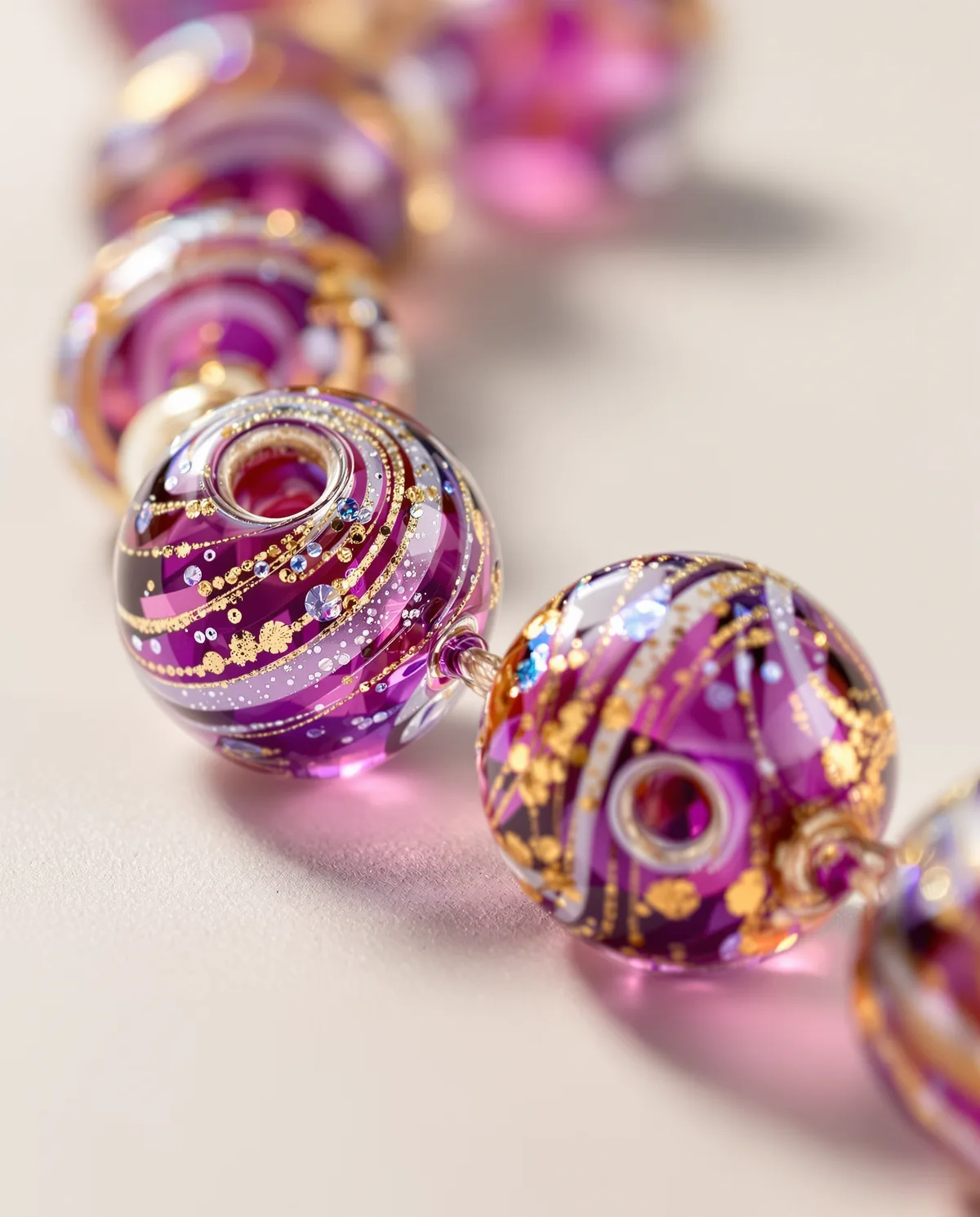
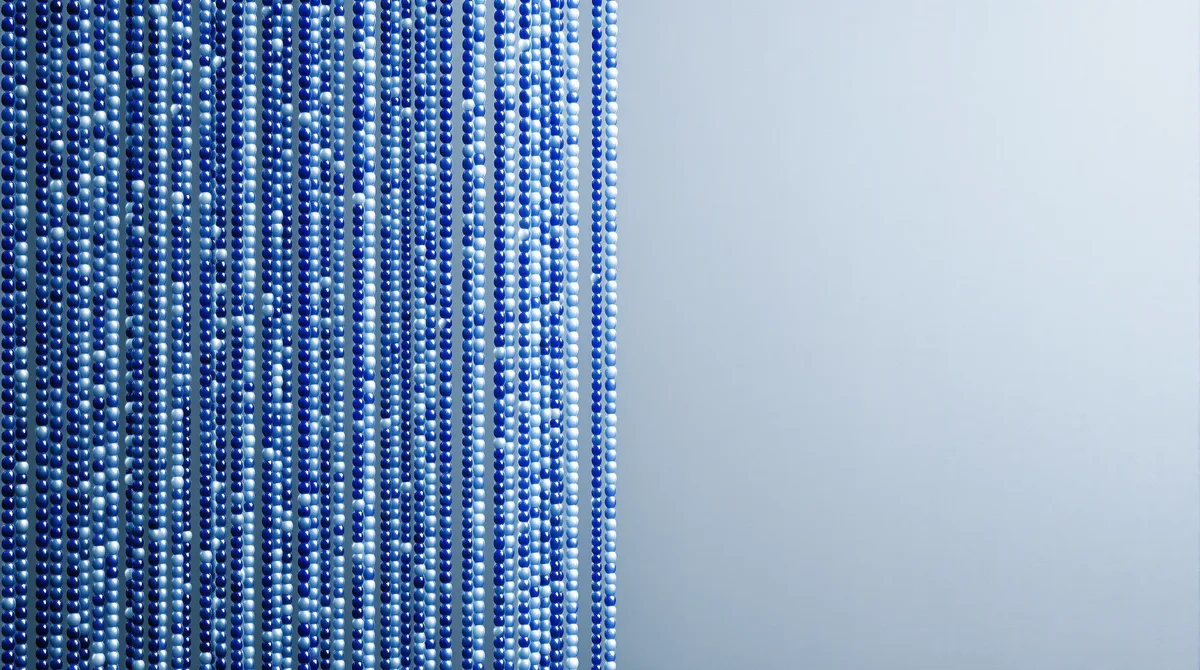
Two places in the record. The first is the icon-bead development: hand-shaped food and holiday beads, the newest work out of the glass works, finished as wine charms. The second is a large hand-made glass door portal built on Venetian-style beads — hand-made, large-format, and the piece that taught us most about annealing, because the first version broke.
That portal is the clearest case of the material's trade-off. The look was only available in hand-made glass. The breakage was only solvable by changing the furnace process, annealing the beads and revising the palette so that incompatible colours were not knocking together in the panel.
A fifteen-millimetre wound round works out near four grams; a twenty-millimetre figural bead can be double that. Those are arithmetic from a nominal 2.5 g/cm³ rather than weighed figures, but they are enough to make the point: a dozen lampwork beads on a strand weigh more than several hundred seed beads.
Practically, that means a lampwork accent is placed low on a strand where its weight helps the drop hang straight, or spaced so no single strand carries most of it. A panel that puts heavy wound beads at the header and light beads below will hang badly, and no hem shape will rescue it.
Broader than a single melt, and differently governed. Lampwork draws on coloured rod stock, and the bead can combine several rods — a core in one colour, cased in another, dotted in a third, raked into a swirl. The result is colour effects that no body-coloured pressed bead can reach.
What it cannot do is hit an exact external reference on demand, because the colour is the rod plus the way it was worked. Where a programme needs a precise match, the reliable mechanism is to accept the lampwork colour as the lead and bring the surrounding beads to it, which is what dyed to match exists for.
| Specification | Working value | Why it matters |
|---|---|---|
| Production method | Glass wound onto a steel mandrel at the torch, then annealed | One bead at a time; the hours are the cost |
| Shape latitude | Effectively unlimited — figural, fruit, food, animal, abstract | Any shape an artisan can make, with no tooling to cut first |
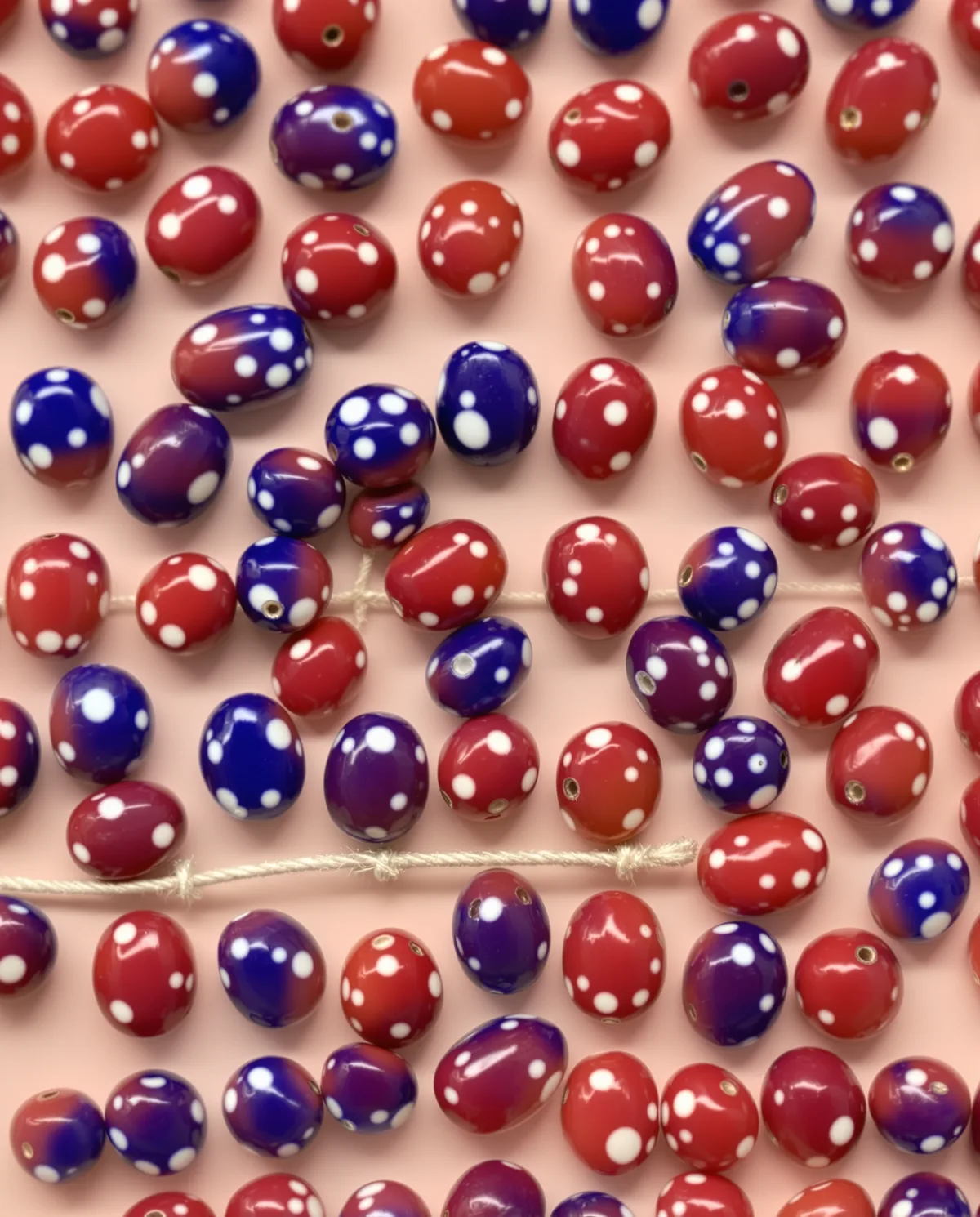
| Repeatability | Close, never identical; variation approved as a range on sample | A brief must say how much variation is acceptable |
| Drill hole | Set by the mandrel diameter, so it is consistent within a run | The one dimension lampwork controls better than pressed glass |
| Weight behaviour | A 15 mm wound round works out near 4 g, about 400 g per hundred | Arithmetic from nominal density; large wound beads are heavy for their count |
| Decoration | Applied dots, drawn canes, millefiori slices, swirls, inclusions | Each pass adds time and another chance of a reject |
| Annealing | Required on large wound beads | Relieves the stress uneven heating builds in |
| Made where | Wound, decorated, annealed and hand-strung in our own Firozabad glass works | Shape development does not wait on tooling |
Good to know
The absence of a mould. A pressed bead is squeezed into a tool and comes out identical every time; a lampwork bead is wound around a mandrel and shaped by hand, so the shape can be anything and the repeat is close rather than exact. Pressed glass buys repeatability. Lampwork buys shape freedom.
Minutes. A plain drawn bead is cut from a cane by the thousand; a decorated lampwork bead occupies one artisan for the time it takes to wind it, shape it, decorate it and set it to anneal. The glass is not the cost. The hours are, which is why a lampwork design is costed on bead count rather than on area.
Orders of magnitude more. A fifteen-millimetre wound round works out near four grams against a fraction of a gram for a seed bead — arithmetic from nominal density, not weighed. In practice that means lampwork is used as a feature at low counts, not as a field, or the panel becomes something the fixing has to be designed around.
Small objects where one bead is the whole subject — wine charms, ornaments, charms, napkin rings — and feature positions on hanging work. It is a poor choice for a full panel field, both on weight and on cost, and a bad one for anything that must hold a repeating image.
The shape, its nominal dimensions, the decoration passes, the hole diameter, and — most importantly — the acceptable variation band, agreed on the approved sample. A lampwork specification that omits the variation band is a specification the factory cannot be held to and the buyer cannot reject against.
Yes. Winding, decorating and annealing all happen at the torch in our own Firozabad glass works, which is why a new icon bead can be developed to a story without cutting tooling first. Our most recent development was a set of food and holiday icon beads — croissants, macarons, blood oranges, peppermints, sourdough and candy ribbons — finished as wine charms.
Lampwork works from coloured rod stock, so the palette is the rod palette plus whatever can be combined on the bead — layered, cased, dotted or swirled. That is broader in effect than a single-colour melt, because two or three rods in one bead give a result no body colour can. The trade is that colour is approved per bead on the sample, not against a dye reference.
Keep exploring
Material
Why a mould, not a draw: how a pressed shape repeats across a run, what the mould seam costs you, and where a feature bead earns its weight.
Compare the optionsMaterial
How seed beads are drawn, why dye lots are quoted per run, what the drill hole limits, and where seed-bead work earns its cost.
View the rangeProcess
What annealing relieves, why a colourant changes the glass it colours, and how a real breakage problem was solved by changing the furnace and the palette.
Specs and sizesProcess
The gather, the drawn cane, the cut, the tumble and the anneal — and why colour is decided in the melt before any bead exists.
Read the guideReference
Nine material families, what each gives in light, weight and colour, and how far our own manufacturing reaches into every one of them.
Open the reference
Start a conversation
Send a reference, a colour chip or a sketch. Minimums are set per design and confirmed per quote; sampling is quoted separately and usually runs 16 to 20 days from an agreed brief.