Material
The engineered shell look
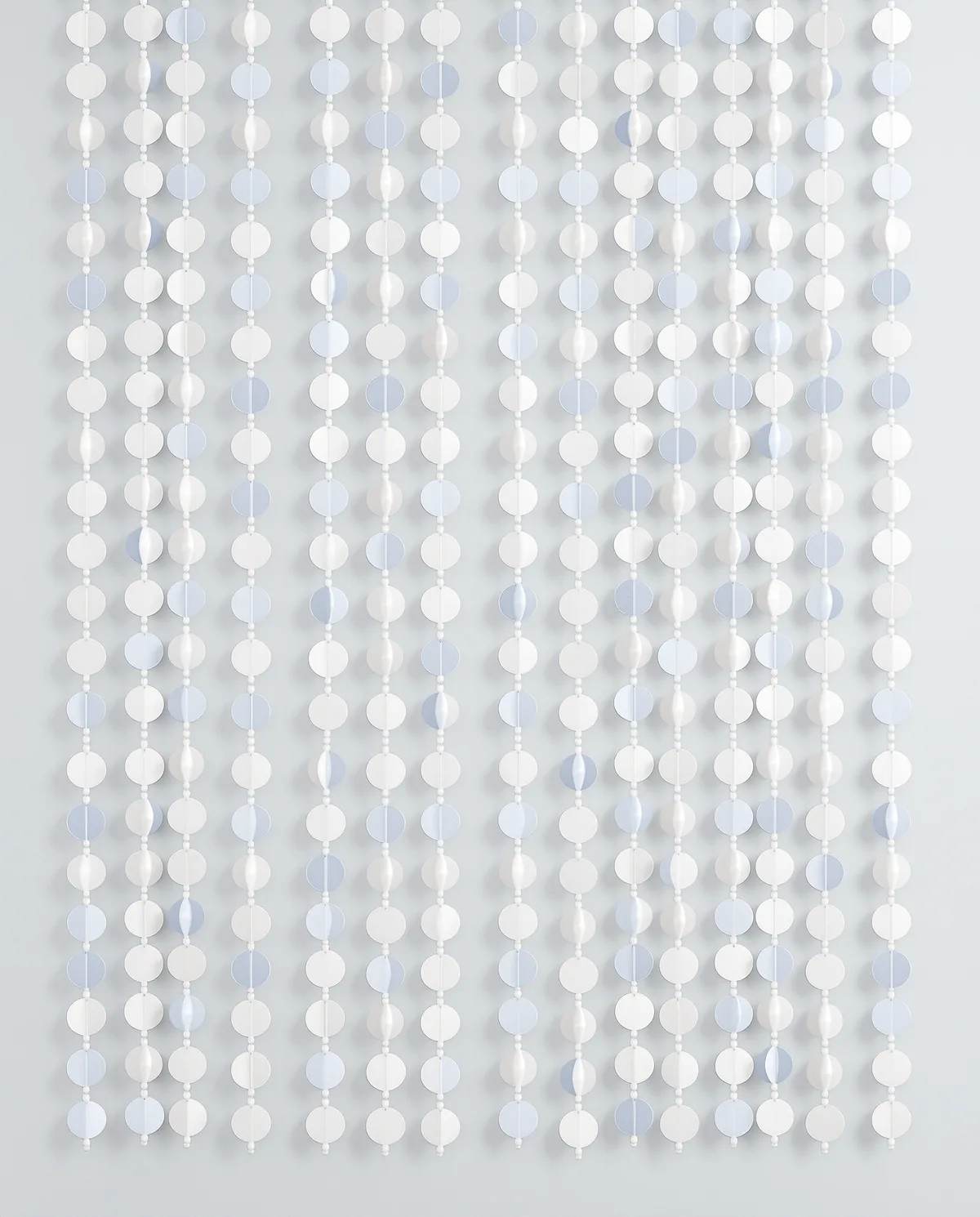
Cast resin or dyed cut acrylic, finished to imitate capiz shell: what it gives that real shell cannot, and why thin discs tangle.
Specs and sizes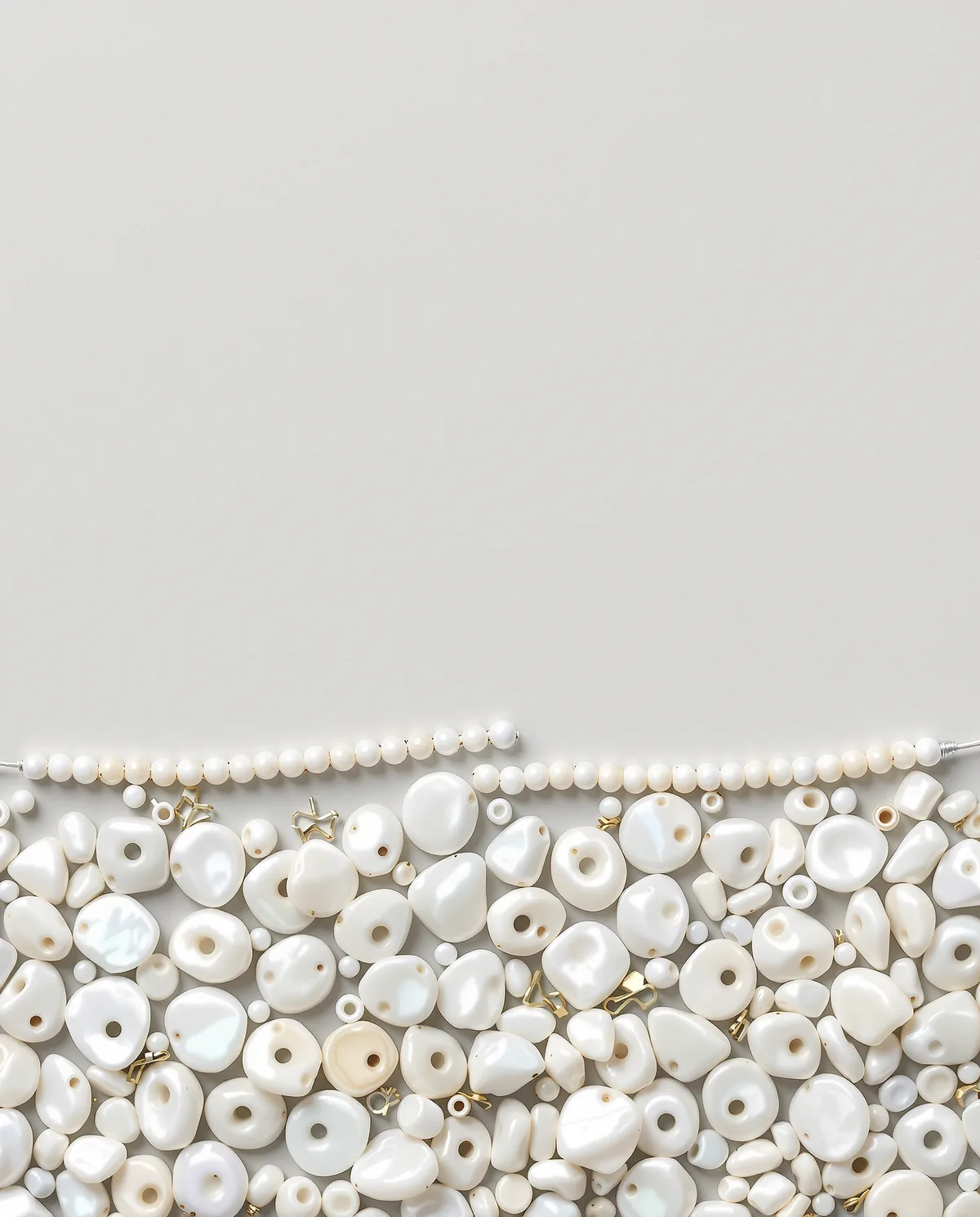
Material · Shell
Nacre does something no engineered material does: it refracts light inside a stack of microscopic layers. That is why the imitation is never quite the same — and why most export programmes still choose the imitation.
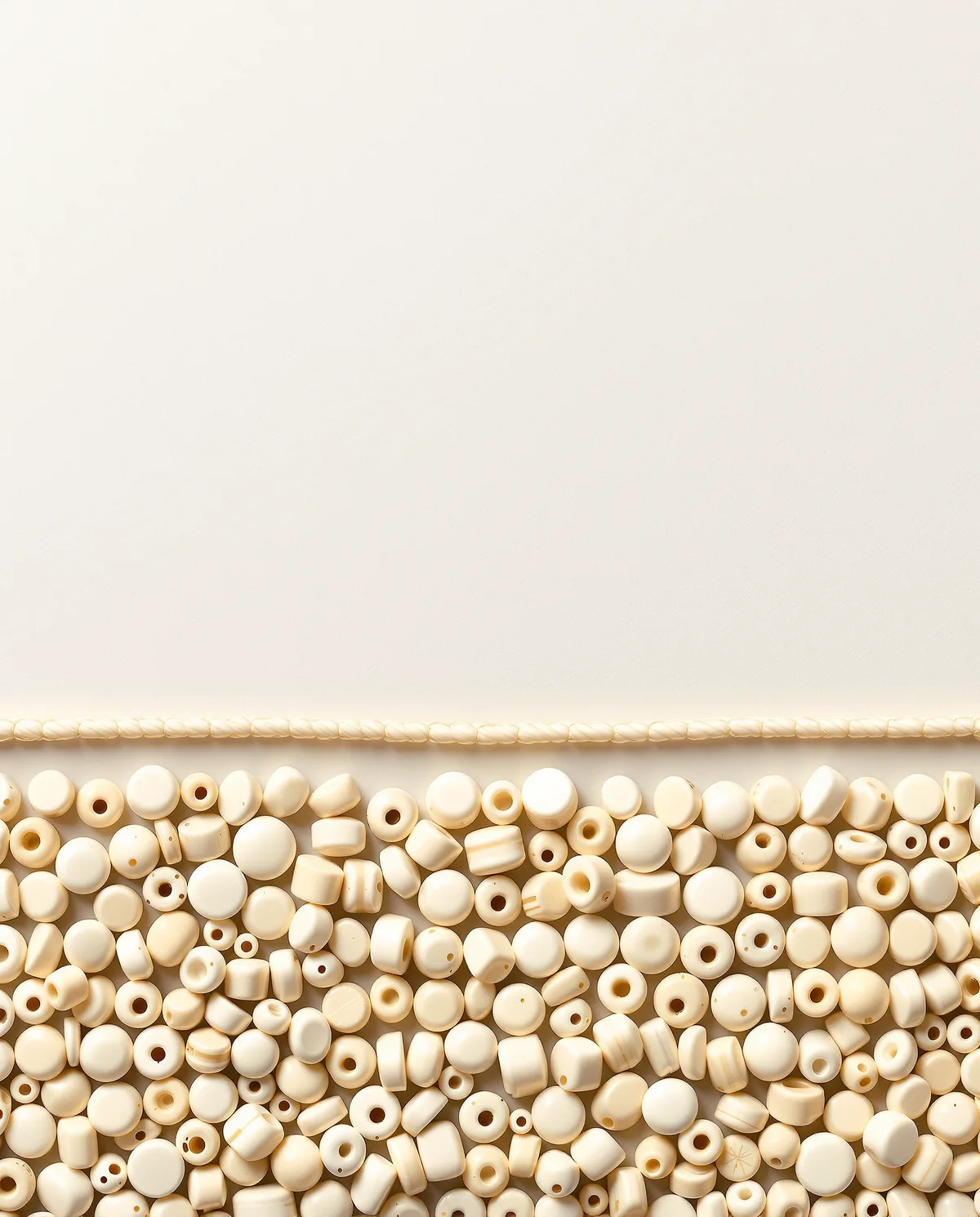
Cut and drilled shell beads — mother-of-pearl discs, irregular chips and small tubes — the nacre shifting from cream to pale blue.
Shell and mother of pearl are cut, drilled and finished to our specification in our own beadwork studios. Nacre's iridescence comes from light interfering inside stacked microscopic layers, which no dye or coating fully reproduces. The trade is variation and paperwork, which is why most export programmes specify engineered faux capiz instead.
Mother of pearl is nacre: the inner lining a mollusc builds from thousands of stacked microscopic plates of aragonite, each one bound in protein and each one a fraction of a wavelength of light thick. When light enters that stack, it reflects off many layers at slightly different depths, and those reflections interfere.
That is why nacre's colour moves as you move. It is structural colour rather than pigment, in the same family as a soap film or a beetle's wing-case, and it is the one optical effect in the bead library that no dye, coating or melt reproduces properly.
Cut, drill, grind, polish. Shell stock is cut into blanks, the blank is shaped, the hole is drilled, and the faces are ground and polished until the nacre reads. It is entirely subtractive, so nothing can be corrected: a blank with a flaw running through it produces a bead with a flaw running through it.
Shell is one of the materials our own beadwork studios are built around, alongside glass, resin and bone beads, zardozi embroidery and faux capiz. The statement of our reach is that we cut, drill and finish shell to our specification in a studio we own — we work the material rather than produce it.
Depth that cannot be faked, and an argument. In a piece where the shell is the subject — an accent, an inlay, a small object — the structural iridescence is a genuine point of difference, and buyers who have held both know immediately which is which.
What it gives the specification is harder. It gives variation as a condition, not as an option.
Very little, and the little it has works differently from everything else here. Nacre can be dyed to tint the material the sheen plays over, which shifts the overall cast — warmer, cooler, deeper — without touching the interference effect that produces the sheen itself. So a dyed shell bead is a tinted iridescent bead, not a coloured one.
Where a palette has to be hit precisely, the route is the usual inversion: let the shell lead and dye the adjacent beads to match it.
A small hole, and the position is the specification. Shell is hard — harder than glass to abrade — and brittle across the plane of its layers. A hole drilled too close to an edge does not produce a crack; it produces a delamination that lifts a layer off the face, and the bead is unusable.
Both diameter and position are confirmed on the sample. Cord then follows the governing rule and is chosen from the smallest hole in the build.
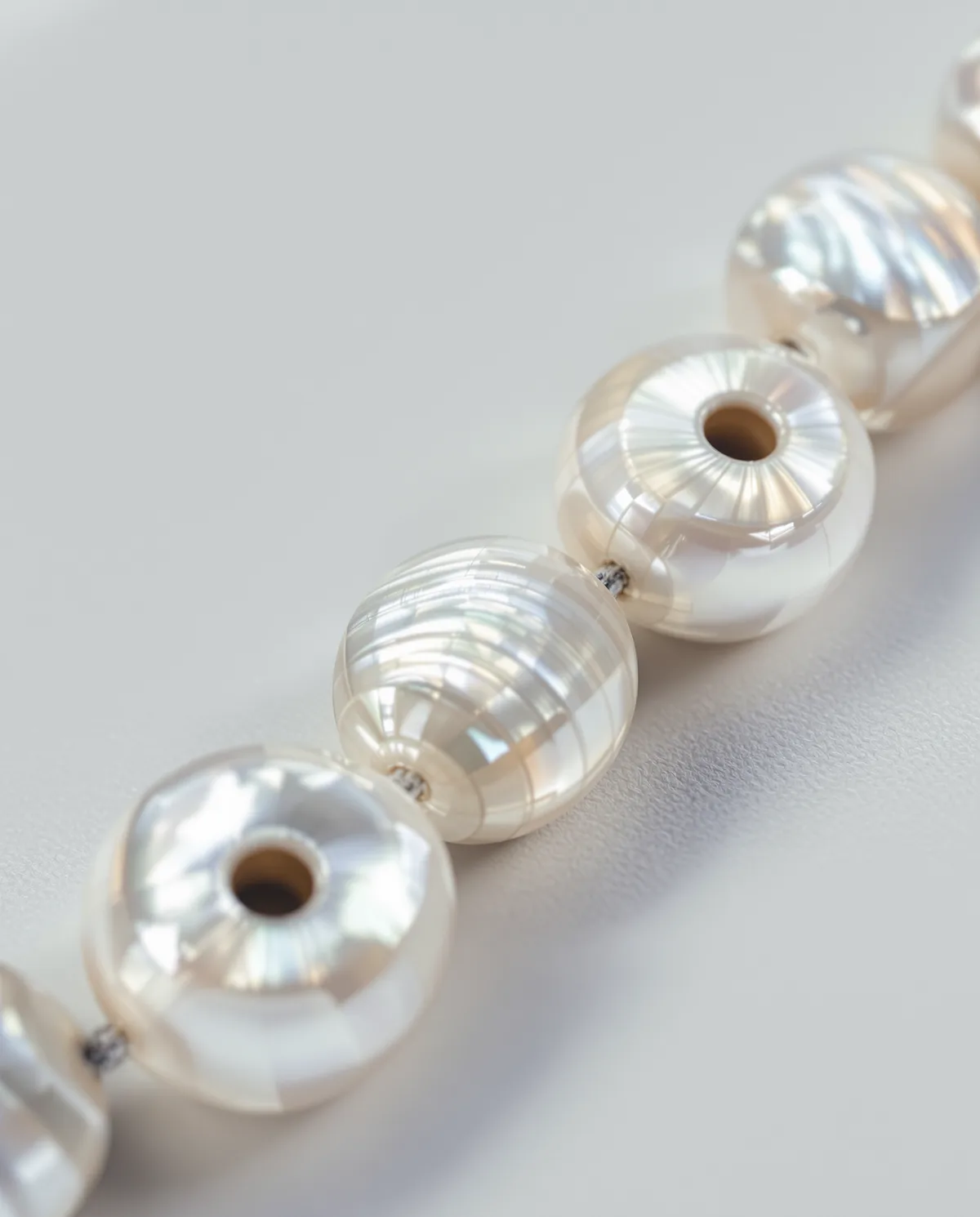
It is not, and no amount of process control changes that. Each bead is cut from a different part of a different shell, so banding, thickness and sheen all vary. Shape repeats because the cutting is tooled. Appearance does not.
For a one-off or a low-count piece that is a feature. For a programme that reorders across seasons against a retail quality standard it is a liability, and the engineered answer exists for exactly that reason.
At the layers and at the rim. Delamination is the characteristic failure: a knock across the face lifts nacre rather than chipping it, and the lifted edge catches light as a white line. The drilled rim is where it starts.
The design answers are thickness, hole position and placement. A thicker blank resists delamination; a hole set well in from the edge resists it further; and keeping shell out of the hem position on a hanging piece keeps it out of the zone that takes the most knocks. On table work the equivalent is a recessed seat rather than an exposed edge.
More than any engineered disc, and the gap widens with size. Cutting a large flat piece from a curved shell wastes most of the stock, which is the same arithmetic that makes casting a faux capiz disc to shape cheaper than cutting one from sheet — except that shell has no sheet and no second chance.
Then there is the paperwork. A natural shell component can attract wildlife import documentation in some markets, and that is a real cost in time even where it is granted. An engineered disc imports as ordinary home décor.
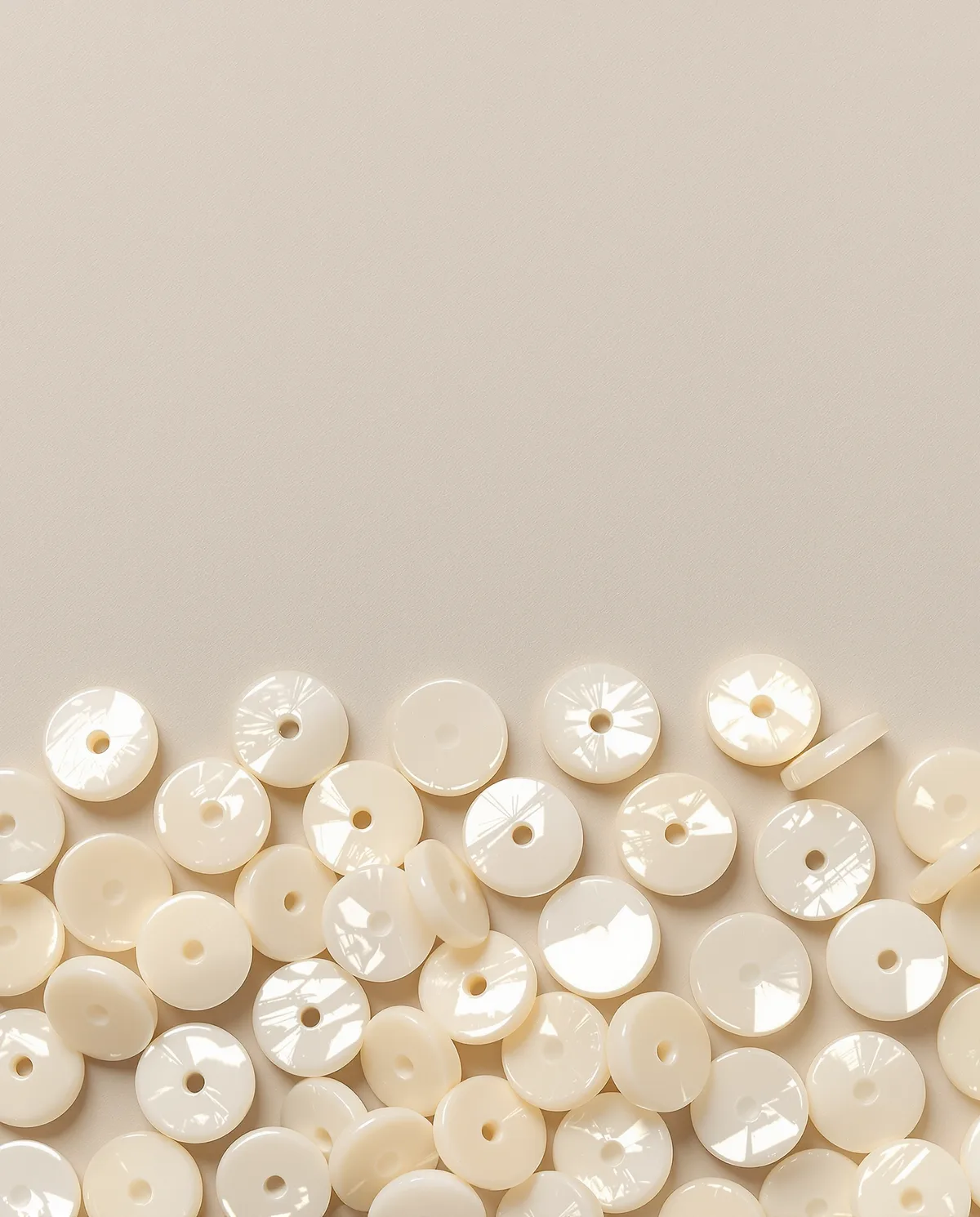
It suits small, high-value work: accent beads, inlay, table and object pieces, and short runs where the material is the selling point. Our own wood factory's inlay capability is the natural home for it.
It does not suit a large hanging panel. The piece would be expensive, heavy for its coverage, fragile at every rim, and impossible to reorder identically. That is precisely the gap the linked faux capiz disc hangings fill: 25 and 50 mm cast resin or dyed acrylic discs, linked into columns, at doorway scale.
Shape, nominal dimensions and thickness. Hole diameter and hole position, as separate entries. The finish. The approved tone and figure range, pointed at a retained sample. And — explicitly — that the component is natural shell rather than an engineered imitation, because that single line determines what documentation the shipment needs.
A pack that says "capiz" without saying which is the commonest cause of a confused quotation in this part of the category.
To the cutting, drilling and finishing, in our own beadwork studios. That is the accurate limit, and it is deliberately narrower than the glass claim: glass we draw ourselves from the melt in our own Firozabad works, and no comparable statement is available for a material that grows.
That faux capiz is shell, or that shell is faux capiz. That a shell programme can be colour-matched. That real shell is more durable than the engineered disc — it is harder and more brittle, which in a hanging panel means it fails more readily, not less. And nothing at all about species or origin, which is not a fact we publish.
Real capiz, the windowpane oyster whose shell gave the look its name, can be discussed as the reference material being imitated. What we manufacture at volume is the resin or acrylic version.
| Specification | Working value | Why it matters |
|---|---|---|
| Production method | Cut from shell stock, drilled, ground and polished | A subtractive process; the shell's own structure survives |
| Optical behaviour | Structural iridescence from stacked layers | Shifts colour with viewing angle in a way a coating cannot copy |
| Variation | Growth marks, banding and thickness all vary | A tone and figure range is approved on sample; no colour match |
| Weight behaviour | A 25 mm shell disc of about 1.5 mm works out near 2 g | Arithmetic from nominal density; roughly twice a resin disc of the same size |
| Failure mode | Delaminates along its layers; chips at the drilled rim | Brittle across the grain of the nacre |
| Colour route | Natural, or dyed to tint the nacre | Dye tints; it cannot override the structural colour |
| Trade consideration | Natural shell components can attract import documentation in some markets | The practical reason the engineered alternative exists |
| Made where | Cut, drilled and finished to our specification in our own beadwork studios | Shell is one of the materials those studios are built around |
Good to know
More for the same volume. Nacre runs near 2.7 g/cm³ against about 2.5 for glass — arithmetic, not weighed. In practice shell beads are thin, so a shell disc weighs less than a glass bead of similar visual size but roughly twice what the equivalent resin disc does.
Smaller, higher-value pieces where the material is the point and the count is low: accent positions, table and object work, inlay. A large shell hanging is possible but it is an expensive and fragile object, and a linked faux capiz disc hanging is the construction most buyers actually want.
Shape and nominal dimensions, thickness, the hole diameter and position, the finish, and the approved tone and figure range with a pointer to the retained sample. It should also state explicitly that the component is natural shell, because that determines what documentation a shipment needs.
They are cut, drilled and finished to our specification in our own beadwork studios, which are built around glass, resin, bone and shell beads together with zardozi embroidery and faux capiz. We work the material; we do not claim to produce the shell.
Its own, plus a tint. Nacre's colour is structural rather than pigmented, so a dye shifts the hue the sheen plays over without replacing it. That is a real effect and a limited one — asking shell to hit a specific reference is asking the wrong material.
A small one, placed carefully. Shell is hard but brittle across its layers, so a hole too close to an edge will start a delamination rather than a crack. Hole diameter and position are both confirmed on the sample.
No, and this is the deciding fact for most programmes. Shape repeats; appearance does not, because every bead is a different piece of a different shell. Where a buyer needs a repeatable iridescent look, faux capiz in cast resin or dyed cut acrylic is the engineered answer.
Keep exploring
Material
Cast resin or dyed cut acrylic, finished to imitate capiz shell: what it gives that real shell cannot, and why thin discs tangle.
Specs and sizesMaterial
Cut, drilled and finished to specification in our own beadwork studios: dense quiet surfaces, natural markings, and the tone range a brief has to allow.
See the detailTechnique
Why a column of linked discs is a different build from a strung strand: the connection, the twist, the packing, and the repair.
Open the referenceMaterial
Moulded to our dies and dyed to the reference: the widest colour latitude in the library, half the weight of glass, and no shatter risk.
Read the guideReference
Nine material families, what each gives in light, weight and colour, and how far our own manufacturing reaches into every one of them.
Specs and sizes
Start a conversation
Send a reference, a colour chip or a sketch. Minimums are set per design and confirmed per quote; sampling is quoted separately and usually runs 16 to 20 days from an agreed brief.