Material
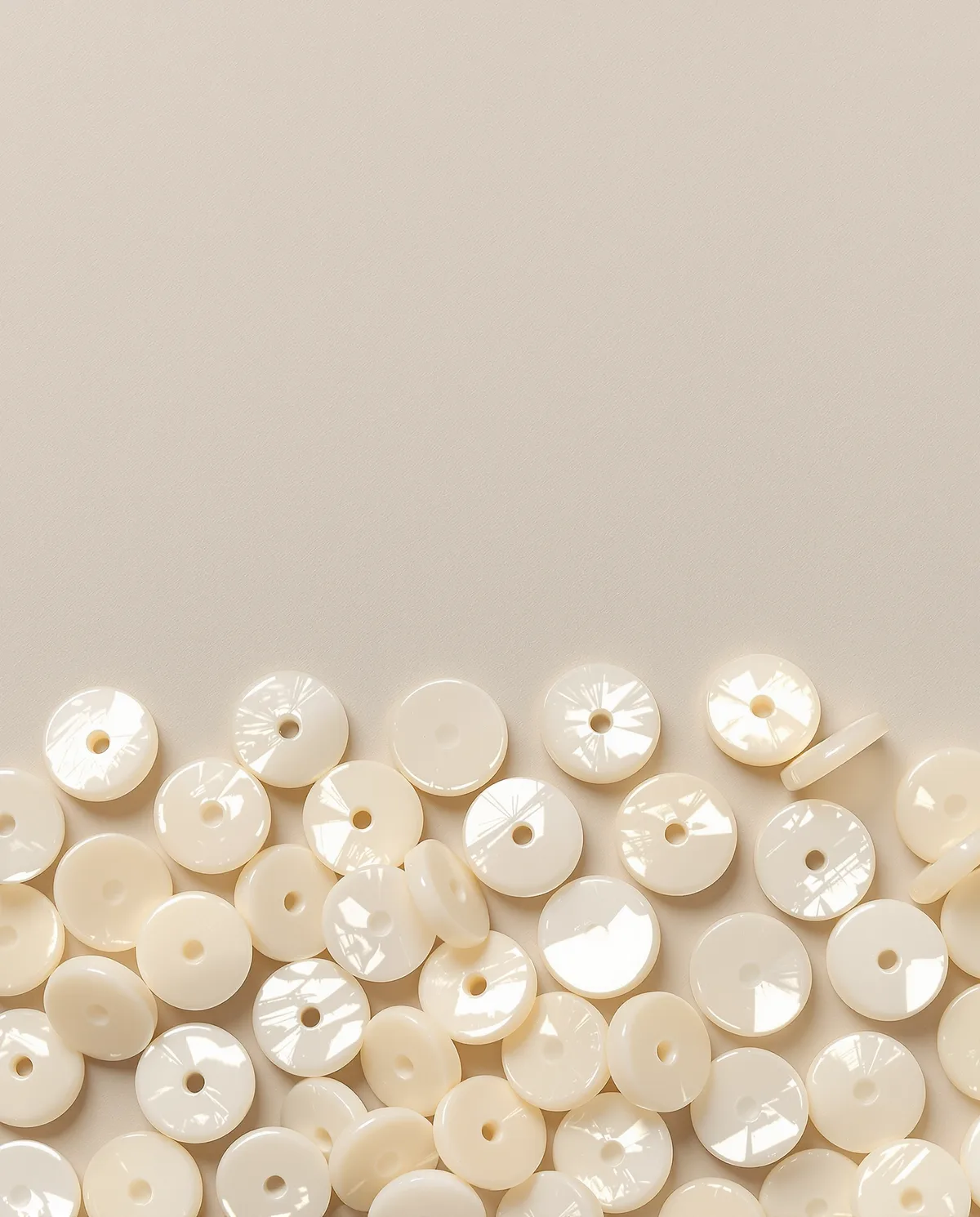
Faux capiz discs
Cast resin or dyed cut acrylic, finished to imitate capiz shell: what it gives that real shell cannot, and why thin discs tangle.
Compare the options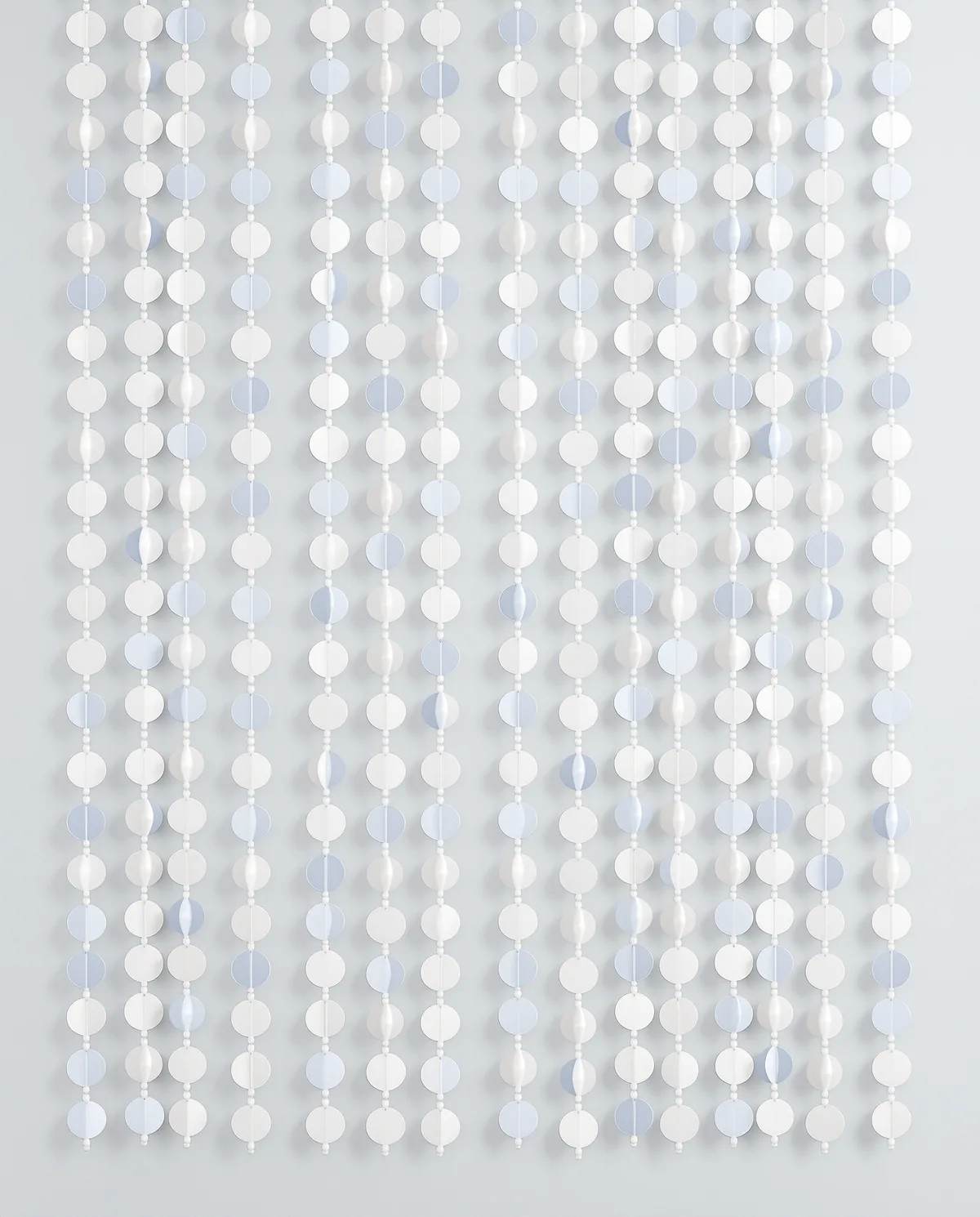
Technique · Linked discs
Strung beads share one cord. Linked discs do not: each disc is joined to the one below it, so a column is a chain of connections rather than a thread of beads. Everything about how it hangs, packs and repairs follows from that.
A linked disc hanging in pearl and grey-blue, cast discs joined edge to edge with jump rings into an open diamond lattice.
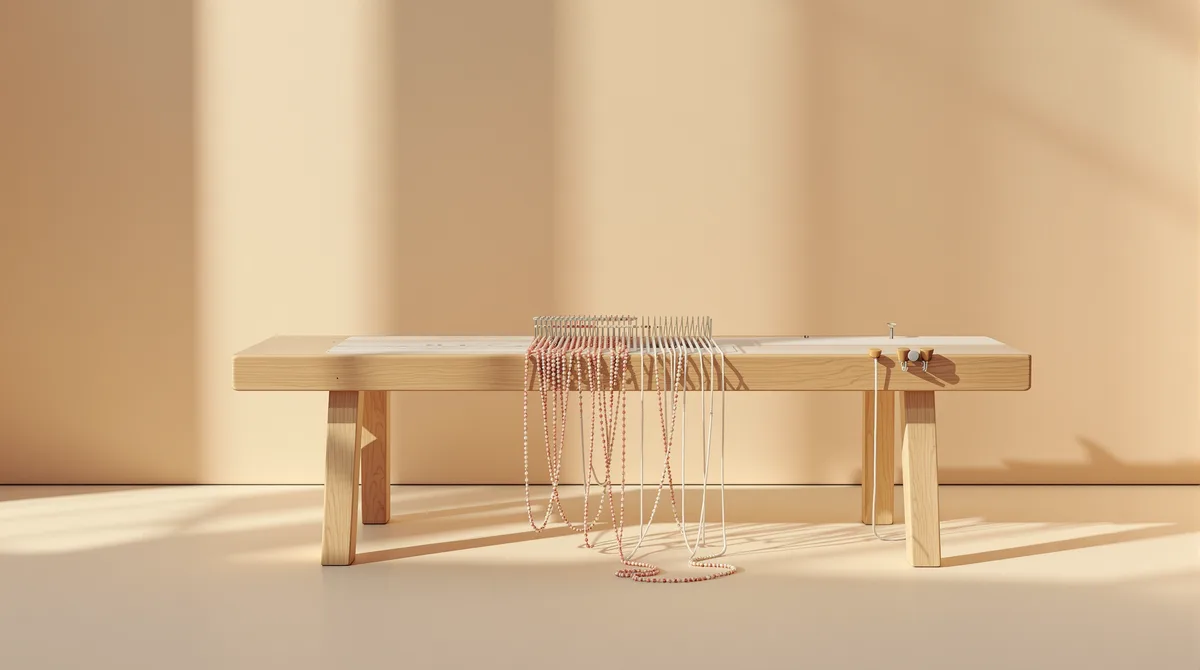
In linked disc construction each disc is joined to the disc below it, so a vertical column is a chain of individual connections rather than beads threaded on one cord. Columns are then hung side by side from a dowel. The build drapes flatter than a strand, packs differently, and can be repaired one connection at a time.
It is a hanging built from chains rather than threads. In a strung panel every bead on a strand shares one continuous cord, so the cord carries the whole load and the beads simply sit on it. In a linked disc build each disc is joined directly to the disc below it, and the join itself carries everything underneath.
A column is therefore a series of separate connections. That is a genuinely different object from a strand, and the salvaged glossary in our own corpus is right to list it as its own construction rather than as a variant of stringing.
Seven stages, and the one that has no equivalent in strung work is the fifth. Columns are laid out side by side on a board before anything is hung, because a flat disc overlaps its neighbour in a way a round bead never does, and overlap has to be checked flat rather than discovered on the dowel.
A flat face at scale. A strung panel is a field of volumes and reads as texture; a linked disc panel is a field of planes and reads as a surface. Light passes through the discs rather than around them, so the whole piece glows evenly instead of sparkling in points.
It also makes local repair possible. On a strung panel a failure anywhere in the strand means re-stringing the strand from the colour-count sheet. On a linked column, one failed connection is replaced and the rest of the column is untouched.
A linked piece is quoted on a disc count rather than a strand count, which is the single biggest practical difference from strung work. The count follows from the column number and the disc size, so those two fields settle the quote before the palette is discussed.
The limit is not weight. Discs are light, so a doorway-scale linked piece is well within what a turned dowel carries. The limit is connection count, because every one is closed by hand.
Hanging, and flat. Hanging shows column pitch, drop set and whether any column has twisted. Flat shows the connections: each link is checked for closure, because a link that is nearly closed passes a visual inspection and fails six months later.
Then colour and disc character against the retained approved piece, and the spacer beads for match. Inspection and export packing run through our own Greater Noida quality and packaging house.
Finished width and drop, with the shortest drop where the hem is shaped. Column count or column pitch — pitch preferred, because it survives a resize. Disc material, named explicitly as cast resin or dyed cut acrylic. Disc diameter and thickness. Hole position as a dimension from the rim. The link type. Whether spacer beads are fitted and whether they are dyed to match. And the top fixing.
Hole position and disc thickness are the two entries that decide whether the piece survives, and they are almost never in an incoming brief.
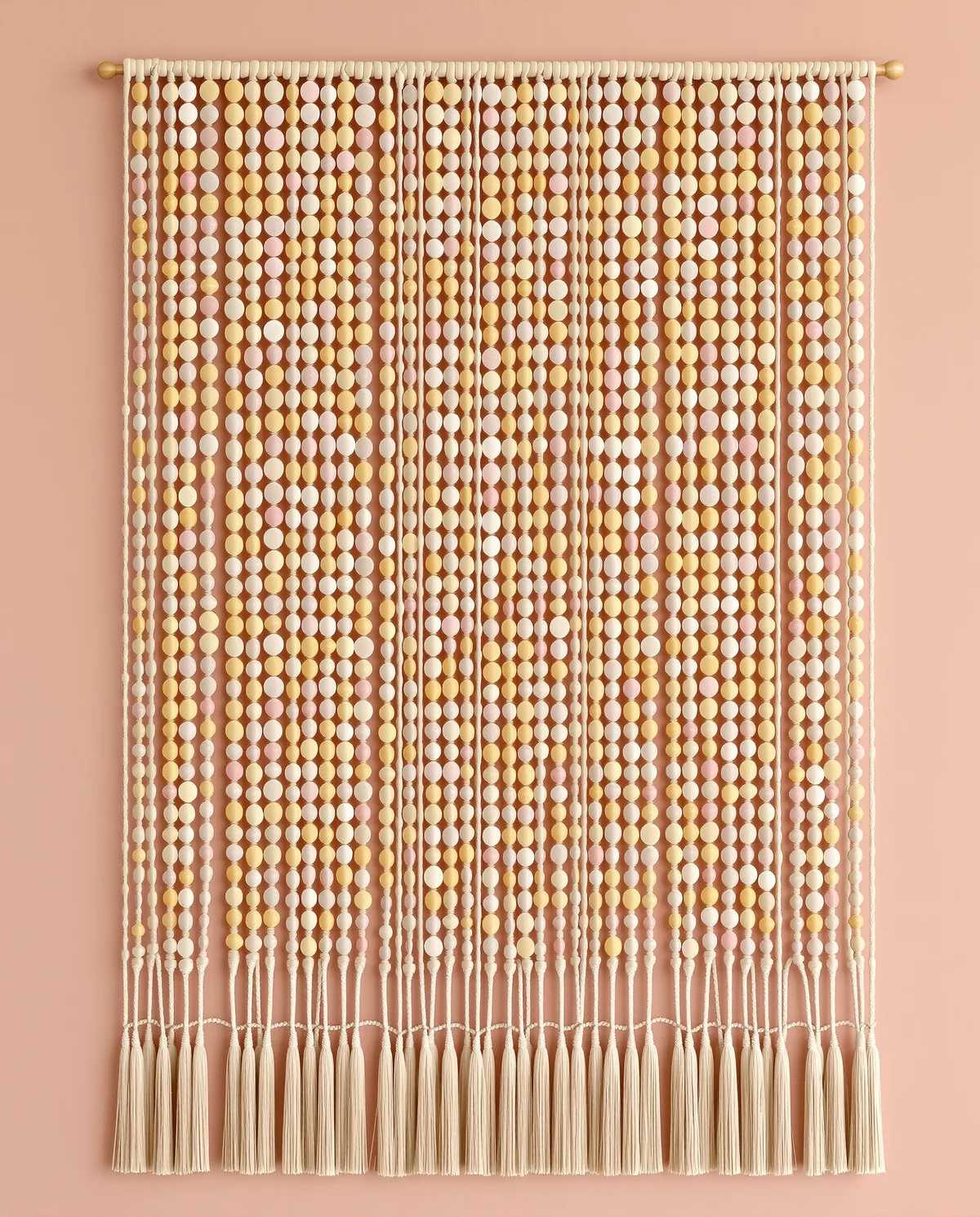
The 2027 library uses it at 70 by 130 cm, 90 by 180 cm and 90 by 200 cm. What they establish for the technique is a working column range — 12 to 16 columns — and two usable disc sizes at 25 mm and 50 mm.
The detail that makes linking work is the spacer at each centre, and it was proved on strung work before it was used on linked work: a dyed-to-match bead in the middle of a blossom stops the component sliding along its own axis. Linking removes the cord but keeps that job.
The same structure as a strung sheet, with columns substituted for strands. Disc identity, size and colour per position. Column count and column pitch. The drop set, which on a shaped hem is several drops rather than one. Spacer beads where fitted. And the link type, which is unique to this construction and is the entry a repair depends on.
Everything else about the document works exactly as bead maps and colour-count sheets describes.
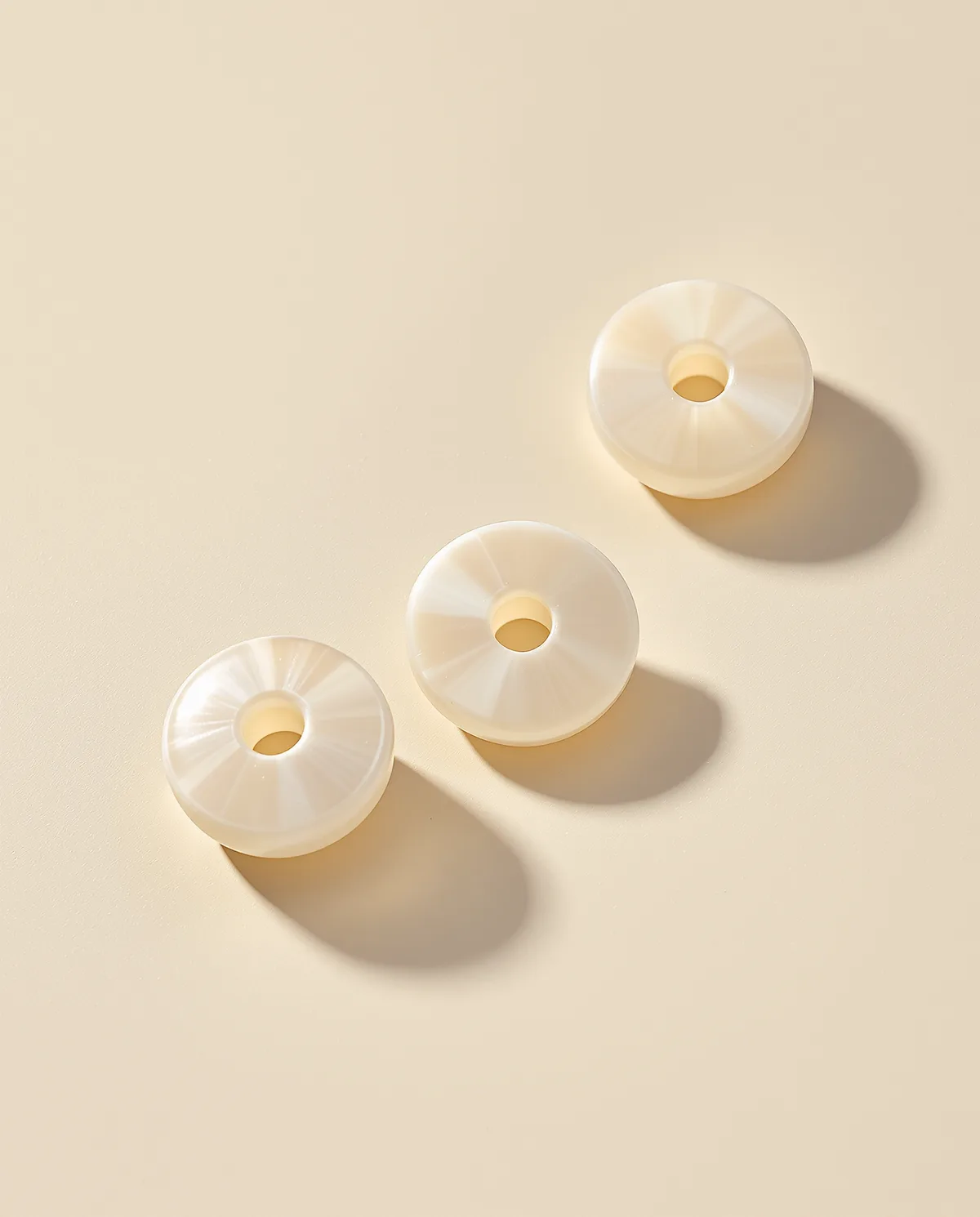
Flat shapes with an edge hole. Faux capiz in cast resin or dyed cut acrylic is the primary material, because the disc is the whole point of the look and the substrate dyes through. Cut acrylic shapes and thin cast resin forms work the same way.
Real shell will physically do it and almost nobody specifies it, for the reasons set out on shell and mother of pearl: every disc is different, the material delaminates at a drilled rim, and a large piece wastes most of its stock. A round bead will not do it at all — it has no face to present and nothing to stop it spinning.
Connections. One per disc, closed with pliers, by hand. A 497-disc piece is roughly 497 operations before anything is hung, and that number does not fall with practice as much as buyers hope.
The levers that actually move it: a larger disc covers the same drop with fewer connections, which is why the 50 mm size exists alongside the 25 mm; a shorter drop removes connections proportionally; and a wider column pitch removes whole columns. Cutting the width saves least, because the header work does not shrink with it — the same asymmetry strung panels have.
By pitch, drop set and connection type on the sheet, and by the retained approved piece for colour. Pitch is the figure to insist on: two pieces with the same column count at different widths are different designs, while two pieces at the same pitch and different widths are the same design at two sizes.
An unclosed link. A tear at the disc hole, where the margin above it could not carry the column below — which is why thickness and hole position are confirmed together and not separately. A twisted column, where discs have rotated to face each other and caught. Uneven column pitch at the header. And a spacer bead that reads as a different colour from its disc.
The first is the expensive one, because it passes inspection. A link that is nearly closed looks closed.
Extractable data
| Stage | What drives the labour | What is rejected here |
|---|---|---|
| Column count from width | One calculation; pitch is the governing figure | A pitch that leaves columns touching |
| Disc hole check | Confirmed on the fired or cast sample | Too little margin above the hole |
| Linking | Number of connections — the dominant cost | Links that are not fully closed |
| Spacer beads | One per cut shape where fitted | A spacer that is visible against the disc |
| Column build to drop | Drop set; a shaped hem means several drops | Columns outside the drop tolerance |
| Gather on the dowel | Column count | Uneven column pitch at the header |
| Documented formats | 70 × 130 cm to 90 × 200 cm, 12–16 columns, about 239–497 discs | — |
| Disc sizes | 25 mm and 50 mm in the 2027 designs | — |
Good to know
Against the retained approved piece for colour and disc character, and against the sheet for column count, column pitch and drop set. The entry that matters most is pitch, because it is what makes a resized piece read as the same design rather than as a different one.
A link that was not fully closed, which eventually drops a disc. A tear at the hole, where the margin above it was too thin for the load below. Columns twisted so discs face each other and catch. Uneven column pitch at the header. And a visible spacer bead that was not dyed to match.
It scales better than most. Discs are light — a 25 mm resin disc works out near a gram by arithmetic from nominal density — so a doorway-scale piece stays within what a dowel carries. In the 2027 library the largest linked piece is 90 by 200 cm at around 497 discs rather than a shipped one.
No. Every connection in a column is closed by hand, which is why the cost scales with connection count rather than with area. The discs themselves are cast or cut to tooling; the assembly is entirely bench work.
It is set by connection count. A piece with 239 discs has roughly that many connections to close; a piece with 497 has twice as many. Production for beaded décor runs 40 to 60 days after sample approval, and the linking is the part of that which does not compress.
Flat shapes with an edge hole: faux capiz discs in cast resin or dyed cut acrylic, cut acrylic shapes, and thin cast resin forms. It is the wrong construction for a round bead, which has no face to present and nothing to resist twist.
The same document with columns instead of strands. It records disc identity, size and colour per position, the column count and pitch, the drop set, the spacer beads where fitted, and the link type. A reorder is held to it exactly as a strung panel is.
Keep exploring
Material
Cast resin or dyed cut acrylic, finished to imitate capiz shell: what it gives that real shell cannot, and why thin discs tangle.
Compare the optionsManufacturing
Cast resin or dyed cut acrylic discs linked into columns at 25 and 50 mm, made to order against an approved sample.
Specs and sizesTechnique
The bead map, the cord, thirty strands on a dowel, hem shapes, suspension loops — and the three levers that move the cost.
Read the guideMaterial
Why nacre looks the way it does, what growth marks mean for a specification, and the reason most export programmes choose faux capiz instead.
Compare the optionsReference
Five craft families — strung, embroidered, wire-wrapped, knotted and wrapped fibre — and what each one is good for.
How it is made
Start a conversation
Send a reference, a colour chip or a sketch. Minimums are set per design and confirmed per quote; sampling is quoted separately and usually runs 16 to 20 days from an agreed brief.