Material
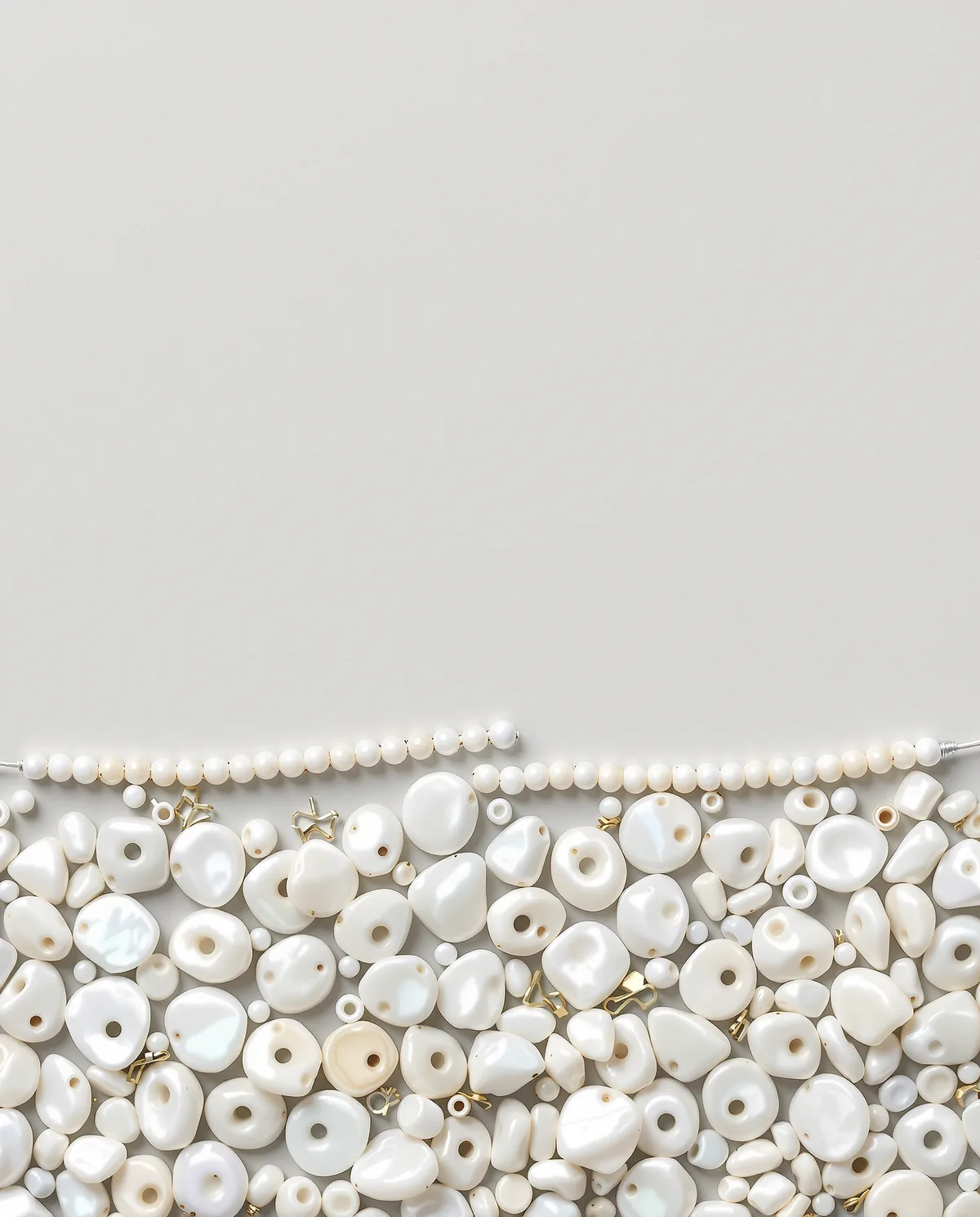
Shell and mother of pearl
Why nacre looks the way it does, what growth marks mean for a specification, and the reason most export programmes choose faux capiz instead.
Read the guide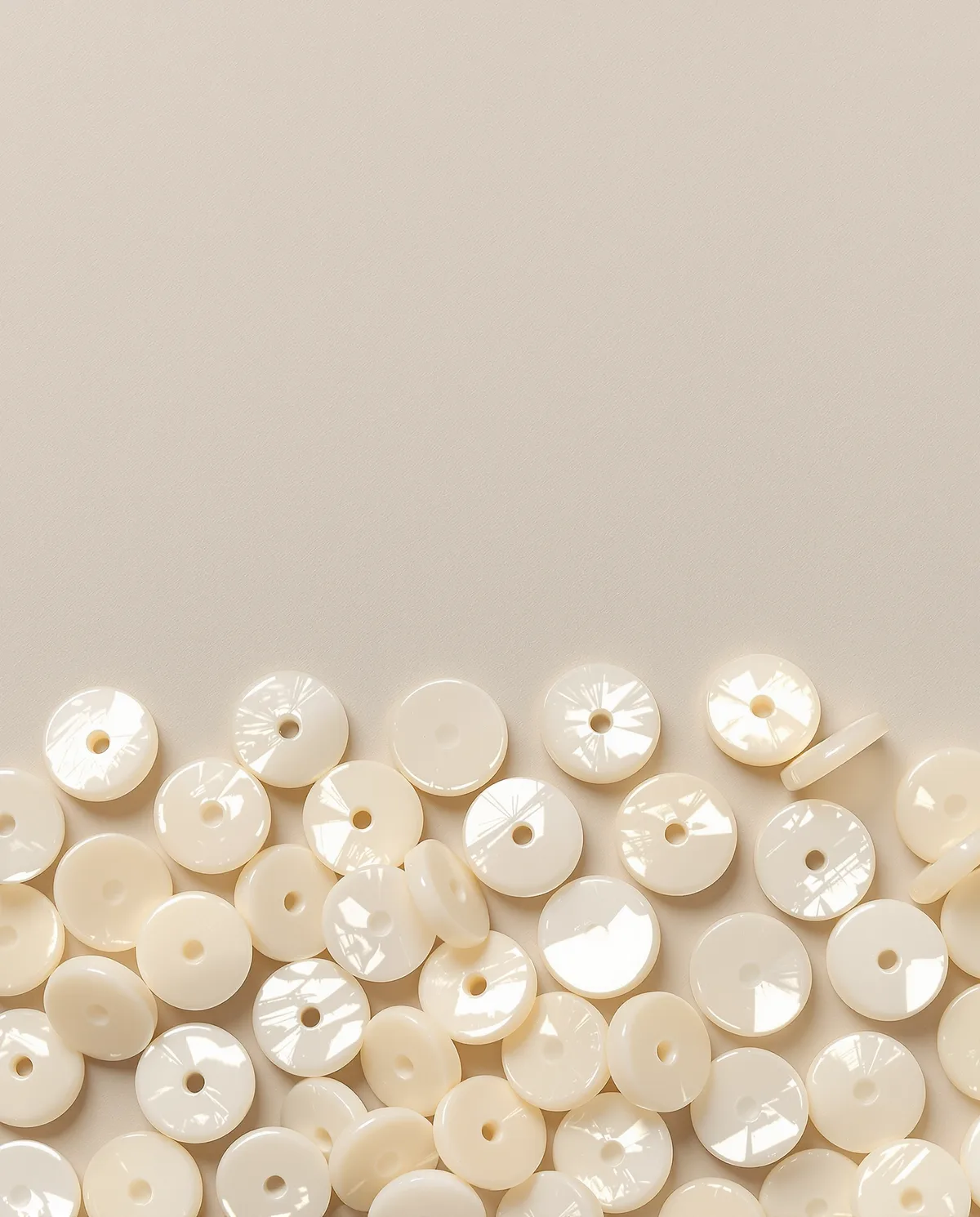
Material · Faux capiz
Faux capiz is cast resin or dyed cut acrylic, cut and finished to imitate capiz shell. It is an engineered imitation, and saying so plainly is a strength: consistent colour, no shell exposure, and a disc that behaves predictably in a panel.
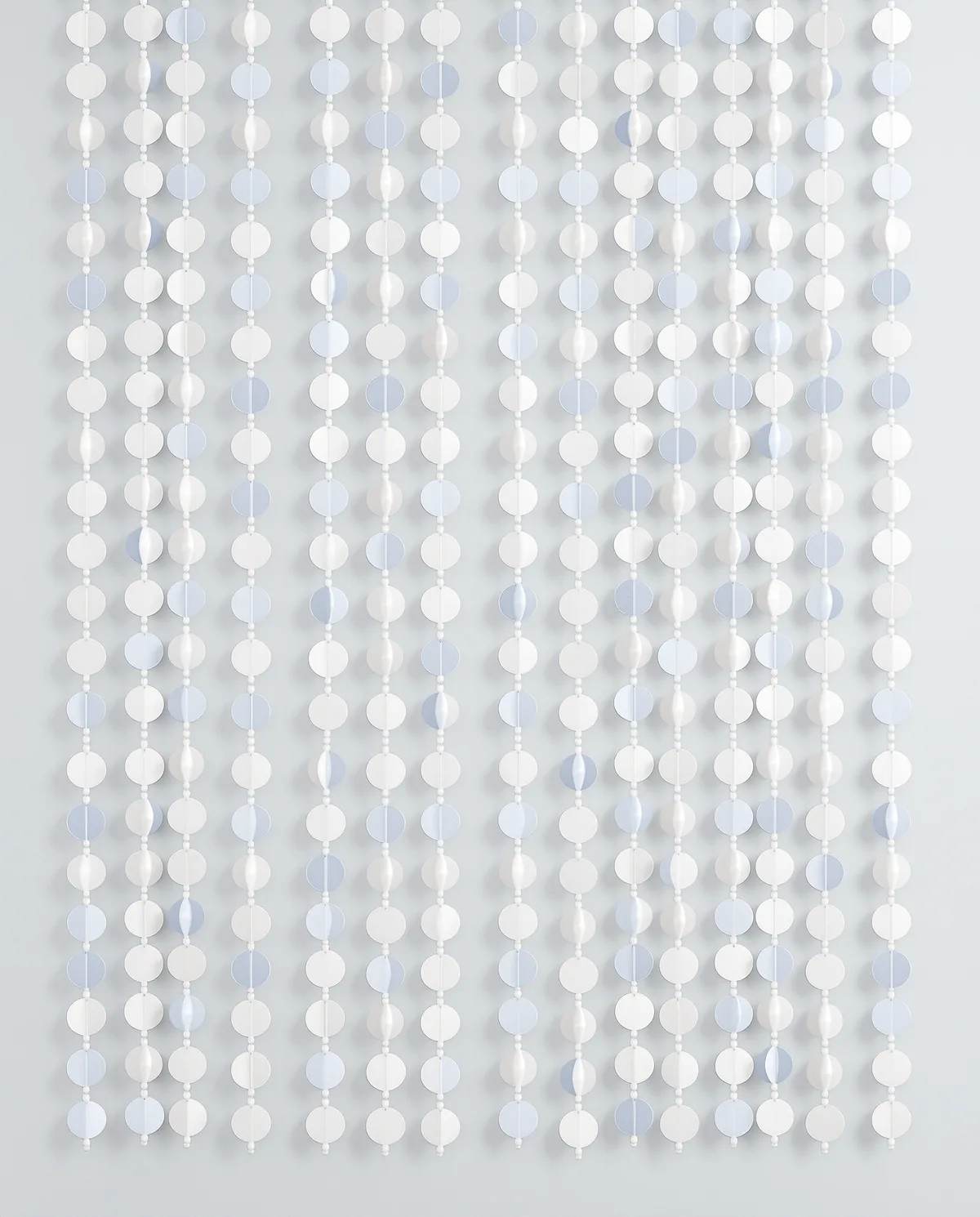
Faux capiz discs at twenty-five and fifty millimetres, cast and dyed to imitate capiz shell, each of even thickness and even colour with a hole near the edge.
Faux capiz is cast resin or dyed cut acrylic, cut and finished to imitate the translucent sheen of capiz shell. It contains no shell. That is the point: the colour is consistent across a run, the thickness is controlled, the disc is far harder to chip than shell, and nothing in the piece carries shell import exposure.
Faux capiz is a thin, translucent disc of cast resin or dyed cut acrylic, finished to imitate the sheen of capiz shell. The reference material is a real one — the windowpane oyster, whose flattened shell is translucent enough to have been used as glazing — and the imitation is honest about being one.
Structurally it is nothing like a bead. A bead is a solid with a hole through its axis; a capiz disc is a flat plane with a hole near its edge, so it hangs as a face rather than as a volume. Everything it does on a cord follows from that.
Two routes, and the choice is mostly economic. The disc can be cast to shape, so the outline comes out of the tool, or cut from sheet stock and finished at the edge.
Casting to shape is what we specified on our own capiz development, for a reason unrelated to appearance: cutting circles out of square sheet leaves the material between the circles as waste, and on a thin, wide disc that offcut is a large fraction of the stock. Casting removes it. Both routes end the same way — dyed to our colour, finished, and linked or strung in our own beadwork studios.
Scale without weight. A disc covers many times the visual area of a bead of the same mass, so a piece can be large — up to the full doorway formats — while staying light enough to hang from an ordinary dowel. Light passes through the disc rather than refracting inside it, so the panel glows evenly instead of sparkling in points. And it gives a repeatable version of a look that is otherwise unrepeatable, which is the commercial argument.
The substrate, named explicitly as cast resin or dyed cut acrylic. Disc diameter and thickness. Hole position, as a dimension from the rim rather than just a hole diameter. The colour route and the reference. Whether a spacer or locking bead is used, and whether it is dyed to match. And the construction — strung on cord, or linked into columns. The two entries that get skipped are hole position and the spacer, and both are structural.
To the tooling and the colour. The disc is cast or cut and dyed to our colour, to our own dies where a design needs a shape that does not exist, then finished and assembled in our own beadwork studios.
Our making reaches the tooling and the colour: the disc is cast or cut and dyed to our colour, to our own dies, then finished and strung by hand in our own beadwork studios. For glass it reaches further back, to the furnace in our own Firozabad works.
Two things, precisely. That it contains shell — it does not. And that it is a cheaper shell — it is a different material that imitates shell, cast or cut to shape and finished in our own beadwork studios, and its advantages are the argument rather than a substitution claim: consistent colour across a run, no shell-import exposure, and a disc that behaves predictably in a build.
Real capiz may be discussed as the reference material being imitated. Our product is the resin or acrylic one.

Two families. The first is the linked disc hangings, where discs are linked one below the next into columns: the 2027 library records a 90 by 200 cm piece of about 497 discs and a 70 by 130 cm piece of about 239, in 25 mm and 50 mm sizes. Those counts are derived from the design-library renders rather than from shipped goods.
The second is a shipped one. A cherry blossom wall hanging built from five-petal faux capiz blossoms, cut to shape, with a small spacer bead dyed to match at the centre of each blossom to stop it sliding on the cord — about 155 to 170 blossoms on the dowel version and about 130 on the rod-pocket version. That piece was adopted in August 2026 and approved in September.
A 25 mm disc of around one and a half millimetres works out near one gram — arithmetic from a nominal resin density of 1.1 to 1.3 g/cm³ rather than a weighed figure. Across a linked piece of 90 by 200 cm and roughly 497 discs, that is a panel measured in hundreds of grams rather than kilograms.
The consequence is that faux capiz scales to large formats more easily than any glass construction. It is also why a disc panel does not settle: there is not enough mass to damp its movement, so it keeps moving after the door closes. Some buyers want exactly that. Those who do not should specify a heavier disc or a weighted end.
Wide, because the substrate is dyeable through. Discs are dyed to a colour reference or a physical chip and confirmed on the sample, and the spacer and locking beads are dyed to match the disc so the fixing vanishes into the face. That is dyed to match doing the same job it does on a strung panel: making the subject read as the subject.
What it cannot do is reproduce shell's irregularity. A dyed disc is evenly coloured by definition, and a brief that wants the mottling of real shell is asking for the one thing an engineered disc is designed not to have.
One hole near the rim, and the position is the specification. Too far in and the disc hangs tilted; too close to the edge and the thin margin above the hole tears under the disc's own movement. Thickness, diameter and hole position have to be settled together on the sample.
Cord follows the same rule as everywhere else: the smallest hole in the build governs, and on a mixed disc-and-bead piece that is usually the bead.
Shape repeats because it is tooled. Colour repeats because it is dyed to a reference and held to a retained sample. That combination is the material's whole commercial case against real shell, which repeats neither.
The residual risk is dye-lot drift on a large single-colour field, and it is handled the way all dyed colour is handled: hold the lot across a programme, or write the acceptable variation into the specification. Bead dyeing and colourfastness sets out what a dyed surface can and cannot promise.
It tangles and it dulls. Tangling is geometry: a thin flat shape rotates freely on a cord, and once two discs have turned to face each other they catch. The fixes are disc weight, disc diameter, a spacer bead to hold position, and beads mixed into the strand to give it a preferred orientation. Dulling is a cleaning problem — an abrasive cleaner takes the sheen off, and the sheen is the product, so care is a soft damp cloth and a dry wipe, nothing more.
Cheaper than real shell, and cheaper to import than anything with shell content. Against glass it wins on weight and coverage per unit and loses on perceived depth. Against plain acrylic beads it costs more per piece and covers far more area, so on a large format it is often the cheaper panel.
The cost lever inside the material is the production route: casting to shape rather than cutting discs from square sheet is the single change that moved the number most on our own development.
| Specification | Working value | Why it matters |
|---|---|---|
| Material | Cast resin, or dyed cut acrylic | An engineered imitation of capiz shell; no shell content |
| Form | Flat or gently domed disc, hole near the edge | An edge hole is what makes a disc hang as a face rather than a bead |
| Recorded disc sizes | 25 mm and 50 mm in the linked-disc designs; 10–30 mm in earlier sampling | Confirmed on the sample for each design |
| Production route | Cast to shape, or cut from sheet and finished | Casting to shape avoids the offcut waste of cutting discs from square stock |
| Colour route | Dyed through, or dyed to match an adjacent bead | A dyeable substrate is what makes repeat colour possible |
| Weight behaviour | A 25 mm resin disc of about 1.5 mm works out near 1 g | Arithmetic from a nominal 1.1–1.3 g/cm³, not a weighed figure |
| Failure mode | Tangling and surface dulling, not shattering | Thin flat shapes twist on their own axis as they hang |
| Made where | Cast or cut and dyed to our colour, to our own dies, then finished and strung in our own beadwork studios | Our making reaches the tooling, the colour and the finishing |
Good to know
Either resin cast to shape, or dyed acrylic cut to shape. We recommend one route per design rather than mixing them, because the two substrates take colour slightly differently and the difference shows when discs from both sit in one panel.
Three reasons. Colour from a dyed substrate repeats and shell does not. Thickness is controlled, so discs hang predictably. And an engineered disc imports as ordinary home décor, without the paperwork a natural shell component can attract.
A wide range, because the substrate is dyeable. Discs are dyed to a colour reference or a physical chip and confirmed on the sample, and small spacer or locking beads are routinely dyed to match the disc so the fixing disappears into the face.
A single hole near the edge on a strung or linked disc, confirmed on the stringing sheet. The hole position matters more than its diameter: moved inboard, the disc hangs as a flat face; moved too close to the rim, the disc tears out under its own movement.
Very thin discs can, because a flat shape has nothing to stop it rotating on the cord. The answers are all at design stage: choose the disc weight and diameter for the drop, add a spacer or locking bead where discs would otherwise slide into each other, and mix in beads where a strand needs steadying.
Better than shell by a wide margin. Shape repeats because it is cast or cut to tooling, and colour repeats because it is dyed to a reference and approved on sample. The residual risk is dye-lot drift across a very large single-colour field, which is handled by holding the lot or writing the acceptable variation into the specification.
Much less. A twenty-five millimetre disc of about one and a half millimetres works out near a gram — arithmetic from a nominal resin density, not a weighed figure — against several grams for a glass bead of comparable visual size. That is why disc hangings go up to large formats without becoming a fixing problem.
Keep exploring
Material
Why nacre looks the way it does, what growth marks mean for a specification, and the reason most export programmes choose faux capiz instead.
Read the guideManufacturing
Cast resin or dyed cut acrylic discs linked into columns at 25 and 50 mm, made to order against an approved sample.
See the detailTechnique
Why a column of linked discs is a different build from a strung strand: the connection, the twist, the packing, and the repair.
How it is madeMaterial
Moulded to our dies and dyed to the reference: the widest colour latitude in the library, half the weight of glass, and no shatter risk.
See the detailReference
Nine material families, what each gives in light, weight and colour, and how far our own manufacturing reaches into every one of them.
How it is made
Start a conversation
Send a reference, a colour chip or a sketch. Minimums are set per design and confirmed per quote; sampling is quoted separately and usually runs 16 to 20 days from an agreed brief.