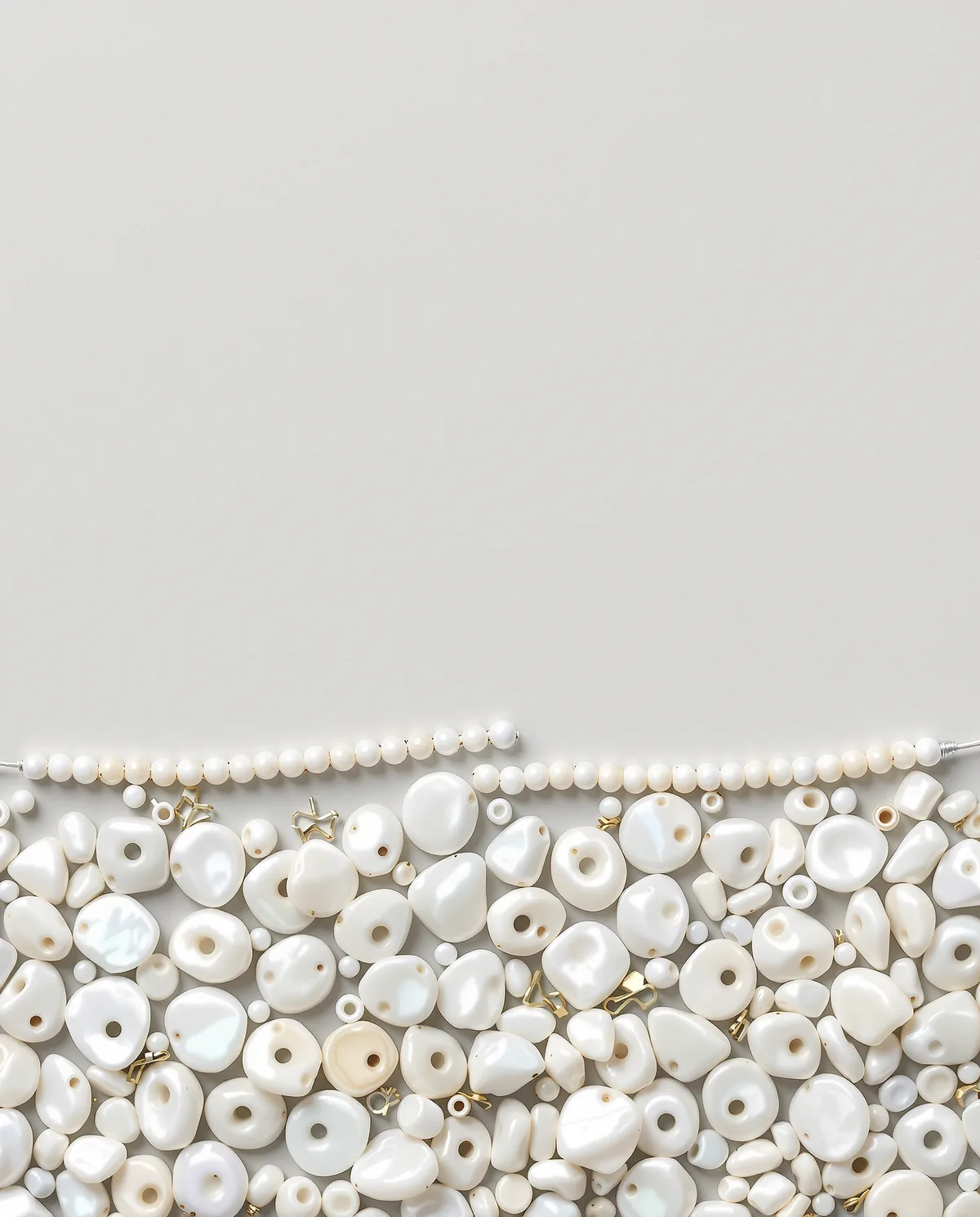
Material
Shell and mother of pearl: real iridescence, real paperwork
Why nacre looks the way it does, what growth marks mean for a specification, and the reason most export programmes choose faux capiz instead.
Specs and sizes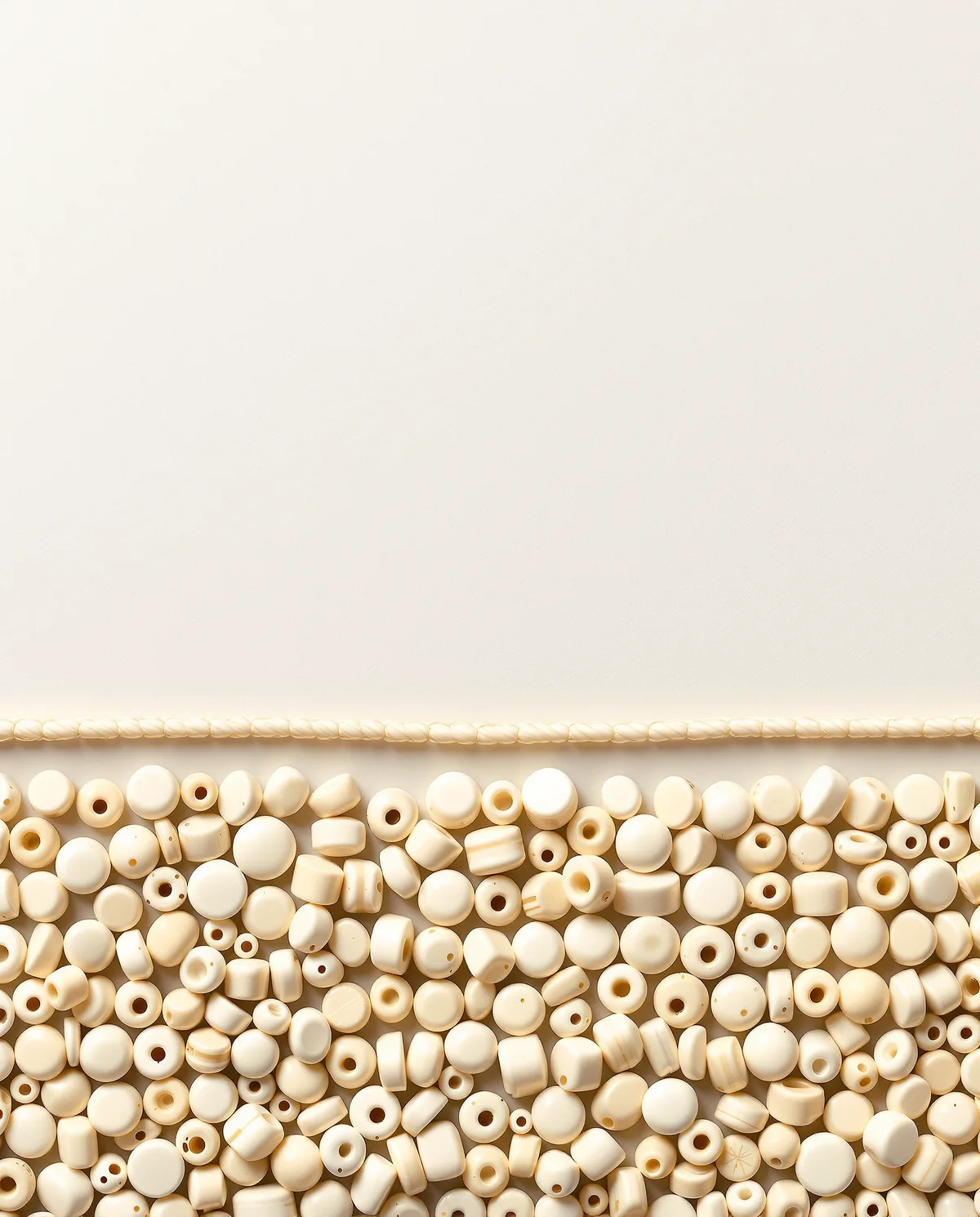
Material · Bone and horn
Bone and horn are the two bead materials that cannot be made to order in a colour. They arrive with their own markings, and a specification either accepts a range or picks a different family.
Cut and polished bone beads in warm natural ivory — tubes, discs and small rounds — each carrying the fine striation of the material.
Bone and horn beads are cut from natural blanks, drilled and then finished — sanded, polished, sometimes dyed darker — to our specification in our own beadwork studios. Both carry natural markings that vary piece to piece, so a specification approves a tone and figure range on the sample rather than naming a single colour.
Both are natural materials cut into beads rather than formed into them. A blank is sawn from the stock, turned or shaped, drilled, and then sanded and polished. Nothing is added; the process only removes, which is why whatever character the blank carried arrives in the finished bead.
They are not the same material. Bone is dense, pale and faintly porous, so it reads as an opaque neutral. Horn is a keratin structure, translucent at a thin edge, and figured with streaks that run from pale amber to near-black. In a panel bone is quiet and horn is dramatic.
Cut, drill, finish. The cutting decides the shape; the drilling decides whether the bead hangs true; the finishing decides how it reads. A sanded matte finish keeps bone looking like bone. A high polish on horn deepens the streaks and brings up the translucency at the edge.
Both are cut, drilled and finished to our specification in our own beadwork studios — the studios that also work glass, resin and shell beads, zardozi embroidery and faux capiz. The discipline is older than the bead programme: bone and resin inlay sits on the published capability list of our own Saharanpur wood factory.
A natural neutral that is not wood. Wood is warm and grainy; bone is cool and smooth; horn is translucent and figured. On a natural-palette panel that gives three distinct neutrals rather than one, and the difference reads clearly at a metre.
They also give a specific sound. Bone and horn knock with a dry click that sits between glass's chime and wood's soft knock — quieter than glass, which matters in a doorway that people walk through all day.
To the cutting, the drilling and the finish. These are materials we work rather than materials we form: there is no furnace step and no mould, so the description of our reach is that the bead is cut, drilled and finished to our specification in our own beadwork studios. We own the network; we are not a sourcing office.
That is a smaller reach than glass, where we draw the bead from the melt, and it is worth saying as plainly as the glass claim is said.
That a colour can be matched. Dye darkens and evens; it does not recolour. That two beads will look alike — the figure in horn is the reason to specify it, and a brief that treats variation as a defect has chosen the wrong material. And that either is waterproof. Both are organic, both move with humidity, and both crack if they are soaked or allowed to dry out completely.
Nothing on this page should be read as a claim about a particular species or origin, because that is not a fact we publish.
They sit in the natural and neutral colour stories rather than in the bright ones. In the 2027 design library, bone appears alongside wood and amber glass in the warmer wall-hanging designs, where its job is to break up a palette of browns with something paler and cooler. Those design-library figures are derived from the renders rather than from shipped goods.
In our own shipped record the natural-palette work has run on wood-tone beads rather than bone, so bone and horn are catalogued library materials here rather than high-volume ones — which is the position.
A ten-millimetre round works out near 0.9 g in bone and 0.6 g in horn, against about 1.2 g in glass — arithmetic from nominal densities of roughly 1.8 to 2.0 and 1.3 g/cm³, not weighed figures. Both land between wood and glass.
That is a comfortable place to be. There is enough mass to pull a strand straight without needing a weighted end bead, and not enough to load a dowel the way a ceramic or metal panel does. On a mixed natural panel, bone beads placed low in the strand do the steadying work that glass would otherwise be added for.
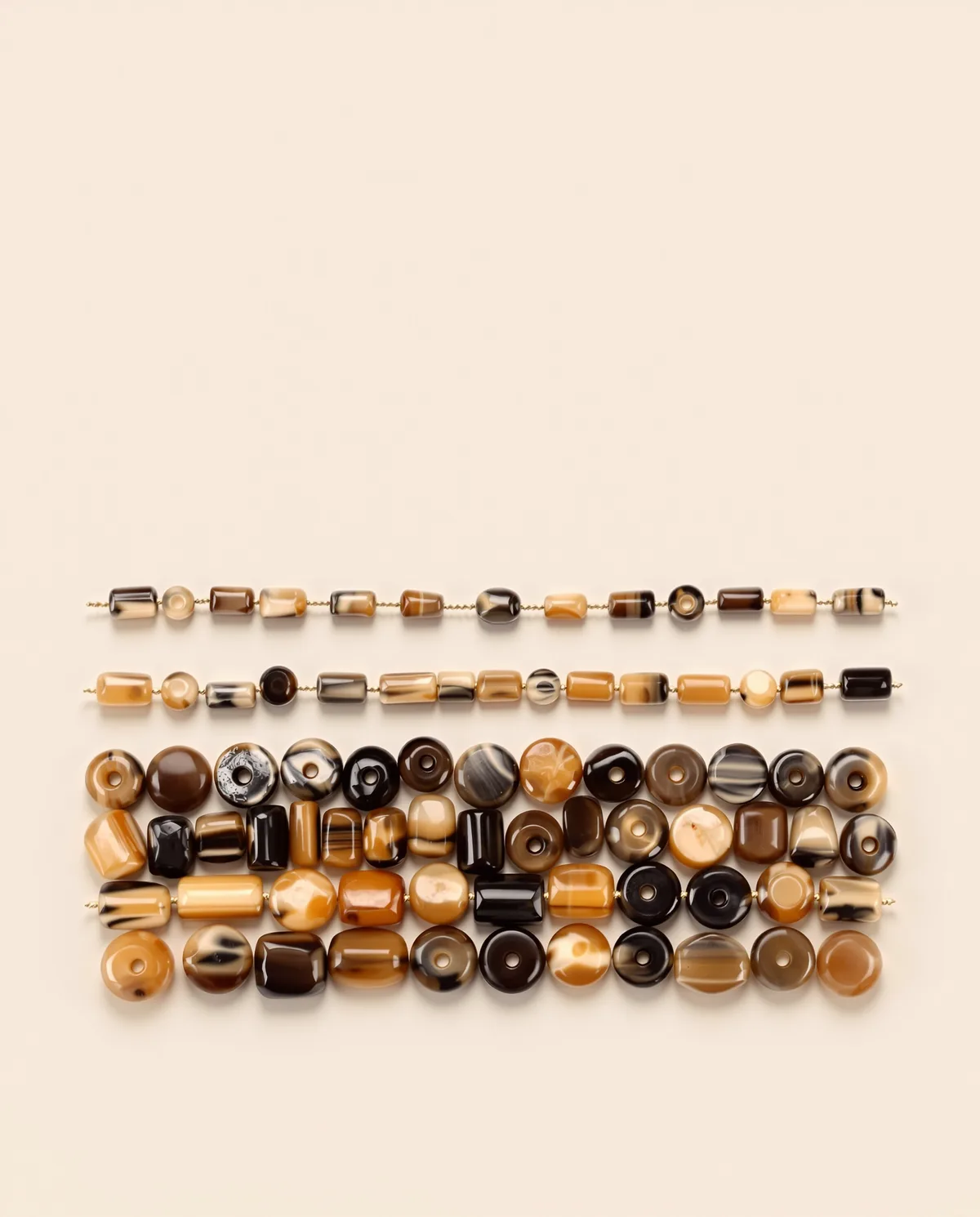
Narrow and specific. Bone runs cream to ivory. Horn runs pale amber through caramel to near-black, streaked. Dye can darken either and can pull a mixed batch into a tighter range, which is genuinely useful when a brief wants horn to read as a single dark material rather than as a spectrum.
What neither will do is take a reference. Where a natural bead has to sit beside a specific colour, the mechanism runs the other way: the adjacent beads are dyed to match the natural stock. That is the same inversion ceramic and lampwork glass require.
Both drill cleanly and tolerate a generous hole, which makes them easy partners on a mixed build. Horn has one real constraint: it has a grain direction, and a hole placed too close to an edge can split along it under load. Hole position is therefore checked on the sample rather than taken from the drawing.
Cord follows the usual rule — chosen from the smallest hole in the whole build, which on a mixed natural panel is normally a glass seed bead rather than the bone.
Dimensionally they are as repeatable as any cut bead. Tonally they are not repeatable at all in the sense a buyer means, and the mechanism is the one wood uses: a tone and figure range approved on the retained sample, with production held inside it.
The practical consequence is a sorting operation. Holding a tight range across a large order means setting aside the beads that fall outside it, and that is labour rather than material — which is where the cost sits on a natural-material programme.
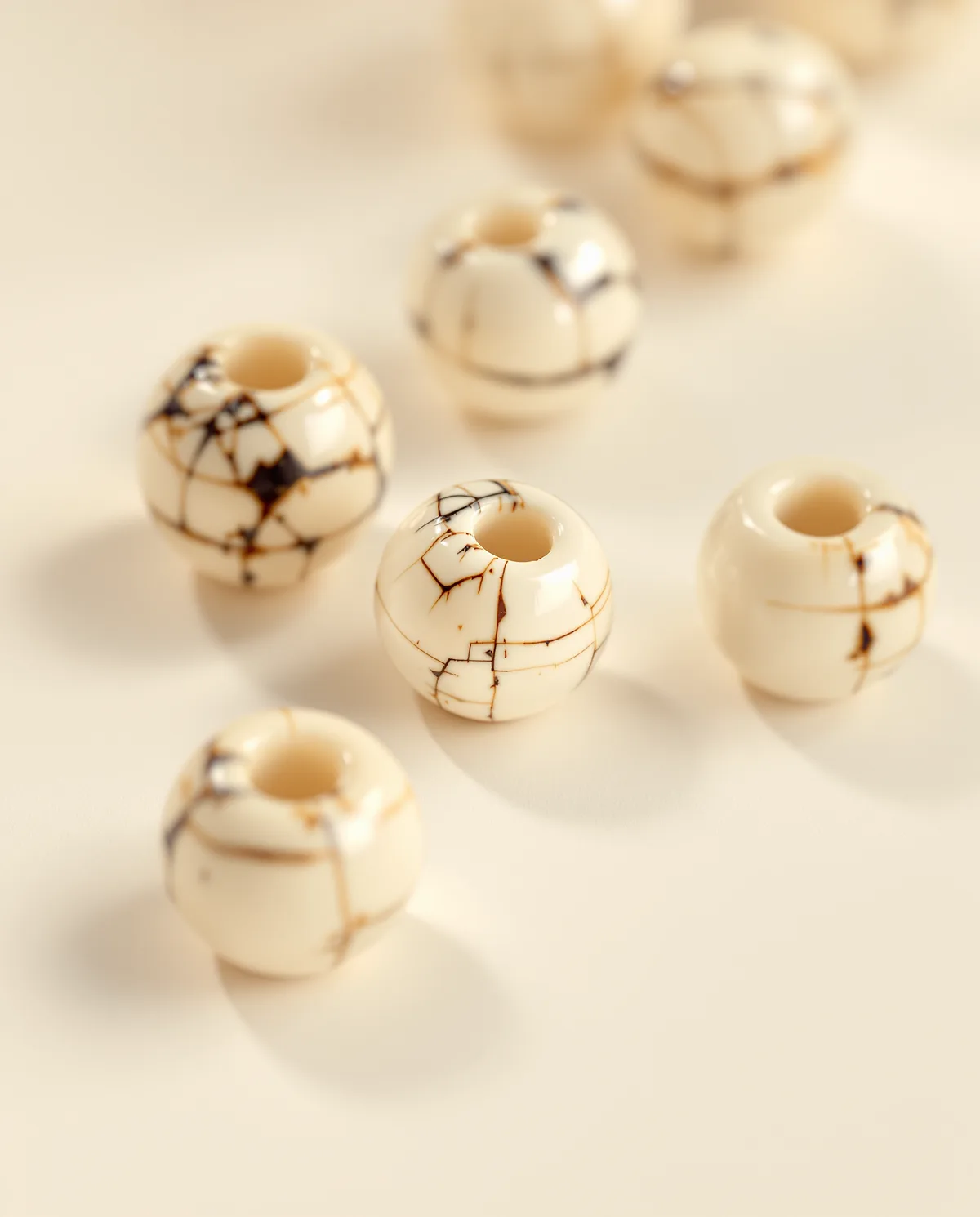
At humidity and at the surface. Both materials move with moisture: soaked, they swell and then crack as they dry; kept in very dry heat, they shrink and check. Both also dull if cleaned with anything abrasive, and the polish is a large part of the look.
The design answers are placement and instruction. Keep natural-material panels out of bathrooms and away from constant steam, and write the care instruction as dry dusting with an occasional wipe of a barely damp cloth. Care and cleaning sets out the sequence by material, because a bone bead and a faux capiz disc want different treatment.
| Specification | Working value | Why it matters |
|---|---|---|
| Production method | Cut from blanks, drilled, sanded and polished; dyed darker where specified | A subtractive process, so the stock's character survives into the bead |
| Bone character | Pale cream to ivory, dense, faint porous grain | Reads as a quiet neutral; shows dust less than a gloss bead |
| Horn character | Translucent at thin edges, streaked light to near-black | The figure is the product; two beads are never alike |
| Colour route | Natural tone range, or dyed darker to even the stock | No colour reference matching; a tone range is approved on sample |
| Weight behaviour | A 10 mm bone round works out near 0.9 g; horn near 0.6 g | Arithmetic from nominal densities; between wood and glass |
| Sound | A soft, dry click | Quieter than glass, drier than wood |
| Failure mode | Cracks if dried out or soaked; dulls under abrasives | A natural material, so humidity matters |
| Made where | Cut, drilled and finished to our specification in our own beadwork studios | Bone and resin inlay is a capability of our own wood factory |
Good to know
They are cut, drilled and finished to our specification in our own beadwork studios, which work glass, resin, bone and shell beads alongside zardozi embroidery and faux capiz. Bone and resin inlay is also a documented capability of our own Saharanpur wood factory, which is where the material discipline comes from.
Their own. Bone runs cream to ivory; horn runs pale amber to near-black with streaks between. Dye can take either darker and can even out a mixed batch, but neither can be matched to a colour reference the way dyed acrylic can — the substrate is not uniform enough to carry it.
Drilled to the build and confirmed on the stringing sheet. Both materials drill cleanly and tolerate a generous hole, but horn can split along its grain if the hole runs too close to an edge, so hole position is checked on the sample rather than assumed.
Dimensionally yes; tonally no. Natural stock varies, so the mechanism is the same one wood uses: approve a tone and figure range on the retained sample and hold production inside it. A programme that needs identical beads run to run should use resin or acrylic.
Less. A ten-millimetre round works out near 0.9 g in bone and 0.6 g in horn, against about 1.2 g in glass — arithmetic from nominal densities, not weighed. Both sit between wood and glass, which makes them easy to hang without needing extra weight at the hem.
Natural and neutral colour stories in hanging work, accent positions where a quiet material is wanted against something brighter, and table and object pieces. They are a poor choice for a bright graphic palette, because neither material will go there.
Shape and nominal dimensions, the hole diameter and position, the finish — sanded, polished or dyed darker — and the approved tone and figure range with a pointer to the retained sample. The range is the entry that makes the shipment inspectable.
Keep exploring
Material
Why nacre looks the way it does, what growth marks mean for a specification, and the reason most export programmes choose faux capiz instead.
Specs and sizesMaterial
Turned and drilled in our own wood factory: grain variation you approve rather than eliminate, the finishes that hold colour, and the dowel from the same plant.
View the rangeMaterial
Poured, not pressed: why casting makes figural shapes possible, how colour goes through the body, and what the mould line costs you.
Read the guideGuide
Dry dusting first, spot cleaning the beads, keeping the cord dry, what never to use, and how to handle a broken strand.
Read moreReference
Nine material families, what each gives in light, weight and colour, and how far our own manufacturing reaches into every one of them.
See the detail
Start a conversation
Send a reference, a colour chip or a sketch. Minimums are set per design and confirmed per quote; sampling is quoted separately and usually runs 16 to 20 days from an agreed brief.