Trend read
Y2K beaded curtains trend
Motif-led, iridescent-ground and reordering fast: the one construction that carries a rotating icon set.
See the detail
Style · Era
The nineties are a material decade. Y2K is a motif decade. Same translucent acrylic ground, a specific set of six icons scattered across it, and a completely different buyer.
Bright moulded acrylic beads in a group: iridescent oil-slick rounds, glitter-filled clear squares, flat butterflies and hearts in candy pink, lilac, aqua and silver, with a…
Y2K is identified by its motif set and its scatter. Smiley, mushroom, daisy, cherry, butterfly and heart, placed at random across a translucent or iridescent ground and never arranged in rows. The nineties register supplies the ground; the icons are what make the panel read as Y2K rather than as nineties.
From the turn of the millennium, and from a very specific visual mood: optimistic, plastic, slightly synthetic, built around a small set of friendly icons that needed no explanation in any language. The smiley, the mushroom, the daisy, the cherry, the butterfly and the heart were doing service across fashion, music packaging, mobile phones and bedroom décor at once. Beadwork picked them up late and is now carrying them again, because the cohort that grew up with them is furnishing its own rooms.
An icon on a pale translucent ground, scattered. The ground is inherited from the nineties and is not distinctive on its own — frosted pastels, clear, iridescent. What places the panel at the turn of the millennium is the motif set and the way it is distributed: sparse, unaligned, at one scale, with the ground doing nothing except holding the icons apart. If the motifs line up the panel reads as a pattern and the register disappears.
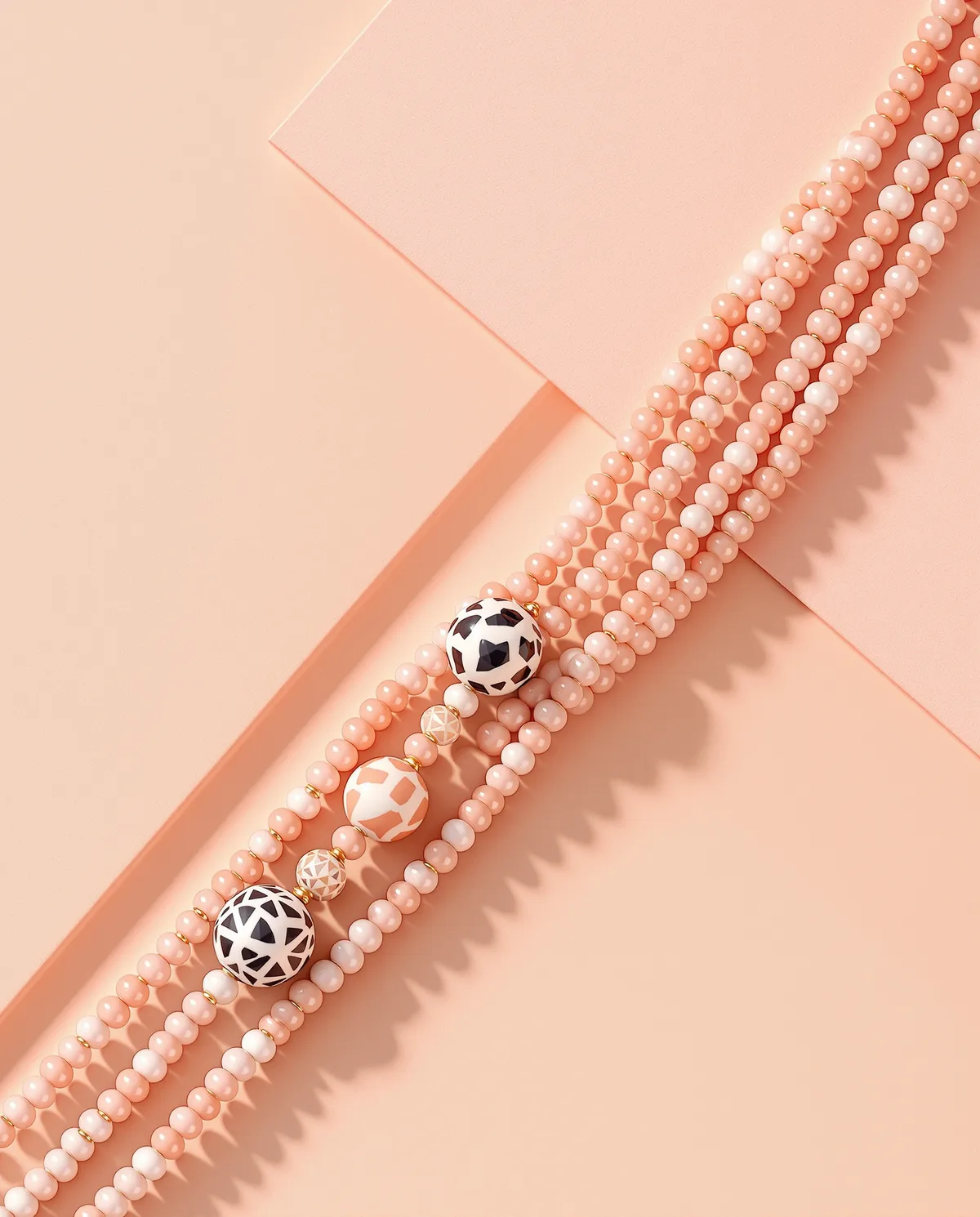
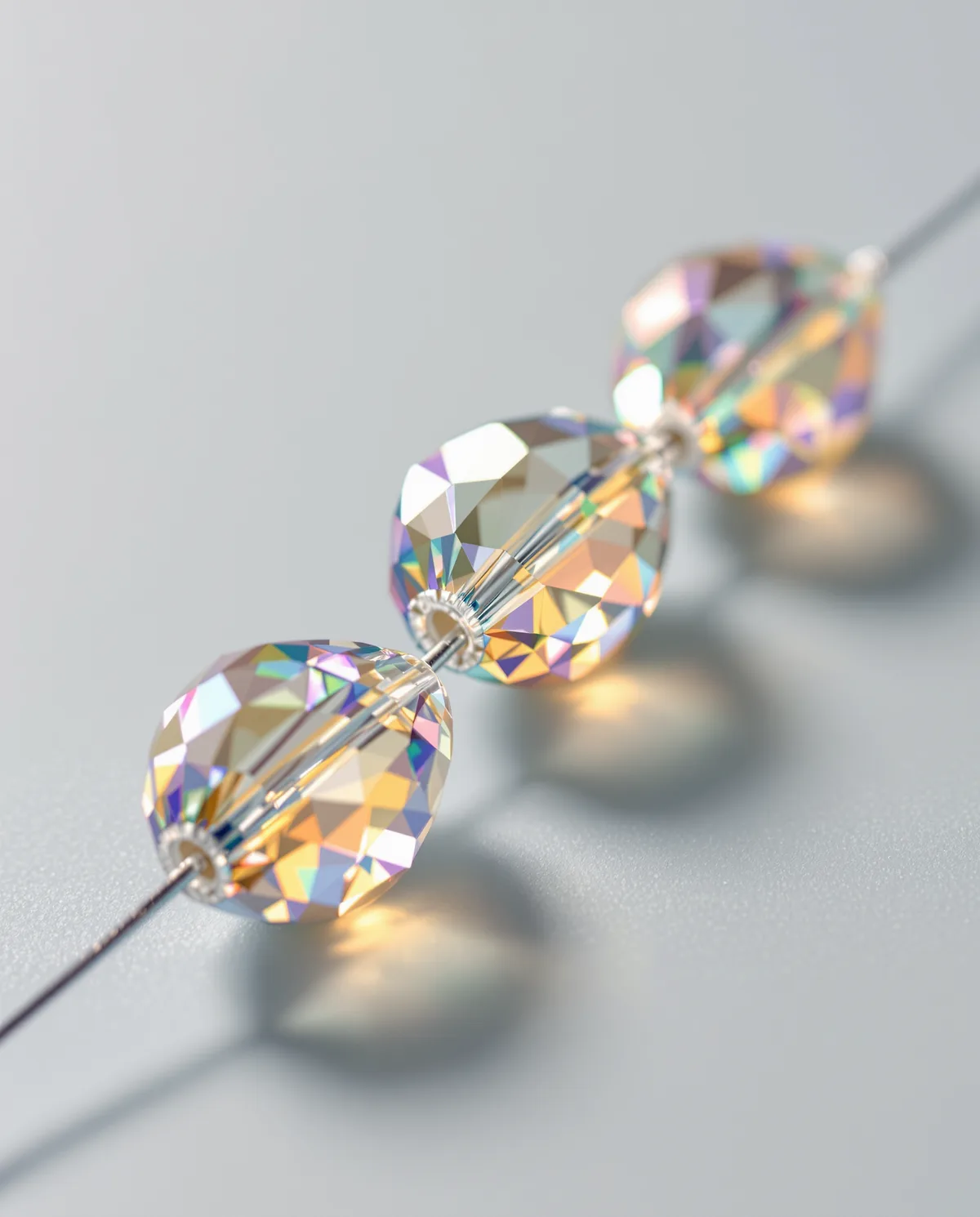
A translucent or frosted acrylic ground, or a glass seed-bead ground dyed to match the motif, with a pressed or moulded motif bead as the subject. Faceted iridescent teardrops in a pearlised crystal finish are the period accent. Hems are straight, because the icons are the only incident the panel needs. End suspension loops at the top of each strand let the panel hang level from either a dowel or a rod.
Home and lifestyle retailers, brands buying under their own label for bedroom, dorm and teen ranges, and gift retail. This is a live commercial register rather than a styling idea: a mushroom-accent portal and a dotted portal are both approved and in production, and a smiley design runs alongside them.
A printed icon on a flat acrylic disc, aligned in rows. Printing removes the silhouette that makes a motif bead read as an object, and alignment removes the scatter that makes the panel read as lively. The combination produces something closer to bunting than to beadwork. The third cheap failure is iridescent coating everywhere rather than on one accent, which reads as novelty at any price.
With a scatter rule in the count sheet: permitted positions per strand, a maximum per strand, and a prohibition on adjacent strands sharing a position band. One live design is instructive about the limits of this. The brief arrived as a reference image with no artwork file behind it, so the whole pattern was mapped bead by bead at the bench and assembled against that map. It is in production and it taught the lesson cleanly: a motif with no artwork file has to be mapped at the bench, and the mapping is the cost. Send artwork — or budget for the mapping.
Above it by the motif line and the placement operation, and the gap depends entirely on whether a bead for the motif already exists. An existing pressed motif bead is a modest addition. A new moulded shape brings a tooling conversation, and we cut our own dies where a design justifies it — the die is ours, drawn in Firozabad and moulded to our colour. A motif that has to be mapped and assembled by hand is the case to brief carefully: the mapping is the work, so send artwork where you have it.
Bedrooms, dorms, student flats, children's and teenagers' rooms, and independent cafés and gift shops. It is a close-range register: the icons have to be identifiable, which means the viewer has to be within a couple of metres. It is wrong for a lobby or a large space, where the motifs vanish and the pale ground reads as nothing.
Keep one icon and make it larger. The thing that separates a current Y2K panel from a 2003 one is scale and restraint: a few large motifs with real ground between them, rather than many small ones scattered densely. The second change is the ground — a chalk or oat seed-bead ground dyed to match the motif reads far more grown-up than a full iridescent field, and costs less.
A revival cycle with real current momentum and a known end. The icons are era-specific and will rotate; the construction underneath — a scattered motif on a matched ground — is permanent. The commercially sensible position is to invest in the construction and the placement discipline rather than in tooling for a single icon, so the next icon set can be dropped straight in.
The original was cheap by intent. Period Y2K bead décor was mass-moulded, loosely finished, often uneven in colour, and that roughness was part of its character. A modern build is dyed to a reference, scattered to a written rule and inspected against an approved sample, which makes it a better object and slightly less authentic. The place that difference shows is the motif: a period smiley bead was crude, and a well-made one can read as corporate. The fix is to keep the motif generous in scale and slightly imperfect in finish rather than to sharpen it.
Good to know
One icon, one scale, scattered. The register collapses when a panel carries smileys and mushrooms and cherries at three sizes, because the icons stop being objects and become a pattern. One motif on a quiet ground is also the version that photographs best.
Yes. A mushroom-accent portal and a dotted portal are both approved and in continuous production, and a smiley design runs alongside them. The register is selling, not reminiscing.
A translucent or frosted acrylic ground, or a glass seed-bead ground dyed to match the motif, with a pressed or moulded motif bead as the subject. Faceted iridescent teardrops with a pearlised finish are the period accent, and we have built and shipped a portal using exactly that bead.
We match a reference's look, colours and bead sizes in new materials as an inspired design, and we do not reproduce another brand's protected design. This register needs one extra check more than any other: several of its icons are somebody's registered mark or a licensed character, and we will not build one without the licence.
Translucent and iridescent grounds in ice blue, lilac, bubblegum and clear, with the motif in a saturated contrast — a yellow smiley, an orange and brown mushroom, a red cherry. The ground should be pale and the motif should be the only saturated thing in the panel.
Yes, by the motif line plus a placement operation. Where it gets expensive is a motif with no bead behind it. A motif with no artwork file has to be mapped at the bench, and the mapping is the cost. Send artwork — or budget for the mapping.
Door portals and café curtains. The motifs have to be at eye level to work, and a café length puts them there at a fraction of the bead count. Dorm and first-apartment buyers also want a format that hangs on a tension rod with no drilling, which acrylic allows.
Keep exploring
Trend read
Motif-led, iridescent-ground and reordering fast: the one construction that carries a rotating icon set.
See the detailStyle
Counted and placed to a rule — about 120 mushroom beads to a thirty-strand portal, up to four a strand, never level across the panel.
Compare the optionsIndex
Twenty-four named looks, each described by the material, palette, pitch and hem that actually produce it.
See the detailStyle
The density-to-count relationship, with the figures: about 11,800 beads dense against about 3,100 spaced, at the same size.
Read the guideStyle
Bead consistency, specialty glass with internal character, a drawn hem and a header that reads as joinery.
Read the guide
Start a conversation
Send a reference, a colour chip or a sketch. Minimums are set per design and confirmed per quote; sampling is quoted separately and usually runs 16 to 20 days from an agreed brief.