Design
Mushroom bead portal
A cream seed-bead base with amber accents and about 120 glass mushroom beads, scattered up to four a strand and never in a row.
Read the guide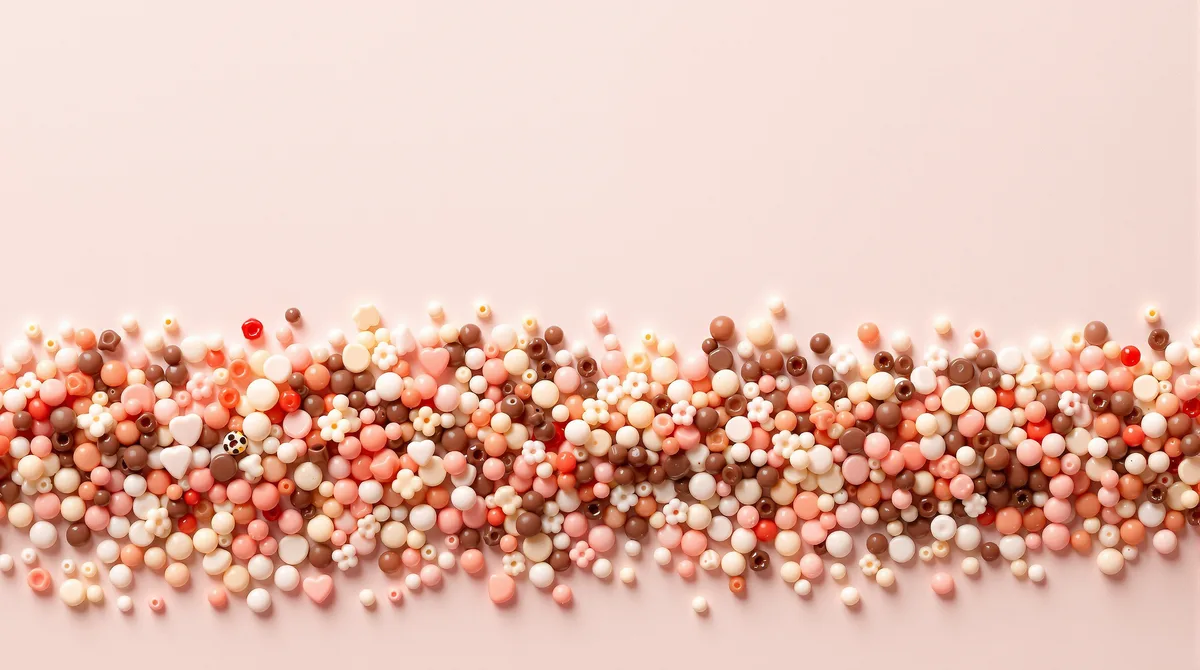
Style · Era
A motif bead is not a pattern. It is an object, and the whole craft of using one is deciding how many go on a panel and where they are not allowed to land.
A heaped band of mixed glass beads in blush, cream, chocolate and coral, plain rounds and small moulded shapes together, filling the lower half of the frame.
Motif beads are counted and placed to a rule. On a thirty-strand portal in our own record, roughly a hundred and twenty glass mushroom beads are scattered across a cream seed-bead base, up to four on any one strand, placed at random and never aligned level across the panel. The count and the rule are the specification.
From two unrelated places that converged. Figurative glass beads are as old as lampworking — a bead wound at a torch can be shaped into anything, and animals, fruit and flowers have been made that way for centuries. The second source is much more recent: the late-1990s and 2000s habit of using a small set of friendly icons — smiley, mushroom, daisy, cherry, butterfly, heart — as a visual language in their own right. Put a centuries-old technique behind a two-decade-old icon set and you get the motif bead panel as it sells now.
Objects on a field, not a pattern in a field. The viewer should read individual things, which means the motifs have to be sparse, unaligned and clearly larger than the ground bead. The ground has to recede, which is why it is dyed to match the motif colours rather than contrasting with them. And the motifs must never form a row, because the moment two land level across adjacent strands the eye reads a stripe and the whole effect inverts.
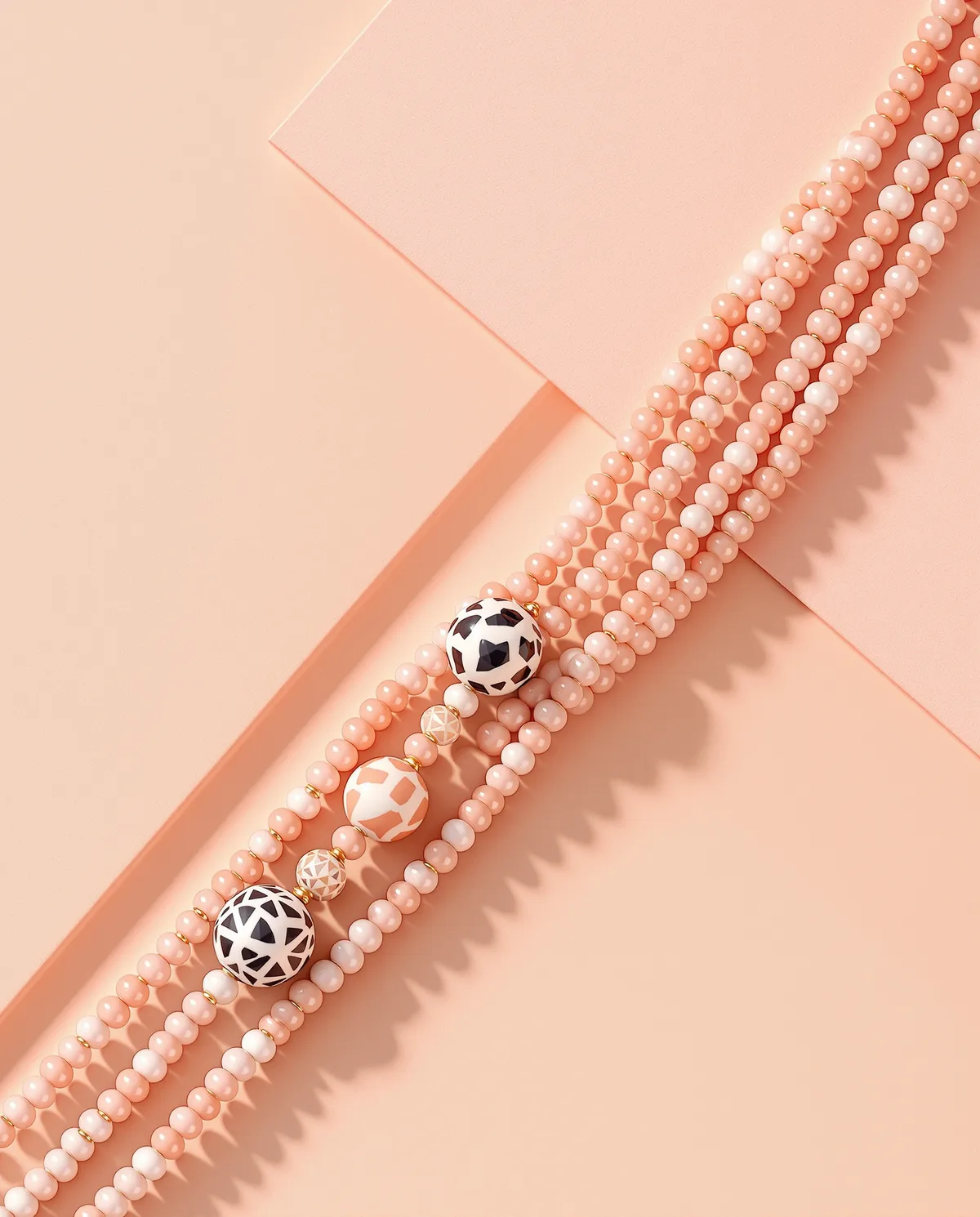
A cream or chalk glass seed-bead base, a small accent bead for incident, and a large motif bead. In the construction we have built and shipped, the motif is a glass mushroom bead, roughly a hundred and twenty to a thirty-strand portal, with the mushrooms alternating orange and brown at the buyer's request. End suspension loops are knotted at the top of each strand so the panel hangs level from either the wooden dowel or a rod pocket header. Hems are straight, so the motifs are the only incident.
The technique is a fixture and the motif is a trend. Figurative beads have been made for centuries and will keep being made; which figure is wanted changes every few years. That distinction has a direct commercial consequence: tool up for a specific motif and you have bought a cycle, develop the capability to put any motif on a strand and you have bought a line.
The original figurative bead was lampwork — unique, variable, expensive. The modern panel can use a pressed motif from a mould, so the shape repeats exactly a thousand times at a fraction of the cost. That is the real change, and it brings a trade: a moulded motif carries a faint mould seam around its waist and perfect uniformity, where a wound bead carries trailed decoration and the mandrel hole from the steel rod it was made on. Both are legitimate. They are different products at different prices.
The motif constructions sit closest to the warm end of the library — the cream, amber and chocolate relationships of Ember and Honey and the cream-soda tones of Seventies Sunroom. For the icon-set reading, Sorbet Parade is the fit, with candy pink, lemon, mint and lilac. The library holds each story by construction, so a motif brief starts from a documented ground rather than from a palette guess.
It photographs at close range and it sells on the motif alone, which makes it the most commercially straightforward register in this library. A shopper recognises a mushroom at thumbnail size. The important frame is a tight crop of two or three motifs against the ground, close enough that a viewer sees the motif is a separate glass object rather than a print.
Home and lifestyle retailers, brands buying under their own label for bedroom, dorm and teen ranges, and gift retail. This register has produced some of the strongest adoption anywhere in our beadwork: a mushroom-accent portal and a dotted portal are both approved and in continuous production.
A printed motif on a flat acrylic disc. It fails for the same reason a printed flower fails: the appeal of a motif bead is that it is a three-dimensional object with its own silhouette against the ground, and print removes the silhouette. The second cheap failure is a motif threaded without a spacer or an end bead, which slides down the cord and ends up facing sideways.
With a scatter rule written into the count sheet. You cannot tell a stringer to place something randomly and expect the next run to match, so the stringing sheet carries permitted positions per strand, a maximum per strand, and a rule that no two adjacent strands may use the same position band. The result repeats as a look without repeating as a sequence. One of the live designs in our record was mapped this way by hand from a reference image alone, because no artwork file was ever supplied.
Above it by the motif line plus a placement operation. The motif bead itself is the variable: a pressed motif from an existing mould is a modest addition; a new moulded shape brings a tooling conversation; a hand-shaped lampwork motif is the most expensive bead we make. The cheapest way to carry the register is to reduce the motif count rather than the motif quality, because the look depends on the motif being good and not on there being many.
Bedrooms, children's and teenagers' rooms, dorms, independent cafés and gift shops. It is a close-range, daylit register that depends on someone being near enough to identify the object. It does not suit a lobby or a large space, where the motifs simply disappear.
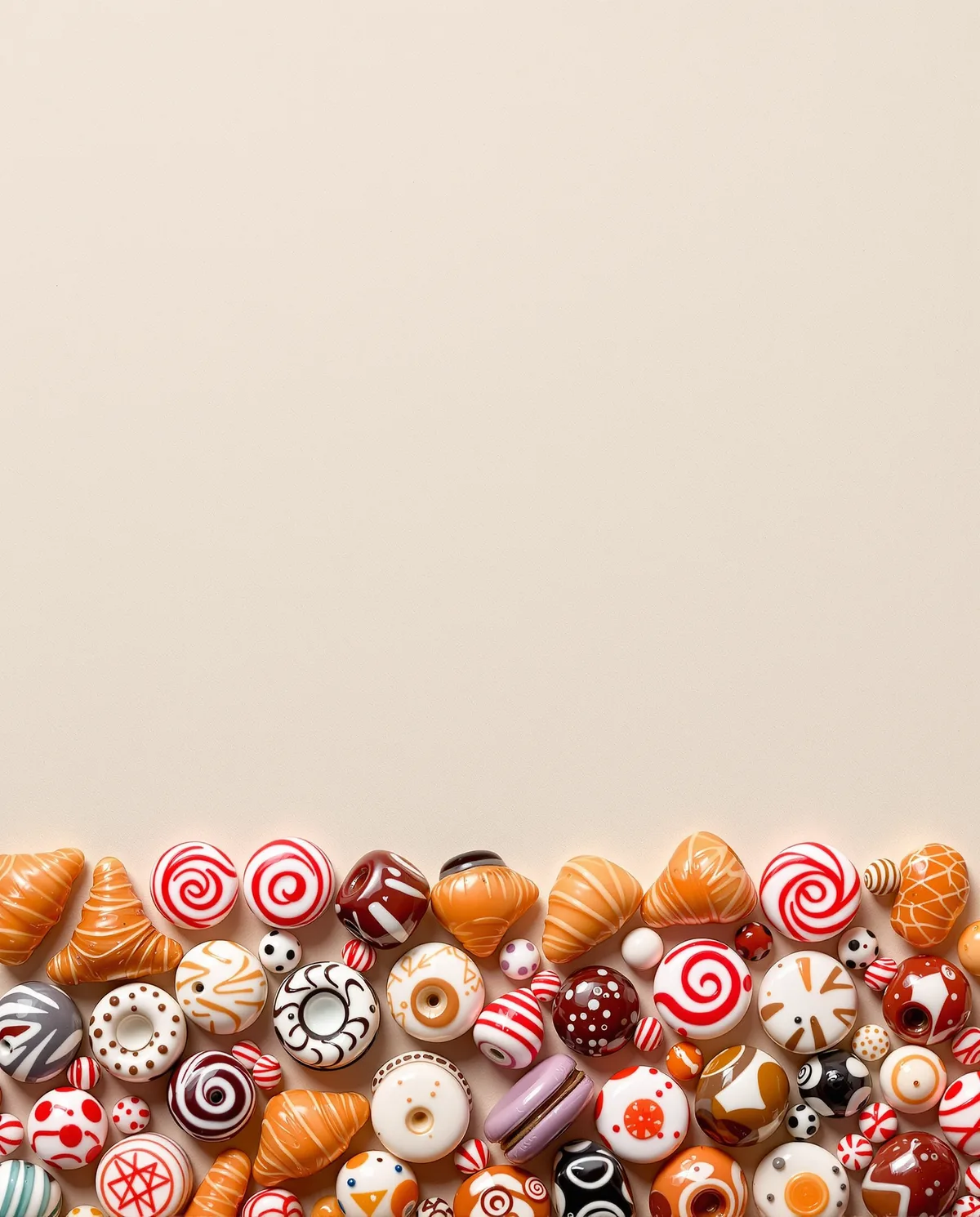
Change the icon set. The mushroom and the smiley are the current ones and they will rotate; the technique behind them will not. Our most recent development in this area is a set of lampwork food and holiday icon beads — croissants, macarons, blood oranges, peppermints, sourdough and candy ribbons, finished as wine charms — made by hand at the torch to whatever story a brief asks for. A range built on the technique survives the icon rotation; a range built on one motif does not.
Good to know
We match a reference's look, colours and bead sizes in new materials as an inspired design, and we do not reproduce another brand's protected design. Motif work needs one extra check: a motif can be somebody's trademark or a licensed character, and we will not build one without the licence.
The motif carries the colour and the ground carries almost none. A cream or chalk base with an amber accent under an orange-and-brown motif is the construction we have built and shipped. The base beads are dyed to match the motif colours so the ground recedes.
Yes, and the amount depends on the motif route. A pressed motif bead from an existing mould adds a bead line and a placement rule. A new moulded shape adds tooling. A hand-shaped lampwork motif adds the highest per-bead cost in the catalogue, because each bead is wound individually at the torch.
Door portals and café curtains. A motif needs to be seen at eye level, and both those formats put it there. On a full-height panel the motifs below knee height do no work, which is a direct argument for the café length when budget is tight.
One motif, one scale, scattered not arranged. Motif work collapses when a panel carries mushrooms, daisies and cherries at three sizes. It also collapses when the motifs line up: a row of mushrooms reads as a stripe, and the object-ness that makes the motif work disappears.
Yes. A mushroom-accent portal is approved and in production, reordering season after season. The motif is a commercial register, not a nostalgia exercise.
Keep exploring
Design
A cream seed-bead base with amber accents and about 120 glass mushroom beads, scattered up to four a strand and never in a row.
Read the guideMaterial
Wound at the torch one bead at a time: what that buys in shape freedom, what it costs in hours, and how variation is specified instead of eliminated.
How it is madeIndex
Twenty-four named looks, each described by the material, palette, pitch and hem that actually produce it.
Read moreStyle
Lantern and zellige geometry, jewel tones and metal accents — and why the influence is named rather than the country claimed.
Specs and sizesStyle
Zardozi bead embroidery, wire-wrapped beadwork and glass-bead drawing — the techniques behind the phrase, and where each is made.
Specs and sizes
Start a conversation
Send a reference, a colour chip or a sketch. Minimums are set per design and confirmed per quote; sampling is quoted separately and usually runs 16 to 20 days from an agreed brief.