Trend read
Maximalism in beadwork
Dense pattern multiplies bead count and picking operations — and the version that actually gets ordered is the scattered accent.
See the detail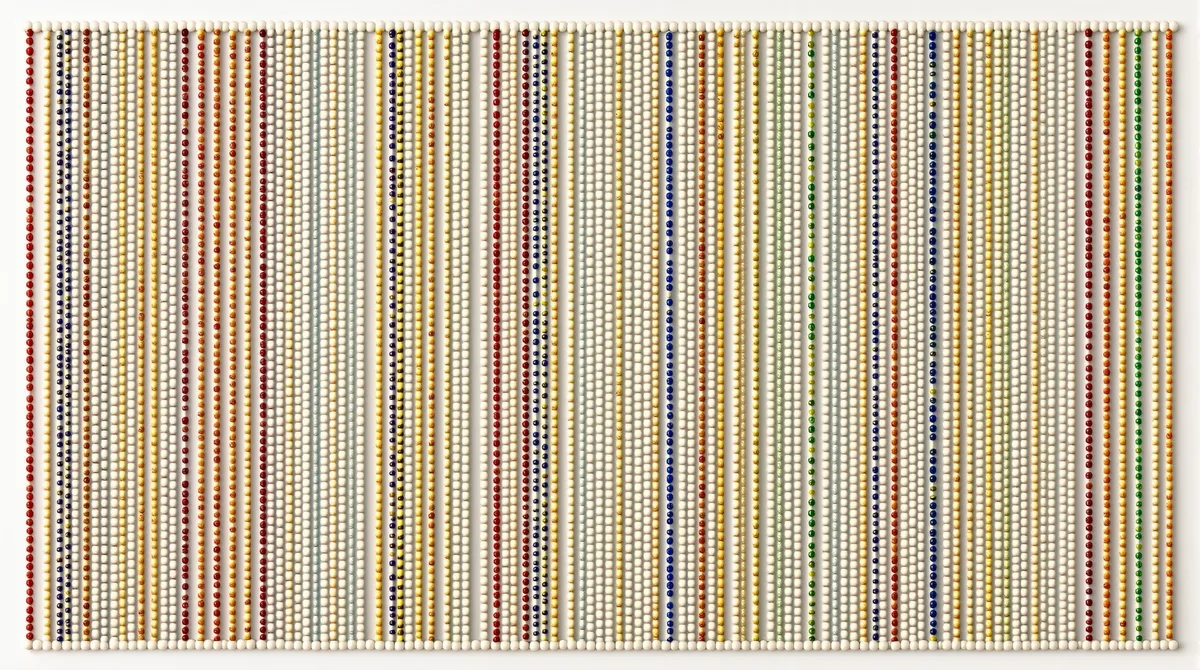
Style · Era
Maximalism in this medium has an arithmetic problem. At the same finished size, a fully patterned panel carries nearly four times the beads of a spaced one, and every one of them is placed by hand.
A beaded panel of extreme pattern density, every strand a different repeat in cherry red, cobalt, canary, emerald, plum, antique gold and chalk white.
Maximalist beadwork is a density decision with a direct cost consequence. A densely patterned curtain at ninety by two hundred centimetres can hold about 11,800 beads, against roughly 3,100 for a spaced design at the same size. Every bead is placed by hand, so density and labour move together.
From the reaction against a decade of grey minimal interiors, and from a much older tradition of abundance as ornament. Beadwork is an unusually direct medium for it, because in beadwork abundance is literal and countable: more pattern means more beads, and more beads means more hours. Most decorative materials let a designer add visual complexity for free by printing it. Beadwork does not, which makes it the medium where maximalism has to be costed rather than merely designed.
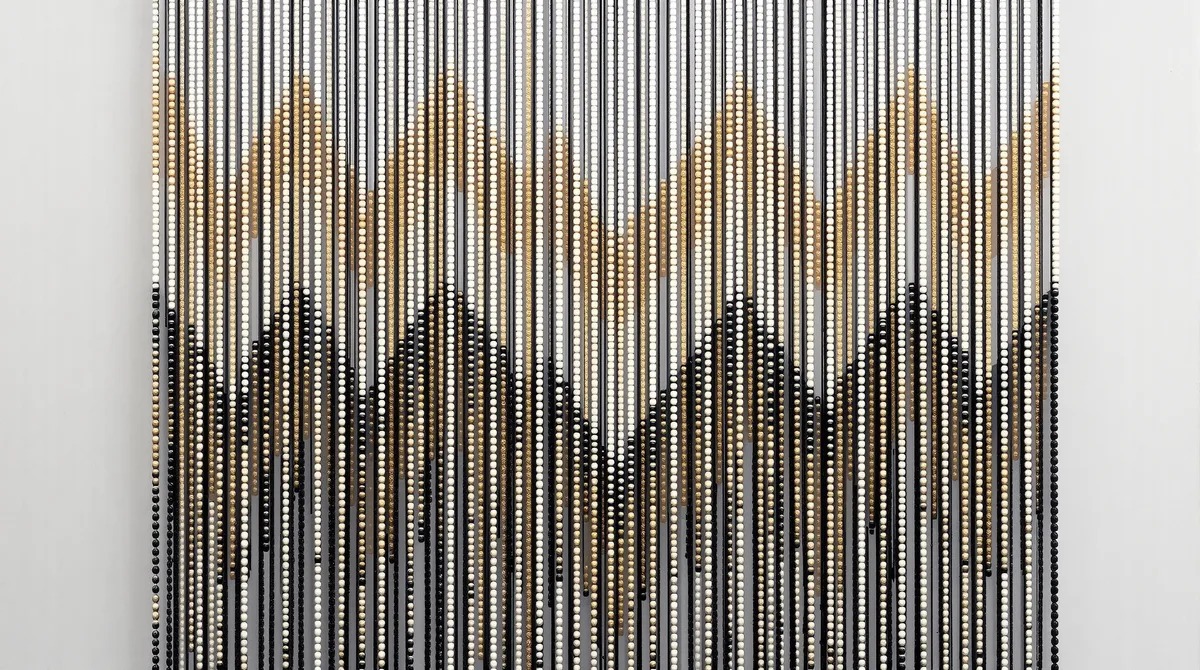
Coverage. A maximalist panel leaves no bare cord: beads run the full drop, packed bead against bead, on strands at a tight pitch, and the pattern changes often. The visual result is a continuous surface rather than a screen of lines, and that is the single distinction between this register and every other one in the library. Spacing is what makes a panel read as restrained, and removing the spacing is what makes it read as maximal.

Large opaque beads for the field, with a smaller bead reserved for detail. A wide clashing palette held by one structural constant. Hems can be elaborate here in a way they cannot elsewhere, because a dense panel can carry a scalloped chevron or a stepped arch without the profile competing with the pattern. Our Sorbet Parade story is the clearest maximalist palette in the library: candy pink, lemon, mint and lilac mixed so each strand reads as scattered confetti.
Sorbet Parade for the confetti reading. Wavy Check for the graphic reading, where the colour changes bead by bead across the strands. Café Society for a maximalism built on tonal depth rather than on brightness — espresso and cocoa through crema to dusty cornflower and pistachio, with one glossy cherry-red note. All three are documented by construction in the design library, which is what lets a density brief be costed before anything is strung.
It photographs as a field, so it needs either a full flat elevation or a very tight crop, and nothing in between. It sells extremely well on social imagery and much less well against a price point, which is the central commercial tension in this register. The format that resolves it is the wall piece: smaller than a door curtain, so the count is affordable, and seen flat, so the density reads.
Brands buying under their own label for statement home accessories, interior designers working on feature walls and thresholds, and event and display companies, who are the one group for whom density is straightforwardly worth the money. In retail the practical compromise is almost always a scattered accent rather than full coverage.
A dense panel in a single cheap bead. It fails because density without variation reads as a mat rather than as a pattern: the eye needs incident to interpret abundance, and a uniform field of small plastic beads provides none. The counter-intuitive truth here is that a spaced panel in a good bead looks more expensive than a dense panel in a poor one.
With a bead map and a de-densifying rule. Every bead position in a patterned field is written down on the stringing sheet, and where the pattern has a large flat area the fill is opened up — tight outline, open fill — which cuts count without changing what a viewer sees at arm's length. We have used the same principle on a beaded pillow programme, where de-densifying the infills was what brought the piece to its target.
This is the one page in the library where the number matters more than the description. A densely patterned curtain at ninety by two hundred centimetres can hold about 11,800 beads, and every one is placed by hand. A spaced design at the same finished size — forty strands at roughly a 2.25 centimetre pitch — comes in near 3,100. That is close to a fourfold difference in material and in stringing time for an identical piece of wall.
Feature walls, bar backs, retail interiors, event sets and any space where one surface is meant to carry the whole room. It needs plain surroundings in the way a loud pattern always does, and as a beaded feature wall it is the strongest thing in this library. Domestically it suits a single wall rather than a doorway, because a dense panel at a threshold is physically in the way.
Keep the density and cut the palette in half. Current maximalism is tonal rather than polychrome — many values of a few hues, rather than many hues — which reads as deliberate where a full spectrum reads as nostalgic. The second change is to let the density vary across the panel instead of running flat, so the surface has a structure.
A cycle with a permanent floor. Full-coverage beadwork will always exist in event, display and hospitality work, where the budget is per project rather than per unit. In retail it rises and falls, and the version that survives the fall is always the scattered accent rather than the all-over pattern.
The dense bead panels of the 1970s were built with large beads because large beads were what was available at that scale, and the result was coarse and effective. The modern instinct is to build the same density with small beads for a finer image, which triples the count and usually fails on price. The modern maximalist panel goes back to the large bead and finds its complexity in colour and placement instead of in resolution.
Good to know
What our order record shows is that the maximalist read sells as a scattered accent on a plain ground rather than as full coverage — the adopted designs in our 2026 programme are accent builds, not all-over patterns.
Large ones. Density is expensive per unit area, so the way to afford it is to cover the area with fewer, bigger beads. A thirteen by twenty-two millimetre pressed oval covers in one unit what a field of two-millimetre seed beads needs dozens to cover, and at normal viewing distance the difference in the colour field does not read.
We match a reference's look, colours and bead sizes in new materials as an inspired design, and we do not reproduce another brand's protected design. With dense vintage panels the first question is always whether the original bead size can be increased, because that is usually the difference between affordable and not.
Many, deliberately clashing, but held by a rule. The maximalist panels that work use a wide palette with one repeated structural element — a consistent bead size, or a consistent ground — so the eye has something to hold on to. A wide palette with no structure reads as a jumble rather than as abundance.
Considerably. Bead count scales with coverage and labour scales with count, so a fully patterned panel can be several times the cost of a plain one at the same dimensions. Height, bead size and strand spacing are the three levers that move it, in that order of effect.
Wall hangings and portals rather than full door curtains. A dense panel on a doorway is heavy to push through and noisy; the same density on a wall is a feature. If the brief wants density at a doorway, an arched-cut opening through the middle keeps the density and removes the obstruction.
Give the abundance one discipline. One bead size, or one ground colour, or one repeating motif at one scale. Maximalism is not the absence of rules; it is a lot of material under a single rule.
Keep exploring
Trend read
Dense pattern multiplies bead count and picking operations — and the version that actually gets ordered is the scattered accent.
See the detailSpecification
How bead count is estimated from size, pitch and diameter — and why density matters more than dimensions.
View the rangeIndex
Twenty-four named looks, each described by the material, palette, pitch and hem that actually produce it.
Compare the optionsStyle
The strand grid is anisotropic, which decides which checks, chevrons and waves survive at a given bead size.
See the detailStyle
A noren is split dyed fabric; a bead panel is strung glass. Same threshold job, different object, different maker.
Read the guide
Start a conversation
Send a reference, a colour chip or a sketch. Minimums are set per design and confirmed per quote; sampling is quoted separately and usually runs 16 to 20 days from an agreed brief.