Manufacturing
Bead shades for lighting
Pendant drums, empire table shades and sconce shades in glass beads — how the frame carries the shape, and why we supply shades only.
Specs and sizesReference · Lighting
The fitter is the small piece of metal that decides whether a beaded shade fits a lamp at all. It is specified by the buyer, measured before the beadwork is drawn, and it is the detail most briefs arrive without.
A beaded shade sits on one of three fitter types. A spider fitter bridges the top ring and seats on a harp finial. A clip-on fitter grips the bulb itself. A Uno fitter is a ring that slips over the socket and is held by a retaining ring, either screw-on or slip-on. The buyer names the fitter; the frame is then built to it.
Six items, in this order: the fitter type, the fixture the shade has to sit on, the top ring diameter, the bottom ring diameter, the height, and the frame finish. A seventh is needed when the lamp is a table lamp — whether the bulb must clear the inside of the shade, which is a function of the fitter drop rather than of the shade's outside dimensions.
The order matters because the frame is manufactured first and the beadwork is strung onto it. A brief that gives a beautiful palette and no fitter cannot be sampled: there is nothing to string the beads to.
| Item | Sits on / value | Where the figure comes from |
|---|---|---|
| Spider fitter | A harp and finial on a table lamp, or a threaded nipple | Industry standard |
| Clip-on fitter | The bulb itself — a sprung wire clip over an A-shape or candle lamp | Industry standard |
| Uno fitter | The socket, held down by a retaining ring | Industry standard |
| Reverse or bottom Uno | The socket, with the ring at the bottom of the shade | Industry standard |
| Uno retaining ring | Screw-on, or slip-on over an O-ring | Industry standard; confirm per lamp |
| Pendant mount | The lamp holder above, through the top ring | Industry standard |
| Flush-mount conversion | A ceiling plate, converting a pendant shade | Industry standard |
| Frame material and finish | Metal, in any of eight standard finishes | Gemixx published finish set |
| Development geometry, flush-mount shade | 14 in diameter × 8 in high | Gemixx development sample |
| Development geometry, Uno sconce shade | 3¼ in top ring, 5½ in bottom ring, 5¼ in high | Gemixx development sample |
| Hem tolerance in hand-strung work | About one bead | Gemixx beadwork practice |
Three fitter families cover almost every fixture. A spider fitter is a three-arm bridge across the top ring with a central hole; on a table lamp it seats on the finial of a harp. A clip-on fitter is a sprung wire clip that grips the bulb itself, which is why it is common on small candle-lamp sconces and needs no harp at all. A Uno fitter is a ring built into the shade that slips over the socket and is held down by a retaining ring, screw-on or slip-on over an O-ring. A reverse Uno does the same with the ring at the bottom, so the shade hangs below the socket.
Top and bottom ring diameters are measured across the outside of the metal ring, not across the beadwork, because the beads overhang. Vertical height is the perpendicular distance between the two ring planes. Slant height runs along the slope of a tapered shade and is always the larger number — quoting slant height where vertical height was asked for is the most common measuring error in this category.
Fitter drop is measured from the top ring plane down to the plane of the fitter, and it is what determines bulb clearance.
Inches and centimetres, in both directions, on frames that are specified in inches in North America and in millimetres almost everywhere else. A 14 inch frame is 356 mm, and a 350 mm frame is not a 14 inch frame.
The second recurring error is treating a Uno ring diameter as a shade diameter. The Uno ring is sized to the socket, typically well under two inches, while the shade around it may be five or fifteen. They are unrelated numbers that both get written down as diameter.
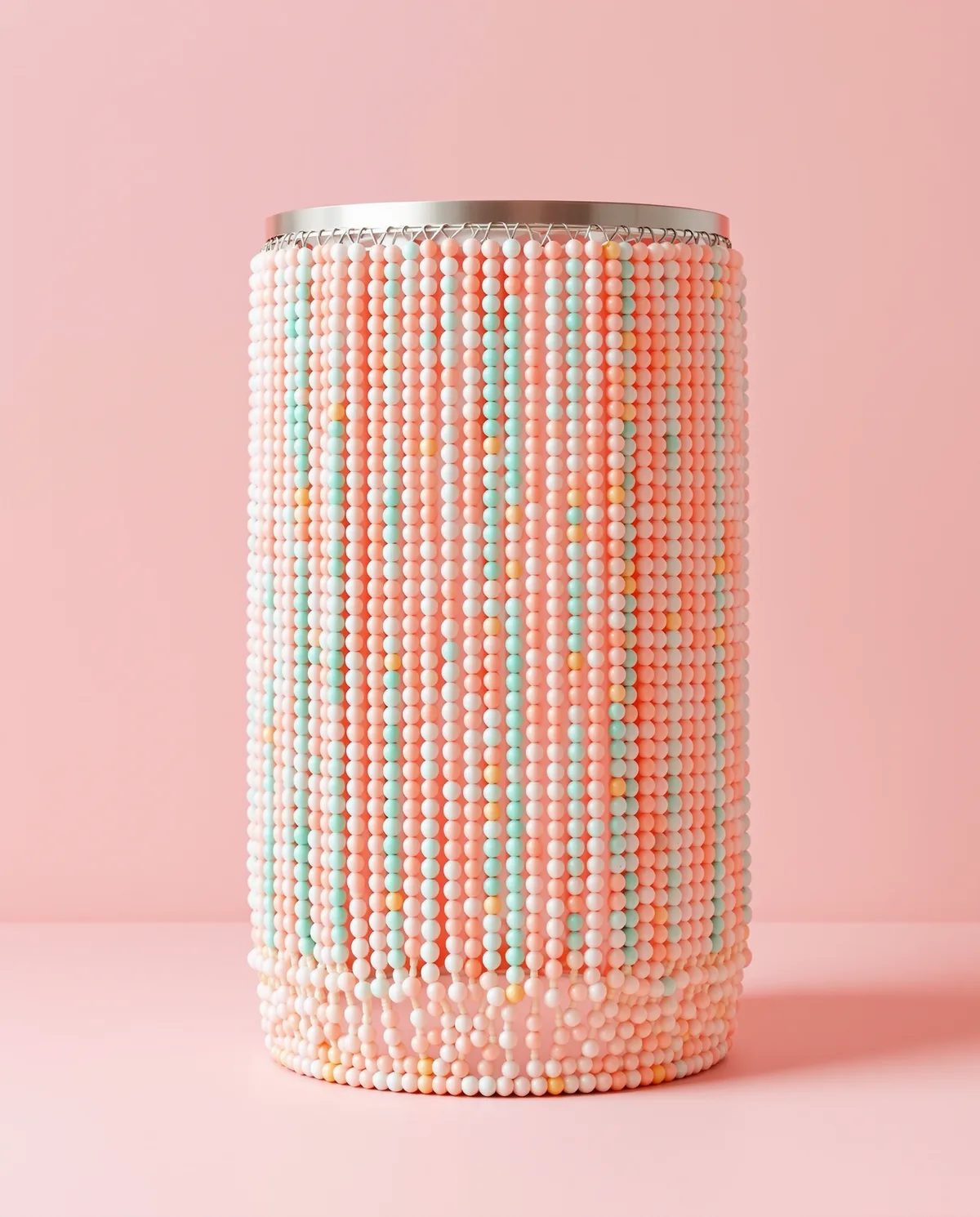
Two geometries out of our own shade development are useful as reference points. A flush-mount conversion shade was built at 14 inches diameter by 8 inches high. A small Uno-fitter shade was built at a 3¼ inch top ring, a 5½ inch bottom ring and 5¼ inches high.
Both are development geometries rather than catalogue sizes, and both make the argument of this page better than any chart could: the frame is settled first, because beads strung to a frame that later changes have to be restrung onto the frame that replaces it.
Fitter dimensions, harp heights and retaining-ring threads. These belong to the buyer's fixture, they vary by market and by manufacturer, and a published table would mislead somebody on the day they relied on it. Pricing and minimums are set per design and confirmed with your quote.
We make the shade, not the lamp. The electrical assembly, its listing and its lamp rating belong to the lighting manufacturer, and the shade is built to fit the fitting and the rating you specify.
The shade gets built to a placeholder and then rebuilt. That is the whole cost of the omission, and it is not small: the frame is the structure, so a frame change is not an adjustment to a sample but a new sample. Strand count follows ring diameter and bead count follows height, so changing either changes the count sheet, the bead quantity and the stringing hours.
The cheap version of this conversation happens before the first drawing. The expensive version happens after the first sample has been photographed.
The frame dimensions do not change with the bead material, but the frame specification does. Glass is roughly twice the density of acrylic beads, so a glass build at the same strand count and drop is a much heavier object hanging from the same rings. Where a design carries that weight, the wire gauge and the number of vertical struts are specified for the load.
Bead size also changes the apparent diameter: a large pressed glass bead on the outside of a ring pushes the visual edge of the shade out by its own width, twice over across a diameter. The bead sizes and stringing specifications sheet carries the dimensions behind that.
On the metal, close: rings are formed and welded to a jig and repeat tightly across a run. On the beadwork, about one bead. A strand is a chain of discrete units, so a drop can only land on a bead boundary, and a hem given as a flat millimetre figure will always carry that tolerance. The way to specify a hem is a bead count per strand, not a length — a count repeats exactly and a length cannot.
Ring diameter drives strand count, and strand count drives stringing hours more directly than anything else on a shade. Height drives bead count per strand. Between them, those two dimensions account for most of the cost of the beadwork.
The frame is the other half. A plated frame in a specialty finish can be a larger share of a small sconce shade's cost than the beads on it, which is counter-intuitive until the strand count is set against the metalwork.
As a frame drawing and a colour-count sheet, side by side. The frame drawing carries the two ring diameters, the vertical and slant heights, the strut count and positions, the fitter type and its drop, and the finish. The count sheet carries the strand count, the bead order down each strand, and the strand lengths as bead counts rather than as dimensions.
One more line belongs in the pack and is routinely forgotten: the retaining-ring type, screw-on or slip-on, because it changes the ring that has to be built in.
The frame drawing first: diameters, height, strut positions, squareness of the fitter to the top ring, and the plated finish for coverage and for bare patches at the welds. Then the count sheet, strand by strand, for bead order and length. Then colour against the approved sample, and for a shade that check is made lit as well as unlit, because transmitted colour is not reflected colour. First article inspection and lot inspection run through our own quality and packing house.
Good to know
That the frame is true and not racked, that the fitter sits square to the top ring, that the retaining ring threads or seats cleanly, that strand lengths match the count sheet, and that the plated finish is even with no bare patches at the welds. A racked ring shows up as a hem that dips on one side, which is the first thing a checker looks for.
Because the fitter is a property of the buyer's lamp, not of our shade. Harp heights, socket collars and retaining-ring threads vary between fixtures and between markets, and a published chart would be wrong for somebody on the day they used it. We build to the fitting you name and confirm it on the sample.
There is no single standard. The three fitter families — spider, clip-on and Uno — are standard, and within each one the dimensions follow the fixture. Two geometries from our own development work give a sense of the range: a 14 inch by 8 inch flush-mount conversion shade, and a small Uno shade at a 3¼ inch top ring and 5½ inch bottom ring.
Four measurements describe any shade frame: top ring diameter, bottom ring diameter, vertical height, and slant height along the slope for a tapered shape. A fifth, the fitter drop, is the distance from the top ring plane down to the plane of the fitter, and it is the one that decides whether the bulb sits inside the shade.
On the metal frame, tight — rings are formed and welded to a jig, so diameters repeat closely. On the beadwork, about one bead. A strand is a chain of discrete units, so a drop lands on a bead boundary and cannot be trimmed to the millimetre. A hem specified as a flat dimension will always carry that one-bead tolerance.
The frame does not, but the load does. A hundred-and-twenty-strand glass pendant is a serious weight on a ceiling fixing, where the same design in moulded acrylic is not. Where a frame has to carry a heavy glass build, the gauge and the number of struts are specified for the load rather than taken from the lightest version of the frame.
The fitter type, the fixture it has to sit on, the top and bottom ring diameters, the height, the frame finish, and whether a bulb has to clear the inside of the shade. With those six, a shade can be drawn. Without the fitter, it cannot — the frame is the first thing made and the beadwork is strung to it.
Keep exploring
Manufacturing
Pendant drums, empire table shades and sconce shades in glass beads — how the frame carries the shape, and why we supply shades only.
Specs and sizesReference
Specification sheets and definitions — the pages to send a designer before they draw.
See the detailHub
The full beaded range — curtains, portals, valances, tabletop, cushions, textiles and beads — from a leading manufacturer that makes the bead as well as the piece.
Read morePillar
Door curtains, portals, café lengths and valances: the standard sizes, the strand counts and the one question each format answers.
Compare the optionsSpecification
Diameters, drill holes, cord selection, strand counts and format dimensions — the sheet to copy into a tech pack.
Open the reference
Start a conversation
Send a reference, a colour chip or a sketch. Minimums are set per design and confirmed per quote; sampling is quoted separately and usually runs 16 to 20 days from an agreed brief.