Specification
Counting the beads
How bead count is estimated from size, pitch and diameter — and why density matters more than dimensions.
How it is madeReference · Strands
Width divided by pitch gives the strand count. That one line of arithmetic sets density, weight, view-through, bead count and most of the stringing hours.
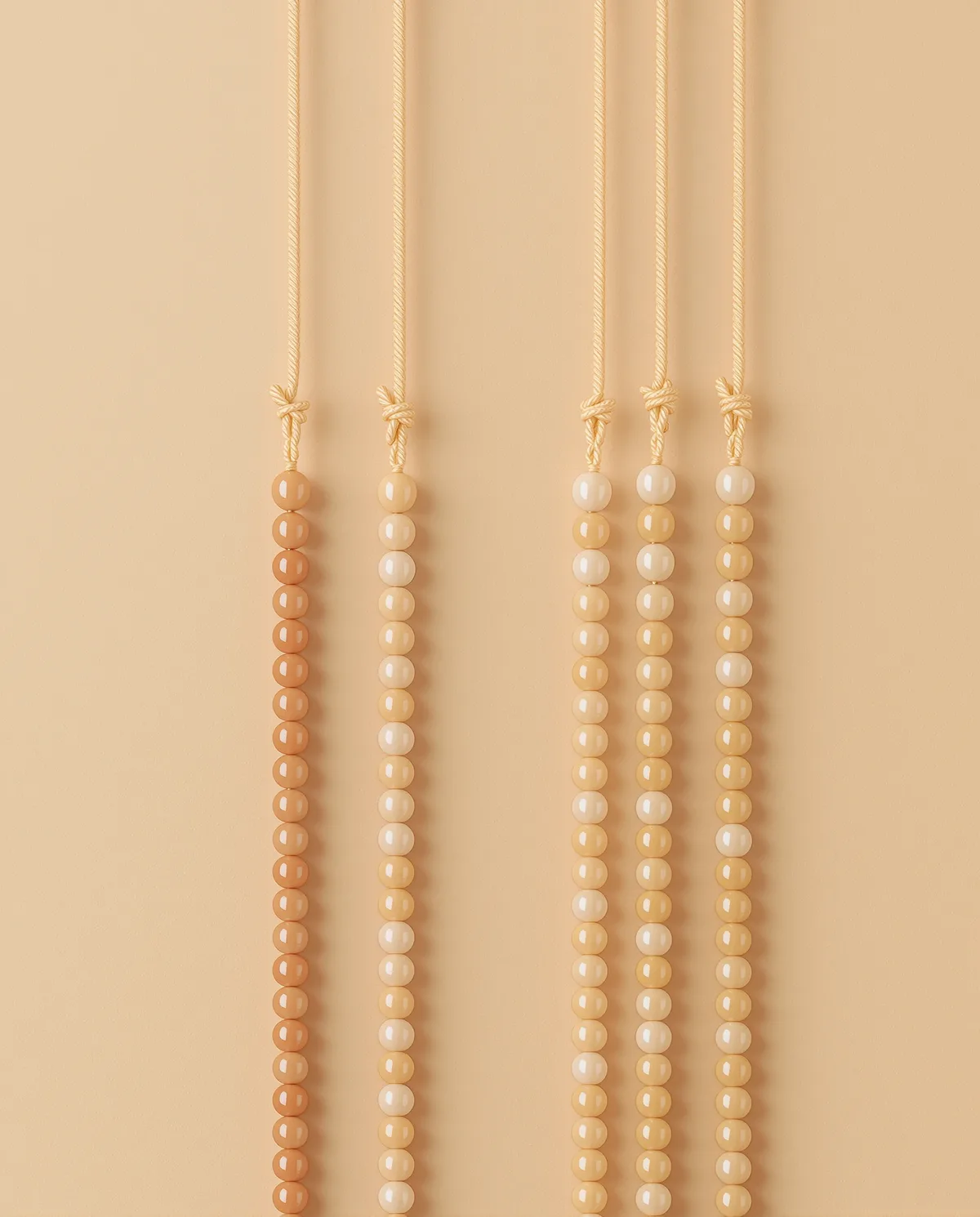
Strand count is how many strands hang from the header; strand pitch is the centre-to-centre distance between them. Width divided by pitch gives the count. Thirty hand-strung strands on a single dowel is the common shipped build at about 90 by 200 cm, while the 2027 design library works at 40 strands on 90 cm and 60 on 120 cm.
Two values, and either one plus the width gives you the other. The strand count is how many strands hang from the header. The pitch is the centre-to-centre distance between adjacent strands where they are fixed.
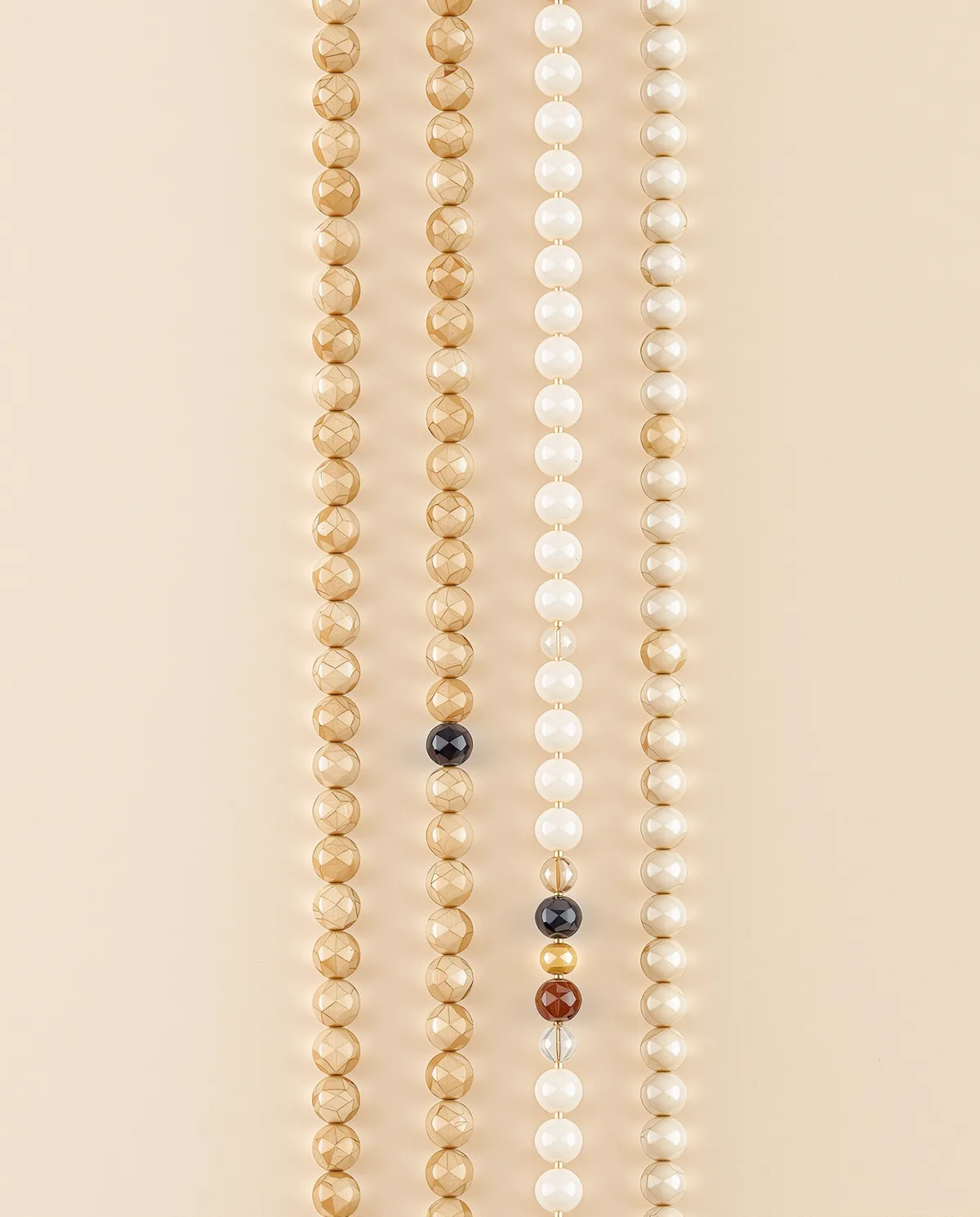
Give a pitch and a width, or a count and a width. A count on its own becomes wrong the moment the width is revised, and a pitch on its own has to be multiplied out by whoever reads the pack.
| Format and width | Strands | Approximate pitch | Origin |
|---|---|---|---|
| Door panel, 90 cm | 30 on a single dowel | About 3 cm | Record |
| Door panel, 90 cm | 40 | About 2.25 cm | Library |
| Door panel, 120 cm | 60 | About 2 cm | Library |
| Doorway portal, 76 cm | 27–40 | About 1.9–2.8 cm | Library |
| Valance, 120 cm | 56–60 | About 2–2.1 cm | Record (image alt) |
| Arched valance, 76 cm | 30 | About 2.5 cm | Record |
| Wall hanging, 50–76 cm | 20–40 | About 1.9–2.5 cm | Library |
| Linked faux-capiz hanging | 12–16 columns | Set by disc diameter | Library |
| Full-length library range | 40–60 | About 2–2.25 cm | Library |
Two separate sets of figures sit behind this, and conflating them is a real risk. The shipped build at around 90 by 200 cm is thirty hand-strung strands on a single wooden dowel, which works out at roughly 3 cm pitch. The 2027 design library draws at 40 strands on a 90 cm panel, about 2.25 cm, and 60 strands on 120 cm, about 2 cm.
Both are true. The library designs are denser by intent.
Pitch is measured centre to centre at the header, in millimetres, at several points across the width. Strand count is counted at the header. Nothing in this specification is measured at the hem, because the strands at the hem have moved.
The value a specifier is often actually interested in is the gap between strands, which is pitch minus the bead diameter. That is worth calculating but not worth specifying, because it is a derived number and the bench cannot set it directly.
Give two: a per-strand pitch tolerance and an overall width tolerance across the header. The second is the one that protects the design, because a small error repeated across sixty strands accumulates into a visible shift at the last strand.
Hand work holds a per-strand pitch comfortably and accumulates if nothing limits the total. A drawing that states both closes that gap.
More than any other single value. Pitch sets strand count, strand count multiplied by the beads per strand gives bead count, and bead count is the largest line in the material cost and most of the stringing hours.
The same panel at a tighter pitch is a materially more expensive product. Where a programme needs to come down in price, pitch is one of the first levers examined — alongside de-densifying the fill within each strand, which reduces bead count without changing the pitch or the apparent width of the panel.
That pitch is set by what the format is for, not by a house rule. Thirty strands on a single dowel for a door panel. Fifty-six to sixty strands across a 120 cm valance, which is much tighter, because a valance is short and is read as a solid band rather than as something to walk through.
Linked faux-capiz hangings replace pitch with column pitch, and the library runs 12 to 16 columns, on formats from 70 by 130 cm to 90 by 200 cm. Disc diameter sets the spacing there, because adjacent columns must not touch.
In the construction block, with the bead diameter next to it. Pitch in millimetres, strand count as a whole number, width stated on the same line. Where a buyer has supplied a reference photograph of the density they want instead of a number, that photograph becomes the specification and should be numbered and referenced like any other sheet.
A reference photograph is legitimate. An unreferenced one in an email thread is not.
The drawing, for pitch and count, and the colour-count sheet, which carries the strand sequences that have to match the count. First-article inspection measures the pitch across the header on the opening pieces, before the balance of the run is strung.
Count is also an integrity check on the sheet: thirty strand sequences and twenty-nine strands on the panel means somebody has skipped a sequence, which will show as a gap at a known position.
Pitch and gap, above all. A buyer who asks for a 2 cm gap between strands and gets a 2 cm pitch has lost most of the openness they wanted, because the bead diameter eats into it.
The other is pitch and fullness. Fabric curtains are specified by fullness, a ratio of fabric width to track width. Beadwork has no fullness, and a brief asking for two-times fullness is asking for a pitch that has not been named.
The spec table above, organised by format and width. It is the table to read alongside the formats sheet: that one fixes the envelope, this one fixes what the envelope is filled with.
A specifier deciding on view-through should read it against the density page, which treats the same numbers as a performance requirement rather than as a construction one.
A single correct pitch. There is none, and a published "standard pitch" would be wrong for most briefs.
Nor is there a published weight per strand, a published open-area percentage or a flammability rating tied to a pitch. None of those has been measured across the format set and none appears here.
The maker fills it from the nearest library design, which on most briefs means a denser panel than a buyer expecting the shipped thirty-strand build would have specified. The panel is correct, the cost is higher than anticipated, and the conversation that should have happened at brief stage happens at quote stage.
After the drill hole, pitch is the most consequential omission in an incoming bead brief.
Good to know
Pitch across the header, measured at several points rather than once, and the total strand count. Cumulative error is the thing being looked for: a pitch 1 mm tight on every strand over sixty strands puts the last strand 60 mm from where the drawing puts it.
Because the right pitch depends on the bead diameter, the drop and what the panel is for, and a single published figure would be wrong more often than right. What is published is the pitch range our own designs work in, with the origin of each figure named.
There are two answers. From shipped work, thirty hand-strung strands on a single wooden dowel at around 90 by 200 cm. From the 2027 design library, 40 strands on a 90 cm panel at about 2.25 cm pitch and 60 on 120 cm at about 2 cm.
Centre to centre at the header, in millimetres. Not the gap between strands, which is pitch minus bead diameter, and not anything measured at the hem, where the strands have moved away from their fixed positions.
State a tolerance on the pitch and a tolerance on the overall width across the header. Those two together control the thing that actually matters, which is that the last strand lands where the drawing says. A per-strand tolerance with no overall limit permits cumulative drift.
The arithmetic does not, but the sensible range does, because bead diameter sets a floor on pitch. A 2 cm pitch is open with a 1 to 3 mm seed bead, tight with a 13 by 22 mm oval, and impossible with a 25 mm disc.
Keep exploring
Specification
How bead count is estimated from size, pitch and diameter — and why density matters more than dimensions.
How it is madeTechnique
The bead map, the cord, thirty strands on a dowel, hem shapes, suspension loops — and the three levers that move the cost.
Open the referenceReference
Specification sheets and definitions — the pages to send a designer before they draw.
Open the referenceSpecification
What a beaded panel weighs by material and density, and which fixings suit light acrylic against heavy glass.
See the detailSpecification
Cotton cord, nylon thread and coated steel wire compared on drape, repair and how each one eventually fails.
Compare the options
Start a conversation
Send a reference, a colour chip or a sketch. Minimums are set per design and confirmed per quote; sampling is quoted separately and usually runs 16 to 20 days from an agreed brief.