Reference
Beadwork techniques
Five craft families — strung, embroidered, wire-wrapped, knotted and wrapped fibre — and what each one is good for.
Compare the options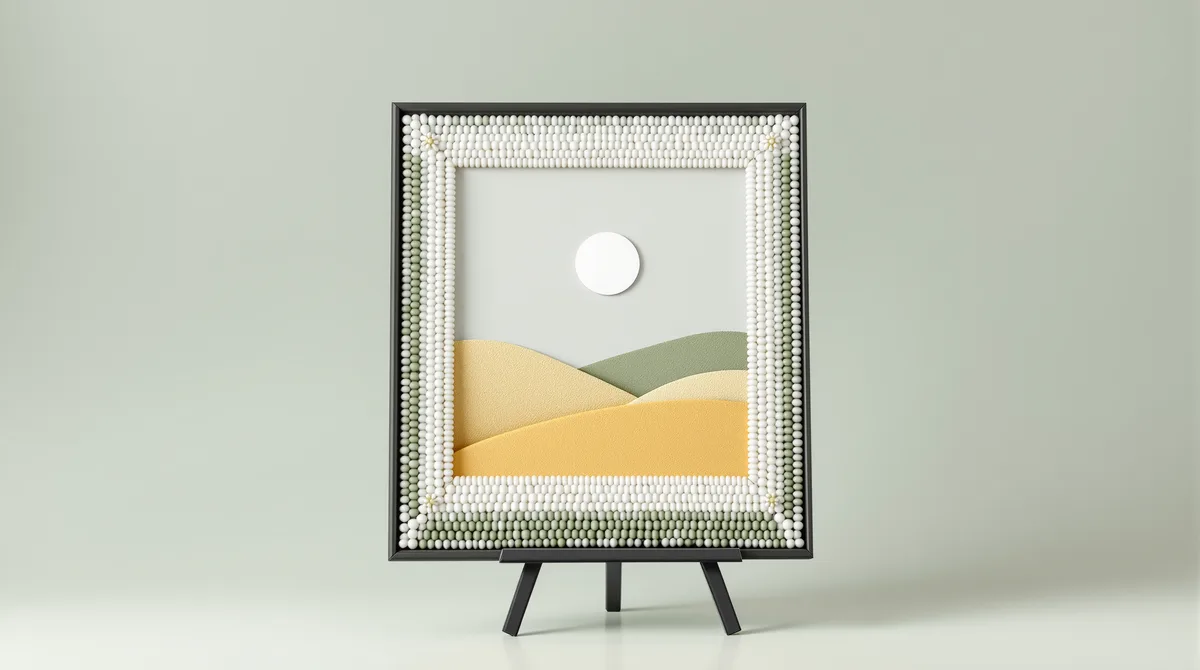
Manufacturing · Frames
Frames drawn bead by bead against real beads, at true size, on a six-millimetre core, with the nine ways a bead can be held on a flat face worked out for each. Pick one and the first piece is a sample, built in our own beadwork studios.
A beaded picture frame standing on a black kickstand, its border built up in close rows of chalk white and sage glass beads, holding a flat graphic landscape of a pale disc sun…
A beaded picture frame is built on a flat core about six millimetres thick. Every bead is threaded on wire that starts and ends in a drilled hole, or glued to a seat if it has no hole. The designs are drawn for a 4 × 6 inch print, each available to develop: the first piece is a sample, built bead by bead in our own beadwork studios.
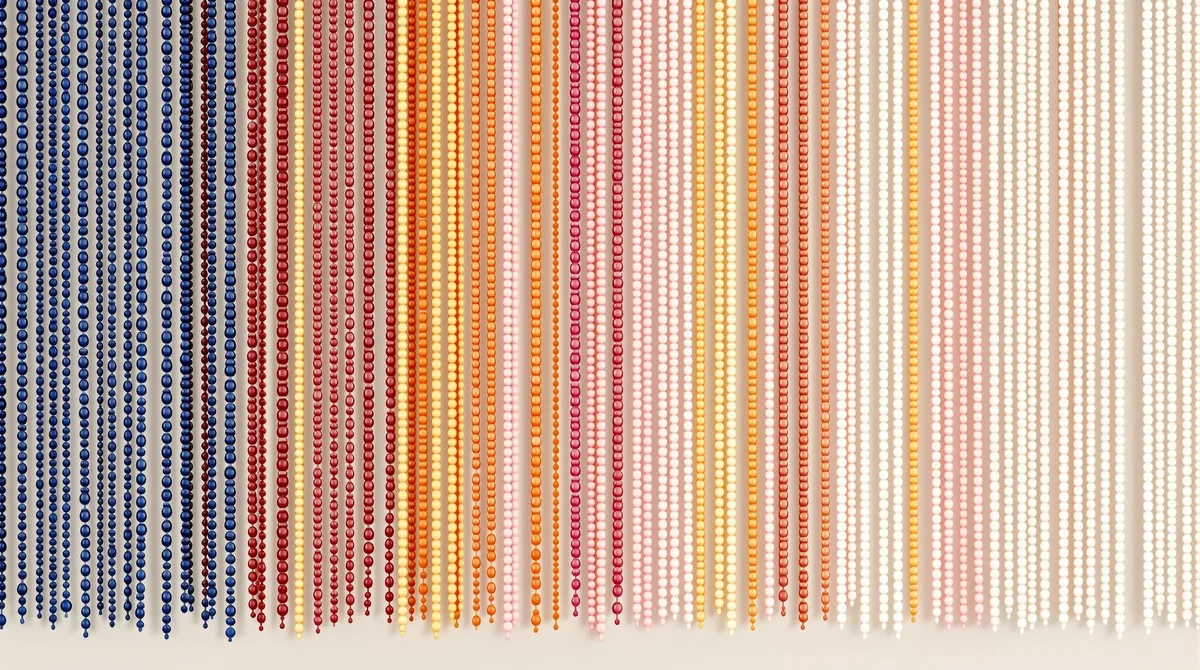
Ten beaded picture frame designs are drawn, each built around a 4 by 6 inch print. The rule that matters: no bead on a frame is ever just placed. Every bead is either threaded on a wire that starts and ends in a hole drilled through the 6 mm core, or glued to a marked seat on the core face if it has no hole at all. Rows run along paths around the photo window, bands fill the border, loops and fringes reach past the edge, and motifs sit where the drawing puts them.
Everything except the bench. The ten frames exist as full layouts drawn at true size from photographs of real, catalogued beads, rendered on their easel backs so the depth of loops and motifs can be judged, with the holding method worked out for every bead in every row.
So the bead mix, the bead count, the drill count and the colours are specifiable now, straight into a construction pack. Hand-feel, finished weight and the sample lead time come off the first sample, which is where every beaded format is contracted anyway.
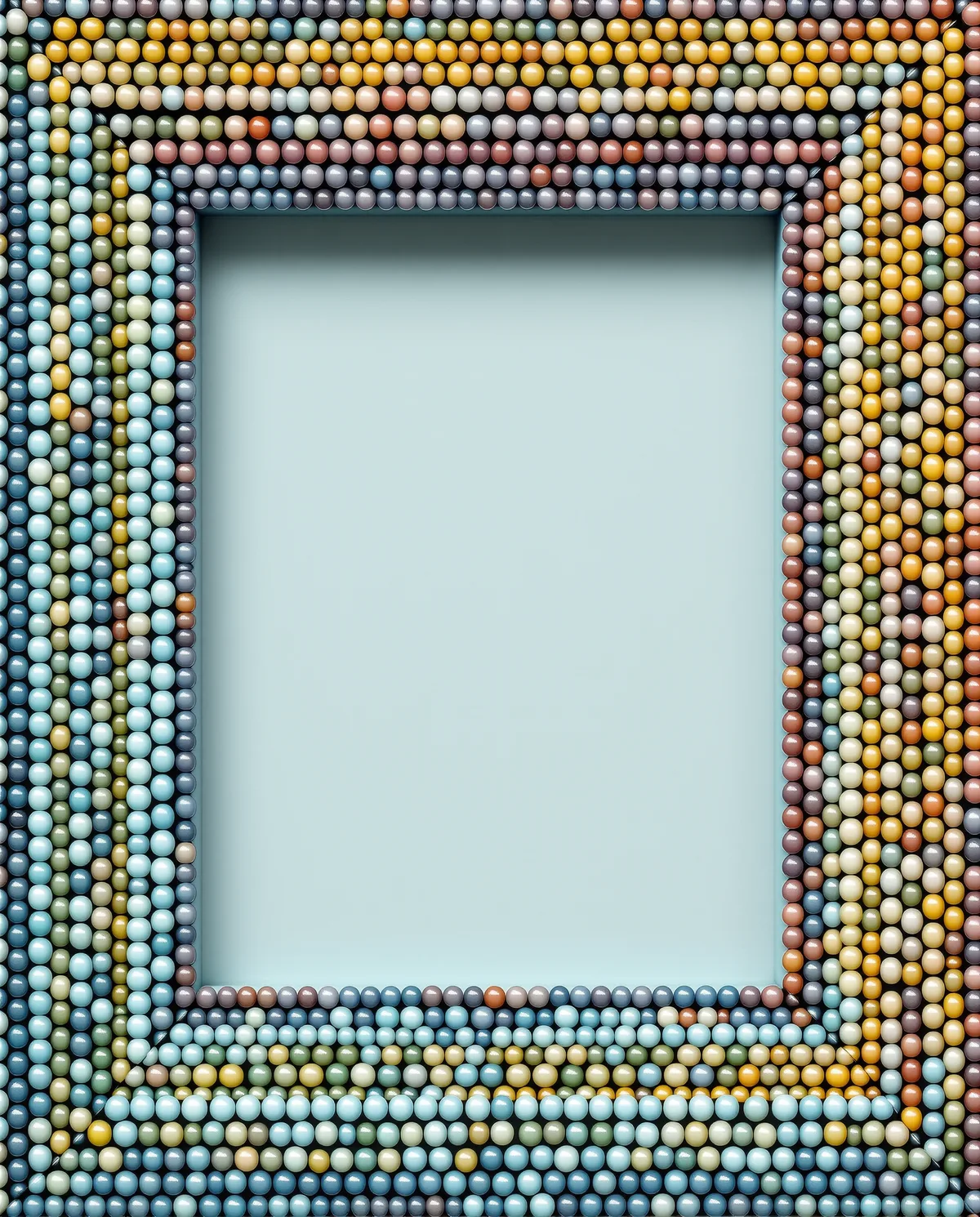
Nine methods cover every bead in every layout, and each bead belongs to exactly one. A face row runs on brass wire through a pair of holes every 42 mm, so a long row cannot bow. A tacked bead takes one short wire, bent flat at the back. A stem is a pin through a single hole at the foot. A pinned rosette or fan uses headpins through one centre hole, or three on an arc wire. An edge loop runs on coated steel wire through two holes and is crimped. A fringe strand runs on coated wire through one hole, with the bottom bead as the stop. An armature is heavier wire tied down at three or four points, for bows and crowns. A hanging loop is doubled coated wire behind the top edge. A glued cabochon has no hole and sits on a glued seat.
Changeable: every bead colour, the bead mix within a catalogued shape and size, the overall size via a redrawn core, the motif selection, and whether the frame stands or hangs.
Fixed: the holding method for each bead is decided in the layout, not on the bench. A cabochon is never threaded and a holed bead is never glued. Loop feet within 5 mm share one drilled hole so neighbouring loops can be crimped together, and an anchor that would fall beyond the core is pulled in towards the centre rather than squared to the nearest edge — which is what makes a corner's loops fan instead of pile.
| Specification | Value |
|---|---|
| Photo size | 4 × 6 in print |
| Photo window | 96 × 146 mm (a 3 mm lip over the print) |
| Core | 156 × 206 mm, 6 mm thick |
| Overall, with loops and motifs | About 6.3–8.4 in wide × 9.4–10.4 in high |
| Designs drawn | Each for a 4 × 6 in print |
| Ways a bead can be held | Nine, one per bead, drawn into the layout |
| Face-row wire spacing | A wire pair every 42 mm so a long row cannot bow |
| Shared loop feet | Feet within 5 mm share one drilled hole |
| Row spacers | 4 mm pressed glass or brass |
| Back | Velvet easel back; one design hangs from a beaded loop |
| Bead materials | Catalogued glass, pressed glass, millefiori and cabochons |
| Status | Designs available to develop at the drawn size |
Every design starts at a 4 by 6 inch print. The overall size varies from frame to frame because loops, crowns and fringes reach past the core by different amounts — hence the range rather than a single figure. Other photo sizes are drawn on request: the core is redrawn, bead sizes stay true, and the motifs keep their proportions instead of being scaled.
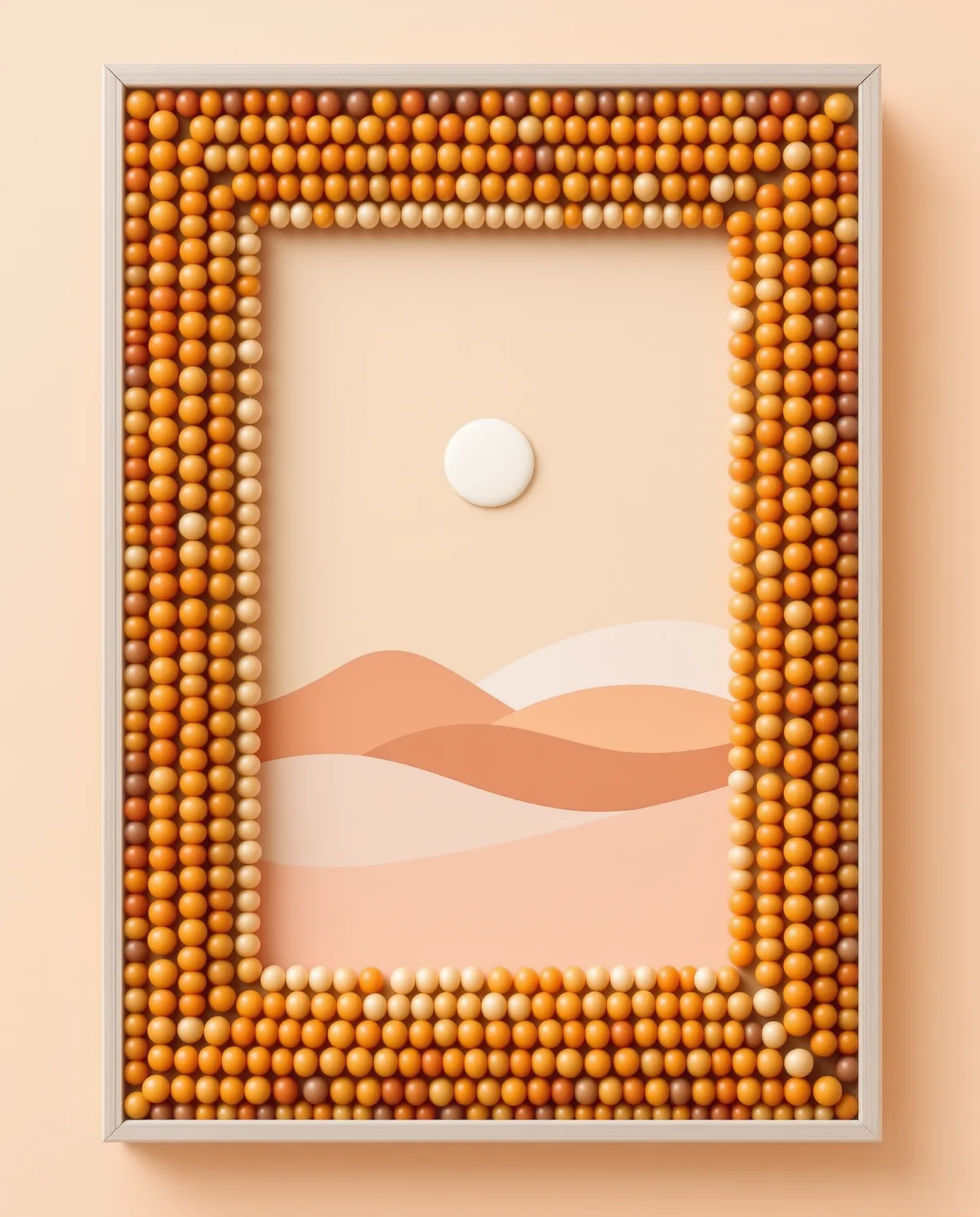
Glass does nearly all the work: pressed glass beads for repeatable shapes, millefiori and crackle for pattern inside a single bead, faceted glass beads for the starburst clusters, and flat-backed cabochons for the motifs that sit proud of the face. Brass wire and nylon-coated steel wire hold everything, and 4 mm spacers keep row spacing even.
A frame is never drawn in invented colours. Each bead type in a layout is a pool of real catalogued beads from the material library — one shape, one stocked size, in the colours it is held in — and a bead joins that library only once a photograph shows it clearly.
The design, the photo size, the colour direction, whether the frame stands or hangs, and the quantity per colourway. Then packing and the port or warehouse. A tech pack is not needed from you; the construction pack is ours to draw.
The useful extra is a palette rather than a list of bead colours: send the palette and the layout is redrawn in it bead by bead, so the frame can be seen before anything is sampled. Where nothing closer than a near match exists — a crackle bead asked for at 8 mm drawn as a 9 mm flake glass bead — the substitution is written into the design at the start, so it never surprises anyone on the sample.
Two routes, and they behave differently. A bead we hold is matched by choosing another colour of the same catalogued bead, which repeats exactly because the shape comes from one mould or one drawn cane. A bead we make ourselves can be matched to a colour reference or a physical chip, which gives a closer palette match but makes the colour a batch property rather than a catalogue one. Fix the motif beads first and let the border rows follow: a motif bead carries the design and a border row only has to agree with it.
Choose a design, and it is redrawn in your colours bead by bead at true size, with a rough cost sheet before anything is made. Everything then goes into a construction pack: the order of work, the plan, the holding method for every run, the drill count and the metres of wire, with each wire drawn in the colour of its method, every hole ringed and every glued seat hatched. The pack cannot be released if a bead is held by nothing, a cabochon has been threaded, too many pins share one hole, or two holes sit on top of each other. The first sample of each design will be built from that pack, with a glass front and a velvet easel back, then checked against the drawing and photographed for approval.
The checks follow the construction pack, and they are the standard the first run is held to. Hold: every bead secure and every crimp closed. Shape: loops even, rows straight, fringes hanging at the drawn length. Colour: beads matching the approved sample. Finish: glass clean, photo window clear, and the frame standing or hanging true.
First-article and lot inspection, kitting and export packing run through our own quality and packing house, as they do for every beaded format.
Bead count first, bead size second, and the number of distinct holding methods third — six methods cost more in labour than three at the same bead count, because each is a different operation at the bench. Drill count is the hidden fourth, and sharing feet within 5 mm is the design decision that takes drilling out. Reducing the overall size saves less than buyers expect, because the glass front, the easel back and the edge work do not shrink with the face.
Gift and lifestyle retailers, where a beaded frame sits at a price point almost nothing else occupies; boutique design retailers buying under their own label; seasonal and holiday ranges, where the bow-topped and crown-topped designs belong; and corporate gifting, where one frame carries more perceived value than most objects at the same cost.
Good to know
No. Minimums are set per design and confirmed per quote. On a frame the bead mix is the whole cost, and a mosaic frame and a loop-edged frame at the same overall size are not comparable jobs, so a range-wide figure would be meaningless.
No. Every beaded format is made to order against an approved sample, and these are designs available to develop: you choose one, we redraw it in your colours and size bead by bead, and the first piece is built in our own beadwork studios as a sample and quoted as one.
In two ways. Each bead in a design is a catalogued bead in a stocked size, so a colour change is normally a swap to another colour of the same bead. Where the bead is one we make ourselves — in our own glass works, or moulded and dyed acrylic — the colour can be matched to a reference or a physical chip instead.
Yes, but it is a redraw, not a scale. The layout is drawn at true size from photographs of real beads, so a new photo size means a new core and a fresh layout at the same bead sizes. That keeps the beads true and the motif proportions right, instead of stretching a drawing until the beads lie.
The sample time is confirmed at quote, because on a frame it is set by the bead mix and the drill count in the design you choose. For context, our beaded curtain samples usually run 16 to 20 days from an agreed brief, and beaded décor production runs 40 to 60 days after sample approval.
Frames have loops and fringes that can catch or chip and a glass front that needs protecting, so each frame is packed so the beadwork is never pressed, and the outer cartons follow your carton and label specification. The packing decision belongs at design stage on any frame with motifs reaching past the core.
Glass seed beads and larger pressed glass are drawn in our own Firozabad glass works. Brass and metal beads are made, finished and plated in our own Moradabad plants. Acrylic beads are moulded and dyed to our colour, to our own bead dies where a design needs a custom moulded bead. Inspection and export packing run through our own Greater Noida house.
Keep exploring
Reference
Five craft families — strung, embroidered, wire-wrapped, knotted and wrapped fibre — and what each one is good for.
Compare the optionsDesign
Colour stories documented by how they are built, not by how they look in a mood board.
Compare the optionsPillar
Brief, rough cost sheet, colour match, sample, production, packing — the six stages with the real published timings.
Specs and sizesHub
The full beaded range — curtains, portals, valances, tabletop, cushions, textiles and beads — from a leading manufacturer that makes the bead as well as the piece.
Specs and sizesGuides
One guide per question that arrives often enough to be worth answering properly.
See the detailManufacturing
Bead-embroidered glass coasters on stiffened felt, or moulded acrylic sets in translucent and opaque — construction, sizes and what moves the cost.
Read the guide
Start a conversation
Send a reference, a colour chip or a sketch. Minimums are set per design and confirmed per quote; sampling is quoted separately and usually runs 16 to 20 days from an agreed brief.