Pillar
Beadwork for the table
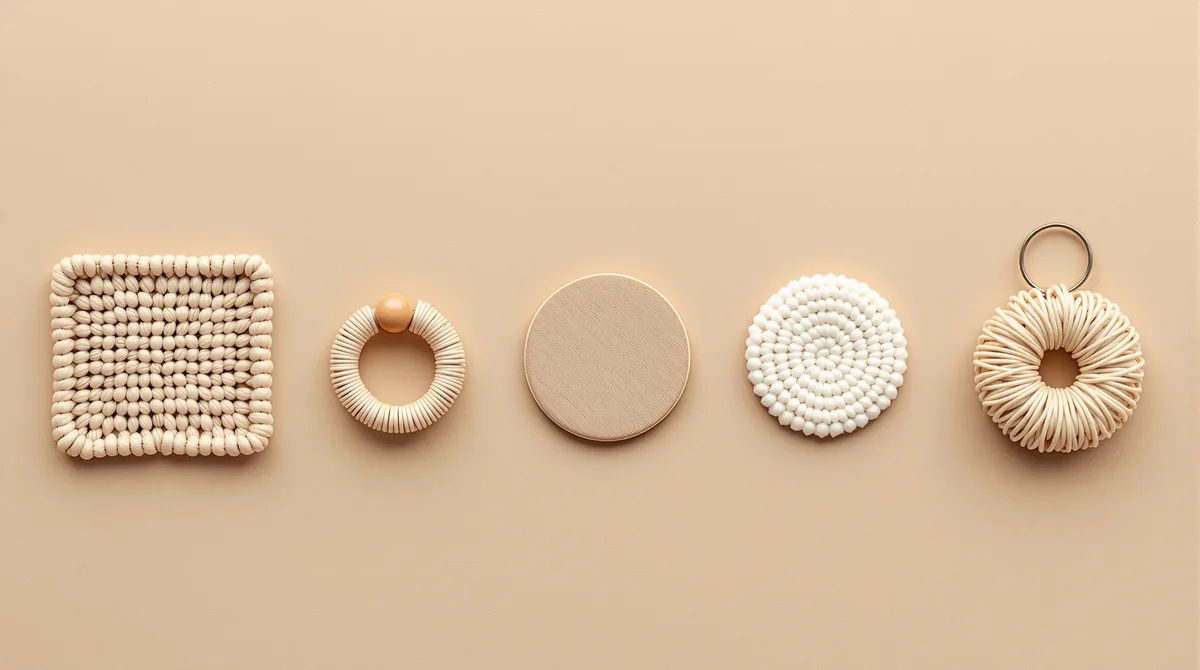
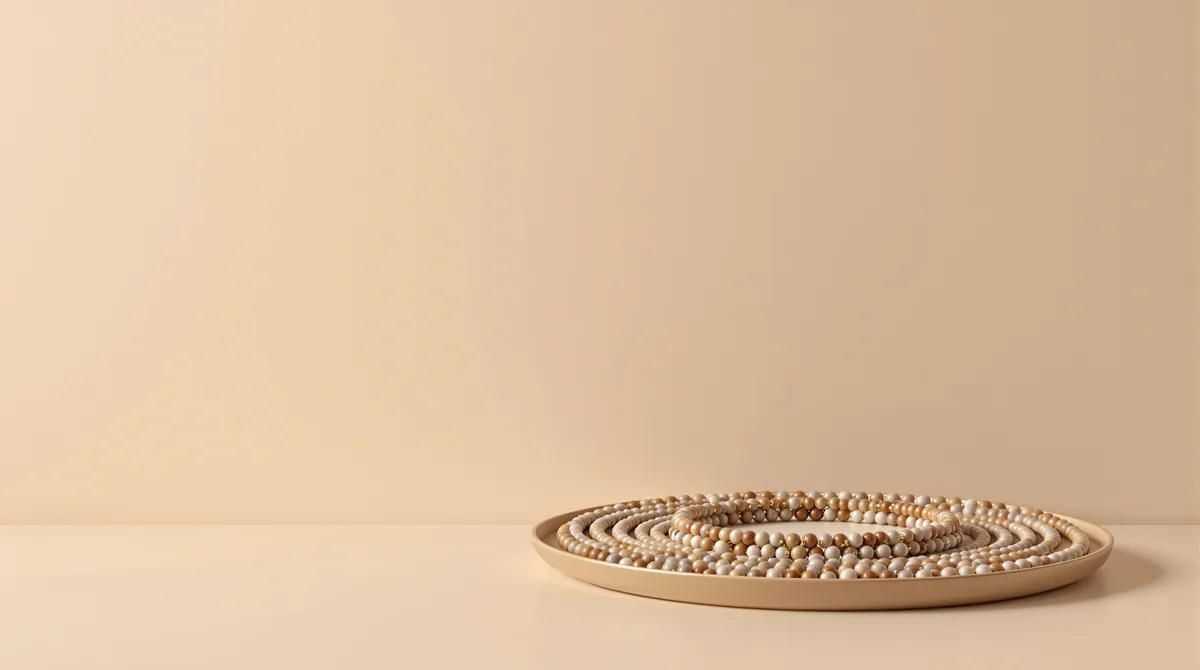
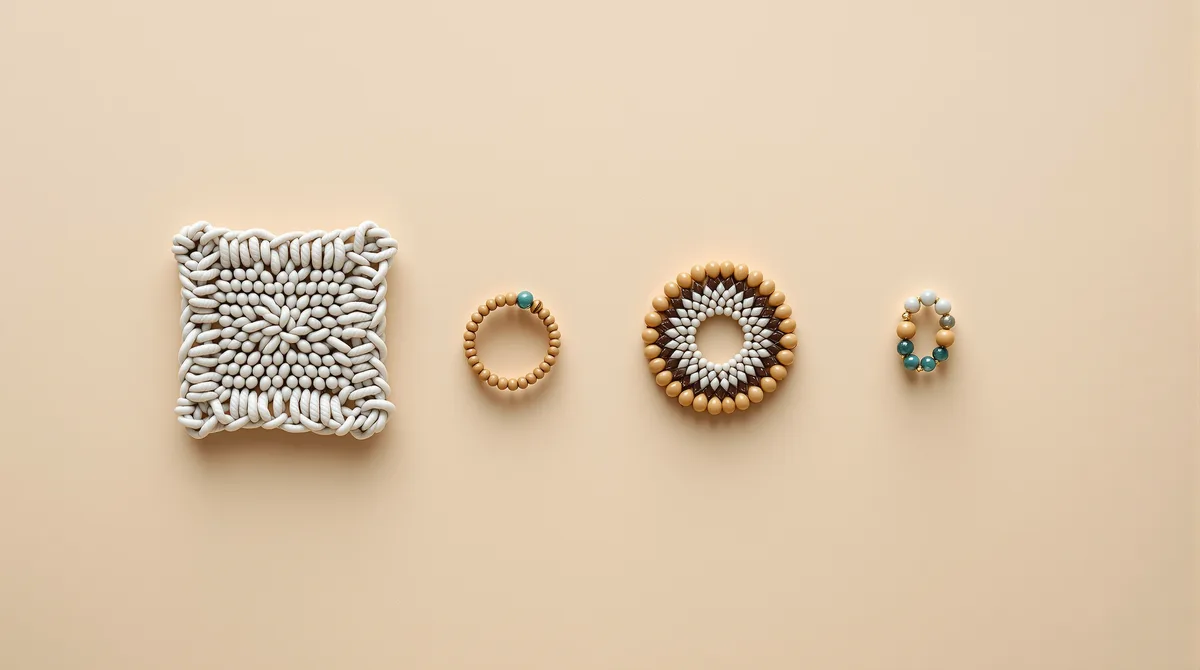
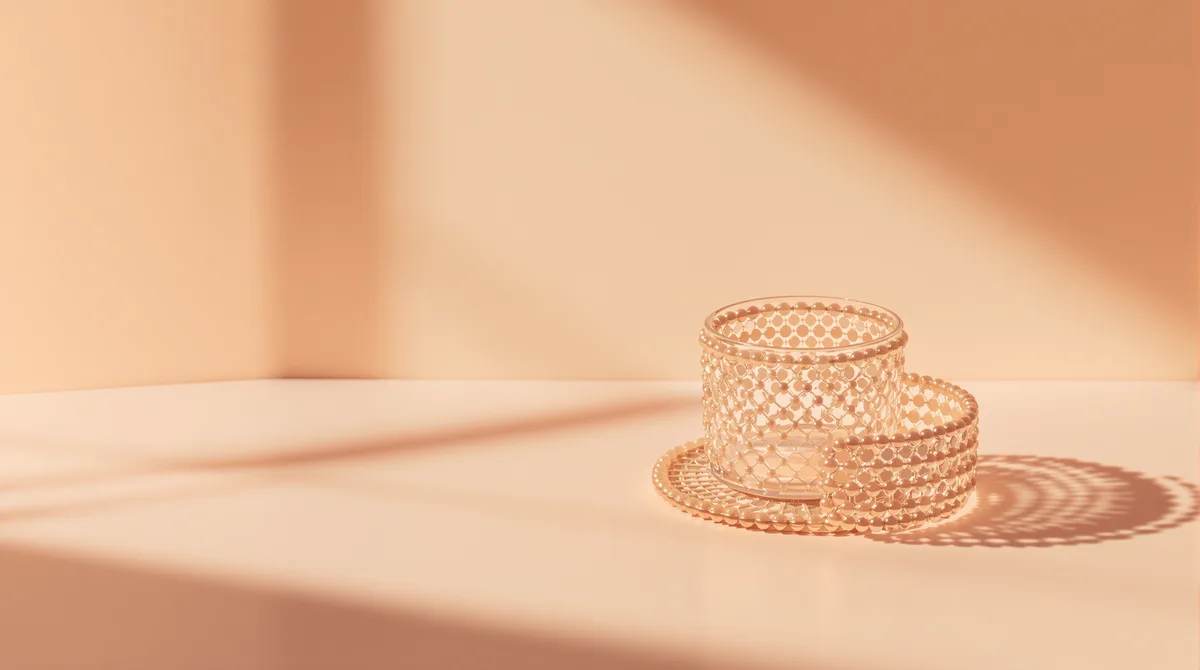
The table cluster: coasters, placemats and chargers, runners and napkin rings, with the construction and ground material each one needs.
See the detail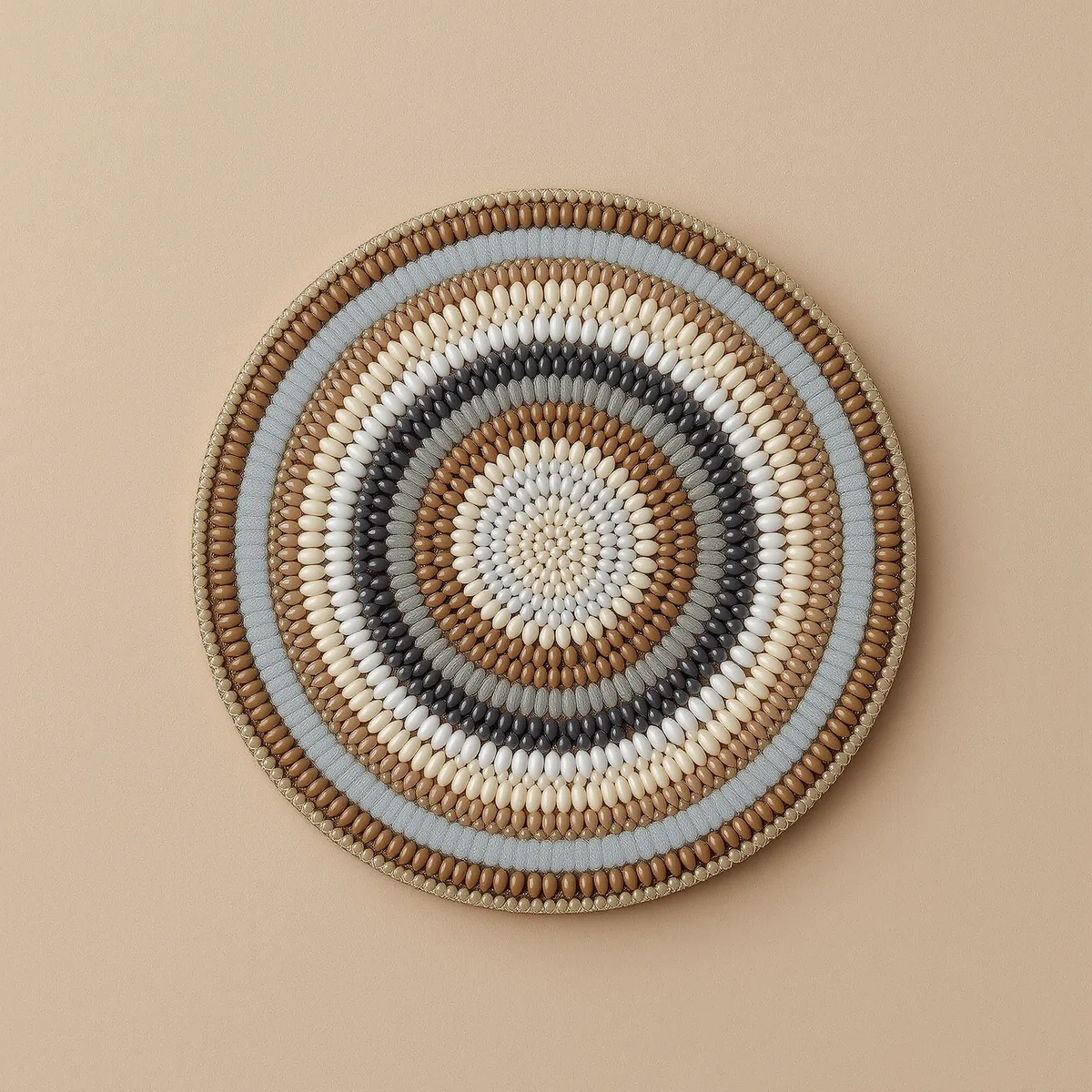
Manufacturing · Beaded table décor
Two constructions, two price positions, one brief. Bead-embroidered glass coasters are a hand-couched object; moulded acrylic coasters are an assembled one. The difference shows in the hand and in the cost sheet.
A round beaded coaster, glass seed and bugle beads couched onto stiffened felt in concentric rings, the felt backing turned at the edge.
Beaded coasters are made two ways. Bead-embroidered coasters couch glass seed and bugle beads onto stiffened felt at 10 to 11 cm across, felt-backed with a turned edge. Moulded acrylic coasters are three inches across and come in translucent and opaque versions. Both are made to order against an approved sample.
A coaster is the hardest small object in beadwork to get right, because it has to survive being used while reading as a decorative piece. There is no gravity to help: every bead has to be held individually, which means thread or a moulded body rather than cord. That single fact is why beaded table décor is quoted by a different studio from hanging work, and why the beadwork techniques that apply here are embroidery and wrapping rather than stringing.
Glass seed and bugle beads are couched onto a stiffened ground with metallic thread, in the same zardozi-tradition bead and thread embroidery used for our dimensional florals and brooch work. Finished diameters run 10 to 11 cm. This is the construction that carries detail: a motif nine to twelve centimetres across can hold real drawing because the beads are small enough to behave like pixels.
The second route drops the ground entirely. Acrylic beads are assembled flat so the beads form the body of the coaster, at three inches across. It was developed in two versions — translucent and opaque — because they photograph and merchandise differently: translucent reads as glass on a lit shelf, opaque reads as a solid object and hides a table underneath it. Neither needs pressed glass: the moulded acrylic bead is the whole object.
Felt backing with a turned edge is not a finishing nicety, it is the functional part. It encloses the couching stitches, keeps the underside flat so the coaster does not rock, and stops the stitches scratching a lacquered table. A coaster with exposed stitches on the base is a returns problem.
Glass seed beads and bugle beads are drawn and hand-strung in our own Firozabad glass works, so size and colour are specification decisions rather than catalogue constraints. Larger accents come from pressed glass or moulded acrylic, and the material library covers the nine families in regular use. Base beads are routinely dyed to match an accent bead so the motif reads cleanly against its ground. For the hole, diameter and cord relationships, see bead sizes and stringing specifications; colour direction comes out of the colour stories in the design library.
Bead count first, bead size second, motif density third. A slightly larger bead covers the same area with far fewer units and far less stitching time, and at arm's length the difference is invisible. De-densifying an infill — keeping the outline tight and opening the fill — is the change that has repeatedly brought a coaster to target without altering what the buyer actually looks at. The same lever works on hand-strung construction, where a scattered accent replaces a fully covered strand. Which bead material you choose moves it again.
Home and lifestyle retailers buying under their own label; e-commerce sellers who need a set rather than a single piece; hospitality buyers specifying for restaurant and bar tables; and corporate gifting programmes, where a boxed set of bead-embroidered coasters carries more perceived value than almost anything else at the same cost.
Pricing and minimums are set per design and confirmed with your quote, and heat and stain behaviour is confirmed on the sample. If a number matters to your programme, ask for it in writing and it will come back as a quote rather than as marketing copy.
Extractable data
| Specification | Bead-embroidered glass | Moulded acrylic |
|---|---|---|
| Diameter | 10–11 cm | 3 in |
| Bead material | Glass seed and bugle beads | Acrylic beads, dyed to colour |
| Construction | Couched with metallic thread, zardozi tradition | Assembled flat, beads form the body |
| Ground | Stiffened fabric or felt | None |
| Backing | Felt, edge turned | Not applicable |
| Finish options | Matte or glossy bead mix | Translucent or opaque |
| Cleaning | Spot-clean only, never immersed | Wipe clean |
| Production | 40–60 days after sample approval | 40–60 days after sample approval |
| Sampling | 16–20 days from an agreed brief | 16–20 days from an agreed brief |
Good to know
The embroidered version is a hand-couched object: glass seed and bugle beads stitched onto stiffened felt with metallic thread, 10 to 11 cm across, felt-backed. The acrylic version is an assembled object: acrylic beads held flat so the beads themselves form the body, three inches across, in translucent and opaque versions. They sit at different price positions and feel completely different in the hand.
Yes, and that is the normal route. We work from artwork or a reference image, draw a bead map so every bead position is fixed, agree bead sizes and colours, then sample. You approve photographs before the sample ships.
Treat them as decorative, not as trivets. Glass beads tolerate a warm cup, but the thread and the ground do not like sustained heat, and acrylic will soften well below the temperature of a fresh pot. Heat tolerance is confirmed on the sample, against the service temperature the piece will actually see.
Spot-clean only. Lift crumbs with a soft brush, wipe the beads with a barely damp cloth and dry immediately. Do not immerse an embroidered coaster: soaking swells the ground, slackens the couching and marks felt.
Minimums are set per design and confirmed per quote rather than fixed across the range, because bead count and motif density change the material and labour completely. Sampling usually runs 16 to 20 days from an agreed brief and is quoted separately; production runs 40 to 60 days after sample approval.
Keep exploring
Pillar
The table cluster: coasters, placemats and chargers, runners and napkin rings, with the construction and ground material each one needs.
See the detailMaterial
How seed beads are drawn, why dye lots are quoted per run, what the drill hole limits, and where seed-bead work earns its cost.
See the detailTechnique
The bead map, the cord, thirty strands on a dowel, hem shapes, suspension loops — and the three levers that move the cost.
See the detailSpecification
Diameters, drill holes, cord selection, strand counts and format dimensions — the sheet to copy into a tech pack.
See the detailGlossary
Dyeing one bead to another bead's colour rather than to a swatch — why it is used, and what it does not promise.
See the detailIndex
Seventeen beaded objects documented from inside the craft — what each one is, how the tradition builds it, and what it would take to develop one.
See the detailManufacturing
Two constructions — a couched bead field on a stiffened ground, and coiled strung rounds lashed together — plus the limits on heat and washing.
See the detailManufacturing
The couched bead-and-metal-thread technique behind the flat beaded objects: what it is, what it can depict, and the forms built with it.
See the detail
Start a conversation
Send a reference, a colour chip or a sketch. Minimums are set per design and confirmed per quote; sampling is quoted separately and usually runs 16 to 20 days from an agreed brief.