Manufacturing
Valance beadwork
Short strung panels at 120 × 35 cm and other formats, 56 to 60 strands, with scalloped, fan-arch, V-point and straight hems — and why height is the cost lever.
How it is madeReference · Accessories
A tieback is a loaded component wearing a decorative finish. The core and the fixing decide whether it works; the beads decide whether anyone buys it.
A beaded tieback is built on a core — a cord, a brass-wire armature or a textile band — with the bead field worked over it, and it is specified from the load rather than from the look. There is no catalogued Gemixx tieback range: the construction families are real and documented, and a tieback is quoted per design.
Three constructions, and a statement that belongs at the top rather than buried. There is no catalogued Gemixx tieback and no shipped tieback in the production record. What exists is the construction capability, documented and proven on adjacent products, and a tieback is developed per design against an approved sample.

The three cores are a cotton or waxed cord, a shaped brass-wire armature, and a stitched textile band. Over each, the bead field is hand-strung, wire-wrapped or bead-embroidered.
Everything visible can be changed: bead material, bead size, colour, pattern, length and termination. What is fixed is the relationship between the core and the load. A tieback holds a curtain back against its own weight and against being pulled, and no bead field substitutes for a core that can take that.
The second fixed thing is that the hardware is not ours. No pins, rings, brackets or screws are supplied with a beaded tieback, and the fixing into the wall is by others.
| Field | Options or value | Origin |
|---|---|---|
| Core | Cotton or waxed cord · brass-wire armature · stitched textile band | Construction families in the record |
| Bead field | Hand-strung · wire-wrapped over an armature · bead-embroidered on a stiffened ground | Construction families in the record |
| Bead materials | Glass seed and bugle, pressed glass, acrylic, wood, bone, horn, ceramic, shell, metal | Working bead library |
| Termination | Loop · ring · finished end for a holdback pin | Agreed per design |
| Finished length | Agreed per design | No standard length is published |
| Working load | Agreed per design, from the curtain it holds | A tieback is a loaded component; confirmed at sampling |
| Holdback hardware | By others | No pins, rings, brackets or screws are supplied |
| Colour matching | A colour reference or a physical chip, confirmed on the sample | Published practice |
| Minimum order quantity | Set per design, confirmed per quote | No figure is published |
| Sampling | Usually 16 to 20 days from an agreed brief, quoted separately | Published |
| Production | 40 to 60 days after sample approval | Published, beaded décor |
| Inspection | First-article and lot inspection in our own Greater Noida house | Published |
Core, bead field, bead materials, termination, finished length, and the working load — which means naming the curtain the tieback has to hold. A tieback specified without the curtain is specified without its only performance requirement.
After that the usual fields: colour references, pattern, packing, quantity by colourway and destination.
The same levers as any beadwork, in the same order. Bead size and material first, because it is the largest single driver. Then the construction — a wire-wrapped armature is far more bench time than a strung cord. Then the bead density along the core. Then the terminations and packing. Then the length.
A rough cost sheet is issued before any sample is made, which shows where the cost sits and which lever moves the price, so look can be traded against cost before anything is made.
Retailers and e-commerce sellers pairing a tieback with a curtain. Brands buying under their own label who need an accessory to complete a range. Interior and hospitality designers specifying a look for hotels, restaurants, salons and spas, where a tieback is scheduled alongside a panel.
It sells as a pair more often than singly, and it sells as an add-on to a curtain rather than on its own, which makes the colour relationship to the main panel the commercial point.
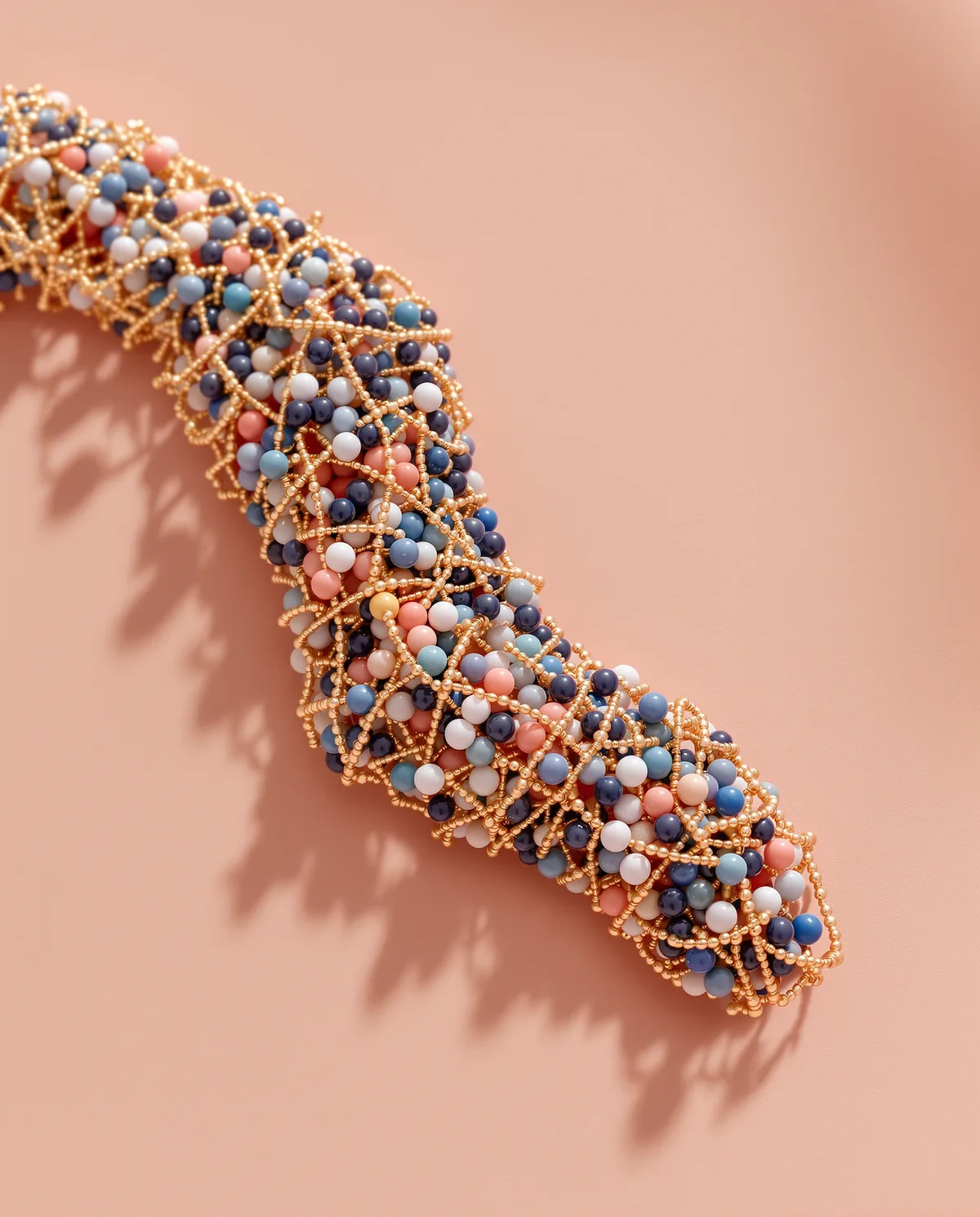
From the working bead library: glass seed and bugle beads, pressed glass, acrylic, wood, bone, horn, ceramic, shell and metal, with more than seventeen thousand beads held in the library across those families.
Metal components are finished and plated in our own Moradabad plants, across the eight standard finishes and custom finishes developed by techniques including hand battering, large-grain sand casting, physical vapour deposition and gold plating.
None, and that is the answer. No tieback length, bead count or load is published, because no tieback has been catalogued or shipped. A length is agreed per design against the curtain it serves.
What is published nearby is the panel format set a tieback would be specified against: door panels at about 90 by 200 cm, portals at 76 by 140 cm, valances at 120 by 35 cm.
Beads are matched to a colour reference or a physical chip, and the colour is confirmed on the sample rather than on the reference alone. Where a base bead is dyed to match an accent, the relationship is written out component by component.
On a tieback the match that matters most is to the curtain it sits with, which means the two should be approved together and ideally from one colour-count sheet.
A brief is agreed. A rough cost sheet is issued before anything is made. Sampling then runs usually 16 to 20 days, with photographs approved before the sample ships, and sampling is quoted separately from production.
A prototype has to be approved before the production run begins. On a loaded component that approval should include a pull test by hand on the sample, which is the only practical check available without a published load figure.
Forty to sixty days after sample approval, which is the published figure for beaded décor. Bohemian and macramé work runs 60 to 90 days and is a different category with a different duration.
Where a tieback is ordered alongside panels, it should be in the same production run. Ordered separately afterwards it becomes a small second run in a possibly different dye lot.
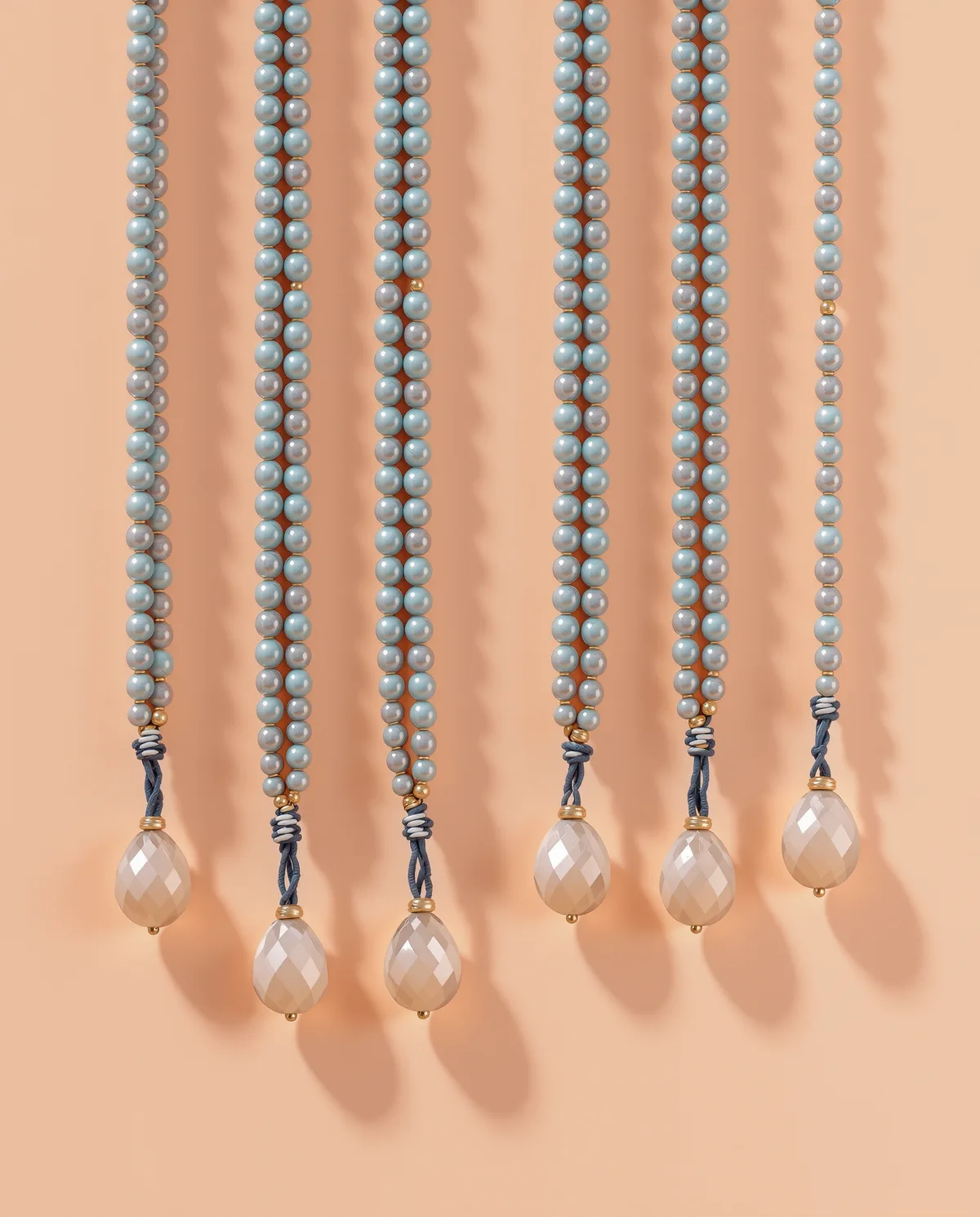
To your carton, label and packaging specification, and shipped to the port or warehouse you name. A tieback is small and robust next to a panel, so the real packing question is presentation — a pair on a header card, a sleeve, or your own pack — rather than protection.
Barcode format, placement and who applies them are confirmed per programme rather than assumed.
A tieback is the one beaded item where the metal matters as much as the bead. Findings, rings and hook plates are finished and plated in our own Moradabad plants — the group began as a metal-finishing business there, and it is still where a loaded component is made. The beads around them are drawn and hand-strung at Firozabad, turned at Saharanpur, fired at Khurja, or moulded and dyed to our colour on our own dies.
Bone, horn, shell and capiz components are cut, drilled and finished to our specification in our own beadwork studios. Five owned plants, one accountable network, no agents and no brokers.
First-article and lot inspection, carried out in our own Greater Noida house. On a tieback the first-article check reads the bead sequence against the colour-count sheet, measures the finished length, and checks both terminations.
The termination check is the one that matters on a loaded component. A bead field with a sound core and a weak loop is a tieback that fails at the one point everybody pulls on, and it is checked on the opening pieces before the balance of a run is made.
Good to know
Beaded décor runs 40 to 60 days after sample approval. Sampling before that is usually 16 to 20 days from an agreed brief, with photographs approved before the sample ships, and sampling is quoted separately from production.
To your carton, label and packaging specification, and shipped to the port or warehouse you name. A tieback is small and robust compared with a panel, so the packing question is presentation rather than protection: whether it sells as a pair on a header card, in a sleeve, or in your own pack.
Glass beads are drawn and hand-strung in our own Firozabad glass works. Any turned timber component comes from our own Saharanpur wood factory. Metal components are finished and plated in our own Moradabad plants. Acrylic and resin beads are moulded and dyed to our colour, to our own dies where a design needs a custom bead. Inspection and export packing run through our own Greater Noida house.
No. Minimums are set per design and confirmed per quote, because a plain beaded cord and a fully wire-wrapped holdback use very different amounts of material and bench time. No minimum order figure is published for beaded décor.
No. There is no retail stock programme for beaded décor and nothing in this line is catalogued. Every piece is made to order against an approved sample, which also means there is no shipped tieback in the production record to show: the construction is proven, the product is developed per brief.
Yes. Beads are matched to a colour reference or a physical chip and the colour is confirmed on the sample. Where a base bead is dyed to match an accent, that relationship is written out component by component rather than left as a general instruction.
Keep exploring
Manufacturing
Short strung panels at 120 × 35 cm and other formats, 56 to 60 strands, with scalloped, fan-arch, V-point and straight hems — and why height is the cost lever.
How it is madeReference
Specification sheets and definitions — the pages to send a designer before they draw.
Specs and sizesHub
The full beaded range — curtains, portals, valances, tabletop, cushions, textiles and beads — from a leading manufacturer that makes the bead as well as the piece.
Compare the optionsPillar
Door curtains, portals, café lengths and valances: the standard sizes, the strand counts and the one question each format answers.
View the range
Start a conversation
Send a reference, a colour chip or a sketch. Minimums are set per design and confirmed per quote; sampling is quoted separately and usually runs 16 to 20 days from an agreed brief.