Reference
Lead times after sample approval
40 to 60 days after sample approval for beadwork, 60 to 90 for bohemian and macramé, with sampling in front of both.
Compare the optionsOrdering · Sampling
Sampling is the only stage where a mistake is still cheap. Sixteen to twenty days from an agreed brief, photographs approved before anything ships, and a sealed sample that production is then held to.
A beadwork sample takes usually 16 to 20 days from an agreed brief, and you approve photographs before the sample ships. Sampling is quoted separately from production. The approved sample is then the reference production is held to, which is why colour is confirmed on the sample rather than on the brief, and why a change after approval is a new approval.
Sixteen to twenty days from an agreed brief, and you approve photographs before the sample ships. Sampling is quoted separately from production.
The phrase that matters there is "agreed brief". The window does not start when an enquiry arrives; it starts when the specification is settled enough to string against. Programmes that arrive with a complete brief and physical colour references start the clock on day one. Programmes that arrive with a mood board start it two weeks later, and then describe the sample as having taken five weeks.
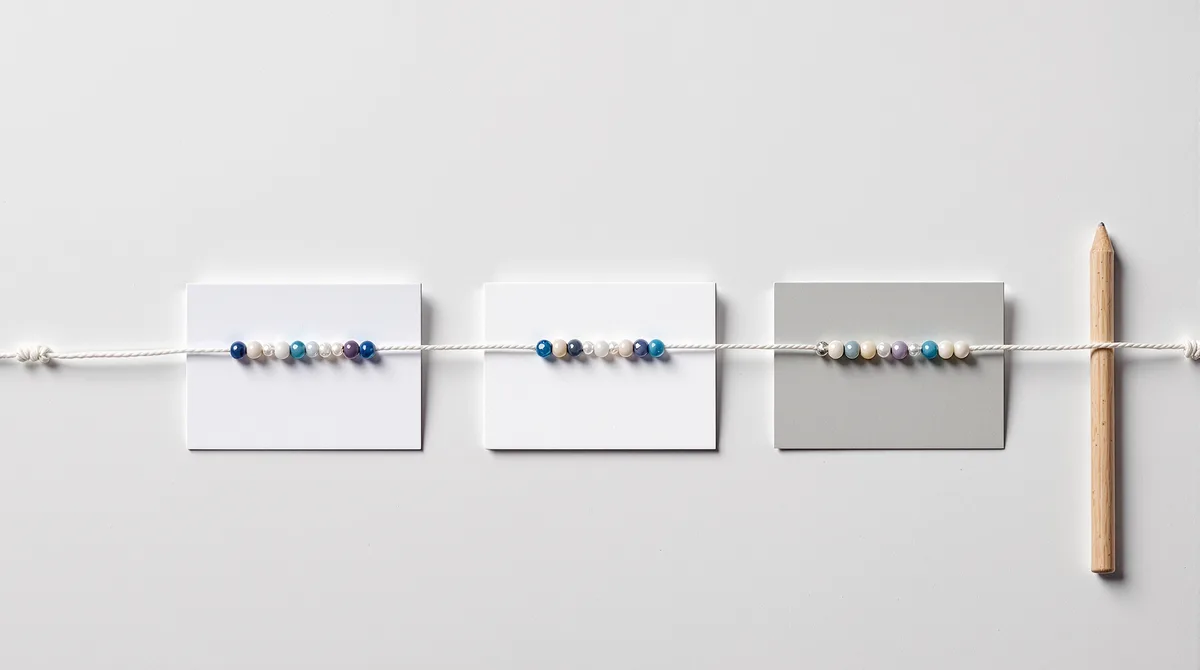
The brief is agreed. A rough cost sheet goes back first, so the design being sampled is already the one that can be afforded. Beads are matched to your colour reference or physical chip. One piece is strung to the specification. It is photographed and the photographs go to you for approval before the piece is packed.
On approval it ships. You check hand, weight and drape — the three things a photograph cannot carry. The sample is then sealed as the reference, and production is released against it with a purchase order.
Whether the beads exist. A sample built from the working library is a stringing job and runs inside the window comfortably. A sample needing a bead that has to be drawn, moulded or dyed to order has a materials step in front of the stringing step, and that step sets the real date.
Pattern type matters second. A rule-strung strand samples quickly. A pattern that has to be mapped bead by bead from a reference image — which is how a figurative design with no artwork file gets made — takes longer at the drawing stage than at the stringing stage.
Compressible: the number of sampling rounds. One well-briefed round beats three interpretations, and the rough cost sheet is what makes one round possible, because it settles the cost argument before the piece is made rather than after.
Not compressible: glass. Where a design needs a new glass colour or a large feature bead, the furnace process and annealing come first. In our own record a Venetian-bead portal had a breakage problem solved by changing the furnace process and annealing the beads, and the palette itself had to be altered because glass strength is colour-dependent and some colours are not compatible when beads knock together in a hanging panel. None of that can be hurried, and none of it is visible in a photograph.
Ask what the sample will not tell you. A sample shows colour, pattern, hand and drape. It does not show lot-to-lot colour variance across a production run, it does not show how the piece behaves after a month on a shop floor, and it does not show carton behaviour in transit. If any of those matter, say so at briefing and they can be built into the sampling plan — a second piece from a different dye lot, or a drop-test carton — rather than discovered later.
Colour, physically. A reference or a chip per bead colour. This is the single highest-value thing a buyer can put in an envelope, and every programme in our record that tried to approve colour from a word went round again.
After colour, a pattern reference. Artwork if it exists; a photograph of the density you want if it does not. Density is the hardest property to convey in prose and the easiest to convey in an image.
Brief to agreed brief: as long as the clarification takes, which is the part under your control. Agreed brief to photographs: inside the 16-to-20-day window. Photograph approval: as long as your internal review takes, and this is the step most often underestimated. Sample in transit: freight time. Sample review to purchase order: yours.
Then 40 to 60 days of production after approval for beaded décor, and 60 to 90 for bohemian and macramé work.
Sampling is quoted separately. Where a design needs a bead moulded to a new die, the tooling is identified as its own line and settled with the quote, so it is visible before a sample is committed rather than discovered in a unit price.
Testing is quoted per market and commissioned against the approved sample, not against the brief, because a test report describes a physical construction.
Order minimums should be confirmed against the same specification, not after the sample is approved.
At approval, when the sample is reviewed by people who were not part of the brief. A sample approved by development and then rejected by a buying team costs a full cycle. The fix is procedural rather than technical: circulate the sample photographs to everyone with a veto before approving them, because the photographs arrive days before the piece does.
The second failure is approving a sample while leaving a field open — a header not finalised, a hem shape still under discussion. An approval with an open field is not an approval, and production released against it will be judged against two different references.
Strand count and pitch and the panel headers are two of the properties a photograph cannot carry.
The sample is more load-bearing than in most categories, because a strung panel cannot be fully specified in text. Strand drift, hem shaping, how a scattered accent reads when it is never aligned in a row, how much a light strand swings — all of those are properties of the physical object. The sealed sample carries them, and the written specification cannot.
That is why the published process puts photograph approval before shipment and a sealed sample before production, and why a change after approval is treated as a new approval rather than as an amendment.
That the published 16-to-20-day window holds for stringing, and that the long cycles are always upstream of it: colour development, cost iteration, or a buyer-side review that took longer than the sample did. One figurative design in our record was pattern-mapped by hand from a reference image alone because no artwork file existed, and the mapping — not the stringing — was the work.
Four neighbours sit immediately around this stage. The tech pack is what starts it; cost levers is what shapes the design being sampled; lead times is what follows approval; and bead colour matching is the single field that most often sends a sample round twice. Where glass is involved, annealing is the step that cannot be hurried.
The sample number and the approval date. The colour references by bead. The hem shape with the longest and shortest drop. The header specification and its length. The inspection standard and whether the sealed sample travels to the inspection, which it should.
An order that names the sealed sample has a defensible quality position. An order that names a photograph does not.
Extractable data
| Step | Who acts | What it produces |
|---|---|---|
| Brief agreed | Buyer and desk | A specification both sides can quote against |
| Rough cost sheet | Desk | Where cost sits, and which lever has room |
| Colour matched | Beadwork studio | Beads matched to a colour reference or a physical chip |
| Sample strung | Beadwork studio | One piece to the agreed specification |
| Photographs sent | Desk | Approval before anything ships |
| Sample shipped | Desk | The physical piece, for hand and drape |
| Sample sealed | Buyer and desk | The reference production is held to |
| Production released | Buyer | A purchase order against the approved sample |
Good to know
A change after sample approval is a new approval. If it touches the bead, the pattern or the size, it resets the cost sheet and can reset the production window, because the colour-count sheet and the bead allocation are both built from the approved sample. Packing and labelling changes are the cheapest kind.
Usually 16 to 20 days from an agreed brief, and you approve photographs before the sample ships. The window starts when the brief is agreed, not when the enquiry arrives, which is why a complete brief buys back days at the front.
A colour reference or a physical chip for every bead colour, and a pattern reference — artwork, or a photograph of the density you want. Those two decide whether the first sample is a candidate or a draft.
Yes. Sampling is quoted separately from production. Testing, where a market requires it, is also quoted separately and is commissioned against the approved sample rather than against the brief.
The sampling discipline is the same and the timing is comparable; a knotted wall piece has gone from tech pack to finished sample in about five weeks in our own record, drawn to a full pack before the first knot. Production on knotted work then runs on the 60 to 90 day window rather than 40 to 60.
The number of rounds compresses if colour arrives physically. Glass colour development does not compress: where a new glass colour or a larger feature bead is involved, annealing trials come before anyone strings a strand, because glass strength is colour-dependent.
Keep exploring
Reference
40 to 60 days after sample approval for beadwork, 60 to 90 for bohemian and macramé, with sampling in front of both.
Compare the optionsReference
The nine fields a beadwork brief has to carry, what each one is used for, and what happens when one is missing.
Read the guidePillar
Brief, rough cost sheet, colour match, sample, production, packing — the six stages with the real published timings.
Specs and sizesReference
The five levers that move a bead price, in order of effect, and why cost per square foot does not describe this product.
Compare the optionsReference
A blank request-for-quote sheet and a bead tech pack template, field by field, usable with any maker.
Read the guide
Start a conversation
Send a reference, a colour chip or a sketch. Minimums are set per design and confirmed per quote; sampling is quoted separately and usually runs 16 to 20 days from an agreed brief.