Technique
Wrapped bead shapes
Bead wrapped over a shaped brass armature: flat-back for rings, full three-dimensional for figural work, and why the wire gauge is the real specification.
See the detail
Craft topic
A bead cannot carry a load. Every beaded basket or vessel that works is a rigid form with a bead surface on it, and the interesting question is always which part is actually holding the shape.
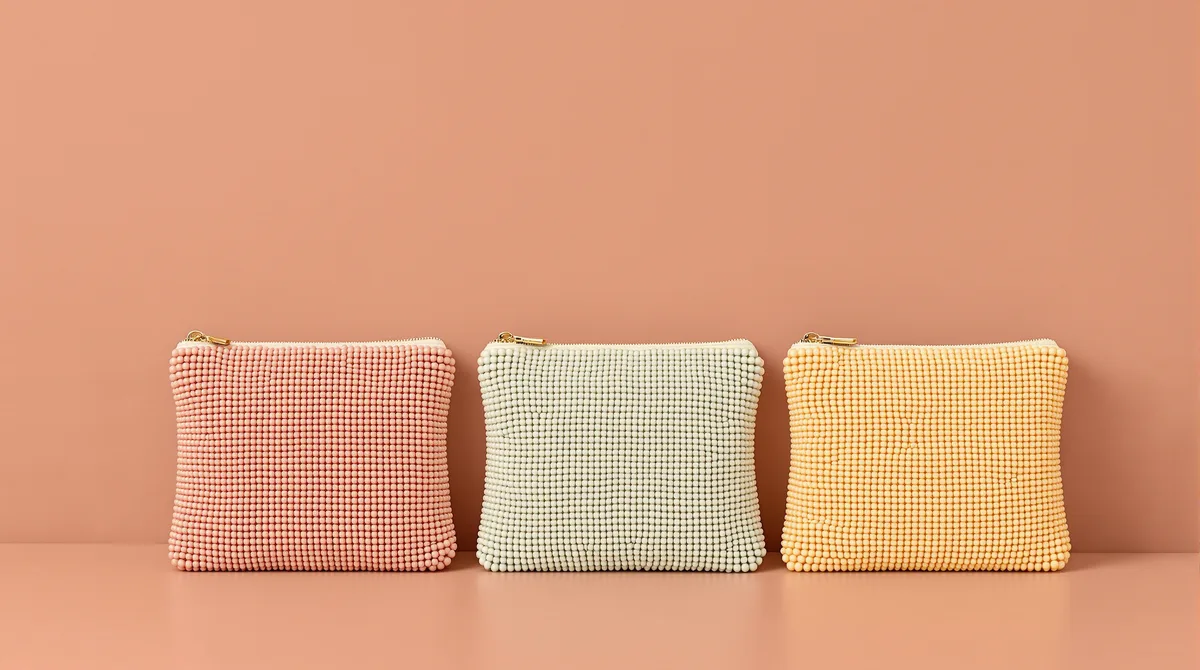
Three beaded vessels in a row, each a rounded open form whose surface is covered in tiny glass seed beads worked in close concentric rows following the curve, in terracotta…
Beads are applied over a basket or vessel three ways: coiled fibre lashed round a wire ring, a bead net worked over an existing rigid vessel, or beads threaded onto the weavers of a cane basket. In all three the form carries the shape and the bead is only the surface, because a bead carries no compression.

A beaded basket or vessel is a container whose outer surface is beadwork. It appears independently in a lot of places — coiled fibre bowls across Africa, the American Southwest and South Asia; bead-netted decanter and tumbler covers in Europe; beaded cane work across Southeast Asia — because the idea is obvious once you have both beads and baskets.
What unites them is a constraint rather than a tradition, and it is worth stating first because it explains every construction decision that follows.
Because a bead carries no compression. A bead is a hard body with a hole through it, held to its neighbours by a thread, a cord or a wire. Push on it and the load goes into whatever is holding it, which is a flexible line.
A basket, by definition, has to hold its own shape with something inside it. So every working beaded vessel is two objects: a rigid form that takes the load, and a bead surface that takes the attention. When one of these pieces fails in use, it is almost always because the form chosen was too light for the bead surface put on it.
Coiled. A core — wire, rope or a bundle of fibre — is wrapped with raffia, jute or cotton rope, and each round is lashed to the round inside it. The wall grows by coiling, and the structure is the coil itself. This is the route that genuinely needs no separate form, because the coil is the form.
Netted. A bead mesh is worked over an existing rigid vessel, usually glass or ceramic, closing at the base and terminating at the rim. The vessel carries everything; the net is a sleeve.
Threaded. Beads are put onto the weavers of a cane or rattan basket while it is being woven, so the bead sits in the weave rather than on it. The cane is the structure.
Because every route terminates there, and a termination is a weakness by definition.
On a coiled piece the last round has nothing outside it to lash to, so it has to be finished back into itself. On a netted vessel the net has to be anchored at the rim, and that anchor takes all the tension of the whole net. On a threaded cane basket the rim is where the weavers are turned and bound, and a bead at the rim sits exactly where the binding goes.
Check the rim first on any piece in this family, before the pattern, the colour or the bead quality. Everything else can be judged from a photograph and the rim cannot.
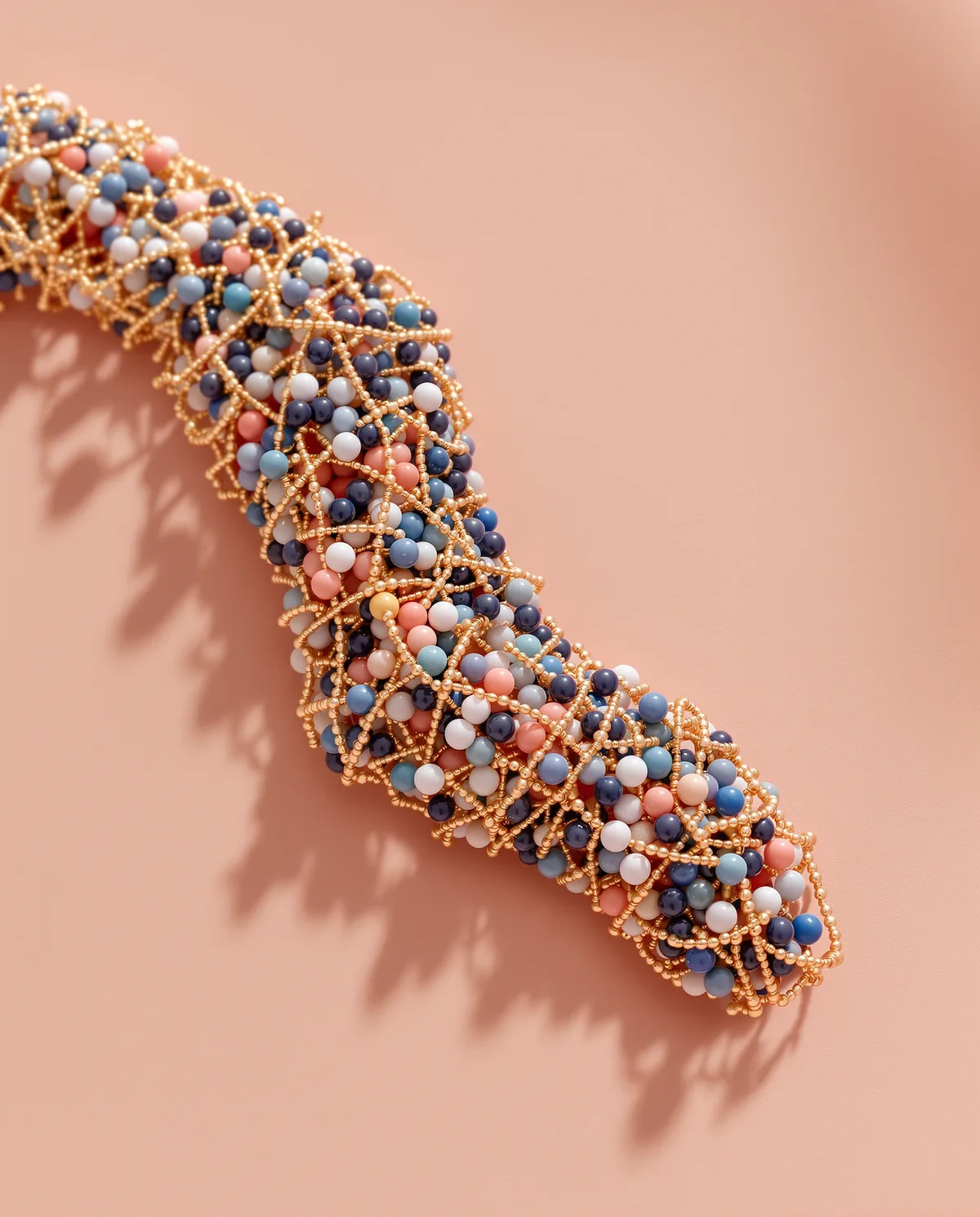
Evenly, and under slight tension all the way round. A net worked loose bags away from the vessel, and then the vessel shows through the gaps — which defeats the whole object, because the point of the net is to be the surface.
A net worked too tight is the other failure. The mesh distorts into ovals, the bead rows stop reading as rows, and on a glass vessel the tension concentrates at whichever point the net was closed.
The test is to turn the piece slowly and watch the gaps. Consistent gaps mean consistent tension. Gaps that change size round the circumference mean they do not.
Raffia, jute and cotton rope for coiling, over a wire ring or rope core. Glass seed beads and bugle beads for netting, on thread or on fine wire. Cane and rattan for threaded work. Glass, ceramic or metal for a vessel that is going to be sleeved.
The natural-fibre family — raffia, jute and cotton rope wrapped and coiled on a wire ring — runs in our own studios at wall-disc scale, 15 to 25 cm, and on coastal charms. That is the technique at wall scale rather than vessel scale, and it is the shortest route to a vessel.
We do not make beaded baskets or vessels. The netting, couching and wire-wrapping a vessel sleeve needs are all techniques we run, so the object is available to develop rather than a line to order.
Three component capabilities are worth naming because they define what a development would start from. Coiling and wrapping on a wire ring is a standing technique in our own studios, alongside wire wrapped beadwork over a shaped armature. Glass vessels are made in our own glass works, so the form a net would go over is something we manufacture. And wire forming and plating runs in our own metal plants.
Our beadwork is overwhelmingly flat or hanging: hand-strung panels, mats, cushion faces, ornaments. A vessel is a closed three-dimensional surface, which means the bead rows have to negotiate a changing circumference in both directions — exactly the pole problem that makes a spherical ornament difficult, except continuously and over a much larger area.
That is the real reason this is a craft page rather than a product one. It is not a hard object to describe and it is a genuinely different bench problem from anything we run.
Coiled fibre bowls are a large craft export category, made at workshop and cooperative scale across Africa and South Asia. Bead-netted vessels are a small artisan market, and the antique European examples are collectors' items. Threaded cane work is made wherever cane baskets are made, which is to say in enormous volume at the low end.
Dust with a soft brush, inside and out. Do not wash: a coiled piece takes water into its core and dries unevenly, and a netted vessel traps water between the net and the glass where it cannot evaporate. Nothing in this family is a food container — if something damp has to go in it, it needs a liner.
Because the structural principle is worth publishing on its own. Anyone specifying a beaded container should be asking which part is carrying the load and how the rim is finished. That is advice that works whoever makes the basket.
Good to know
The rim first, because every construction route ends there and an unfinished rim unravels. Then press the side wall: it should not flex, and if it does the form underneath is too light for the bead surface on it. Then look between the beads on a netted piece for the vessel showing through where the net has bagged.
On a surface, usually, and on its base. A coiled disc version hangs on a wall from a loop worked into the back of the coil. A netted vessel should sit rather than hang, because the net is not a handle and lifting one by its beadwork is how the net separates from the rim.
Dust with a soft brush, inside and out. Do not wash it: a coiled fibre piece absorbs water into the core and dries unevenly, and a netted vessel traps water between the net and the glass. Nothing beaded in this family is a food container — treat them as decorative vessels and keep anything damp in a liner.
A form specification first, because that is the part doing the work: a wire ring, a cane body, or a bought-to-specification vessel. Then the bead surface — net, coil or threaded weaver — a rim treatment, a size set and a sample. The coiled technique already runs here, which makes the coiled route the shortest.
Not as a line. The adjacent technique runs here: a natural-fibre family of raffia, jute and cotton rope wrapped and coiled over a wire ring, used for wall discs at 15 to 25 cm and coastal charms. That is the technique rather than the object, and a vessel is available to develop on it.
The coiled route starts with a wire or rope core, wraps it with fibre, and lashes each round to the one inside it so the wall grows outwards and upwards. The netted route works a bead mesh over an existing vessel, closing at the base and finishing at the rim. The threaded route puts beads onto the weavers of a cane basket as it is woven.
Beaded basket, beaded bowl, beaded vase sleeve, bead-netted vessel and coiled bowl all describe pieces in this family, and the material library covers every bead family used in them. Coiling as a technique has traditions across Africa, the American Southwest and South Asia, and bead-netting over glass has a long European history in decanter and tumbler covers.
Keep exploring
Technique
Bead wrapped over a shaped brass armature: flat-back for rings, full three-dimensional for figural work, and why the wire gauge is the real specification.
See the detailIndex
Seventeen beaded objects documented from inside the craft — what each one is, how the tradition builds it, and what it would take to develop one.
How it is madeCraft topic
A hoop, a clasp and one hand-formed bead — and why lampwork, where each bead is shaped at the torch, is the technique this format exists for.
Specs and sizesCraft topic
Wire instead of thread, crimps instead of knots, and bead choices that survive keys — plus the wire-wrapped family behind the page.
See the detailCraft topic
Beaded flat, then made up: why the seam allowance has to stay bead-free, why the lining carries the load, and the hardware decisions that go with it.
Specs and sizesCraft topic
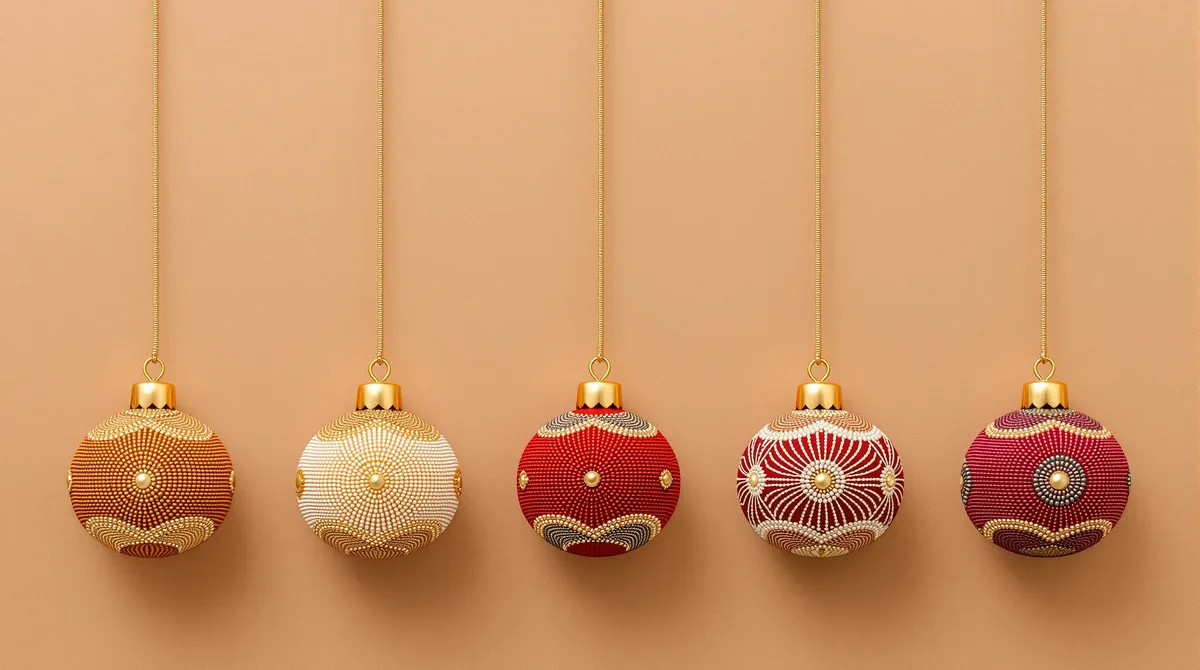
Four elements — form, ground, couched beads, hanging loop — at seven to eleven centimetres, and why the poles of a sphere are where ornaments fail.
See the detail
Start a conversation
Send a reference, a colour chip or a sketch. Minimums are set per design and confirmed per quote; sampling is quoted separately and usually runs 16 to 20 days from an agreed brief.