Material
Hand-made lampwork
Wound at the torch one bead at a time: what that buys in shape freedom, what it costs in hours, and how variation is specified instead of eliminated.
See the detail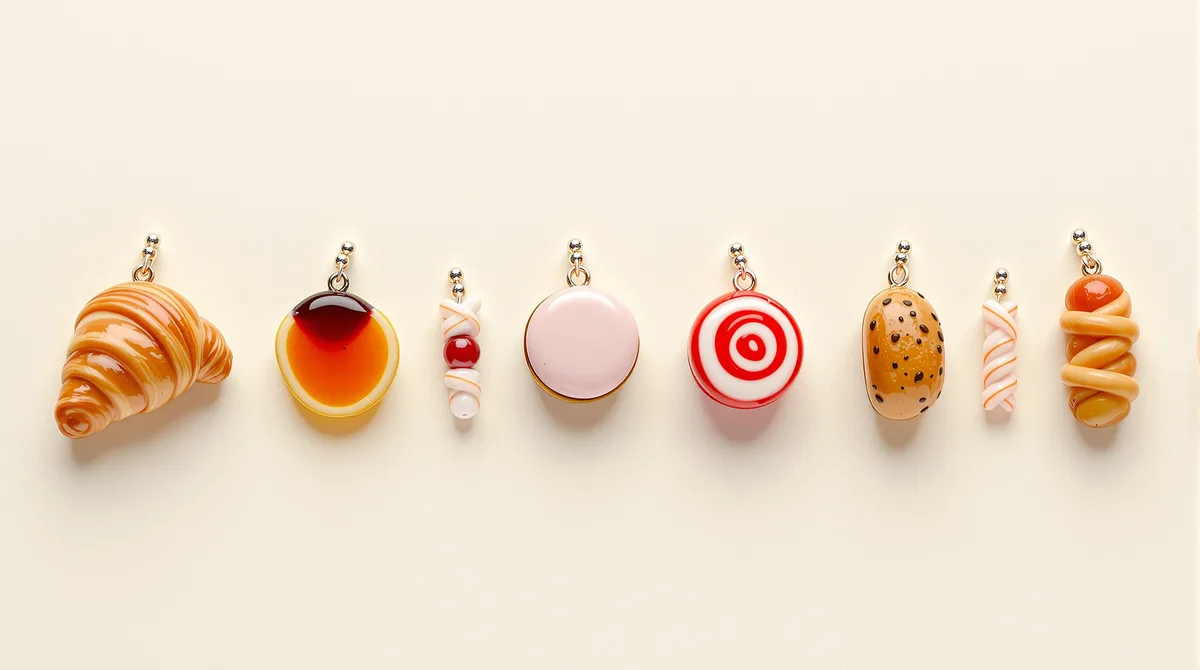
Craft topic
Three components and one bead. A wine charm is the smallest object in beaded décor, and it is the only one where the whole product is a single bead — which is why it is the format that justifies lampwork.
Beaded charms in a row on plain wire hoops, each carrying one hand-shaped lampwork glass icon bead — a croissant, a macaron, a swirl, a loaf and a candy ribbon — between tiny…
A beaded wine charm is a wire hoop, a closure and one or more beads, clipped round the stem of a glass so a drinker can identify it. Lampwork icon beads are the version worth making: each bead is shaped by hand at the torch, so the catalogue is whatever can be drawn rather than whatever exists in a mould.
A wine charm is a small hoop clipped round the stem of a glass so that a drinker can find their own drink again. It is a solved problem with a single requirement — the charms in a set have to be distinguishable at a glance — and everything interesting about the object follows from that.
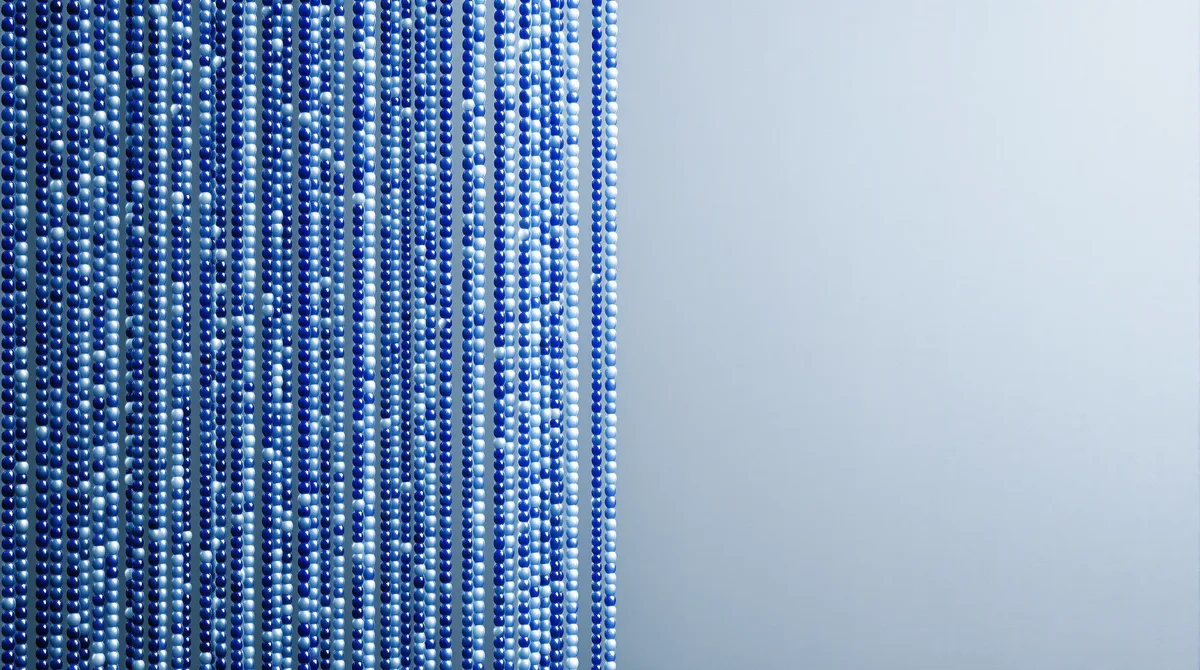
It is also the smallest thing in beaded décor. A curtain holds about 11,800 beads. A wine charm holds one that matters.
Because when the whole product is a single bead, the bead can carry the whole cost.
Lampwork — sometimes called flamework — means the bead is shaped by hand at the torch, one at a time, from rod glass. It is the most expensive of the three glass bead trades per bead, and on almost every other format that rules it out: nobody is paying for 11,800 hand-shaped beads. On a set of wine charms, six hand-shaped beads is an entirely reasonable bill of materials.
And it is the only route to a figurative bead. Pressed glass needs a mould, which means a tooling conversation and a shape committed for the life of the die. Lampwork needs an artisan who can see the thing. The catalogue is therefore whatever can be drawn, not whatever is in a mould.
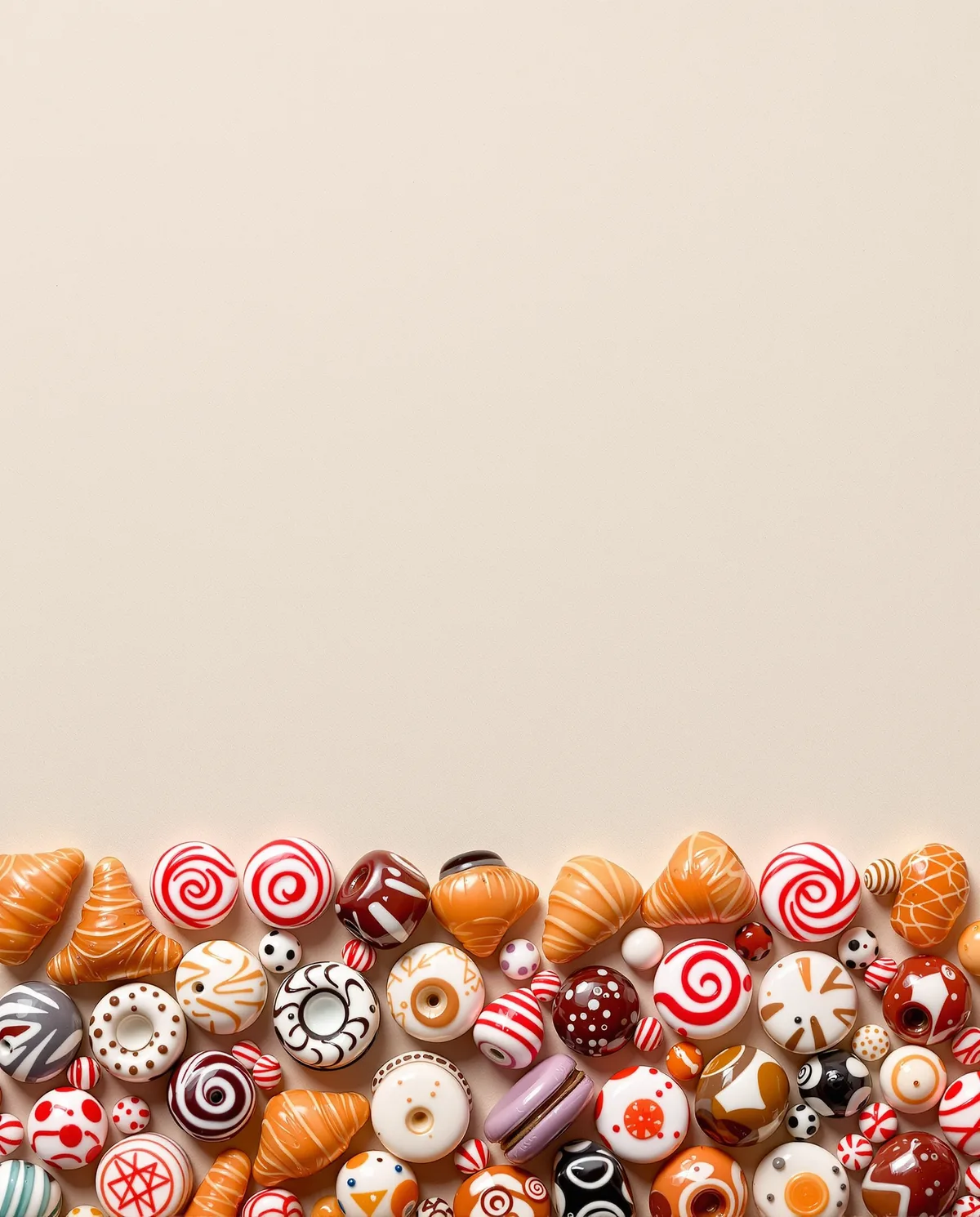
Custom lampwork food and holiday icon beads are our newest bead development. The set made includes croissants, macarons, blood oranges, peppermints, sourdough and candy ribbons, hand-shaped by lampwork artisans, and they were developed finished as wine charms.
That is the strongest claim on this page and it is a bead claim. The charm around the bead — hoop, closure, plated finish — is ordinary metal work out of our own metal plants. As with everything in beaded décor: nothing is held in stock, every piece is made to order against an approved sample, minimums are set per design and confirmed per quote.
Three components. A hoop, formed from memory wire that springs closed on itself, or a hinged ring with a small clasp. A closure, which on the simplest version is the sprung hoop meeting its own tail and on better versions is a hook-and-eye or a tiny lobster clasp. And the bead or beads, threaded on, with small spacers either side of an icon bead to hold it upright and stop it spinning round the wire.
The metal is finished and plated — eight standard finishes are available because plating is in-house — and on an object this small the finish is a large part of what the customer sees.
Because a bead hangs from its hole, and an icon has an up.
If the hole through a croissant runs across the croissant, the croissant hangs flat and reads correctly. If it runs through the croissant's belly, the croissant hangs nose-down and reads as a shape rather than as a croissant. The decision is made at the torch, in the second the bead is formed, and nothing afterwards can correct it.
This is the single most useful thing to inspect on a figural bead of any kind, and it is also the reason a figural bead sample should be approved hanging rather than lying on a card.
Distinguishability under the real conditions: low light, a person holding a drink, at arm's length, probably after the second glass. That means the six icons in a set have to differ in silhouette, not only in colour. A set of six fruits in six colours fails, because colour is the first thing low light takes away.
Silhouette variety is also why a food-icon set works so well: a croissant, a macaron, a blood orange and a loaf of sourdough are unmistakable from each other as shapes alone.
Hand-shaped lampwork glass for the icon bead. Pressed glass or small seed beads as spacers. Memory wire or formed brass wire for the hoop, with crimps, hooks or a small clasp, finished and plated. Where a charm is bigger than a stem marker, the same construction scales into a bag charm or a zip pull.
Larger hand-made glass beads are annealed — heat-treated for strength — which matters more in a hanging panel where beads knock together than on a charm, but is good practice on any large lampwork bead.
Entirely, in that there is barely any beadwork in it. This is a glass-making product with a metal finding attached. Our strung and couched work is labour on top of beads; a wine charm is a bead with almost no labour on top of it.
That inverts the cost structure. On a curtain, bead count is the cost. On a charm, the bead itself is the cost, and the assembly is trivial.
Hang it and check the bead sits upright. Close the hoop and shake it. Look into the bead hole for roughness, because a rough bore saws at the wire over time. Check the plating at the point where the hoop closes, which is where it wears first. Then stand back two metres and see whether the set still reads as a set.
Low-cost sets are machine-assembled from pressed or acrylic beads in very large volume. Hand-made lampwork sets are a small, slow, premium market made wherever there are lampwork benches — which for us means our own glass works, where the glass and bead vertical has run since 1992.
Because the bead is the development and the charm is the packaging, and this page is honest about which is which. The lampwork icon beads are real and recent. A wine-charm range with sizes, sets and packing specifications is not something we publish, and the useful thing we can give a reader instead is an accurate account of why a hand-shaped bead is worth paying for on an object this small.
Good to know
Wipe with a damp cloth and dry. Do not put wine charms in a dishwasher: the hoop will tarnish or lose its plating, the spring will stiffen, and a hand-made glass bead that has been annealed for strength still does not benefit from a thermal cycle every week. They are a tabletop object, not a wash-up object.
Less than almost anything else on this part of the property, because the hard part already exists. Lampwork icon beads are our newest bead development, hand-shaped by lampwork artisans to any story. A charm programme needs a hoop and closure specification, a metal finish, a set composition and a bead with a hole placed for upright hang.
The bead, yes, and that is the substance of the object. Custom lampwork food and holiday icon beads are our most recent bead development — croissants, macarons, blood oranges, peppermints, sourdough and candy ribbons — and they were developed finished as wine charms. As with all beaded décor, nothing is held in stock and everything is made to order against an approved sample.
A length of memory wire or a hinged hoop is formed and finished, a closure is fitted — a hook-and-eye, a small clasp or the sprung hoop closing on itself — and the beads are threaded on. On a single-bead charm the bead is simply strung; on a multi-bead charm small spacers hold the icon bead upright and stop it spinning.
Wine charm, glass charm, glass marker, stem marker and wine glass ring all describe the same thing. Icon bead and figural bead describe the bead rather than the charm. Lampwork, sometimes called flamework or torch work, is the glass technique, and in the bead trade a lampwork bead means a hand-shaped one by definition.
Hold the charm up and see whether the bead hangs upright. If the hole was placed wrong when the bead was formed, the icon hangs sideways and nothing downstream fixes it. Then close the hoop and shake it: it should hold. Then look inside the bead hole for roughness, because a rough bore saws at the wire. Then check a set of six is distinguishable at arm's length in low light.
Round the stem of a glass, which is the whole purpose. In retail, a set of six sells boxed or carded, and it has to be openable enough that a customer can see all six icons at once — a set where the differences are hidden in a box is a set nobody buys.
Keep exploring
Material
Wound at the torch one bead at a time: what that buys in shape freedom, what it costs in hours, and how variation is specified instead of eliminated.
See the detailIndex
Seventeen beaded objects documented from inside the craft — what each one is, how the tradition builds it, and what it would take to develop one.
Read moreCraft topic
Backdrop, aisle run and favour — three scales, three constructions, three lead times, and the fixed date that makes the arithmetic unforgiving.
Compare the optionsCraft topic
Three routes — coiled rope on a wire ring, a bead net over a vessel, beads threaded into cane — and why the rim is always where these pieces fail.
Specs and sizesCraft topic
Wire-wrapped and couched ring constructions, and the plain heat rule by material: the ring goes around a holder, never against hot glass.
Compare the optionsCraft topic
Wire instead of thread, crimps instead of knots, and bead choices that survive keys — plus the wire-wrapped family behind the page.
Read the guide
Start a conversation
Send a reference, a colour chip or a sketch. Minimums are set per design and confirmed per quote; sampling is quoted separately and usually runs 16 to 20 days from an agreed brief.